Culture Wars and Christianity

Christianity: Rooted in Culture Wars

September 2024

by John Partridge

While you might not have the time to read the paper that I wrote last semester (and what is likely to become a part of a book next spring), what follows is an important excerpt. Working through several chapters of Matthew, I detail how our knowledge of modern archaeology and history adds to our understanding and gives depth to scripture. Below, I discuss how Christianity, from its birth, has been no stranger to culture wars and what we should learn from that.


When we read Jesus’ caution that “No one can serve two masters,” in Matthew 6:24, we find that our study of history expands our understanding beyond the surface meaning. Many of us have tried to please two bosses or have otherwise been pulled between our loyalties to work, family, and faith, but Roman Palestine, and Galilee in particular, felt many of these pressures, each demanding that they choose them as their master. At the time of Jesus, the rule of King Herod and Rome was less than 70 years old.  But there were institutions, buildings, and cultural memories of the earlier Hasmonean dynasty under which Israel was free and independent.

The Hasmonean dynasty had emphasized, and even required, an adherence to a more traditional Jewish culture and religion, but with the fall of the Hasmoneans, the rise of Herod the Great, and Israel’s subjugation by the Roman Empire, things were changing. There were changes in clothing style, architecture, language, art, and language, and all these changes were often seen as an incredible culture war between the traditional Jewish culture, and the newer Greco-Roman culture, known as Hellenism. Hellenism, of course, was not entirely new. It had begun generations earlier with the conquest of Pompey and the Greeks (in 63 BCE), even before the Hasmoneans rose to power, but was now, under Herod and the Romans, an increasingly strong influence.

While upper Galilee retained a traditional Jewish culture, lower Galilee, with the presence of the Greco-Roman cities of Sepphoris and Tiberias, as well as its proximity to Hippos on the opposite shore of the lake, was seen as having made a greater degree of accommodation to Hellenism. Israel’s elites, including the chief priests and much of Jerusalem with them, adopted Roman culture to fit in, to get ahead, and to win favor. This influence of Hellenism triggered strong emotions, and this is the tension that we see in passages such as Matthew 6:20.

Further, when we remember that ninety percent of Roman Palestine lived at a subsistence level or below, we see Jesus’ instruction in a different light when he says, “’So, do not worry, saying what shall we eat?’ or ‘What shall we drink?’ or ‘What shall we wear?’ For the pagans run after these things, and your heavenly father knows that you need them. But seek first his kingdom and his righteousness, and all these things will be given to you as well” (Matt 6:31-33). With this in mind, we not only understand that Jesus is teaching his listeners that they should make God’s kingdom a priority in their lives, but to people who were so poor that they often struggled to eat, or to drink, or wear, much of anything at all, Jesus was offering hope.

The people from rural villages in Galilee were insulated from Greco-Roman influence but they saw wealthy landowners, priests and other elites who were trying to fit into Roman culture, and they saw how that caused them to match what the Romans were eating, drinking, and wearing. But Jesus’ message was that conforming to Roman culture was not important and that it was not a curse to be so poor that they could not afford those things. His message was that God remembered them, knew what they needed, and would provide for them if they remained faithful and pursued righteousness instead of chasing after wealth and culture.

This was more than offering empty hope. The message of Jesus was that people should follow the law and live lives of moral integrity but also that they should be filled with compassion for one another. Rather than just watching out for themselves, or for their immediate and extended family, which was often the norm, Jesus and his disciples teach, and model, a life in which they all care for one another. Moreover, Jesus says that God sees them and cares for them in real life and not only on a spiritual level. God’s love for his children is not as a distant and disinterested observer, but as a father who cares for his children in tangible and physical ways saying, “ask and it will be given to you” (Matt 7:7) and “your Father in heaven gives good gifts to those who ask him!” (Matt 7:11)


That’s just a sample from my paper, but the takeaway for all of us is that Christianity was born in the middle of an enormous culture war. What we see today is not new. But the message of scripture is still the same. No man can serve two masters, the people of the church should care for one another rather than only looking out for themselves, and God still loves us, not just spiritually or metaphysically, but deeply, tangibly, and physically.

Much has changed in two thousand years and times will continue to change with each generation.

But God’s love for us never changes.


Please LIKE and SHARE!

Click here to subscribe to Pastor John’s blog.

Click here if you would like to subscribe to Pastor John’s weekly messages.

Click here to visit Pastor John’s YouTube channel.

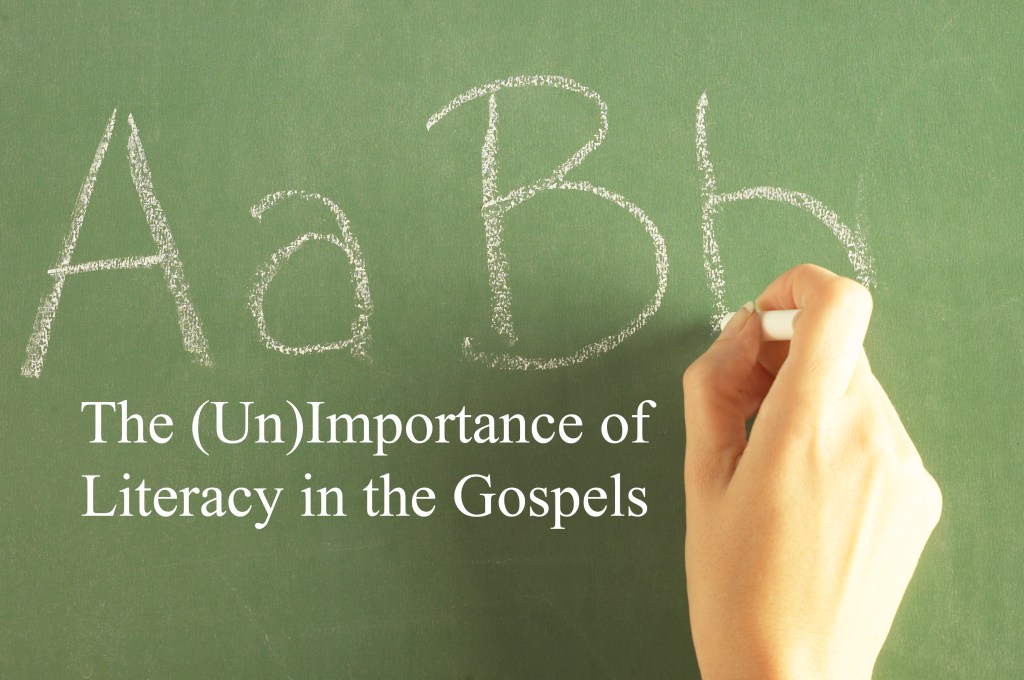
The (Un)Importance of Literacy in the Gospels

The (Un)Importance of Literacy in the Gospels

July 10, 2024

by John Partridge

When we read the Bible, or when we teach, preach, or listen to the Sunday sermon in church we use our imagination to picture, in our mind, the one of the biggest mistakes that we make is to imagine that the people of the New Testament were just like us. Oh, we know that they didn’t have modern conveniences like telephones, electricity, and air conditioning, but in our mind’s eye we see the characters of the bible as having the same values, education, and attitudes that we do… and almost every time we do that, we’re wrong.

Often, our being wrong in this way is not a problem. I have often said on Sunday mornings that as much as times have changed, people are still people and so it’s easy for us to imagine the feelings and emotions that the people in our scripture lessons felt. When we read stories of families who suffered from infertility, in a culture where fertility was seen as God’s approval and blessing, we can feel their frustration and pain. When we read about the death of Jesus’ friend Lazarus, it isn’t hard for us to feel the grief and loss of his sisters Mary and Martha. And it doesn’t matter much if we make a few incorrect assumptions about their values and education.

But sometimes it does.

As I studied the history of first century Israel and Judea this week, I was struck by the literacy rates that historians now attribute to the people of that time and place. But before I get to that, consider that, in the United States, the average rate of literacy is 79 percent. The highest rate of literacy is in the state of New Hampshire at 94.2 percent and the lowest rate is in the state of California which has a literacy rate of 76.9 percent. Without getting into a discussion of politics or education, many nations, even many of those that Americans would look upon as less developed, clock in much higher.

But statistics like these assume that literacy requires both reading and writing because, in our modern culture, reading and writing, for both genders, are both assumed to be necessary. But that hasn’t always been the case, and it certainly wasn’t the case at the turn of the first century. When we read the stories of the New Testament, the people that we meet live in a literary world that is nothing at all like the one in our lived experience and that difference can sometimes change the way that we see and understand them.

One of the first places that we see this difference is found in our expectation of what would be seen as Jesus and his disciples visited synagogues in and around Galilee. Because our life experience tells us that (almost) every church has a pastor or priest, every synagogue has a rabbi, and all of them are literate, we have a natural expectation that this is what happened in the world of the gospels also.

But it isn’t.

First, synagogues, as dedicated buildings, were rare. Instead, in the first century, many synagogues were meetings in private homes or in public buildings that served multiple purposes much like “meeting houses” that were seen in small towns in the American West. Second, while there were such things as rabbis, the rabbis of the first century were scholars and theologians who mostly studied in Jerusalem and rarely, if ever, taught anywhere. Likewise, Pharisees didn’t teach, nor did scribes, which I will say more about later. What happened in synagogues was that the Torah was read or recited from memory. And here we encounter our first big break between our expectations and reality as it relates to literacy.

The typical synagogue rule was that any male in the synagogue gathering could stand and read from the Torah and, from our experience, we would expect that this would be most of the men present. But that wasn’t the case at all. And it is here that I need to draw another distinction that we typically do not make in the twenty-first century, and that is the difference between reading literacy and writing literacy. While we see both as vitally important, that was not the case in the first century. The ability to read simple literary texts, reading literacy, was less than 10 to 15 percent and the majority of those who could do that would be found among the aristocracy in cities and larger towns and not in the small rural areas of Galilee. But to refine that idea a little further, since the literacy rate among girls would have been nearly zero, then the apparent literacy among men would have appeared to be higher. In any case, the result was that in a small rural synagogue, the number of men in the gathering who could read well enough to stand and read from the Torah would have been very small.

In most cases, both in Jewish and in Greco-Roman families, education was private and informal, meaning that the father would teach his children (if the father had any education himself), and then usually only his sons as it was seen to be a waste of time to educate girls. Public schools, as we understand them, simply did not exist in the first century and children did not have the leisure time necessary for education. In a subsistence economy, the labor of children, as soon as they were able to do much of anything, was needed to help their families to grow crops, fish, spin cloth, or whatever was needed for their family to survive. Illiteracy was not seen as a bad thing; it was just an ordinary thing. Only those parents who valued education and had the financial wealth to do it, and had the needed leisure time, would have promoted education, and that leaves us with only a handful of moderately wealthy families.

As I noted earlier, even fewer people could write. Perhaps 10 to 15 percent of people could write slowly, but many not at all. And, as we would measure literacy, being truly literate and able to both read and write, reduces the number to only 2 or 3 percent. According to Richard Horsley, “Writing had little importance except for certain functions of the elite.” People simply did not write letters, or keep journals, or take notes in school. If you needed something written, you hired a scribe, or used a slave that knew how to write. Persons who could write were not seen as socially valuable and may even have been looked down upon. Writing was a skill, much like we see modern tradespersons. If you needed it done, you hired someone who could do it. And that helps explain why scribes didn’t teach. While they had the skill to write, most often they were not otherwise particularly learned or educated.

And when we begin to think about the world of Jesus in this way, it changes how we see the people, the events that we see in the synagogues, about how Jesus was able to read from the Torah scroll (or did he?) and how the Gospels themselves came to be written.

________________________________________________

Please LIKE and SHARE!

Click here to subscribe to Pastor John’s blog.

Click here if you would like to subscribe to Pastor John’s weekly messages.

Click here to visit Pastor John’s YouTube channel.

Photo by Dynamic Graphics Group on Freeimages.com

Hellen Who?

Hellen Who?

 (or Why History Matters)

by John Partridge

For the last few weeks, I have been reading several accounts of Israel’s history. None of this is contained in the Bible because the particular histories that I have been reading describe the “Hellenization” of Israel that occurred between Malachi, the last book of the Old Testament, and Matthew, the first book of the New Testament. But what is Hellenization?  And, why does it matter if it isn’t in the Bible?

First, let me explain a little about Hellenism. Quite simply, “Hellenic” is just a synonym for “Greek.” Greek people can be known as Hellenes, and one of the first democracies was known as the Hellenic Republic. Greek government and culture was widely known in the ancient world and, when Alexander the Great (who was technically Macedonian) conquered much of the ancient world, including Israel, both the culture and the style of government of Greece spread with the empire. This influence is seen in the way that governments were organized, the language that people spoke, the types of art that became popular, the architecture that was used, and a host of other things as well.

But you still might ask why that matters if the empire that we find in the New Testament is Roman and not Greek. It matters because the Greek empire, in one form or another, was around for a long time and when the Romans finally became the dominant force, old political divisions of the Greek empire were still felt in the Roman empire. Even so, the Romans so admired Greek culture that they kept much of it. In the Roman empire, Greek was the language of business (and even in some military units), much of Roman government was modeled after the system used by the Greeks, and so was much of their art, philosophy, educational system, sporting events, and architecture. These two cultures were so tied together, and the Romans so influenced by Greek culture, that we often see them referred to not as Greek culture, or Roman culture separately, but as Greco-Roman culture collectively.

Because of their faith, their relationship with God, and their own unique history, Israel resisted some of these changes, but adopted others. Some crept in little by little, some were fought by religious leaders, but others, at least among the wealthy and political leaders, were adopted wholeheartedly. Learning about this cultural shift helps us to better grasp what happened between Malachi and Matthew and better understand the world that we enter as we read the New Testament. Even if these things aren’t described in the pages of scripture, their influence is felt everywhere on those pages. Learning about this inter-testamental history helps us to better understand the tensions between the rich and the poor, between the political leaders and the religious leaders, and between the various religious sects like the Pharisees, Sadducees, Essenes, and the new teachings of Jesus.

But history tells us more than that, and understanding history makes the stories of the New Testament richer, deeper, and more three-dimensional. Learning about the history of the intertestamental period (the time between Malachi and Matthew) helps us to see that King Herod was more three-dimensional than the tyrant that we see in a handful of verses in the gospels. This history tells us where Herod came from, who his family was, how he came to power, why he was so loyal to the Roman government, why his loyalties sometimes shifted, how Herod was politically astute in the extreme, and why he appears to be so incredibly paranoid when we meet him in the New Testament. And understanding Herod just scratches the surface because he and his family only really appear a few decades before Jesus. Before Herod and his father Antipater, there was an entire line of Jews that governed Israel known as the Hasmonean empire. And understanding that history explains more about Herod’s family and both why, and how, the Romans came to occupy, and then rule over Israel as well as how Herod conspired to murder the last of the Hasmoneans. This last thing also explains some of the ill will, and even outright hatred, that some Jews had for Herod.

As we read scripture, we become familiar with the Temple in Jerusalem, and many of us know that this was a magnificent engineering achievement of King Herod and possibly his crowning achievement. But what we don’t find in scripture is that the Temple in Jerusalem isn’t the only temple that Herod built. In fact, it isn’t the only temple that Herod built in Israel. Herod also built temples to Augustus, to Roma, and to Saturn in places like Caesarea, Sebaste in Samaria, Paneaus north of Galilee, and other Greek cities in Israel, as well as temples and municipal building projects in other countries of the Roman Empire. As a result, people across the Roman world knew of, and were grateful to Israel’s King Herod and, by extension, knew of, and were grateful to, the nation of Israel herself.

Understanding the history of the ancient world also helps us to understand the stories of the New Testament beyond the gospel stories. As we read Paul’s letters, and the stories of his travels, imprisonments, beatings, and trials, a knowledge of extra-biblical history helps us to understand why people sometimes listened to his preaching but at other times the crowds tried to kill him or the local authorities arrested and imprisoned him. We know from scripture that Paul was a Roman citizen, but history offers several possibilities surrounding how Paul, and his family, might have acquired Roman citizenship.  Likewise, connecting to my original point, while we know that Paul was well educated, what scholars still debate is just how much Greek (or Hellenizing) influence there was in Paul’s education. There are hints in Paul’s writings that might suggest an understanding, or at least the influence, of Greek philosophy and the structure used in public Greek and Roman debate. So, if even Paul, who described himself as a Jew among Jews, and a Pharisee among Pharisees felt the influence of Hellenism, then yes, it’s worth stretching ourselves to learn more about history outside of what we find in the pages of scripture.

Because… history matters.


Please LIKE and SHARE!

Click here to subscribe to Pastor John’s blog.

Click here if you would like to subscribe to Pastor John’s weekly messages.

Click here to visit Pastor John’s YouTube channel.


Considering “What’s Next?”

Considering “What’s Next?”

Easter 2024
by John Partridge

As we approach Easter, we must all consider the question of “What’s next?” If we’re serious about our faith, Easter is all about the “what’s next” and not yesterday, today, or tradition.

What do I mean by that?

What I mean is, Easter, from the very beginning, was a transformative, and transformational event. No one who saw what happened, or who believed that it happened, was the same afterward as they were before. After the crucifixion, Peter gave up. He left Jerusalem, walked home to Galilee, and went back to work as a fisherman. And it wasn’t just Peter because the story in John 21 tells us that Thomas, Nathaniel, James, John, and two others were with him. This had to be some time after they had seen Jesus in Jerusalem because Galilee is 60 or 70 miles away and probably a three-day walk. But after they meet Jesus, again, but it is here that Jesus commands Peter to “Feed my sheep,” “Feed my lambs,” and “Follow me.”

After this moment, Peter, and all the other disciples, never make any further attempts to go back to a normal life. From this moment onward, they dedicate their lives to telling the world about what they had seen and heard, and what Jesus had done for every human being that ever lived. For the disciples, for Lazarus and his sisters, for the unnamed followers of Jesus, men and women alike, who were gathered in the upper room at Pentecost, and even for many of the Pharisees and priests that came to believe the truth about Jesus, “What’s next” was a life changing question.

Their lives would never be the same. They could never go back to whatever “normal’ they had before they had met Jesus. Knowing the truth changed the way that they looked at the world, changed the way that they saw the people around them, and changed the way that they made the choices that guided their careers, their lives, and everything that they did forever.

As we celebrate Easter, we need to put ourselves in their place. If we genuinely believe that the events of Easter really happened, and that Jesus really is who the gospel writers say that he is, then we need to ask ourselves the same question. “What’s next?”

Knowing the truth changes us.

Like the disciples, we must listen to where God is leading us, what he is calling us to do, where he is calling us to go, and how God intends to transform us. And like the disciples, those changes might be terrific, but they might be terrifying, they might be successful, but they might be sacrificial. Whatever it is that God is calling us to do, and wherever it is that God is calling us to go…

…simply returning to the old “normal” is not an option.

Blessings,

Pastor John

Waiting for Hope

Waiting for Hope

December 24, 2023*

(Christmas Eve)

By Pastor John Partridge

Isaiah 9:2-7                Luke 2:1-20                Titus 2:11-14

READING 1:

Isaiah 9:2-7

The people walking in darkness have seen a great light;
on those living in the land of deep darkness a light has dawned.
You have enlarged the nation and increased their joy;
they rejoice before you as people rejoice at the harvest,
as warriors rejoice when dividing the plunder.
For as in the day of Midian’s defeat, you have shattered
the yoke that burdens them, the bar across their shoulders,
    the rod of their oppressor.
Every warrior’s boot used in battle and every garment rolled in blood
will be destined for burning, will be fuel for the fire.
For to us a child is born, to us a son is given, and the government will be on his shoulders.
And he will be called Wonderful Counselor, Mighty God, Everlasting Father, Prince of Peace.
Of the greatness of his government and peace there will be no end.
He will reign on David’s throne and over his kingdom, establishing and upholding it
    with justice and righteousness from that time on and forever.
The zeal of the Lord Almighty will accomplish this.

READING 2:

Luke 2:1-7
2:1
 In those days Caesar Augustus issued a decree that a census should be taken of the entire Roman world. (This was the first census that took place while[a] Quirinius was governor of Syria.) And everyone went to their own town to register.

So Joseph also went up from the town of Nazareth in Galilee to Judea, to Bethlehem the town of David, because he belonged to the house and line of David. He went there to register with Mary, who was pledged to be married to him and was expecting a child. While they were there, the time came for the baby to be born, 7and she gave birth to her firstborn, a son. She wrapped him in cloths and placed him in a manger, because there was no guest room available for them.

READING 3:

Luke 2:8-14

And there were shepherds living out in the fields nearby, keeping watch over their flocks at night. An angel of the Lord appeared to them, and the glory of the Lord shone around them, and they were terrified. 10 But the angel said to them, “Do not be afraid. I bring you good news that will cause great joy for all the people. 11 Today in the town of David a Savior has been born to you; he is the Messiah, the Lord. 12 This will be a sign to you: You will find a baby wrapped in cloths and lying in a manger.”

13 Suddenly a great company of the heavenly host appeared with the angel, praising God, and saying,

14 “Glory to God in the highest heaven,
    and on earth peace to those on whom his favor rests.”

READING 4:

Luke 2:15-20

15 When the angels had left them and gone into heaven, the shepherds said to one another, “Let’s go to Bethlehem and see this thing that has happened, which the Lord has told us about.”

16 So they hurried off and found Mary and Joseph, and the baby, who was lying in the manger. 17 When they had seen him, they spread the word concerning what had been told them about this child, 18and all who heard it were amazed at what the shepherds said to them. 19 But Mary treasured up all these things and pondered them in her heart. 20 The shepherds returned, glorifying, and praising God for all the things they had heard and seen, which were just as they had been told.

Waiting for Hope

By Pastor John Partridge

Well… we’ve arrived.

For many of us, Christmas is our favorite season of the year. For some of you here, I have seen your posts on social media counting down to tonight and tomorrow morning. We might have hoped for a white Christmas, but I’m certain that we’ll have enough of that soon enough. We’ve sung the songs, we’ve heard the children, the pipe organ, the choir, and the bells. In a few minutes we will light the candles and welcome Christmas as we sing Silent Night. For many of us that is the moment that we know that Christmas has arrived and our hearts, and our souls are, even if only for a moment… at peace.

But what does it all mean?

Yes, we’ve heard the story. Yes, we know that the King of Kings was born to a virgin, entered into our earthly existence, and begun the journey that led to our salvation and rescue, but what about the here and now? We know the first century story, but what is the twenty-first century story? What does the Christmas story mean to us in our hectic, helter-skelter, world of rushed deadlines, underfunded budgets, and overscheduled calendars?

As much as we love the Christmas story, we all know that it represents just the very beginning of God’s invasion of the world and our work to tell humanity of Christ’s coming and call everyone to repentance and reconciliation with God. The disciples knew that too. And in his letter to his friend, we hear Paul helping Titus to grapple with the message of Jesus Christ and understand his, and our, role in the world around us. Titus was one of Paul’s missionary partners, a pastor, capable church administrator, responsible ally, evangelist, and a trusted friend. And, in Paul’s letter he tells Titus that what we are doing in the post-resurrection world, is… waiting for hope. That’s a puzzling idea, and so let’s read a larger passage from Titus 2:11-14, to hear, in context, what Paul is saying. He says:

11 For the grace of God has appeared that offers salvation to all people. 12 It teaches us to say “No” to ungodliness and worldly passions, and to live self-controlled, upright and godly lives in this present age, 13 while we wait for the blessed hope—the appearing of the glory of our great God and Savior, Jesus Christ, 14 who gave himself for us to redeem us from all wickedness and to purify for himself a people that are his very own, eager to do what is good.

Paul says that the coming of Jesus Christ was, for us, the appearance of God’s grace to the world and offers salvation to all people. That grace, and that rescue, teaches us to navigate the chaos of the world around us. We surrounded by a culture that admires and idolizes lives that are at least, or often completely, out of control and burning with ungodly and worldly passions that worship sex, drugs, gambling, power, and excesses of every kind and flavor. But God’s grace guides us toward lives that are moral, ethical, upright, and self-controlled… which absolutely is not saying that we live lives that are boring, humorless, or without fun or other enjoyment, but that find fun and enjoyment in ways that honor God.

The odd part of Paul’s writing is where it says that we live these lives “while we wait for the blessed hope – the appearing of… Jesus Christ.” I’m certain that Paul isn’t saying that we live without hope, because Jesus Christ is our hope. Rather, I think what he is saying, when he says that we wait for the “blessed hope,” is that we live these lives while we wait for the fulfillment of our hope and return of Jesus Christ.

And so, as we celebrate the birth of our Savior, we must remember not just that he came, but why he came. Jesus came to earth to call the world to repentance, to rescue us from sin and death, to teach us how to live moral, ethical, upright, and godly lives in the middle of a world that is immoral, unethical, out of control, and ungodly. Our mission is to tell the people around us that God offers them a better way and a better life. And we must live and love in such a way, that the people around us can see that better life in us, know that God’s offer is real, and want what we have.

Merry Christmas everyone.


Please LIKE and SHARE!

Click here to subscribe to Pastor John’s blog.

Click here if you would like to subscribe to Pastor John’s weekly messages.

Click here to visit Pastor John’s YouTube channel.


*You have been reading a message presented at Christ United Methodist Church on the date noted at the top of the first page.  Rev. John Partridge is the pastor at Christ UMC in Alliance, Ohio.  Duplication of this message is a part of our Media ministry, if you have received a blessing in this way, we would love to hear from you.  Letters and donations in support of the Media ministry or any of our other projects may be sent to Christ United Methodist Church, 470 East Broadway Street, Alliance, Ohio 44601.  These messages are available to any interested persons regardless of membership.  You may subscribe to these messages, in print or electronic formats, by writing to the address noted, or by contacting us at secretary@CUMCAlliance.org.  These messages can also be found online at https://pastorpartridge.com .  All Scripture quotations, unless otherwise indicated, are taken from the Holy Bible, New International Version®, NIV®. Copyright ©1973, 1978, 1984, 2011 by Biblica, Inc.™ Used by permission of Zondervan. All rights reserved worldwide. www.zondervan.comThe “NIV” and “New International Version” are trademarks registered in the United States Patent and Trademark Office by Biblica, Inc.™


Pastor’s Christmas Letter

Pastor’s Christmas Letter

by John Partridge

Dear Friends,

This year the Advent season seemed to sneak up on us faster than I remember others in the past and we are already racing towards Christmas. This seems to race even faster when our fourth Sunday of Advent falls on Christmas Eve morning. This feeling of hectic scheduling makes it even more important that we be deliberate in preparing ourselves for the celebration of our Lord’s birth. I don’t just mean buying presents and decorating our homes, but preparing our hearts and our souls so that we can enjoy and appreciate the arrival of the newborn king.

I admit that since I was in my twenties, and in most ordinary years, I struggled (past tense) and still struggle (present tense) with being a humbug. I just don’t “feel” Christmas-y.  Before Patti and I were married, I discovered that one way to fight back, and to start feeling the warmth of the holiday was to start listening to Christmas music after Thanksgiving, even if I didn’t feel like it.  More recently, with the loss of my hearing and music often sounding off-key, music hasn’t been as effective and so instead I make sure to decorate our Christmas tree, turn on the lights, and look at it for a while every evening.

But that isn’t enough. Because the Spirit of God dwells within each one of us as the followers of Jesus, when we are together, we feel the presence, not only of other people, but also the presence of God himself. And so, every Sunday, but especially during Advent, it is important for all of us to worship together, to simply be together, so that we can feel that sensation of closeness to God and prepare our hearts for Christmas. That closeness to God is real and, as important as it is to us personally, it’s important that we don’t keep it to ourselves.

Statistically, about one-third of, or one in three, people say that they would be willing to attend or visit a church if they were invited. That willingness is often highest at Christmastime. Christmas Eve is easily one of the most attended worship services of the year in almost every church in North America. And so, as I have in the past, I hope that each one of you will invite at least five others to join us. Toward that end, we have printed business cards that you can give to your friends, classmates, business associates, barber, hairdresser, grocery store clerk, or anybody else, and invite them to join us as we worship and celebrate Christmas Eve.

Christmas Eve and Christmas are a time when we draw close to one another, and draw close to God, in a way that is both special and memorable not just because of the people, but because it is a time when we encounter the Spirit of God in a special way. Of course, we will share the extraordinary experience of hearing our choirs, bell choirs, pipe organ, and singing traditional and meaningful carols of Christmas together. But most importantly, we will remember the story of God’s invasion of the earth and the arrival of the Christ child, who would become the rescuer and redeemer of all humanity.

I hope that you will join us as we draw closer one another, and closer to God, together.

Blessings,

Pastor John


Please LIKE and SHARE!

Click here to subscribe to Pastor John’s blog.

Click here if you would like to subscribe to Pastor John’s weekly messages.

Click here to visit Pastor John’s YouTube channel.

Challenging the Comfortable

Challenging the Comfortable

by John Partridge

Years ago, I was told that the job of a pastor is to “Comfort the afflicted and afflict the comfortable.” While that’s used jokingly, it is often true. We need to be comforted when we hurt, but often get stuck when we’re comfortable and need someone to give us a shove if we hope to move forward again. Those of us who have changed jobs, moved to new communities, started businesses, gone back to school, or otherwise made changes to our lives can attest to that. Sometimes getting something that we want, or something better than what we have, requires that we leave behind some of what we know, some of the things that make us comfortable, and launch out into the unknown and the uncomfortable.

Similarly, it has been said that “Ships in harbor are safe, but that’s not what ships were built for.” Sometimes launching our on a new adventure is something that we choose for ourselves, but other times we get drafted and dragged into those adventures kicking and screaming all the way. This past year has seen some of that for us at Christ Church. We are doing some things differently, and with different people, simply because some of the people who have always done them are no longer with us. In the last few years, people have moved away, gone to college, found other churches, or passed from this life and into the next. But we are also having conversations about other changes that we might choose for our future.

I saw a quote this week from the book Fusion, by Nelson Searcy, which suggests three markers to measure your church’s “guest flow.” It said that a church in “Maintenance mode” needed three first-time guests for every one hundred in worship attendance just to stay in the same place in worship attendance. To be in “Growth mode” required five first-time guests for every one hundred, and “Rapid-growth mode” required seven first-time guests for every one hundred. That’s a lot, and I’m not sure that I believe that the numbers are that high (especially if those are weekly figures) … as long as at least some of those visitors can be attracted to stay. But even so, our experience says that there is some truth to it. In the last few years, we’ve had more visitors, and each year more of those visitors have decided to stay. For each of the last several years we’ve been bringing in a few new members. But we haven’t… yet… been able to bring in more new members than we have lost.

I emphasize the word “yet” because I see change happening. Our worship attendance, since the Covid-19 shutdowns, is once again increasing. And, as we move forward into a New Year, we are, at least occasionally, doing things to move out of our comfort zones and try new things. And that brings me to my challenge for the people of Christ Church. I challenge you to be uncomfortable… at least occasionally. I challenge you to have conversations with friends, neighbors, family, coworkers, and yes, even strangers, about your faith and what it means to you. I challenge you to tell them why you come here and why you like it and invite some of those people to sit with you on Sunday morning, or volunteer and work with you on one of our work projects. I challenge our Sunday school teachers to teach a series on how to share your faith and how to have those kinds of conversations.

We all know that Christ Church is a great church family and is full of compassionate, loving people. But we don’t always do a good job of telling our neighbors about who we are and what we do. And we don’t always do as much as we might do to help the people around us. And so, my challenge is not only to invite people, but to continue pushing ourselves to be a little uncomfortable. To keep trying new things and finding new ways to reach out to the people in our community. God has put us in this place, at this moment, to be his hands and feet to the people of Alliance and beyond. Let us listen to his voice and consider where God is leading us.

Staying in the harbor, and doing what we’ve always done, is safe.

But that isn’t what God built churches to do.

Blessings,

Pastor John


Please LIKE and SHARE!

Click here to subscribe to Pastor John’s blog.

Click here if you would like to subscribe to Pastor John’s weekly messages.

Click here to visit Pastor John’s YouTube channel.

Jesus, the Master of Insults?

Jesus, the Master of Insults?

A message for teachers, preachers, and scholars

by John Partridge

As we read through the book of Matthew, there are many times when Jesus quotes from what we know as the Old Testament scriptures. Most of the time that Jesus does this he is simply teaching as rabbis and pastors have always done. Around his disciples, to people with honest questions, and in front of the crowds that gathered to hear him speak, Jesus preaches from the scriptures and teaches the people. But there are a handful of encounters in which Jesus does something different. When the Pharisees, and occasionally the Sadducees, come to Jesus, his approach, his intent, and his methodology are completely different. Rather than preaching from scripture, Jesus quotes scripture to the Pharisees… and it’s not pretty. In these cases, Jesus quotes from the scriptures, but rather than preaching or teaching in the gentle way that a father and son would play catch, Jesus quotes scripture as if he is hurling it at the Pharisees as a slinger in the army of Israel would launch stones, or a bowman would let loose his arrows.

We find the first of these instances in Matthew 12:3 in which Jesus attacks the Pharisees, men who dedicated their lives to reading, studying, memorizing, discussing, and debating scripture and its meaning. Here, Jesus’ attack is confrontational and deliberately insulting when he says, “Haven’t you read…?” as if these learned men had spent their time playing games rather than being serious scholars.

In another encounter with the Pharisees in Matthew chapter 15, the Pharisees come to Jesus and criticize him, and his disciples, for breaking the traditions of the elders. In other words, this isn’t about breaking the law, or committing sin, but about breaking the rules, habits, and traditions that had been handed down from other Pharisees, and perhaps even traditions that predated the Pharisees. But Jesus isn’t having any of that, and especially not from a group of people who are essentially the pot calling out the kettle for being black.

And so, in Matthew 15:3, Jesus once again insults them saying, “Why do you break the commands of God for the sake of your tradition?” For this group of men who followed hundreds of rules, specifically for the purpose of not breaking the commands of God, this is an obvious insult. But Jesus doesn’t stop there.

In Matthew 15: 7-9, Jesus continues by saying:

You hypocrites! Isaiah was right when he prophesied about you:

“‘These people honor me with their lips,
    but their hearts are far from me.
They worship me in vain;
    their teachings are merely human rules.’”

This passage from the prophet Isaiah that Jesus quotes comes from Isaiah 29:13 where it says:

13 The Lord says:

“These people come near to me with their mouth
    and honor me with their lips,
    but their hearts are far from me.
Their worship of me
    is based on merely human rules they have been taught.

The Septuagint reading is only slightly different in the first and last line but gives us some additional insight. The first line here saying, “They worship me in vain;” and the last saying, “their teachings are merely human rules.”

Of course, Isaiah wasn’t prophesying about the Pharisees but pronouncing a series of woes and judgements upon the people of his own time, but the similarities between the two situations are so strikingly similar that they can’t help but be compared to one another. The Word Biblical Commentary described this as being “in the sense of a typological correspondence between Isaiah’s day and the time of Jesus.” The Pharisees had certainly read and studied the words of Isaiah, and they understood that Israel had been carried into captivity because of their unbelief, and they devoted themselves to avoid a repetition of that mistake. And so, in other words, Jesus is calling the Pharisees out for having become exactly the thing that their entire movement had been intended to avoid.

But as we continue through Matthew’s gospel, Jesus isn’t yet done insulting the Pharisees. In Matthew 19:4, Jesus again meets the Pharisees and after they attempt to ask him a trick question about divorce, Jesus says, “Haven’t you read…?” once again suggesting that these scholars had not done their homework.

Again, when the Pharisees criticize Jesus for allowing the children to shout Hosanna as he healed the blind and the lame in the Temple, in Matthew 21:16, Jesus says, “Have you never read…? As he again quotes from the Psalms.

Not long after that, after deliberately insulting the Pharisees in Matthew 21:31 by saying that tax collectors and prostitutes are entering the kingdom of God ahead of them, and again in Matthew 21:33-40 when Jesus ends the parable of the tenants by quoting Psalm 118 in Matthew 21:42 saying:

 “Have you never read in the Scriptures:

“‘The stone the builders rejected
    has become the cornerstone;
the Lord has done this,
    and it is marvelous in our eyes’?

43 “Therefore I tell you that the kingdom of God will be taken away from you and given to a people who will produce its fruit.

Even here, Jesus isn’t done. In Matthew 22: 41 after the Pharisees had asked him a difficult question as a test, Jesus asks a question of his own saying, “What do think about the Christ? Whose son is he?” But, when the Pharisees correctly answer that the Christ is the son of David, Jesus, quoting Psalm 110, asks, in Matthew 22:44, “How is it then that David, speaking by the Spirit, calls him Lord?” This exchange, on the surface, appears more respectful than some of their previous encounters, but again Jesus insults the Pharisees by exposing their lack of understanding.

The Sadducees appear in Matthew 22:23 for some of the same, as they ask a question with a quote from Ezra 7 in hopes of making Jesus look foolish. But Jesus’ response in verse 29 is to say that “You are in error because you do not know the scriptures or the power of God.” And so, Jesus once again declares that men who were known for their knowledge of scripture, really didn’t know what they were talking about.

And all of that is followed by Matthew 23, in which almost the entire chapter is a Jesus delivering a diatribe against the Pharisees and all that they stand for.

From that, I think that all of us who study and preach should take note. Jesus was known for his gentleness, calm, and healing presence around sinners, tax collectors, prostitutes, foreigners, and even Roman soldiers if their questions were sincere. But Jesus had no tolerance at all for the people who claimed to be scholars, priests, and teachers. Jesus expected these learned people to understand what they were studying and teaching, and he expected that their lives would be lived in line with what they knew. Like it or not, we should see ourselves as the Pharisees, Sadducees, priests, and the teachers of Israel and heed Jesus words of caution so that we do not earn the kind of criticism that Jesus reserved for them.

As teachers, preachers, and as scholars, we are held to a higher standard and we are expected to live our lives in a way that models the scriptures so that on the day of judgement we might hear “Well done” and not, “Have you never read…?


Please LIKE and SHARE!

Click here to subscribe to Pastor John’s blog.

Click here if you would like to subscribe to Pastor John’s weekly messages.

Click here to visit Pastor John’s YouTube channel.

A Cup Full of Jesus, Please

A Cup Full of Jesus

by John Partridge

In my New Testament Culture class discussion this week, we noted that today’s church, and its people, often bears a striking resemblance to the ancient Jerusalem temple and its Jewish congregants.  Like us, they had priests and Levites who were the professionals that led worship, nearby were the faithful “serious lay scholars” that were the Pharisees.  These folks were lay people, but nearly all of their free time was dedicated to the church and to the study of scripture.  Neither of these groups were large and, together, only represented a small percentage of Jerusalem’s population.  The people in the temple courts were, like today, divided among the regular attenders, the occasional visitors, and those, both local and from far away, that only showed up for the big holy days and festivals. 

Two thousand years of history hasn’t changed human behavior much.  Then, like now, many of the people in the temple and in the church, were folks who were just trying to get by, survive, and get through life.  But all of that reminded me of a Sunday school lesson that my friend Brian Baer used in our class something like thirty years ago.  In that lesson, much like I mentioned during our Sunday morning prayer time recently, Brian reminded us that we worship a God of miracles.  Our God is the god who spoke the universe into existence, set the stars in place, created the earth and all that is in it, and knit us together each with our own skills, talents, and abilities.  We follow Jesus who raised Lazarus from the dead, healed incurable diseases, rose from the dead, and changed the course of human history forever.

And yet, how many of us come to church expecting little or nothing?  How many of us are so focused on getting by, or so focused on stability, repeatability, and maintaining the status quo of our lives, that we ask nothing more from God than absolutely necessary.  We come to the foot of a raging waterfall of miraculous power and blessing that dwarfs Niagara Falls, and in our hand is nothing more than a teacup.

I’d like a cup full of Jesus, please.

The only thing we ask is enough of Jesus to get by, to get us through the next week, and for only enough of Jesus to survive.

Why is that?  What are we afraid of?

Are we worried that too much of Jesus would overwhelm us?  That asking, and expecting, more from Jesus would be transformative and force us to change?  Are we worried that if God’s Spirit and blessing really poured out upon us that we would have to deal with changes in our church, our families, or our personal lives?  Are we worried that God might change how we think about the people around us and how we act around them?  Or are we worried that God might ask something of us in return?  Would God pour out his blessing on us and ask us to go on a mission trip, or teach, volunteer, go into ministry, or do something, anything, outside of our comfort zone?

God is waiting to pour out a Niagara Falls of his Spirit and blessing into your lives.

Don’t be afraid to ask for big things.  Don’t be afraid of what a loving God might want to give you, how he might want to transform you, or how he may intend to change us both personally, and as a church.

At the very least, let us come to Jesus with expectation and hope and not, teacup in hand, asking only for another cup of Jesus.


Please LIKE and SHARE!

Click here to subscribe to Pastor John’s blog.

Click here if you would like to subscribe to Pastor John’s weekly messages.

Click here to visit Pastor John’s YouTube channel.

Half-Truths and Lies

Half-Truths and Lies

February 26, 2023*

(1st Sunday of Lent)

By Pastor John Partridge

Genesis 2:15-17; 3:1-7                      Matthew 4:1-11                     Romans 5:12-19

In Star Wars – Return of the Jedi, Luke encounters his mentor, Obi Wan Kenobi, and asks him why he lied and told him that Darth Vader had killed his father.  Obi Wan answers by saying “So, what I told you was true… from a certain point of view.” When Luke presses the issue, Obi Wan continues by saying, “Luke, you’re going to find that many of the truths we cling to depend greatly on our own point of view.”  We all find that history is often told by the victors, and that the same events, when recounted by participants and authors from opposite sides, are often described very differently.

But what makes matters worse, is that in an effort to make themselves look good, many writers and public speakers not only tell stories from differing points of view, they resort to telling those stories and filling them with half-truths, lies, and outright fabrications.  As sad as this situation may be, it isn’t new.  We see that very thing in the story of creation and the fall of Adam and Eve in Genesis 2:15-17; 3:1-7 when the serpent twists the truth to his own purposes.  In that story we hear this:

15 The Lord God took the man and put him in the Garden of Eden to work it and take care of it. 16 And the Lord God commanded the man, “You are free to eat from any tree in the garden; 17 but you must not eat from the tree of the knowledge of good and evil, for when you eat from it you will certainly die.”

3 Now the serpent was more crafty than any of the wild animals the Lord God had made. He said to the woman, “Did God really say, ‘You must not eat from any tree in the garden’?”

The woman said to the serpent, “We may eat fruit from the trees in the garden, but God did say, ‘You must not eat fruit from the tree that is in the middle of the garden, and you must not touch it, or you will die.’”

“You will not certainly die,” the serpent said to the woman. “For God knows that when you eat from it your eyes will be opened, and you will be like God, knowing good and evil.”

When the woman saw that the fruit of the tree was good for food and pleasing to the eye, and also desirable for gaining wisdom, she took some and ate it. She also gave some to her husband, who was with her, and he ate it. Then the eyes of both of them were opened, and they realized they were naked; so they sewed fig leaves together and made coverings for themselves.

The story is sadly familiar to us, and we have seen the process repeated every day in our news media.  God made a simple statement explaining the rules of living in the garden, “you are free to eat… but you must not eat from the tree of the knowledge of good and evil.”  But when the serpent quotes God’s instructions, he twists the words to say that God had forbidden them from eating the fruit of all the trees.  Eve argues, but having heard the serpent’s exaggeration, she also exaggerates, misunderstands, or misinterprets God’s instructions and claims that they cannot even touch the tree or God will strike them dead.  The serpent then escalates to outright lies and more half-truths, saying that surely, they would not die, but that by eating the fruit from the tree of the knowledge of good and evil, they would become like God.

Having believed the lie, sadly, after eating the fruit, Adam and Eve discovered that they were not like God.  Their eyes were opened, they gained understanding, but they had lost their innocence, their home, and their relationship with God.  And that was Satan’s intent all along.  His goal was, and is, to destroy the relationship between God and his people and true to form, we see him attempting to do exactly the same thing, using exactly the same methods, in the story of Jesus’ wilderness temptation in Matthew 4:1-11 where it says…

4:1 Then Jesus was led by the Spirit into the wilderness to be temptedby the devil. After fasting forty days and forty nights, he was hungry. The tempter came to him and said, “If you are the Son of God, tell these stones to become bread.”

Jesus answered, “It is written: ‘Man shall not live on bread alone, but on every word that comes from the mouth of God.’”

Then the devil took him to the holy city and had him stand on the highest point of the temple. “If you are the Son of God,” he said, “throw yourself down. For it is written:

“‘He will command his angels concerning you,
    and they will lift you up in their hands,
    so that you will not strike your foot against a stone.’”

Jesus answered him, “It is also written: ‘Do not put the Lord your God to the test.’”

Again, the devil took him to a very high mountain and showed him all the kingdoms of the world and their splendor. “All this I will give you,” he said, “if you will bow down and worship me.”

10 Jesus said to him, “Away from me, Satan! For it is written: ‘Worship the Lord your God, and serve him only.’”

11 Then the devil left him, and angels came and attended him.

Knowing that Jesus is too smart to believe his lies, but willing to try anyway, Satan begins by twisting the truth, and attempting to play on Jesus’ pride.  He challenges Jesus to prove who he is by saying “If you are the Son of God…” then prove it.  If you are who you say that you are, if you are who you believe yourself to be, then do this thing to prove it.  But Jesus doesn’t have anything to prove, and has the humility to realize that pride is a trap.  Instead of walking into that trap, Jesus replies that the scriptures that describe the Messiah and the Son of God, also say that he is obedient.  The Son of God doesn’t need to live on bread but genuinely needs to live on the word of God.  The Son of God may be protected by the angels of heaven, but he is wise enough to know that it would be sinful to test God by deliberately putting himself in danger.

Once again, Satan appeals to pride and to impatience, by offering Jesus the kingdoms of the world that are, by God’s grace, at his disposal.  But Jesus knows that all these will be his eventually, and in any case, regardless of Satan’s temporary control of the principalities of earth, God is the true king who creates, controls, and rules over the universe and everything in it, including Satan and his minions.  Jesus knew that the words of Satan were half-truths and lies, and so his enemy leaves him in hopes that he might try again at another time.

Time after time, the enemy of God has demonstrated a regular pattern of behavior that he uses to deceive the followers of God in an attempt to destroy their relationship with God and with one another.  The enemy of God is the original master of spin, who twists the truth, speaks half-truths, slander, and distributes lies and total fabrications wherever they might be believed.  The good news is that the enemy of God isn’t the only one with a pattern of behavior, and that’s exactly what Paul describes in his letter to the church in Rome that we find in Romans 5:12-19, where he says:

12 Therefore, just as sin entered the world through one man, and death through sin, and in this way death came to all people, because all sinned—

13 To be sure, sin was in the world before the law was given, but sin is not charged against anyone’s account where there is no law. 14 Nevertheless, death reigned from the time of Adam to the time of Moses, even over those who did not sin by breaking a command, as did Adam, who is a pattern of the one to come.

15 But the gift is not like the trespass. For if the many died by the trespass of the one man, how much more did God’s grace and the gift that came by the grace of the one man, Jesus Christ, overflow to the many! 16 Nor can the gift of God be compared with the result of one man’s sin: The judgment followed one sin and brought condemnation, but the gift followed many trespasses and brought justification. 17 For if, by the trespass of the one man, death reigned through that one man, how much more will those who receive God’s abundant provision of grace and of the gift of righteousness reign in life through the one man, Jesus Christ!

18 Consequently, just as one trespass resulted in condemnation for all people, so also one righteous act resulted in justification and life for all people. 19 For just as through the disobedience of the one man the many were made sinners, so also through the obedience of the one man the many will be made righteous.

Paul begins this conversation about sin with Adam and reminds us that it was with Adam and Eve that sin entered the world and into humanity.  But he also points out that before they ate the fruit of the tree of the knowledge of good and evil, their actions were not sinful because of their innocence.  Because they didn’t know the difference between good and evil, they were not guilty of sin.  But afterward, after they ate the fruit, they knew… and that knowledge was passed down from generation to generation into all of humanity.  Adam and Eve became the pattern for all of humanity.

And that is why Paul says that, ordinarily, human beings could not have been convicted of breaking the laws of God prior to God giving the law to Moses.  You simply cannot be convicted of breaking a law that hasn’t been passed, but we still can be found guilty of our conscience because, in our hearts, we know the difference between good and evil.  It is for this reason that all of humanity, from the time of Adam and Eve, is guilty of sin, and this is why, as Paul puts it, death reigned.

But… God sent a gift.  Through his grace, God sent his son to break the pattern that had been set by Adam and Eve.  Because of the gift and the sacrifice of one man, Jesus, a pathway to forgiveness and righteousness was opened to all of humanity.  The lies and half-truths of the enemy no longer need to entangle us, destroy our relationship with God, and drag us down into death.  God’s grace is now freely available at all times, to everyone, everywhere.

We must, of course, continue to be aware, and be wary.  The enemy of God still roams throughout the earth searching for those whom he may destroy.  He is still the grandmaster of spin.  He still speaks finely crafted half-truths, lies, and fabrications that are designed to appeal to our egos, our vanity, our impatience, our pride, and all our other shortcomings and vulnerabilities.  We will still drift off course.  We will still fall into his traps.  We will still make mistakes.  We will still fall short of God’s commands, teachings, and expectations.  But we are no longer doomed to repeat those mistakes and allow them to become the pattern of our lives. 

Grace awaits.

At any moment, in any place, we may go to God and ask for forgiveness and know that because of the obedience of Jesus, and his act of righteousness on the cross, our forgiveness is guaranteed.

The pattern of sin and death has been broken.

This is the Good News that we are called to share with the world.


Did you enjoy this?

Please LIKE and SHARE!

Click here to subscribe to Pastor John’s blog.

Click here if you would like to subscribe to Pastor John’s weekly messages.

Click here to visit Pastor John’s YouTube channel.


*You have been reading a message presented at Christ United Methodist Church on the date noted at the top of the first page.  Rev. John Partridge is the pastor at Christ UMC in Alliance, Ohio.  Duplication of this message is a part of our Media ministry, if you have received a blessing in this way, we would love to hear from you.  Letters and donations in support of the Media ministry or any of our other projects may be sent to Christ United Methodist Church, 470 East Broadway Street, Alliance, Ohio 44601.  These messages are available to any interested persons regardless of membership.  You may subscribe to these messages, in print or electronic formats, by writing to the address noted, or by contacting us at secretary@CUMCAlliance.org.  These messages can also be found online at https://pastorpartridge.com .  All Scripture quotations, unless otherwise indicated, are taken from the Holy Bible, New International Version®, NIV®. Copyright ©1973, 1978, 1984, 2011 by Biblica, Inc.™ Used by permission of Zondervan. All rights reserved worldwide. www.zondervan.comThe “NIV” and “New International Version” are trademarks registered in the United States Patent and Trademark Office by Biblica, Inc.™