Last fall, we had several strategic planning meetings. One of the things that grew out of those meetings was our new vision statement that you see at the top of our bulletin every week. But another was a conversation about why God has put us here, as Queen Esther would have said, “for such a time as this.” During the strategic planning meeting we asked two important questions. First, “What are the pressing needs of our community?” And second, “What are the strengths of our congregation?” Only when we answer the latter two questions, we will be able to answer the two questions that I asked at the beginning of this letter.
The needs that we listed in our meetings, with the input of many community leaders, were poverty, hunger, housing (including homelessness, blight, and high rents), lack of workforce and lack of jobs, safe places for youth, support for parents, mental health, drugs, and transportation. At the same time, we listed the strengths of our congregation as outreach, music, caring and compassionate congregation, generosity, education, leaders, organizers, our endowment, our connections and contacts, our physical plant/building and our adjoining lots used for both green space and the community garden.
That’s a lot.
But I want to keep these ideas in front of us rather than just allowing them to be an exercise that we once did and promptly forgot. Our community needs us, and our future depends upon us doing something about it.
And so, I’m inviting you all to think and dream about where these two lists intersect. What is the intersection of What we are, and what is needed? What is the intersection of “Why are we here?” and “What do the people around us need us to be and do?”
We really need you to do this.
Often, I ask these sorts of questions in our newsletter, and everyone seems to think that they are rhetorical questions (they are not). And I never get more than one or two answers, if any. But these questions need to be answered and I will be bringing them to our church boards for more discussion as we seek to find a new direction, purpose, and yes, a new strategic plan for our future.
But what might that look like?
From the list above, it could be many things, but here is an example based on something that we already do, and with which we already have some familiarity. Think about housing. Last week the Alliance chapter of Habitat for Humanity accepted applications for this year’s round of construction. Habitat will build or renovate three houses, but they had something like 150 applications. Yikes. That number is mind blowing, but it gives us a glimpse of insight into the housing needs of our community.
So, what if, instead of raising money for three months, once every other year, for our share of the Apostle build, what if we raised money for twenty-four months? What if, instead of setting our goal at $5,000. We set a goal of $20,000 or even $150,000 (which is the cost of an entire Habitat house)?
What if, as some churches are doing in other states, we used some of our vacant land to build “tiny houses” to help get homeless people in our community under a roof, out of the weather, and help them move toward a better life?
What if our church bought and renovated one of the empty buildings in our city and created a multi-unit, low cost, rent-controlled, safe place, apartment complex?
These are all examples to help you dream. Some of them are big dreams. But honestly, given the resources, generosity, and leadership available in our congregation, I believe that, given enough time, any of them, or all of them, are possible for us to achieve if we decided to do so. But housing is just one of the needs that we listed.
Well, our annual “End of Year” reports have been completed and turned in to the East Ohio Annual Conference. So… how did we do? Overall, I am pleased and think that we did well. Of course, the numbers don’t tell the whole story, but they do tell us things. So, let’s review a few numbers and consider what they tell us.
We started 2023 with 289 members and we received 5 new members. Unfortunately, we removed 13 members that were lost to death. That is both sad and unfortunate and we grieve the loss of our friends. The good news is that we did gain five new members and, if we’re honest, that’s five more than many churches. The reality remains that our survival depends upon us inviting new people to worship, connecting them to small groups and other ministries of the church and, eventually, bringing them into membership.
Despite the loss of so many members, quite a few of whom were regular in worship, our average attendance increased from 65 to 70, which is an increase of 8 percent and our United Women in Faith saw a 25 percent increase in membership. At the same time, the average number of people who worship online increased by 50 percent from 24 to 36. We also saw an 83 percent increase in the number of children, growing from 6 to 11 in Sunday school and the addition of one more children’s class to accommodate them. Not surprisingly, we did see a small decrease in adult Sunday school attendance, largely due to the loss of the older members previously mentioned. Overall, however, our average attendance in Sunday school increased by 5 percent. And, although I have said it before, as has Pastor Chris, the percentage of our congregation that attends Sunday school, compared to most any other church in our connection, is strikingly high. In the average Protestant church, 44 percent of those in worship attend Sunday school. At Christ Church, that number is 63 percent.
We did see a 7 percent decrease in total giving and, with the departure of Men’s Challenge, a small drop in building use fees, but we did see a 9 percent increase in pledged giving and an increase in “unidentified gifts” which is made up of things like our loose offering, Chuck Wagon offering, Pennies for Heaven, Sunday school offerings, and this year will include the Noisy Can offering.
Additionally, we continue to have a strong (for our size) online presence. The website where our sermons are posted currently has 221 subscribers which translates to about 70 views per week. Those same sermons are sent out to 296 subscribers by email, which is an increase of 89 from last year. Of those, about 60 subscribers open the email and read it. And our YouTube livestream increased by 17 subscribers during 2023 and now has 123 total subscribers with between 30 and 40 viewers of each week’s message.
So, what does all that mean?
As I look at it, it means that there is still a need for, and an interest in what we are doing. It means that people are watching and reading online, but that some of them are also coming here in person. It means that the members and friends of Christ Church are inviting our friends and neighbors to worship with us and some of them have decided to stay and join our church family. It means that where only a few years ago it was common to have a Sunday without children, now it is rare that we do not have at least a few.
Yes, we have some challenges in front of us, but just as God has led us to navigate through those challenges in the past, we trust that he will continue to lead us into the future. Moreover, despite the losses that we have felt over the last year, the growth that we have seen gives us every reason to expect that growth to continue if we remain faithful in doing the work that God has given to us, continue being the hands and feet of Jesus, and never stop sharing what a great family that we have here at Christ Church.
In other words, there is every reason to have hope for, and even to expect a bright future.
2 The people walking in darkness have seen a great light; on those living in the land of deep darkness a light has dawned. 3 You have enlarged the nation and increased their joy; they rejoice before you as people rejoice at the harvest, as warriors rejoice when dividing the plunder. 4 For as in the day of Midian’s defeat, you have shattered the yoke that burdens them, the bar across their shoulders, the rod of their oppressor. 5 Every warrior’s boot used in battle and every garment rolled in blood will be destined for burning, will be fuel for the fire. 6 For to us a child is born, to us a son is given, and the government will be on his shoulders. And he will be called Wonderful Counselor, Mighty God, Everlasting Father, Prince of Peace. 7 Of the greatness of his government and peace there will be no end. He will reign on David’s throne and over his kingdom, establishing and upholding it with justice and righteousness from that time on and forever. The zeal of the Lord Almighty will accomplish this.
READING 2:
Luke 2:1-7 2:1 In those days Caesar Augustus issued a decree that a census should be taken of the entire Roman world. 2 (This was the first census that took place while[a] Quirinius was governor of Syria.) 3 And everyone went to their own town to register.
4 So Joseph also went up from the town of Nazareth in Galilee to Judea, to Bethlehem the town of David, because he belonged to the house and line of David. 5 He went there to register with Mary, who was pledged to be married to him and was expecting a child. 6 While they were there, the time came for the baby to be born, 7and she gave birth to her firstborn, a son. She wrapped him in cloths and placed him in a manger, because there was no guest room available for them.
READING 3:
Luke 2:8-14
8 And there were shepherds living out in the fields nearby, keeping watch over their flocks at night. 9 An angel of the Lord appeared to them, and the glory of the Lord shone around them, and they were terrified. 10 But the angel said to them, “Do not be afraid. I bring you good news that will cause great joy for all the people. 11 Today in the town of David a Savior has been born to you; he is the Messiah, the Lord. 12 This will be a sign to you: You will find a baby wrapped in cloths and lying in a manger.”
13 Suddenly a great company of the heavenly host appeared with the angel, praising God, and saying,
14 “Glory to God in the highest heaven, and on earth peace to those on whom his favor rests.”
READING 4:
Luke 2:15-20
15 When the angels had left them and gone into heaven, the shepherds said to one another, “Let’s go to Bethlehem and see this thing that has happened, which the Lord has told us about.”
16 So they hurried off and found Mary and Joseph, and the baby, who was lying in the manger. 17 When they had seen him, they spread the word concerning what had been told them about this child, 18and all who heard it were amazed at what the shepherds said to them. 19 But Mary treasured up all these things and pondered them in her heart. 20 The shepherds returned, glorifying, and praising God for all the things they had heard and seen, which were just as they had been told.
Waiting for Hope
By Pastor John Partridge
Well… we’ve arrived.
For many of us, Christmas is our favorite season of the year. For some of you here, I have seen your posts on social media counting down to tonight and tomorrow morning. We might have hoped for a white Christmas, but I’m certain that we’ll have enough of that soon enough. We’ve sung the songs, we’ve heard the children, the pipe organ, the choir, and the bells. In a few minutes we will light the candles and welcome Christmas as we sing Silent Night. For many of us that is the moment that we know that Christmas has arrived and our hearts, and our souls are, even if only for a moment… at peace.
But what does it all mean?
Yes, we’ve heard the story. Yes, we know that the King of Kings was born to a virgin, entered into our earthly existence, and begun the journey that led to our salvation and rescue, but what about the here and now? We know the first century story, but what is the twenty-first century story? What does the Christmas story mean to us in our hectic, helter-skelter, world of rushed deadlines, underfunded budgets, and overscheduled calendars?
As much as we love the Christmas story, we all know that it represents just the very beginning of God’s invasion of the world and our work to tell humanity of Christ’s coming and call everyone to repentance and reconciliation with God. The disciples knew that too. And in his letter to his friend, we hear Paul helping Titus to grapple with the message of Jesus Christ and understand his, and our, role in the world around us. Titus was one of Paul’s missionary partners, a pastor, capable church administrator, responsible ally, evangelist, and a trusted friend. And, in Paul’s letter he tells Titus that what we are doing in the post-resurrection world, is… waiting for hope. That’s a puzzling idea, and so let’s read a larger passage from Titus 2:11-14, to hear, in context, what Paul is saying. He says:
11 For the grace of God has appeared that offers salvation to all people. 12 It teaches us to say “No” to ungodliness and worldly passions, and to live self-controlled, upright and godly lives in this present age, 13 while we wait for the blessed hope—the appearing of the glory of our great God and Savior, Jesus Christ, 14 who gave himself for us to redeem us from all wickedness and to purify for himself a people that are his very own, eager to do what is good.
Paul says that the coming of Jesus Christ was, for us, the appearance of God’s grace to the world and offers salvation to all people. That grace, and that rescue, teaches us to navigate the chaos of the world around us. We surrounded by a culture that admires and idolizes lives that are at least, or often completely, out of control and burning with ungodly and worldly passions that worship sex, drugs, gambling, power, and excesses of every kind and flavor. But God’s grace guides us toward lives that are moral, ethical, upright, and self-controlled… which absolutely is not saying that we live lives that are boring, humorless, or without fun or other enjoyment, but that find fun and enjoyment in ways that honor God.
The odd part of Paul’s writing is where it says that we live these lives “while we wait for the blessed hope – the appearing of… Jesus Christ.” I’m certain that Paul isn’t saying that we live without hope, because Jesus Christ is our hope. Rather, I think what he is saying, when he says that we wait for the “blessed hope,” is that we live these lives while we wait for the fulfillment of our hope and return of Jesus Christ.
And so, as we celebrate the birth of our Savior, we must remember not just that he came, but why he came. Jesus came to earth to call the world to repentance, to rescue us from sin and death, to teach us how to live moral, ethical, upright, and godly lives in the middle of a world that is immoral, unethical, out of control, and ungodly. Our mission is to tell the people around us that God offers them a better way and a better life. And we must live and love in such a way, that the people around us can see that better life in us, know that God’s offer is real, and want what we have.
This year the Advent season seemed to sneak up on us faster than I remember others in the past and we are already racing towards Christmas. This seems to race even faster when our fourth Sunday of Advent falls on Christmas Eve morning. This feeling of hectic scheduling makes it even more important that we be deliberate in preparing ourselves for the celebration of our Lord’s birth. I don’t just mean buying presents and decorating our homes, but preparing our hearts and our souls so that we can enjoy and appreciate the arrival of the newborn king.
I admit that since I was in my twenties, and in most ordinary years, I struggled (past tense) and still struggle (present tense) with being a humbug. I just don’t “feel” Christmas-y. Before Patti and I were married, I discovered that one way to fight back, and to start feeling the warmth of the holiday was to start listening to Christmas music after Thanksgiving, even if I didn’t feel like it. More recently, with the loss of my hearing and music often sounding off-key, music hasn’t been as effective and so instead I make sure to decorate our Christmas tree, turn on the lights, and look at it for a while every evening.
But that isn’t enough. Because the Spirit of God dwells within each one of us as the followers of Jesus, when we are together, we feel the presence, not only of other people, but also the presence of God himself. And so, every Sunday, but especially during Advent, it is important for all of us to worship together, to simply be together, so that we can feel that sensation of closeness to God and prepare our hearts for Christmas. That closeness to God is real and, as important as it is to us personally, it’s important that we don’t keep it to ourselves.
Statistically, about one-third of, or one in three, people say that they would be willing to attend or visit a church if they were invited. That willingness is often highest at Christmastime. Christmas Eve is easily one of the most attended worship services of the year in almost every church in North America. And so, as I have in the past, I hope that each one of you will invite at least five others to join us. Toward that end, we have printed business cards that you can give to your friends, classmates, business associates, barber, hairdresser, grocery store clerk, or anybody else, and invite them to join us as we worship and celebrate Christmas Eve.
Christmas Eve and Christmas are a time when we draw close to one another, and draw close to God, in a way that is both special and memorable not just because of the people, but because it is a time when we encounter the Spirit of God in a special way. Of course, we will share the extraordinary experience of hearing our choirs, bell choirs, pipe organ, and singing traditional and meaningful carols of Christmas together. But most importantly, we will remember the story of God’s invasion of the earth and the arrival of the Christ child, who would become the rescuer and redeemer of all humanity.
I hope that you will join us as we draw closer one another, and closer to God, together.
Years ago, I was told that the job of a pastor is to “Comfort the afflicted and afflict the comfortable.” While that’s used jokingly, it is often true. We need to be comforted when we hurt, but often get stuck when we’re comfortable and need someone to give us a shove if we hope to move forward again. Those of us who have changed jobs, moved to new communities, started businesses, gone back to school, or otherwise made changes to our lives can attest to that. Sometimes getting something that we want, or something better than what we have, requires that we leave behind some of what we know, some of the things that make us comfortable, and launch out into the unknown and the uncomfortable.
Similarly, it has been said that “Ships in harbor are safe, but that’s not what ships were built for.” Sometimes launching our on a new adventure is something that we choose for ourselves, but other times we get drafted and dragged into those adventures kicking and screaming all the way. This past year has seen some of that for us at Christ Church. We are doing some things differently, and with different people, simply because some of the people who have always done them are no longer with us. In the last few years, people have moved away, gone to college, found other churches, or passed from this life and into the next. But we are also having conversations about other changes that we might choose for our future.
I saw a quote this week from the book Fusion, by Nelson Searcy, which suggests three markers to measure your church’s “guest flow.” It said that a church in “Maintenance mode” needed three first-time guests for every one hundred in worship attendance just to stay in the same place in worship attendance. To be in “Growth mode” required five first-time guests for every one hundred, and “Rapid-growth mode” required seven first-time guests for every one hundred. That’s a lot, and I’m not sure that I believe that the numbers are that high (especially if those are weekly figures) … as long as at least some of those visitors can be attracted to stay. But even so, our experience says that there is some truth to it. In the last few years, we’ve had more visitors, and each year more of those visitors have decided to stay. For each of the last several years we’ve been bringing in a few new members. But we haven’t… yet… been able to bring in more new members than we have lost.
I emphasize the word “yet” because I see change happening. Our worship attendance, since the Covid-19 shutdowns, is once again increasing. And, as we move forward into a New Year, we are, at least occasionally, doing things to move out of our comfort zones and try new things. And that brings me to my challenge for the people of Christ Church. I challenge you to be uncomfortable… at least occasionally. I challenge you to have conversations with friends, neighbors, family, coworkers, and yes, even strangers, about your faith and what it means to you. I challenge you to tell them why you come here and why you like it and invite some of those people to sit with you on Sunday morning, or volunteer and work with you on one of our work projects. I challenge our Sunday school teachers to teach a series on how to share your faith and how to have those kinds of conversations.
We all know that Christ Church is a great church family and is full of compassionate, loving people. But we don’t always do a good job of telling our neighbors about who we are and what we do. And we don’t always do as much as we might do to help the people around us. And so, my challenge is not only to invite people, but to continue pushing ourselves to be a little uncomfortable. To keep trying new things and finding new ways to reach out to the people in our community. God has put us in this place, at this moment, to be his hands and feet to the people of Alliance and beyond. Let us listen to his voice and consider where God is leading us.
Staying in the harbor, and doing what we’ve always done, is safe.
As we read through the book of Matthew, there are many times when Jesus quotes from what we know as the Old Testament scriptures. Most of the time that Jesus does this he is simply teaching as rabbis and pastors have always done. Around his disciples, to people with honest questions, and in front of the crowds that gathered to hear him speak, Jesus preaches from the scriptures and teaches the people. But there are a handful of encounters in which Jesus does something different. When the Pharisees, and occasionally the Sadducees, come to Jesus, his approach, his intent, and his methodology are completely different. Rather than preaching from scripture, Jesus quotes scripture to the Pharisees… and it’s not pretty. In these cases, Jesus quotes from the scriptures, but rather than preaching or teaching in the gentle way that a father and son would play catch, Jesus quotes scripture as if he is hurling it at the Pharisees as a slinger in the army of Israel would launch stones, or a bowman would let loose his arrows.
We find the first of these instances in Matthew 12:3 in which Jesus attacks the Pharisees, men who dedicated their lives to reading, studying, memorizing, discussing, and debating scripture and its meaning. Here, Jesus’ attack is confrontational and deliberately insulting when he says, “Haven’t you read…?” as if these learned men had spent their time playing games rather than being serious scholars.
In another encounter with the Pharisees in Matthew chapter 15, the Pharisees come to Jesus and criticize him, and his disciples, for breaking the traditions of the elders. In other words, this isn’t about breaking the law, or committing sin, but about breaking the rules, habits, and traditions that had been handed down from other Pharisees, and perhaps even traditions that predated the Pharisees. But Jesus isn’t having any of that, and especially not from a group of people who are essentially the pot calling out the kettle for being black.
And so, in Matthew 15:3, Jesus once again insults them saying, “Why do you break the commands of God for the sake of your tradition?” For this group of men who followed hundreds of rules, specifically for the purpose of not breaking the commands of God, this is an obvious insult. But Jesus doesn’t stop there.
In Matthew 15: 7-9, Jesus continues by saying:
7 You hypocrites! Isaiah was right when he prophesied about you:
8 “‘These people honor me with their lips, but their hearts are far from me. 9 They worship me in vain; their teachings are merely human rules.’”
This passage from the prophet Isaiah that Jesus quotes comes from Isaiah 29:13 where it says:
13 The Lord says:
“These people come near to me with their mouth and honor me with their lips, but their hearts are far from me. Their worship of me is based on merely human rules they have been taught.
The Septuagint reading is only slightly different in the first and last line but gives us some additional insight. The first line here saying, “They worship me in vain;” and the last saying, “their teachings are merely human rules.”
Of course, Isaiah wasn’t prophesying about the Pharisees but pronouncing a series of woes and judgements upon the people of his own time, but the similarities between the two situations are so strikingly similar that they can’t help but be compared to one another. The Word Biblical Commentary described this as being “in the sense of a typological correspondence between Isaiah’s day and the time of Jesus.” The Pharisees had certainly read and studied the words of Isaiah, and they understood that Israel had been carried into captivity because of their unbelief, and they devoted themselves to avoid a repetition of that mistake. And so, in other words, Jesus is calling the Pharisees out for having become exactly the thing that their entire movement had been intended to avoid.
But as we continue through Matthew’s gospel, Jesus isn’t yet done insulting the Pharisees. In Matthew 19:4, Jesus again meets the Pharisees and after they attempt to ask him a trick question about divorce, Jesus says, “Haven’t you read…?” once again suggesting that these scholars had not done their homework.
Again, when the Pharisees criticize Jesus for allowing the children to shout Hosanna as he healed the blind and the lame in the Temple, in Matthew 21:16, Jesus says, “Have you never read…? As he again quotes from the Psalms.
Not long after that, after deliberately insulting the Pharisees in Matthew 21:31 by saying that tax collectors and prostitutes are entering the kingdom of God ahead of them, and again in Matthew 21:33-40 when Jesus ends the parable of the tenants by quoting Psalm 118 in Matthew 21:42 saying:
“Have you never read in the Scriptures:
“‘The stone the builders rejected has become the cornerstone; the Lord has done this, and it is marvelous in our eyes’?
43 “Therefore I tell you that the kingdom of God will be taken away from you and given to a people who will produce its fruit.
Even here, Jesus isn’t done. In Matthew 22: 41 after the Pharisees had asked him a difficult question as a test, Jesus asks a question of his own saying, “What do think about the Christ? Whose son is he?” But, when the Pharisees correctly answer that the Christ is the son of David, Jesus, quoting Psalm 110, asks, in Matthew 22:44, “How is it then that David, speaking by the Spirit, calls him Lord?” This exchange, on the surface, appears more respectful than some of their previous encounters, but again Jesus insults the Pharisees by exposing their lack of understanding.
The Sadducees appear in Matthew 22:23 for some of the same, as they ask a question with a quote from Ezra 7 in hopes of making Jesus look foolish. But Jesus’ response in verse 29 is to say that “You are in error because you do not know the scriptures or the power of God.” And so, Jesus once again declares that men who were known for their knowledge of scripture, really didn’t know what they were talking about.
And all of that is followed by Matthew 23, in which almost the entire chapter is a Jesus delivering a diatribe against the Pharisees and all that they stand for.
From that, I think that all of us who study and preach should take note. Jesus was known for his gentleness, calm, and healing presence around sinners, tax collectors, prostitutes, foreigners, and even Roman soldiers if their questions were sincere. But Jesus had no tolerance at all for the people who claimed to be scholars, priests, and teachers. Jesus expected these learned people to understand what they were studying and teaching, and he expected that their lives would be lived in line with what they knew. Like it or not, we should see ourselves as the Pharisees, Sadducees, priests, and the teachers of Israel and heed Jesus words of caution so that we do not earn the kind of criticism that Jesus reserved for them.
As teachers, preachers, and as scholars, we are held to a higher standard and we are expected to live our lives in a way that models the scriptures so that on the day of judgement we might hear “Well done” and not, “Have you never read…?
It’s Fall, school has started, and most of our church folk have concluded our summer activities though it’s hard to grasp that June, July, and August passed by so quickly. As always, I thought that I would manage to get more done than I did. In any case, this is the time of year that our church begins to make plans for next year. Our fantastic finance team, led by Julie, our treasurer, has already completed a draft of our budget for next year and only needs to finalize budget numbers that are given to us by our Annual Conference. But that means that our Committee on Nominations and Leadership Development (aka the Nominating Committee) has also begun to meet and to consider who will lead our church in 2024.
I admit that this is sometimes tedious. Much like summer, our entire year passes so quickly that it seems as if our committee just finished the last list before we begin on the next one. But, at the same time, our work is sometimes a little exciting. We talk to many of you, imagine how things might change, and preview the new list of leaders before anyone else. Of course, since our church is not bursting at the seams with new members, many members of our committees are “recycled” from last year, and that’s not a bad thing either. As long as many of our experienced and highly capable leaders are willing to continue their work, we’re glad to have them do so. But, at the same time, we understand when they get tired and need to do something different.
But all that introduction leads me to two things that I probably say every year. First, I want to thank everyone who has served in leadership, not just in 2023, but over the 130 plus years of Christ Church (and First Church) in this place. All the time, effort, skill, and experience of all those leaders, as well as the power of the Spirit of God, are the reason that we’re still here and still in ministry to the people of Alliance. Over the past few years, our church has navigated a pandemic and other changes that the church members of the past could hardly have imagined, and we did it with the help of our amazing leadership team. So, again, thank you.
Second, I want to encourage everyone who isn’t currently serving, or who hasn’t ever served on a committee, whether you are a member of Christ Church or not, to consider how you can be a part of leading our church in 2024. While there are some restrictions on what leadership positions that nonmembers can hold, there are a great many that are open to anyone who attends worship and who wants to contribute. Please be in prayer and consider what God might be leading you to do. Your opinion, and your contribution, matter.
Finally, even though our Nominating Committee has only had one meeting (at the time I’m writing this), there are already some exciting developments because of the people who have already said ‘yes.’ I remain convinced that God has big plans for Christ Church, and I hope that you will be a part of it. Please let me, or any member of our Nominating Committee know what it is that you are interested in doing.
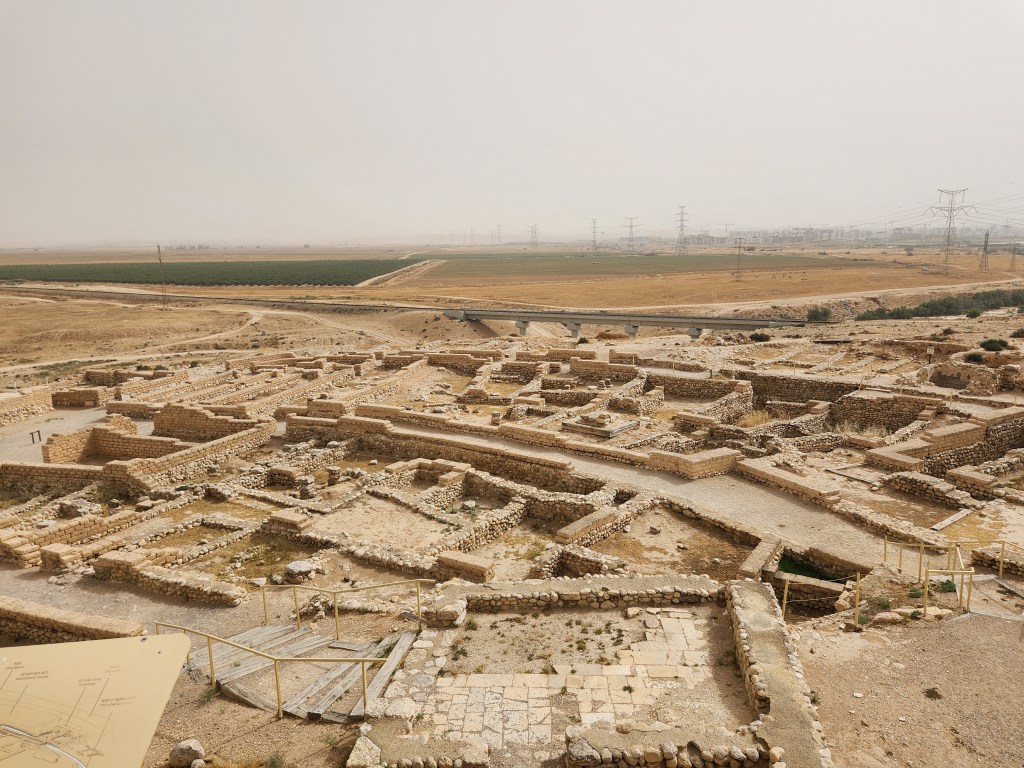
An overview of most of the remains of ancient Beersheba
Beersheba Unexpected
Each day, as we rode on our tour bus toward a new destination, our class took turns preparing a short biblical history lesson of what had happened in that place. Sometimes these were recorded in the Old or New Testaments but sometimes the events of interest to us were to be found in the writings of Josephus, or in rediscovered texts from Egypt, Mesopotamia, or other archeological explorations. And so, on our way to Be’er Sheva (biblical Beersheba) we were reminded of the many biblical references, which are entirely in the Old Testament for reasons that I will explain shortly.
The first reference to Beersheba comes as early Genesis 21 when Abraham sends Hagar and Ishmael away and they “wandered in the Desert of Beersheba.” Just a few verses later, Abraham makes an oath (which amounts to a modern treaty) with Abimelech and exchange seven lambs as a part of the agreement. The name “Beersheba” therefore is said to stem from that event either because the word Beersheba is similar to the Hebrew root of “made an oath,” or because it is similar to the root word of “seven” (or possibly both).
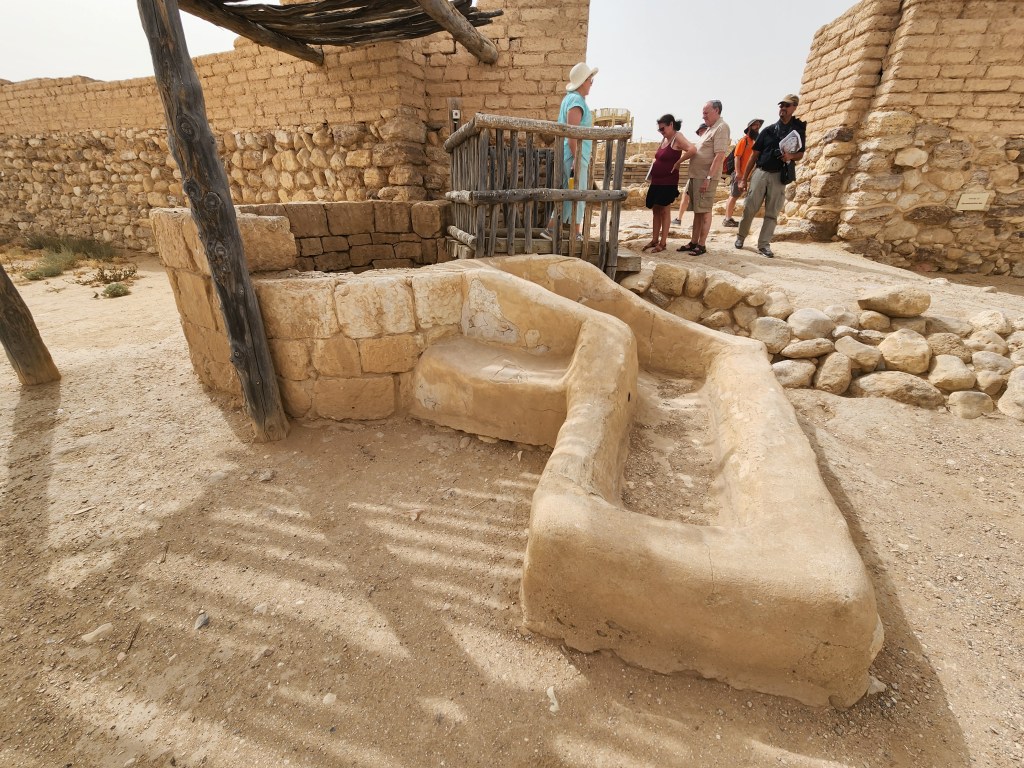
The well at Beersheba
Later, in Genesis 46, Jacob stops in Beersheba to offer sacrifices to God on his way to Egypt, Elijah stops there while running for his life in 1 Kings 19, and almost all of the other occurrences simply use Beersheba as an expression to say all of Israel from north to south as we see in Judges 20:1 when it says, “Then all Israel from Dan to Beersheba and from the land of Gilead came together as one and assembled before the Lord in Mizpah.” This expression is used simply because Dan was, for the most part, the farthest north that Israel grew, and Beersheba was its farthest southern extent. To the north of Dan was the nation of Aram (which is modern day Syria) and to the south was… well, sand. Beersheba was, and is, at the northern edge of the Negev desert, which scripture often describes as “wilderness” and the Sinai Peninsula. Continuing south brings you to the borders of Egypt. When the Jews returned to Israel after the Babylonian captivity, Nehemiah records that some returned to Beersheba, but, perhaps because there were so few, and because that territory is no longer controlled by Israel, there is no other mention of that place in scripture.
Looking down into the (deep) well
And so, while Beersheba is well attested in the Bible, compared to many of the other places that we visited, not a lot happened there. And yet, I was struck by the presence of the place in a way that I wasn’t in many of the others. Beersheba may not have had a central role in the stories of scripture, but it was present. The reason that Beersheba was important to Abraham and Isaac was because of the well that was there. Here, at the northern edge of the desert, there isn’t much water other that what flows down the wadi (dry riverbed) during the infrequent rains. And so, this well is very likely the same well that Abraham knew. Moreover, even though it may not often be mentioned by name, anyone who traveled through this region was almost certain to have stopped here.
A model of the Horned Altar found at Beersheba
It is also believed that Beersheba was one of the places of worship that had been built so that people wouldn’t have to travel the many miles north to Jerusalem. If so, this is one of the temples that King Hezekiah ordered torn down in 1 Kings 18. During archaeological digs here, a four-horned altar, often described in scripture, and typically used for sacrifice, was discovered here in secondary use. “Secondary use” means that after the temple here had been torn down, someone reused the stones as a part of wall. The stones from that wall have been moved to the Israel Museum in Jerusalem and reassembled into an altar.
Finally, during those times that Israel controlled Beersheba, it was a military outpost. This was the border between Israel and the wilderness, and between Israel and any enemies, such as Egypt, that might come from the south. Duty here was probably far from home, and certainly hot, unforgiving, and generally miserable.
A city street
Still, what is it about Be’er Sheva that unexpectedly struck me? Why does it have a presence that I could feel? For me, it’s because, like just a few other places, this is where it happened. In other places, over the last two thousand years, the places described in scripture have moved, walls have been torn down and rebuilt, whole cities have been destroyed, rebuilt, destroyed again, over and over until the places that we read about are tens of meters below the surface. But wells don’t move. While the stones surrounding this well at the surface may have been replaced many times, this is the place where Abraham, Isaac, Jacob, Elijah, invading Pharaohs, Mesopotamian generals, Roman armies, Israelite kings, and so many others have stood, draw water, and had a moment of rest.
It was unexpected. I was surprised.
Beersheba city gate
But here, on a smallish hill on the edge of the desert, I felt as if I was in the presence of history.
And, having done so, it is so much easier to imagine what those people were feeling. The panic of Hagar as she is cast out to almost certain death in the desert, the relief of Israeli merchants returning home from Egypt, the apprehension of outpost soldiers knowing that Egypt’s army was on its way towards them, the anticipation of Pharoah as he moved north towards larger, more well-defended outposts and cities, and the courage of those settlers who dared to make this remote place their home.
It is that insight, out ability to imagine what it must have been like, that allows us to better understand, explain, teach, and preach the stories of scripture. Because understanding those people, and their feelings transforms dry words into real people.
For the last several years, I have mentioned in this letter, that “this is an unusual time.” But, for the most part, we are putting the unusual-ness of the pandemic behind us and accepting what’s left as a new normal. We are going out to eat, holding church dinners, attending plays and concerts, and doing almost all of the things that we were doing before we first heard the acronym COVID-19.
But why does it matter that we are returning to normal?
It matters because a return to normal means that we can be done focusing only on surviving for the next few months or even for the next year. Returning to normal means that our focus once again shifts to look farther into the future. How do we envision Christ Church five years from now, a decade from now, or fifty years from now? Shifting our focus requires that we imagine how Christ Church might be different and how it might change. And imagining how Christ Church might change means that we must consider how we might change. And considering how we might change must include both the plural and the singular, both we collectively, and each of us individually.
But those things are also a part of the message of Lent and Easter. As we hear the familiar stories from scripture, as we read and listen to the story of Lazarus’ resurrection and his unprecedented second chance, as we hear the wonder in the voices of the crowd of witnesses, of the women who find an empty tomb, of the men walking to Emmaus with Jesus, of Thomas as he puts his hand in the Jesus’s wounds, and of the disciples who witness Jesus appear in a locked room, we must imagine with them, how our lives will be changed.
The resurrection of Jesus changed everything. It changed the direction of the lives of everyone who knew him. Peter and the others would never go back to their fishing boats because God had a different future planned for them. And twenty-one centuries later, the resurrection of Jesus is still transforming lives. As we celebrate Easter and move into the season of Eastertide, let us once again consider where God is leading us, how God intends to change us and transform us so that we are fit to do the work and the mission of the future that he has planned for us.
We are the disciples of Jesus Christ.
And God is still calling us to do his work.
Let us listen to his voice, consider what we must do, and how we might need to change in order to receive his blessings and arrive at the future that he has planned for us… for our children… for our grandchildren… and beyond.
Regardless of whether you watched the unfolding events at the chapel on the campus of Asbury University, particularly during this season of Lent, I have been struck by the similarities between the events unfolding at Asbury and the ministry of John the Baptist. As the weekly chapel worship service at Asbury continued well beyond its scheduled ending, the students stayed because, whether they could put a name to it or not, they didn’t want to leave the presence that they felt in that place. In Christian circles, we would say that they felt the presence of God. Reports say that they were called to a closeness with God, they felt the call of God upon their lives, and they felt a call and a need for repentance.
That chapel service continued for the rest of that day, on into the night, and for more than a week beyond its scheduled time. Students arranged to lead worship in shifts of sorts, not with an official schedule, but by choosing small groups of worship leaders from among those present as the Spirit led them. The names of the worship leaders weren’t given to the press because they wanted God to get the credit. If you knew who they were, you could find PhD’s bringing water to thirsty people in line, pushing wheelchairs, and guiding visitors to the nearest restroom.
Students and adults from nearby towns came first, then folks from out of state, and brothers and sisters in Christ from around the world. They came to see, and to feel, this thing that God was doing and, by the accounts that I have read, they were deeply moved and came away changed, even if their visit was brief. But of course, they weren’t the only ones that came. Asbury’s campus was also visited by the media, the curious, by academics who had written about an earlier Asbury revival in the 1970’s, by “ministry professionals” with decades of experience, and some who were openly skeptical.
Within days, the academics, the skeptics, and the “ministry professionals” could be found online, critiquing Asbury, its students, the worship leaders, and everything about that event. Whether you want to call it a revival or something else, it reminded me a lot of Jesus’ baptism. John was admittedly more than a little odd. He dressed in camel hair, ate locusts and wild honey, and wandered the countryside preaching a message of repentance. But as odd as he was, people felt something in his presence. People from across the entire region flocked to hear him, to repent of their sin, recommit their lives to following God, and be baptized as an outward sign of their repentance.
But mixed in among those whose lives were changed were the curious, the academics, the skeptics, and the “ministry professionals.” The Pharisees then, as the modern equivalents are doing even now, insisted that this isn’t how God works, that John was doing it wrong, that the people were being deceived, and that certainly, as professionals, they knew better. And yet, God didn’t choose to work through them. God has always chosen unexpected, under-prepared, and often unqualified people, in unexpected places, to do unexpected things, and following paths that surprise us.
So, what was really happening at Asbury University? I won’t pretend to have all the answers, but it seems safe to say that God was doing something, even if we can’t put a name to it, or explain exactly what it was. After all, scholars and skeptics are still trying to explain what John the Baptist’s ministry was about, what he accomplished, and what God was doing through him. I’m certain that books and countless internet articles will debate what happened at Asbury for decades to come. But from my perspective, I think that we can all find comfort, reassurance, and a timely message for Ash Wednesday and the season of Lent.
We are both comforted and reassured as we see God engaged in human affairs. God has not abandoned us. God still walks the earth and is still calling us to follow him. But particularly in this season of Lent, just as we heard from the ministry of John the Baptist, we are reminded that God is calling us to repent of our sins and to recommit our lives to following God. I’m certain that as you read about what happened in Kentucky on the campus of Asbury University, that you will hear the voices of the skeptics, the critics, and the “ministry professionals” proclaiming that they know better. But I also hope that you will hear the quiet voice of God in these remarkable events as he says, “Follow me, and I will give you rest.”







 Pastor Partridge