Spring Cleaning

Spring Cleaning

April 2024

by Pastor John Partridge

By the time you read this, the calendar will say that Spring has finally arrived. Some spring flowers have already blossomed, and baseball season started on March 28th. This is the time when many people begin to think about spring cleaning, a time to wash windows, vacuum behind and under things that don’t normally get moved, and clear out a year’s worth (or more) of clothes that don’t fit and other accumulated clutter.

But what would it look like if we had a spiritual spring cleaning? Some activities might look a lot like the season of Lent when we reflect on our year, on our actions, on our inaction, and repent of our sins against God and against one another. But what else might this version of spring-cleaning look like?

Physical window washing removes accumulated dirt, grime, and the films that accumulate on the windows of our homes and automobiles so that we can see the world outside more clearly. But, just as dirt and grime accumulate on our physical windows, our personal biases and the misinformation that circulates so freely in the world around us colors our perception of the real world, and the people in it. Doing some spiritual window washing might require us to go out into the world, meet new people, make new acquaintances, and see new things. As I said in church recently, knowing just one homeless person by name, as a person, changes the way that we think about homelessness. Meeting the people who come to, and are supported by, the Red Bird Mission and its outreach centers, in person, changes how we think about the people of rural Kentucky. Making friends with the people in Harrisburg, Liberia, or meeting the school children that we support in Sierra Leone, helping with health clinics or building homes with my sister in Jamaica, or a thousand other experiences like that, will clear away our biases and make us see the world in a different way.

Spiritual vacuuming might mean that we take a close look at where we’ve been in the last year, looking under the “furniture” that we don’t usually move, considering the actions and the conversations that we’ve had, and… just maybe, cleaning up some of the messes that we left behind. Our friends and neighbors who work through any of the twelve step programs refer to this kind of cleaning as “making amends.” How do we clean up our messes? How do we apologize? How do we show the people that we’ve hurt that we are genuinely sorry?

And what about those clothes that have gone out of style and don’t fit us any longer? Don’t we have the same thing going on with some of our attitudes that we wear? Or the people who are a bad influence on us? Or the places that we hung out before we committed to following Jesus? Sometimes ridding ourselves of clothes that no longer fit is something that we need to do so that we aren’t distracted from the new path that we’ve chosen to follow.

As we begin spring, celebrate Easter, and do a little spring cleaning in our homes, we should probably take some time to consider the inside of ourselves as well.

What accumulated clutter do we need to leave behind?

Blessings,
Pastor John


Please LIKE and SHARE!

Click here to subscribe to Pastor John’s blog.

Click here if you would like to subscribe to Pastor John’s weekly messages.

Click here to visit Pastor John’s YouTube channel.

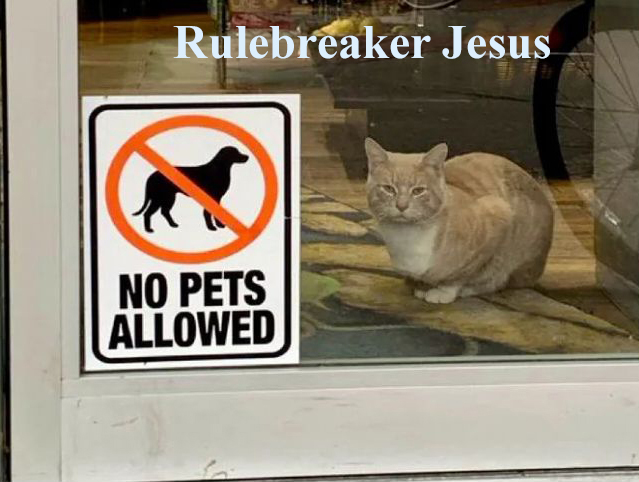
Rulebreaker Jesus

Rulebreaker Jesus

February 25, 2024*

By Pastor John Partridge

Hosea 2:14-20            Mark 2:13-22                         2 Corinthians 3:1-6

What are Christians known for in our communities and in our world today?

In the first through the third centuries, Christians were not popular, and their critics often attacked them for the ways that the Christian community went against the prevailing culture and community standards. Christians (and Jews) were seen as atheists because they did not participate in holy day celebrations at the temples of various gods and goddesses, they were accused of practicing cannibalism for the sharing of communion, they were mocked for their belief in resurrection, for following and worshiping a criminal who had been crucified, and other ways that folks just found to be odd, irregular, unusual, and rude. But as much as Christians were criticized and even persecuted, their critics recognized that there were things for which Christians were known and remembered, and most of those things, at least today, would be thought of as good things.

David Bentley Hart, in his book “The Story of Christianity,” lists the characteristics of Christians that were used by pagan critics to describe early followers of Jesus. Christians were described as sober, gentle, faithful to their spouses without exploitation or abuse, caring for the poor, willing to nurse the gravely ill, even at significant risk to themselves, such as during a time of plague, and the ability to exhibit virtues such as self-control and courage, which were thought to be impossible for anyone who was poor or who was not philosophically trained.

But even though Christianity’s critics may have grudgingly admitted that the movement had some positive points, and even though some of those we listed were presented as ridicule and not praise, Christians were still known, and often rejected, for the ways that their new religion made them break the rules of the culture and of the empire. But that shouldn’t surprise us when the founder of our movement, and the object of our worship, was, from the beginning, a ruler breaker. But before we get to that, let’s begin in the Old Testament book of Hosea in Hosea 2:14-20, where we hear God describing how he will win back a morally wandering Israel, and describe what he desires to provide for his people. God says…

14 “Therefore I am now going to allure her;
    I will lead her into the wilderness
    and speak tenderly to her.
15 There I will give her back her vineyards,
    and will make the Valley of Achor a door of hope.
There she will respond as in the days of her youth,
    as in the day she came up out of Egypt.

16 “In that day,” declares the Lord,
    “you will call me ‘my husband’;
    you will no longer call me ‘my master.’
17 I will remove the names of the Baals from her lips;
    no longer will their names be invoked.
18 In that day I will make a covenant for them
    with the beasts of the field, the birds in the sky
    and the creatures that move along the ground.
Bow and sword and battle
    I will abolish from the land,
    so that all may lie down in safety.
19 I will betroth you to me forever;
    I will betroth you in righteousness and justice,
    in love and compassion.
20 I will betroth you in faithfulness,
    and you will acknowledge the Lord
.

The story of Hosea is one in which Israel goes astray from God in a spectacular way and, through Hosea’s marriage to an unfaithful lady of the evening, God describes Israel as a prostitute who has sold herself for foreign gods. But here, God declares that he is going to win his bride back. God intends to allure her, speak tenderly to her, give her back her vineyards, and give her hope. Once again, Israel will return to God and forget the idols of her past so that God can give her a life of righteousness, justice, compassion, faithfulness, and peace. But those are the things that God has always wanted for his people. The problem has never been with God, it has been with the unfaithfulness of his people. And that is what is at the heart of the rule breaking Jesus that we meet in Mark 2:13-22. When the culture of God’s people, or any culture, values other things more than the things of God, then people of faith are compelled to break the rules. And that’s what we see as Jesus meets the tax collector Levi, who we also know as the disciple Matthew:

13 Once again Jesus went out beside the lake. A large crowd came to him, and he began to teach them. 14 As he walked along, he saw Levi, son of Alphaeus, sitting at the tax collector’s booth. “Follow me,” Jesus told him, and Levi got up and followed him.

15 While Jesus was having dinner at Levi’s house, many tax collectors and sinners were eating with him and his disciples, for there were many who followed him. 16 When the teachers of the law who were Pharisees saw him eating with the sinners and tax collectors, they asked his disciples: “Why does he eat with tax collectors and sinners?”

17 On hearing this, Jesus said to them, “It is not the healthy who need a doctor, but the sick. I have not come to call the righteous, but sinners.”

18 Now John’s disciples and the Pharisees were fasting. Some people came and asked Jesus, “How is it that John’s disciples and the disciples of the Pharisees are fasting, but yours are not?”

19 Jesus answered, “How can the guests of the bridegroom fast while he is with them? They cannot, so long as they have him with them. 20 But the time will come when the bridegroom will be taken from them, and on that day they will fast.

21 “No one sews a patch of unshrunk cloth on an old garment. Otherwise, the new piece will pull away from the old, making the tear worse. 22 And no one pours new wine into old wineskins. Otherwise, the wine will burst the skins, and both the wine and the wineskins will be ruined. No, they pour new wine into new wineskins.”

Jesus, in defiance of custom and propriety, sits down to dinner with a roomful of outsiders and outcasts, people that the religious leaders believe to be contemptable sinners and therefore a contaminating influence on people of good character. Worse, sharing a meal was seen as an intimate act that was only done with family, friends, and people of quality. In addition, Jesus is accused of ignoring a traditional time of fasting when the religious leaders and even the followers of John the Baptist are observing that cultural tradition.

But Jesus responds to the accusations and criticisms of the Pharisees by reminding them that what is appropriate sometimes varies. No one would expect wedding guests to fast regardless of the tradition of the religious leaders and Jesus equates his presence among his disciples as qualifying for the same kind of exemption. The comparison of the wineskins is the same sort of thing. New wineskins, made of sheepskin, can stretch when the new wine in them begins to ferment, but old wineskins have already stretched, and using them for new wine would only cause them to burst. And so, again, Jesus is reminding everyone that we don’t always adhere to strict rules, but instead make judgements on what is appropriate for the occasion.

But why does that matter to us?

Even though we are the followers of Jesus, he is not physically with us, so why are we having a discussion of what is, and is not, culturally appropriate?

And, in addition to the story of the first century church with which we began, we gain some focus as we read Paul’s letter to the church in Corinth in 2 Corinthians 3:1-6 as Paul explains how the people around us view our actions. Paul says…

3:1 Are we beginning to commend ourselves again? Or do we need, like some people, letters of recommendation to you or from you? You yourselves are our letter, written on our hearts, known and read by everyone. You show that you are a letter from Christ, the result of our ministry, written not with ink but with the Spirit of the living God, not on tablets of stone but on tablets of human hearts.

Such confidence we have through Christ before God. Not that we are competent in ourselves to claim anything for ourselves, but our competence comes from God. He has made us competent as ministers of a new covenant—not of the letter but of the Spirit; for the letter kills, but the Spirit gives life.

Paul describes us, the people of the church and the followers of Jesus Christ, as individual letters, from Jesus, to our communities and to the people around us. Many people will never read a bible, but they will read the life that you live. You are a sign to the community that tells the story of Jesus and the story of our church, and in you, and in us, they will read the story of Jesus and find the truth about our faith the work that we do. Paul says that “the letter kills, but the Spirit gives life.” And by this, Paul explains to the people of the church, that the message of Jesus isn’t all about following a strict interpretation of a bunch of rules, but instead is about a life that is lived in love.

What God wants is a life of righteousness, justice, compassion, faithfulness, and peace but far too often, when unbelievers read the story of Jesus that Christians live out in their lives, what they see is anger, prejudice, greed, violence, arrogance, abuse, and the admiration of, if not a complete alliance with, worldly power.

When Jesus broke the rules of his culture, he broke them so that he could show love and compassion to others. When the Christians of the first century behaved strangely, and broke the rules of their culture, they still earned the respect of their critics because they were sober, gentle, faithful to their spouses, cared for the poor, nursed the gravely ill even at risk to themselves, and exhibited virtues such as self-control and courage.

And so, we return to the question with which we began. What are Christians known for in our communities and in our world today?

Every day, the people around you, people that may never read a bible or set foot in a church, will read a letter from Jesus in the life that you live.

Will they read a message of love and compassion?

Or will they find something else?


Please LIKE and SHARE!

Click here to subscribe to Pastor John’s blog.

Click here if you would like to subscribe to Pastor John’s weekly messages.

Click here to visit Pastor John’s YouTube channel.


*You have been reading a message presented at Christ United Methodist Church on the date noted at the top of the first page.  Rev. John Partridge is the pastor at Christ UMC in Alliance, Ohio.  Duplication of this message is a part of our Media ministry, if you have received a blessing in this way, we would love to hear from you.  Letters and donations in support of the Media ministry or any of our other projects may be sent to Christ United Methodist Church, 470 East Broadway Street, Alliance, Ohio 44601.  These messages are available to any interested persons regardless of membership.  You may subscribe to these messages, in print or electronic formats, by writing to the address noted, or by contacting us at secretary@CUMCAlliance.org.  These messages can also be found online at https://pastorpartridge.com .  All Scripture quotations, unless otherwise indicated, are taken from the Holy Bible, New International Version®, NIV®. Copyright ©1973, 1978, 1984, 2011 by Biblica, Inc.™ Used by permission of Zondervan. All rights reserved worldwide. www.zondervan.comThe “NIV” and “New International Version” are trademarks registered in the United States Patent and Trademark Office by Biblica, In

The Intersection of Why and What

The Intersection of Why and What

February 22, 2024

by John Partridge


Here are two important questions:

  1. Why are we here?
  2. What are we doing about it?

Last fall, we had several strategic planning meetings. One of the things that grew out of those meetings was our new vision statement that you see at the top of our bulletin every week. But another was a conversation about why God has put us here, as Queen Esther would have said, “for such a time as this.” During the strategic planning meeting we asked two important questions. First, “What are the pressing needs of our community?” And second, “What are the strengths of our congregation?” Only when we answer the latter two questions, we will be able to answer the two questions that I asked at the beginning of this letter.

The needs that we listed in our meetings, with the input of many community leaders, were poverty, hunger, housing (including homelessness, blight, and high rents), lack of workforce and lack of jobs, safe places for youth, support for parents, mental health, drugs, and transportation. At the same time, we listed the strengths of our congregation as outreach, music, caring and compassionate congregation, generosity, education, leaders, organizers, our endowment, our connections and contacts, our physical plant/building and our adjoining lots used for both green space and the community garden.

That’s a lot.

But I want to keep these ideas in front of us rather than just allowing them to be an exercise that we once did and promptly forgot. Our community needs us, and our future depends upon us doing something about it.

And so, I’m inviting you all to think and dream about where these two lists intersect. What is the intersection of What we are, and what is needed? What is the intersection of “Why are we here?” and “What do the people around us need us to be and do?”

We really need you to do this.

Often, I ask these sorts of questions in our newsletter, and everyone seems to think that they are rhetorical questions (they are not). And I never get more than one or two answers, if any. But these questions need to be answered and I will be bringing them to our church boards for more discussion as we seek to find a new direction, purpose, and yes, a new strategic plan for our future.

But what might that look like?

From the list above, it could be many things, but here is an example based on something that we already do, and with which we already have some familiarity. Think about housing. Last week the Alliance chapter of Habitat for Humanity accepted applications for this year’s round of construction. Habitat will build or renovate three houses, but they had something like 150 applications. Yikes.  That number is mind blowing, but it gives us a glimpse of insight into the housing needs of our community.

So, what if, instead of raising money for three months, once every other year, for our share of the Apostle build, what if we raised money for twenty-four months? What if, instead of setting our goal at $5,000. We set a goal of $20,000 or even $150,000 (which is the cost of an entire Habitat house)?

What if, as some churches are doing in other states, we used some of our vacant land to build “tiny houses” to help get homeless people in our community under a roof, out of the weather, and help them move toward a better life?

What if our church bought and renovated one of the empty buildings in our city and created a multi-unit, low cost, rent-controlled, safe place, apartment complex?

These are all examples to help you dream. Some of them are big dreams. But honestly, given the resources, generosity, and leadership available in our congregation, I believe that, given enough time, any of them, or all of them, are possible for us to achieve if we decided to do so. But housing is just one of the needs that we listed.

What else might God be calling us to be or to do?

Why are we here?

What are we doing about it?


Please LIKE and SHARE!

Click here to subscribe to Pastor John’s blog.

Click here if you would like to subscribe to Pastor John’s weekly messages.

Click here to visit Pastor John’s YouTube channel.


A Year in Review: 2023

2023 Year in Review

by John Partridge

Well, our annual “End of Year” reports have been completed and turned in to the East Ohio Annual Conference. So… how did we do? Overall, I am pleased and think that we did well. Of course, the numbers don’t tell the whole story, but they do tell us things. So, let’s review a few numbers and consider what they tell us.

We started 2023 with 289 members and we received 5 new members. Unfortunately, we removed 13 members that were lost to death. That is both sad and unfortunate and we grieve the loss of our friends. The good news is that we did gain five new members and, if we’re honest, that’s five more than many churches. The reality remains that our survival depends upon us inviting new people to worship, connecting them to small groups and other ministries of the church and, eventually, bringing them into membership.

Despite the loss of so many members, quite a few of whom were regular in worship, our average attendance increased from 65 to 70, which is an increase of 8 percent and our United Women in Faith saw a 25 percent increase in membership. At the same time, the average number of people who worship online increased by 50 percent from 24 to 36. We also saw an 83 percent increase in the number of children, growing from 6 to 11 in Sunday school and the addition of one more children’s class to accommodate them. Not surprisingly, we did see a small decrease in adult Sunday school attendance, largely due to the loss of the older members previously mentioned. Overall, however, our average attendance in Sunday school increased by 5 percent. And, although I have said it before, as has Pastor Chris, the percentage of our congregation that attends Sunday school, compared to most any other church in our connection, is strikingly high. In the average Protestant church, 44 percent of those in worship attend Sunday school. At Christ Church, that number is 63 percent.

We did see a 7 percent decrease in total giving and, with the departure of Men’s Challenge, a small drop in building use fees, but we did see a 9 percent increase in pledged giving and an increase in “unidentified gifts” which is made up of things like our loose offering, Chuck Wagon offering, Pennies for Heaven, Sunday school offerings, and this year will include the Noisy Can offering.

Additionally, we continue to have a strong (for our size) online presence. The website where our sermons are posted currently has 221 subscribers which translates to about 70 views per week. Those same sermons are sent out to 296 subscribers by email, which is an increase of 89 from last year. Of those, about 60 subscribers open the email and read it. And our YouTube livestream increased by 17 subscribers during 2023 and now has 123 total subscribers with between 30 and 40 viewers of each week’s message.

So, what does all that mean?

As I look at it, it means that there is still a need for, and an interest in what we are doing. It means that people are watching and reading online, but that some of them are also coming here in person. It means that the members and friends of Christ Church are inviting our friends and neighbors to worship with us and some of them have decided to stay and join our church family. It means that where only a few years ago it was common to have a Sunday without children, now it is rare that we do not have at least a few.

Yes, we have some challenges in front of us, but just as God has led us to navigate through those challenges in the past, we trust that he will continue to lead us into the future. Moreover, despite the losses that we have felt over the last year, the growth that we have seen gives us every reason to expect that growth to continue if we remain faithful in doing the work that God has given to us, continue being the hands and feet of Jesus, and never stop sharing what a great family that we have here at Christ Church.

In other words, there is every reason to have hope for, and even to expect a bright future.

Blessings,

Pastor John


Please LIKE and SHARE!

Click here to subscribe to Pastor John’s blog.

Click here if you would like to subscribe to Pastor John’s weekly messages.

Click here to visit Pastor John’s YouTube channel.

Waiting for Hope

Waiting for Hope

December 24, 2023*

(Christmas Eve)

By Pastor John Partridge

Isaiah 9:2-7                Luke 2:1-20                Titus 2:11-14

READING 1:

Isaiah 9:2-7

The people walking in darkness have seen a great light;
on those living in the land of deep darkness a light has dawned.
You have enlarged the nation and increased their joy;
they rejoice before you as people rejoice at the harvest,
as warriors rejoice when dividing the plunder.
For as in the day of Midian’s defeat, you have shattered
the yoke that burdens them, the bar across their shoulders,
    the rod of their oppressor.
Every warrior’s boot used in battle and every garment rolled in blood
will be destined for burning, will be fuel for the fire.
For to us a child is born, to us a son is given, and the government will be on his shoulders.
And he will be called Wonderful Counselor, Mighty God, Everlasting Father, Prince of Peace.
Of the greatness of his government and peace there will be no end.
He will reign on David’s throne and over his kingdom, establishing and upholding it
    with justice and righteousness from that time on and forever.
The zeal of the Lord Almighty will accomplish this.

READING 2:

Luke 2:1-7
2:1
 In those days Caesar Augustus issued a decree that a census should be taken of the entire Roman world. (This was the first census that took place while[a] Quirinius was governor of Syria.) And everyone went to their own town to register.

So Joseph also went up from the town of Nazareth in Galilee to Judea, to Bethlehem the town of David, because he belonged to the house and line of David. He went there to register with Mary, who was pledged to be married to him and was expecting a child. While they were there, the time came for the baby to be born, 7and she gave birth to her firstborn, a son. She wrapped him in cloths and placed him in a manger, because there was no guest room available for them.

READING 3:

Luke 2:8-14

And there were shepherds living out in the fields nearby, keeping watch over their flocks at night. An angel of the Lord appeared to them, and the glory of the Lord shone around them, and they were terrified. 10 But the angel said to them, “Do not be afraid. I bring you good news that will cause great joy for all the people. 11 Today in the town of David a Savior has been born to you; he is the Messiah, the Lord. 12 This will be a sign to you: You will find a baby wrapped in cloths and lying in a manger.”

13 Suddenly a great company of the heavenly host appeared with the angel, praising God, and saying,

14 “Glory to God in the highest heaven,
    and on earth peace to those on whom his favor rests.”

READING 4:

Luke 2:15-20

15 When the angels had left them and gone into heaven, the shepherds said to one another, “Let’s go to Bethlehem and see this thing that has happened, which the Lord has told us about.”

16 So they hurried off and found Mary and Joseph, and the baby, who was lying in the manger. 17 When they had seen him, they spread the word concerning what had been told them about this child, 18and all who heard it were amazed at what the shepherds said to them. 19 But Mary treasured up all these things and pondered them in her heart. 20 The shepherds returned, glorifying, and praising God for all the things they had heard and seen, which were just as they had been told.

Waiting for Hope

By Pastor John Partridge

Well… we’ve arrived.

For many of us, Christmas is our favorite season of the year. For some of you here, I have seen your posts on social media counting down to tonight and tomorrow morning. We might have hoped for a white Christmas, but I’m certain that we’ll have enough of that soon enough. We’ve sung the songs, we’ve heard the children, the pipe organ, the choir, and the bells. In a few minutes we will light the candles and welcome Christmas as we sing Silent Night. For many of us that is the moment that we know that Christmas has arrived and our hearts, and our souls are, even if only for a moment… at peace.

But what does it all mean?

Yes, we’ve heard the story. Yes, we know that the King of Kings was born to a virgin, entered into our earthly existence, and begun the journey that led to our salvation and rescue, but what about the here and now? We know the first century story, but what is the twenty-first century story? What does the Christmas story mean to us in our hectic, helter-skelter, world of rushed deadlines, underfunded budgets, and overscheduled calendars?

As much as we love the Christmas story, we all know that it represents just the very beginning of God’s invasion of the world and our work to tell humanity of Christ’s coming and call everyone to repentance and reconciliation with God. The disciples knew that too. And in his letter to his friend, we hear Paul helping Titus to grapple with the message of Jesus Christ and understand his, and our, role in the world around us. Titus was one of Paul’s missionary partners, a pastor, capable church administrator, responsible ally, evangelist, and a trusted friend. And, in Paul’s letter he tells Titus that what we are doing in the post-resurrection world, is… waiting for hope. That’s a puzzling idea, and so let’s read a larger passage from Titus 2:11-14, to hear, in context, what Paul is saying. He says:

11 For the grace of God has appeared that offers salvation to all people. 12 It teaches us to say “No” to ungodliness and worldly passions, and to live self-controlled, upright and godly lives in this present age, 13 while we wait for the blessed hope—the appearing of the glory of our great God and Savior, Jesus Christ, 14 who gave himself for us to redeem us from all wickedness and to purify for himself a people that are his very own, eager to do what is good.

Paul says that the coming of Jesus Christ was, for us, the appearance of God’s grace to the world and offers salvation to all people. That grace, and that rescue, teaches us to navigate the chaos of the world around us. We surrounded by a culture that admires and idolizes lives that are at least, or often completely, out of control and burning with ungodly and worldly passions that worship sex, drugs, gambling, power, and excesses of every kind and flavor. But God’s grace guides us toward lives that are moral, ethical, upright, and self-controlled… which absolutely is not saying that we live lives that are boring, humorless, or without fun or other enjoyment, but that find fun and enjoyment in ways that honor God.

The odd part of Paul’s writing is where it says that we live these lives “while we wait for the blessed hope – the appearing of… Jesus Christ.” I’m certain that Paul isn’t saying that we live without hope, because Jesus Christ is our hope. Rather, I think what he is saying, when he says that we wait for the “blessed hope,” is that we live these lives while we wait for the fulfillment of our hope and return of Jesus Christ.

And so, as we celebrate the birth of our Savior, we must remember not just that he came, but why he came. Jesus came to earth to call the world to repentance, to rescue us from sin and death, to teach us how to live moral, ethical, upright, and godly lives in the middle of a world that is immoral, unethical, out of control, and ungodly. Our mission is to tell the people around us that God offers them a better way and a better life. And we must live and love in such a way, that the people around us can see that better life in us, know that God’s offer is real, and want what we have.

Merry Christmas everyone.


Please LIKE and SHARE!

Click here to subscribe to Pastor John’s blog.

Click here if you would like to subscribe to Pastor John’s weekly messages.

Click here to visit Pastor John’s YouTube channel.


*You have been reading a message presented at Christ United Methodist Church on the date noted at the top of the first page.  Rev. John Partridge is the pastor at Christ UMC in Alliance, Ohio.  Duplication of this message is a part of our Media ministry, if you have received a blessing in this way, we would love to hear from you.  Letters and donations in support of the Media ministry or any of our other projects may be sent to Christ United Methodist Church, 470 East Broadway Street, Alliance, Ohio 44601.  These messages are available to any interested persons regardless of membership.  You may subscribe to these messages, in print or electronic formats, by writing to the address noted, or by contacting us at secretary@CUMCAlliance.org.  These messages can also be found online at https://pastorpartridge.com .  All Scripture quotations, unless otherwise indicated, are taken from the Holy Bible, New International Version®, NIV®. Copyright ©1973, 1978, 1984, 2011 by Biblica, Inc.™ Used by permission of Zondervan. All rights reserved worldwide. www.zondervan.comThe “NIV” and “New International Version” are trademarks registered in the United States Patent and Trademark Office by Biblica, Inc.™

Pastor’s Christmas Letter

Pastor’s Christmas Letter

by John Partridge

Dear Friends,

This year the Advent season seemed to sneak up on us faster than I remember others in the past and we are already racing towards Christmas. This seems to race even faster when our fourth Sunday of Advent falls on Christmas Eve morning. This feeling of hectic scheduling makes it even more important that we be deliberate in preparing ourselves for the celebration of our Lord’s birth. I don’t just mean buying presents and decorating our homes, but preparing our hearts and our souls so that we can enjoy and appreciate the arrival of the newborn king.

I admit that since I was in my twenties, and in most ordinary years, I struggled (past tense) and still struggle (present tense) with being a humbug. I just don’t “feel” Christmas-y.  Before Patti and I were married, I discovered that one way to fight back, and to start feeling the warmth of the holiday was to start listening to Christmas music after Thanksgiving, even if I didn’t feel like it.  More recently, with the loss of my hearing and music often sounding off-key, music hasn’t been as effective and so instead I make sure to decorate our Christmas tree, turn on the lights, and look at it for a while every evening.

But that isn’t enough. Because the Spirit of God dwells within each one of us as the followers of Jesus, when we are together, we feel the presence, not only of other people, but also the presence of God himself. And so, every Sunday, but especially during Advent, it is important for all of us to worship together, to simply be together, so that we can feel that sensation of closeness to God and prepare our hearts for Christmas. That closeness to God is real and, as important as it is to us personally, it’s important that we don’t keep it to ourselves.

Statistically, about one-third of, or one in three, people say that they would be willing to attend or visit a church if they were invited. That willingness is often highest at Christmastime. Christmas Eve is easily one of the most attended worship services of the year in almost every church in North America. And so, as I have in the past, I hope that each one of you will invite at least five others to join us. Toward that end, we have printed business cards that you can give to your friends, classmates, business associates, barber, hairdresser, grocery store clerk, or anybody else, and invite them to join us as we worship and celebrate Christmas Eve.

Christmas Eve and Christmas are a time when we draw close to one another, and draw close to God, in a way that is both special and memorable not just because of the people, but because it is a time when we encounter the Spirit of God in a special way. Of course, we will share the extraordinary experience of hearing our choirs, bell choirs, pipe organ, and singing traditional and meaningful carols of Christmas together. But most importantly, we will remember the story of God’s invasion of the earth and the arrival of the Christ child, who would become the rescuer and redeemer of all humanity.

I hope that you will join us as we draw closer one another, and closer to God, together.

Blessings,

Pastor John


Please LIKE and SHARE!

Click here to subscribe to Pastor John’s blog.

Click here if you would like to subscribe to Pastor John’s weekly messages.

Click here to visit Pastor John’s YouTube channel.

Challenging the Comfortable

Challenging the Comfortable

by John Partridge

Years ago, I was told that the job of a pastor is to “Comfort the afflicted and afflict the comfortable.” While that’s used jokingly, it is often true. We need to be comforted when we hurt, but often get stuck when we’re comfortable and need someone to give us a shove if we hope to move forward again. Those of us who have changed jobs, moved to new communities, started businesses, gone back to school, or otherwise made changes to our lives can attest to that. Sometimes getting something that we want, or something better than what we have, requires that we leave behind some of what we know, some of the things that make us comfortable, and launch out into the unknown and the uncomfortable.

Similarly, it has been said that “Ships in harbor are safe, but that’s not what ships were built for.” Sometimes launching our on a new adventure is something that we choose for ourselves, but other times we get drafted and dragged into those adventures kicking and screaming all the way. This past year has seen some of that for us at Christ Church. We are doing some things differently, and with different people, simply because some of the people who have always done them are no longer with us. In the last few years, people have moved away, gone to college, found other churches, or passed from this life and into the next. But we are also having conversations about other changes that we might choose for our future.

I saw a quote this week from the book Fusion, by Nelson Searcy, which suggests three markers to measure your church’s “guest flow.” It said that a church in “Maintenance mode” needed three first-time guests for every one hundred in worship attendance just to stay in the same place in worship attendance. To be in “Growth mode” required five first-time guests for every one hundred, and “Rapid-growth mode” required seven first-time guests for every one hundred. That’s a lot, and I’m not sure that I believe that the numbers are that high (especially if those are weekly figures) … as long as at least some of those visitors can be attracted to stay. But even so, our experience says that there is some truth to it. In the last few years, we’ve had more visitors, and each year more of those visitors have decided to stay. For each of the last several years we’ve been bringing in a few new members. But we haven’t… yet… been able to bring in more new members than we have lost.

I emphasize the word “yet” because I see change happening. Our worship attendance, since the Covid-19 shutdowns, is once again increasing. And, as we move forward into a New Year, we are, at least occasionally, doing things to move out of our comfort zones and try new things. And that brings me to my challenge for the people of Christ Church. I challenge you to be uncomfortable… at least occasionally. I challenge you to have conversations with friends, neighbors, family, coworkers, and yes, even strangers, about your faith and what it means to you. I challenge you to tell them why you come here and why you like it and invite some of those people to sit with you on Sunday morning, or volunteer and work with you on one of our work projects. I challenge our Sunday school teachers to teach a series on how to share your faith and how to have those kinds of conversations.

We all know that Christ Church is a great church family and is full of compassionate, loving people. But we don’t always do a good job of telling our neighbors about who we are and what we do. And we don’t always do as much as we might do to help the people around us. And so, my challenge is not only to invite people, but to continue pushing ourselves to be a little uncomfortable. To keep trying new things and finding new ways to reach out to the people in our community. God has put us in this place, at this moment, to be his hands and feet to the people of Alliance and beyond. Let us listen to his voice and consider where God is leading us.

Staying in the harbor, and doing what we’ve always done, is safe.

But that isn’t what God built churches to do.

Blessings,

Pastor John


Please LIKE and SHARE!

Click here to subscribe to Pastor John’s blog.

Click here if you would like to subscribe to Pastor John’s weekly messages.

Click here to visit Pastor John’s YouTube channel.

From Mourning to Joy

From Mourning to Joy

December 17, 2023*

By Pastor John Partridge

Isaiah 61:1-4, 8-11                 John 1:6-8, 19-28                          1 Thessalonians 5:16-24

On June second of 2022, seventeen-year-old Ethan Liming, the son of United Methodist Pastor Bill Liming, was beaten to death during an altercation at a basketball court in downtown Akron. This week we were notified that another of our East Ohio Conference colleagues, Beth Wilterdink, with whom Mike Greiner and I have served on the conference committee on camps and retreats, is mourning, with her husband and family, the loss of their barely two-year-old daughter Cora. I can read about these things, but I can’t begin to understand the pain and the grief that these families must feel.

But many of us have experienced our own kinds of loss. Some of you have lost children, many of us have lost parents or siblings. We each understand grief in our own way. And so, we have some insight into the lives of the people who heard God’s message through his prophet Isaiah. These were the people who had lost everything. They had lost sons, daughters, husbands, wives, brothers, sisters, parents, and grandparents, they had lost their nation and their freedom and had been carried off into captivity in Babylon. They were filled with grief. But God speaks to them through the writings of Isaiah and tells them that in the midst of their grief, there is good news. We hear these words in Isaiah 61:1-4, 8-11…

61:1 The Spirit of the Sovereign Lord is on me, because the Lord has anointed me
    to proclaim good news to the poor.
He has sent me to bind up the brokenhearted, to proclaim freedom for the captives
    and release from darkness for the prisoners,
to proclaim the year of the Lord’s favor and the day of vengeance of our God,
to comfort all who mourn,
    and provide for those who grieve in Zion— to bestow on them a crown of beauty
    instead of ashes, the oil of joy instead of mourning, and a garment of praise
    instead of a spirit of despair.
They will be called oaks of righteousness, a planting of the Lord for the display of his splendor.

They will rebuild the ancient ruins and restore the places long devastated;
they will renew the ruined cities that have been devastated for generations.

“For I, the Lord, love justice;I hate robbery and wrongdoing.
In my faithfulness I will reward my people and make an everlasting covenant with them.
Their descendants will be known among the nations and their offspring among the peoples.
All who see them will acknowledge that they are a people the Lord has blessed.”

10 I delight greatly in the Lord;my soul rejoices in my God.
For he has clothed me with garments of salvation and arrayed me in a robe of his righteousness,
as a bridegroom adorns his head like a priest, and as a bride adorns herself with her jewels.
11 For as the soil makes the sprout come up and a garden causes seeds to grow,
so the Sovereign Lord will make righteousness and praise spring up before all nations.

God says that there will be healing for the brokenhearted, release for prisoners, comfort for those who mourn, and God promises to transform the ashes of their grief into a crown of beauty. God promises to rebuild, restore, and renew, and to bring justice and faithfulness to replace their despair and loss. And in the end, God will use the nations of the world to raise up gardens of righteousness and praise.

In no way does God, or Isaiah, diminish the pain, loss, and grief that we experience today, God does not tell us to “get over it,” but God does promise that he will, one day, transform our grief into joy.

But, because John the Baptist had been quoting from the words of Isaiah, the priests and the leaders of Israel came out to the wilderness in John 1:6-8, 19-28 to ask if he was a resurrected Isaiah that God had sent to fulfill the promises that had been written so long ago.

There was a man sent from God whose name was John. He came as a witness to testify concerning that light, so that through him all might believe. He himself was not the light; he came only as a witness to the light.

19 Now this was John’s testimony when the Jewish leaders in Jerusalem sent priests and Levites to ask him who he was. 20 He did not fail to confess, but confessed freely, “I am not the Messiah.”

21 They asked him, “Then who are you? Are you Elijah?”

He said, “I am not.”

“Are you the Prophet?”

He answered, “No.”

22 Finally they said, “Who are you? Give us an answer to take back to those who sent us. What do you say about yourself?”

23 John replied in the words of Isaiah the prophet, “I am the voice of one calling in the wilderness, ‘Make straight the way for the Lord.’”

24 Now the Pharisees who had been sent 25 questioned him, “Why then do you baptize if you are not the Messiah, nor Elijah, nor the Prophet?”

26 “I baptize with water,” John replied, “but among you stands one you do not know. 27 He is the one who comes after me, the straps of whose sandals I am not worthy to untie.”

28 This all happened at Bethany on the other side of the Jordan, where John was baptizing.

But John says that he is not Isaiah, nor is he Elijah, nor is he the promised messiah. Instead, he has come to point to the Messiah, to announce his arrival, and to proclaim the fulfillment of God’s promises in Isaiah in the person of Jesus Christ.

But, knowing that Jesus is the Messiah, as we do, what does that mean for us today? What does that tell us about our grief, and our pain, and how we are to live our lives in the twenty-first century? In his letter to the church in Thessalonica, contained in 1 Thessalonians 5:16-24, Paul says this:

16 Rejoice always, 17 pray continually, 18 give thanks in all circumstances; for this is God’s will for you in Christ Jesus.

19 Do not quench the Spirit. 20 Do not treat prophecies with contempt 21 but test them all; hold on to what is good, 22 reject every kind of evil.

23 May God himself, the God of peace, sanctify you through and through. May your whole spirit, soul and body be kept blameless at the coming of our Lord Jesus Christ. 24 The one who calls you is faithful, and he will do it.

Paul says that God’s will for us is to live in anticipation of God’s final and ultimate victory. We are to live as if Christ has already returned, and God has already fulfilled his promises of rescue, rebuilding, restoration, renewal, and transformation. Rejoice always, pray continually, give thanks in all circumstances, test the prophecies of God to prove their truthfulness, reject every kind of evil, but hold on to all that is good.

In this world, we know that we will experience suffering, pain, grief, and death.

But one day God will transform our mourning into joy.

Until then…

…reject every kind of evil and…

                                    …hold on to what is good.


Please LIKE and SHARE!

Click here to subscribe to Pastor John’s blog.

Click here if you would like to subscribe to Pastor John’s weekly messages.

Click here to visit Pastor John’s YouTube channel.


*You have been reading a message presented at Christ United Methodist Church on the date noted at the top of the first page.  Rev. John Partridge is the pastor at Christ UMC in Alliance, Ohio.  Duplication of this message is a part of our Media ministry, if you have received a blessing in this way, we would love to hear from you.  Letters and donations in support of the Media ministry or any of our other projects may be sent to Christ United Methodist Church, 470 East Broadway Street, Alliance, Ohio 44601.  These messages are available to any interested persons regardless of membership.  You may subscribe to these messages, in print or electronic formats, by writing to the address noted, or by contacting us at secretary@CUMCAlliance.org.  These messages can also be found online at https://pastorpartridge.com .  All Scripture quotations, unless otherwise indicated, are taken from the Holy Bible, New International Version®, NIV®. Copyright ©1973, 1978, 1984, 2011 by Biblica, Inc.™ Used by permission of Zondervan. All rights reserved worldwide. www.zondervan.comThe “NIV” and “New International Version” are trademarks registered in the United States Patent and Trademark Office by Biblica, Inc.™

Jesus, the Master of Insults?

Jesus, the Master of Insults?

A message for teachers, preachers, and scholars

by John Partridge

As we read through the book of Matthew, there are many times when Jesus quotes from what we know as the Old Testament scriptures. Most of the time that Jesus does this he is simply teaching as rabbis and pastors have always done. Around his disciples, to people with honest questions, and in front of the crowds that gathered to hear him speak, Jesus preaches from the scriptures and teaches the people. But there are a handful of encounters in which Jesus does something different. When the Pharisees, and occasionally the Sadducees, come to Jesus, his approach, his intent, and his methodology are completely different. Rather than preaching from scripture, Jesus quotes scripture to the Pharisees… and it’s not pretty. In these cases, Jesus quotes from the scriptures, but rather than preaching or teaching in the gentle way that a father and son would play catch, Jesus quotes scripture as if he is hurling it at the Pharisees as a slinger in the army of Israel would launch stones, or a bowman would let loose his arrows.

We find the first of these instances in Matthew 12:3 in which Jesus attacks the Pharisees, men who dedicated their lives to reading, studying, memorizing, discussing, and debating scripture and its meaning. Here, Jesus’ attack is confrontational and deliberately insulting when he says, “Haven’t you read…?” as if these learned men had spent their time playing games rather than being serious scholars.

In another encounter with the Pharisees in Matthew chapter 15, the Pharisees come to Jesus and criticize him, and his disciples, for breaking the traditions of the elders. In other words, this isn’t about breaking the law, or committing sin, but about breaking the rules, habits, and traditions that had been handed down from other Pharisees, and perhaps even traditions that predated the Pharisees. But Jesus isn’t having any of that, and especially not from a group of people who are essentially the pot calling out the kettle for being black.

And so, in Matthew 15:3, Jesus once again insults them saying, “Why do you break the commands of God for the sake of your tradition?” For this group of men who followed hundreds of rules, specifically for the purpose of not breaking the commands of God, this is an obvious insult. But Jesus doesn’t stop there.

In Matthew 15: 7-9, Jesus continues by saying:

You hypocrites! Isaiah was right when he prophesied about you:

“‘These people honor me with their lips,
    but their hearts are far from me.
They worship me in vain;
    their teachings are merely human rules.’”

This passage from the prophet Isaiah that Jesus quotes comes from Isaiah 29:13 where it says:

13 The Lord says:

“These people come near to me with their mouth
    and honor me with their lips,
    but their hearts are far from me.
Their worship of me
    is based on merely human rules they have been taught.

The Septuagint reading is only slightly different in the first and last line but gives us some additional insight. The first line here saying, “They worship me in vain;” and the last saying, “their teachings are merely human rules.”

Of course, Isaiah wasn’t prophesying about the Pharisees but pronouncing a series of woes and judgements upon the people of his own time, but the similarities between the two situations are so strikingly similar that they can’t help but be compared to one another. The Word Biblical Commentary described this as being “in the sense of a typological correspondence between Isaiah’s day and the time of Jesus.” The Pharisees had certainly read and studied the words of Isaiah, and they understood that Israel had been carried into captivity because of their unbelief, and they devoted themselves to avoid a repetition of that mistake. And so, in other words, Jesus is calling the Pharisees out for having become exactly the thing that their entire movement had been intended to avoid.

But as we continue through Matthew’s gospel, Jesus isn’t yet done insulting the Pharisees. In Matthew 19:4, Jesus again meets the Pharisees and after they attempt to ask him a trick question about divorce, Jesus says, “Haven’t you read…?” once again suggesting that these scholars had not done their homework.

Again, when the Pharisees criticize Jesus for allowing the children to shout Hosanna as he healed the blind and the lame in the Temple, in Matthew 21:16, Jesus says, “Have you never read…? As he again quotes from the Psalms.

Not long after that, after deliberately insulting the Pharisees in Matthew 21:31 by saying that tax collectors and prostitutes are entering the kingdom of God ahead of them, and again in Matthew 21:33-40 when Jesus ends the parable of the tenants by quoting Psalm 118 in Matthew 21:42 saying:

 “Have you never read in the Scriptures:

“‘The stone the builders rejected
    has become the cornerstone;
the Lord has done this,
    and it is marvelous in our eyes’?

43 “Therefore I tell you that the kingdom of God will be taken away from you and given to a people who will produce its fruit.

Even here, Jesus isn’t done. In Matthew 22: 41 after the Pharisees had asked him a difficult question as a test, Jesus asks a question of his own saying, “What do think about the Christ? Whose son is he?” But, when the Pharisees correctly answer that the Christ is the son of David, Jesus, quoting Psalm 110, asks, in Matthew 22:44, “How is it then that David, speaking by the Spirit, calls him Lord?” This exchange, on the surface, appears more respectful than some of their previous encounters, but again Jesus insults the Pharisees by exposing their lack of understanding.

The Sadducees appear in Matthew 22:23 for some of the same, as they ask a question with a quote from Ezra 7 in hopes of making Jesus look foolish. But Jesus’ response in verse 29 is to say that “You are in error because you do not know the scriptures or the power of God.” And so, Jesus once again declares that men who were known for their knowledge of scripture, really didn’t know what they were talking about.

And all of that is followed by Matthew 23, in which almost the entire chapter is a Jesus delivering a diatribe against the Pharisees and all that they stand for.

From that, I think that all of us who study and preach should take note. Jesus was known for his gentleness, calm, and healing presence around sinners, tax collectors, prostitutes, foreigners, and even Roman soldiers if their questions were sincere. But Jesus had no tolerance at all for the people who claimed to be scholars, priests, and teachers. Jesus expected these learned people to understand what they were studying and teaching, and he expected that their lives would be lived in line with what they knew. Like it or not, we should see ourselves as the Pharisees, Sadducees, priests, and the teachers of Israel and heed Jesus words of caution so that we do not earn the kind of criticism that Jesus reserved for them.

As teachers, preachers, and as scholars, we are held to a higher standard and we are expected to live our lives in a way that models the scriptures so that on the day of judgement we might hear “Well done” and not, “Have you never read…?


Please LIKE and SHARE!

Click here to subscribe to Pastor John’s blog.

Click here if you would like to subscribe to Pastor John’s weekly messages.

Click here to visit Pastor John’s YouTube channel.

Pastor’s Report 2023

Pastor Report 2023

by Pastor John Partridge

Note: Every year, I am asked to present a report of the year for our annual Charge Conference. It’s really sort of a “what I did last summer” kind of report that asks, “What did your church do for the last year?” Long ago I decided that my answers should not be seen as any kind of a secret, and so I publish them here, and in our church newsletter. I’m excited about the future of Christ Church and its people and I hope that by talking more about it, others might learn about it and join us in our mission to care for the people around us, and around the world, the way that Jesus cares for us. So, what follows is this year’s report:


In 2023, Christ Church did what we have always done, survived, endured, persisted, explored, and innovated. As in life, things change and while some of those changes are good, others can challenge us. This year, after a particularly strong Spring storm, our scouts discovered that one of our tower windows had been sucked out of the building and shattered in the street. Further investigation showed that our roof had taken some damage in that same storm. But, as they have done for over a century, our trustees are managing, and repairing the damage to maintain our facilities. Similarly, we’ve lost a number of members to death, as well as several non-member family and friends, and our members have had their share of falls, surgeries, and other setbacks.

But through it all, we continue to do what we’ve always done. Christ Church has been, and remains a visible presence in our community through our semi-annual basement sales, the Habitat for Humanity Apostle build, our continued support of our Scouting youth ministry, contributions to school scholarships in Sierra Leone, the construction of a high school in Liberia, ongoing support for the missions in the Red Bird missionary conference, the bread ministry and Tuesday community dinners with the Alliance of Churches, the Salvation Army food pantry and Christmas “giving tree” programs, domestic violence shelter, coordinating and hosting the delivery of nearly a thousand Thanksgiving dinners, as well as our ongoing support of the Alliance community food pantry, and probably others that I’m forgetting.  We also have continued to live stream our weekly worship services and offer our sermons online in both text and audio formats. These online platforms now connect to more than 600 subscribers, though of course, not everyone connects every week.

At the same time, Christ Church has been doing some new things and exploring new possibilities for the future. This year saw the installation, and refinement of a new sound system that will allow an “autopilot” mode for days when our sound engineer cannot be present as well as our participation in the return of the Ministerial Association’s community Good Friday service (after Covid) in a re-imagined format. That service, in its new format, returned to a packed house at the First Christian Church.

Christ Church has also seen continued growth in our scouting ministry which now has four full patrols and continues to be one of the only troops for female scouts on this end of Stark County. This growth in the scouting program resulted in our church trustees giving the scouts a second room in the church in which they can store all the additional camping equipment and other things that these active troops need. We have also seen continued growth in the number of children attending Sunday worship which has resulted in a restart of a long-dormant children’s Sunday school program, and a collection to purchase all new toys for our nursery, in addition to our continuing children’s church program during worship.

As we look forward to 2024, we hope to continue to do what we’ve always done, but we are also exploring our partnership with the Coalition for Christian Outreach and the possibility of hiring a full-time campus ministry staff person. We also continue to work through the lessons that we learned during our strategic planning sessions and set goals for ministries that align our strengths with the needs of our neighborhood and the community of Alliance.

While our Sunday morning church attendance has not yet returned to its pre-pandemic levels, it does seem to be headed in the right direction and the signs that we see every week give us every reason to hope for the future.

As it has often been said, “We may not know what the future holds, but we know who holds the future.”


Please LIKE and SHARE!

Click here to subscribe to Pastor John’s blog.

Click here if you would like to subscribe to Pastor John’s weekly messages by email.

Click here to watch our worship services on Pastor John’s YouTube channel.