From Ruin to Rescue

Click here to listen to the Podcast

Click here to watch on YouTube: https://youtu.be/ti7TpIKkqLQ


From Ruin to Rescue

February 06, 2022*

By Pastor John Partridge

Isaiah 6:1-13

Luke 5:1-11

1 Corinthians 15:1-11

There is a story that is common to special Sundays with the Gideon’s, or to inspirational speakers who are recovered alcoholics, or drug addicts, or former gang members.  It’s the same attraction that we have to the stories of people like Chuck Colson.  Colson was convicted of breaking into the Watergate building and was a key participant in that Nixon-era scandal, but he encountered the message of the risen Jesus in prison and founded Prison Fellowship ministry to reach others who find themselves on the wrong side of iron bars.  We are inspired by stories of people who got lost or reached rock bottom, but ultimately found a way to rebuild their lives.

As we read the stories of scripture, we find many stories like that and, in fact, the whole point of God’s message is a story of redemption, rescue, and restoration.  But before a story of rescue can be told, we often need to hear a story of ruin.  Before we hear how a person rose from the ashes like a phoenix, there is often a story of how they crashed and burned.  And, for that, we begin with the story of Israel contained in Isaiah 6:1-13 where we hear this:

6:1 In the year that King Uzziah died, I saw the Lord, high and exalted, seated on a throne; and the train of his robe filled the temple. Above him were seraphim, each with six wings: With two wings they covered their faces, with two they covered their feet, and with two they were flying. And they were calling to one another:

“Holy, holy, holy is the Lord Almighty; the whole earth is full of his glory.”

At the sound of their voices the doorposts and thresholds shook, and the temple was filled with smoke.

“Woe to me!” I cried. “I am ruined! For I am a man of unclean lips, and I live among a people of unclean lips, and my eyes have seen the King, the Lord Almighty.”

Then one of the seraphim flew to me with a live coal in his hand, which he had taken with tongs from the altar. With it he touched my mouth and said, “See, this has touched your lips; your guilt is taken away and your sin atoned for.”

Then I heard the voice of the Lord saying, “Whom shall I send? And who will go for us?”

And I said, “Here am I. Send me!”

He said, “Go and tell this people:

“‘Be ever hearing, but never understanding;
    be ever seeing, but never perceiving.’
10 Make the heart of this people calloused; make their ears dull and close their eyes.
Otherwise, they might see with their eyes, hear with their ears,
    understand with their hearts, and turn and be healed.”

11 Then I said, “For how long, Lord?”

And he answered:

“Until the cities lie ruined and without inhabitant,
until the houses are left deserted
    and the fields ruined and ravaged,
12 until the Lord has sent everyone far away
    and the land is utterly forsaken.
13 And though a tenth remains in the land,
    it will again be laid waste.
But as the terebinth and oak
    leave stumps when they are cut down,
    so the holy seed will be the stump* in the land.”

Isaiah has a vision of God in all his glory, sitting on the throne of heaven and Isaiah cries out that he is ruined or, we perhaps understand his intentions better by translating that as “I am a dead man walking.”    It was a common belief that any imperfect and sinful mortal who saw a perfect and holy God face to face would immediately die.  But an angel, a seraph, takes a hot coal from the altar, touches it to Isaiah’s lips and says that his guilt has been taken away and atonement has been made for his sin.  And so, when God asks who he might send into the world as his ambassador, Isaiah raises his hand and volunteers. 

.

But the message that God has for the people of Israel is terrifying.  God’s message is that the people just aren’t getting it.  They don’t see, they don’t understand, they’re sick, and they don’t want to get better, and God’s judgement is that for their disobedience, he will allow them to suffer the consequences of their unbelief.  And, when Isaiah asks how long this punishment will endure, God replies that Israel will be left to their own devices until their houses, fields, people, and everything else are utterly ruined and the trees are left as stumps. 

Stumps.

The word “stumps” is worth noting because a few chapters later, Isaiah refers to the messiah as a shoot that comes up from the “stump of Jesse.” (Isaiah 11:1) God’s punishment is to turn Israel over to the natural consequences of their disobedient actions and refuse to rescue them.  But, in the same passage, God hints at the hope of future rescue.

And then, after we have heard about what happens to a disobedient people, and what happens to them when they refuse to hear the words of God, in Luke 5:1-11, we are given a vision of what happens when God’s people do listen and are obedient to his words as Jesus begins his ministry and encounters fishermen by the shores of the Sea of Galilee.

5:1 One day as Jesus was standing by the Lake of Gennesaret, the people were crowding around him and listening to the word of God. He saw at the water’s edge two boats, left there by the fishermen, who were washing their nets. He got into one of the boats, the one belonging to Simon, and asked him to put out a little from shore. Then he sat down and taught the people from the boat.

When he had finished speaking, he said to Simon, “Put out into deep water, and let down the nets for a catch.”

Simon answered, “Master, we’ve worked hard all night and haven’t caught anything. But because you say so, I will let down the nets.”

When they had done so, they caught such a large number of fish that their nets began to break. So they signaled their partners in the other boat to come and help them, and they came and filled both boats so full that they began to sink.

When Simon Peter saw this, he fell at Jesus’ knees and said, “Go away from me, Lord; I am a sinful man!” For he and all his companions were astonished at the catch of fish they had taken, 10 and so were James and John, the sons of Zebedee, Simon’s partners.

Then Jesus said to Simon, “Don’t be afraid; from now on you will fish for people.” 11 So they pulled their boats up on shore, left everything, and followed him.

Jesus had barely started his ministry but even so, Simon, who would later be called Peter, was willing to let Jesus borrow his boat as a place to preach to the people gathered on the shores of Galilee.  After Jesus was done preaching, he asked Simon, a professional fisherman who had been fishing the shores of this lake for his entire life, to go out into deep water and to throw out the nets that he and his partners had just spent hours cleaning.  Worse still, the fisherman had not only just cleaned the nets, they had spent the entire night fishing with them and caught nothing but weeds, grass, sticks, and rocks.  They had been awake all night.  They had been throwing heavy, wet, nets into the sea and hauling them back out, hand over hand, time after time, hour after hour, all night.  And then, after they had spent their morning cleaning and repairing those same nets, they were ready to go home, see their families, eat, get some sleep, and get ready to do it again.  They were tired, sore, hungry, and probably more than a little grouchy.

But despite their hunger, irritation, fatigue, professional experience, and every other reason that they had to say no, and tell Jesus to get stuffed, Simon tells Jesus, “…because you say so, I will let down the nets.”

“Because you say so, I will let down the nets.”

And because Simon and his friends are willing to be obedient, even when they don’t even really know Jesus, and even though everything says that they should just go home and get some sleep, their lives are completely transformed.  This is the opposite of what we saw a moment ago in Isaiah 6.  There, the people of God knew the words of God but selfishly chose to go their own way and to do their own thing.  Here, even though they haven’t yet recognized Jesus as the Messiah, these fishermen are willing to be obedient, even in the face of their own hunger, fatigue, and irritation.  And it is that willingness to be obedient that transforms their lives.

And that brings us to 1 Corinthians 15:1-11, where we find Paul warning the church in Corinth that they seem to be drifting toward selfishness and away from obedience.  Paul says:

15:1 Now, brothers and sisters, I want to remind you of the gospel I preached to you, which you received and on which you have taken your stand. By this gospel you are saved, if you hold firmly to the word I preached to you. Otherwise, you have believed in vain.

For what I received I passed on to you as of first importance: that Christ died for our sins according to the Scriptures, that he was buried, that he was raised on the third day according to the Scriptures, and that he appeared to Cephas, and then to the Twelve. After that, he appeared to more than five hundred of the brothers and sisters at the same time, most of whom are still living, though some have fallen asleep. Then he appeared to James, then to all the apostles, and last of all he appeared to me also, as to one abnormally born.

For I am the least of the apostles and do not even deserve to be called an apostle, because I persecuted the church of God. 10 But by the grace of God I am what I am, and his grace to me was not without effect. No, I worked harder than all of them—yet not I, but the grace of God that was with me. 11 Whether then, it is I or they, this is what we preach, and this is what you believed.

Paul says that the people of the church need to remember where they started, to remember the gospel message that they had originally found so compelling that they had left behind their former gods, and former religions, and chosen to follow Jesus instead.  It was that message, Paul says, that saved them and abandoning that message would make everything that they had done, and everything that they had endured, completely pointless.  He then recites four points that are still contained on many of our creeds today, that Christ died, was buried, raised on the third day, and appeared to Peter and the twelve. 

But Paul also says that although he had once persecuted the church, he was shown grace by God, had been transformed, and was now a missionary to the Gentiles for the cause of Jesus Christ.  Like Peter, Paul’s entire life was transformed by his obedience to God, and he urges the people of the church in Corinth to remember that this was the power of the gospel in which they had put their faith.

We face a choice between ruin and redemption, between ruin and rescue, and the thing that transforms one to the other is our obedience to God and our willingness to do the things that Jesus asks us to do.  Clinging to selfishness will inevitably lead to our destruction, but like Peter, the fishermen, and like Paul, our obedience to Jesus Christ can completely transform our lives into something new, powerful, unexpected, and completely amazing.

But, having been rescued, God asks us to rescue others.  God is still asking, “Whom shall I send? And who will go for us?”

Are you ready to be obedient?  Are you ready to fish for people?

What will be your answer? 


Did you enjoy reading this?

Please LIKE and SHARE!

Click here to subscribe to Pastor John’s blog.

Click here if you would like to subscribe to Pastor John’s weekly messages.

Click here to visit Pastor John’s YouTube channel.


*You have been reading a message presented at Christ United Methodist Church on the date noted at the top of the first page.  Rev. John Partridge is the pastor at Christ UMC in Alliance, Ohio.  Duplication of this message is a part of our Media ministry, if you have received a blessing in this way, we would love to hear from you.  Letters and donations in support of the Media ministry or any of our other projects may be sent to Christ United Methodist Church, 470 East Broadway Street, Alliance, Ohio 44601.  These messages are available to any interested persons regardless of membership.  You may subscribe to these messages, in print or electronic formats, by writing to the address noted, or by contacting us at secretary@CUMCAlliance.org.    These messages can also be found online at https://pastorpartridge.com/.  All Scripture references are from the New International Version unless otherwise noted.

Missing the Point

You can find the livestream of this service here: https://youtu.be/NPJQzZy3N9U

Missing the Point Podcast

Some thoughts on how the followers of Jesus should have conversations about politics and other difficult (and divisive) subjects can be found in this special video short of today’s benediction:

https://youtu.be/K-5cLL-5p-s

Missing the Point

January 30, 2022*

By Pastor John Partridge

Jeremiah 1:4-10

Luke 4:21-30

1 Corinthians 13:1-13

To find an example for this morning’s message, I opened my search engine and entered, “People who missed the point” and I was not disappointed.  I was instantly directed to an article on Buzzfeed with a title that almost exactly matched my search, and while some of the illustrations are too visual to explain here there were still plenty of examples to make you smile… and groan a little.  There was the photo a handicap “accessible” bathroom that was at the top of two stairs, a person using the blade of a Swiss army knife to open a wine bottle while the corkscrew was plainly in view a fraction of an inch from their thumb, a photo of a CNN “Breaking News” bulletin that the Titanic had sunk 102 years ago, a “connect the dots” coloring book in which the printed dots were already connected, a company named “Just Wireless” that was selling computer cable wires, a restaurant that offered a veggie burger with bacon, and Crest mouthwash that advertised 24-hour protection with instructions to use twice per day.

Sometimes people seem to completely miss the point… and sometimes it’s funny when they do.  We probably all do it from time to time.  But sometimes missing the point isn’t funny at all, and sometimes the results of missing the point can be downright tragic.  We begin in Jeremiah 1:4-10 where we hear God cautioning a very young Jeremiah, possibly only 12 years old, that he should not miss the point.

The word of the Lord came to me, saying,

“Before I formed you in the womb I knewyou,
    before you were born, I set you apart;
    I appointed you as a prophet to the nations.”

“Alas, Sovereign Lord,” I said, “I do not know how to speak; I am too young.”

But the Lord said to me, “Do not say, ‘I am too young.’ You must go to everyone I send you to and say whatever I command you. Do not be afraid of them, for I am with you and will rescue you,” declares the Lord.

Then the Lord reached out his hand and touched my mouth and said to me, “I have put my words in your mouth. 10 See, today I appoint you over nations and kingdoms to uproot and tear down, to destroy and overthrow, to build and to plant.”

God tells Jeremiah that he has known everything about him, about his life, about his purpose, and about his calling to mission and ministry since before he was even conceived by his parents.  But Jeremiah is certain that God has made a mistake, misses the point, and argues with God because he is certain that God cannot use a twelve-year-old to bring a message to the leaders, priests, royalty, and the king of Israel.  But, again, Jeremiah misses the point and God says something that amounts to, “What part of I set you apart,” or “I appointed you” did you not understand?  God says that the point is not that Jeremiah is young and will, almost certainly, be disrespected by the elders of Israel because of his age, the point is that God, the creator of the universe, is sending him, is going with him, and promises to rescue him from whatever happens.  And to make that point even clearer, God touches Jeremiah and says that he has put the words of God into his mouth and gives him the authority to uproot, tear down, destroy, overthrow, build, or to plant entire nations and kingdoms. 

Boom. 

That’s the point.

And, as we rejoin the story of Jesus that we began last week (The Power of Systems Integration), we discover that the people of Jesus’ hometown of Nazareth missed the point quite spectacularly in Luke 4:21-30 after Jesus read from the Isaiah scroll and announced the fulfillment of scripture.

21 He began by saying to them, “Today this scripture is fulfilled in your hearing.”

22 All spoke well of him and were amazed at the gracious words that came from his lips. “Isn’t this Joseph’s son?” they asked.

23 Jesus said to them, “Surely you will quote this proverb to me: ‘Physician, heal yourself!’ And you will tell me, ‘Do here in your hometown what we have heard that you did in Capernaum.’”

24 “Truly I tell you,” he continued, “no prophet is accepted in his hometown. 25 I assure you that there were many widows in Israel in Elijah’s time, when the sky was shut for three and a half years and there was a severe famine throughout the land. 26 Yet Elijah was not sent to any of them, but to a widow in Zarephath in the region of Sidon. 27 And there were many in Israel with leprosyin the time of Elisha the prophet, yet not one of them was cleansed—only Naaman the Syrian.”

28 All the people in the synagogue were furious when they heard this. 29 They got up, drove him out of the town, and took him to the brow of the hill on which the town was built, in order to throw him off the cliff. 30 But he walked right through the crowd and went on his way.

Jesus announces that the people in the synagogue are witnesses as he begins the fulfillment of some of the messianic prophecies found in the writings of Isaiah, and the response of the people is “Who does this guy think he is?  We know him. We’ve known him his entire life.  We grew up with his parents. Obviously, the Jesus we know cannot be the Messiah.”  Jesus replies by pointing out that their attitude was expected.  Prophets throughout history were commonly misunderstood and completely disrespected in their hometowns for the same reasons that the people of Nazareth misunderstood Jesus.  And it was for that reason that Elijah performed a miracle for an outcast, outsider, and foreigner and why Elisha healed the leprosy of the commander of an enemy army rather than any of the people of Israel.

Jeremiah and the people of Nazareth made the same mistake.  They assumed that the focus was on them when God repeatedly tells us that the work of the kingdom is not about us.  It’s about God.  And when Jesus reminded them that they weren’t the center of attention, that Israel’s greatest prophets revealed God’s power to outsiders, and that he simply isn’t going to perform miracles on command, they got so angry that they transformed into a mob that tried to kill him.  And that’s when the miracle happens.  The synagogue mob tries to throw Jesus off a cliff… and he walks right through the crowd and goes on his way.  There seems to be only two possibilities.  Either Jesus simply faces down the mob and they suddenly have a change of heart, or some other miracle happened such that they were stunned, or Jesus became invisible, or something.  But from what we know about mobs, and how intense they are when they become violent, it seems obvious that God miraculously intervened at this moment so that Jesus just walks away and goes on about his business.

The people in the synagogue in Nazareth completely missed the point.

But how often are we guilty of the same thing?

In 1 Corinthians 13:1-13, Paul writes to the church and cautions them not to miss the point saying:

13:1 If I speak in the tonguesof men or of angels, but do not have love, I am only a resounding gong or a clanging cymbal. If I have the gift of prophecy and can fathom all mysteries and all knowledge, and if I have a faith that can move mountains, but do not have love, I am nothing. If I give all I possess to the poor and give over my body to hardship that I may boast, but do not have love, I gain nothing.

Love is patient, love is kind. It does not envy, it does not boast, it is not proud. It does not dishonor others, it is not self-seeking, it is not easily angered, it keeps no record of wrongs. Love does not delight in evil but rejoices with the truth. It always protects, always trusts, always hopes, always perseveres.

Love never fails. But where there are prophecies, they will cease; where there are tongues, they will be stilled; where there is knowledge, it will pass away. For we know in part, and we prophesy in part, 10 but when completeness comes, what is in part disappears. 11 When I was a child, I talked like a child, I thought like a child, I reasoned like a child. When I became a man, I put the ways of childhood behind me. 12 For now we see only a reflection as in a mirror; then we shall see face to face. Now I know in part; then I shall know fully, even as I am fully known.

13 And now these three remain: faith, hope and love. But the greatest of these is love.

Paul says that the whole point of ministry in the kingdom of God, is to be loving while we’re doing it.  The point is that everything eventually ends.  Prophecies end, languages end, voices end, childhood ends, people end, knowledge ends, everything eventually ends.  The only exceptions to the rule, the only things that last forever, are faith, hope, and love.  And love is the greatest of the three.

Too often we, even in the church, miss the point.  Too often, like Jeremiah, we think that ministry is about us. That we can’t witness, that we can’t minister to others, that we can’t participate in God’s mission and ministry because of some limitation that we think we have.  We’re too young, we’re too old, we’re too shy, we’re not good with words, we’re not popular enough, or rich enough, or good looking enough, or some other excuse with which we’ve convinced ourselves.  But God’s reply to us is the same as it was to Jeremiah.  It’s not about us.  It’s all about the God who created the universe.  And if, and when, God sends us, he goes with us and give us the power to do the thing that he sent us to do.

Too often miss the point like the people in the synagogue of Nazareth.  We think that God will perform miracles for us on command.  We pray for something that we want and get angry, and even we lose faith, when God doesn’t do what we think God ought to do.

And too often we miss the point like the people of Corinth.  We want to do ministry the way that we want to do it.  We want things to be the way that we want them.  We want the rules to be the way we want them.  We want to say whatever we want to say in whatever way we feel like saying it.  We want to do whatever we want to do.  We do things our way and convince ourselves that we’re doing the work of God.  And we do all these things without any regard to how it makes other people feel.  But Paul reminds us that we’ve forgotten the point if we forget to be loving.  We can’t tell the world about a loving God while we’re hurting them.  Mission and ministry are great.  God calls all of us to kingdom work.  All of us are called to be a part of God’s mission and ministry.  But we miss the point if the people around us can’t see that our ministry is filled with faith, hope, and love.

Yes, we need to tell the people of the world about Jesus.

But they can’t, and they won’t, hear about his love if they can’t feel our love first.


Did you enjoy reading this?

Please LIKE and SHARE!

Click here to subscribe to Pastor John’s blog.

Click here if you would like to subscribe to Pastor John’s weekly messages.

Click here to visit Pastor John’s YouTube channel.


*You have been reading a message presented at Christ United Methodist Church on the date noted at the top of the first page.  Rev. John Partridge is the pastor at Christ UMC in Alliance, Ohio.  Duplication of this message is a part of our Media ministry, if you have received a blessing in this way, we would love to hear from you.  Letters and donations in support of the Media ministry or any of our other projects may be sent to Christ United Methodist Church, 470 East Broadway Street, Alliance, Ohio 44601.  These messages are available to any interested persons regardless of membership.  You may subscribe to these messages, in print or electronic formats, by writing to the address noted, or by contacting us at secretary@CUMCAlliance.org.  If you have questions, you can ask them in our discussion forum on Facebook (search for Pastor John Online).  These messages can also be found online at https://pastorpartridge.com/.  All Scripture references are from the New International Version unless otherwise noted.

Strength for the Main Thing

Strength for the Main Thing

February 07, 2021*

By Pastor John Partridge

Isaiah 40:21-31                      Mark 1:29-39                         1 Corinthians 9:16-23

In football, the “main thing” is moving the ball toward the goal line.  But there are plans in place to keep the players healthy and rested.  The team can’t move the ball if everyone is too tired to play.  The same is true in the Indianapolis 500 the Daytona 500, 24 hours at Le Mans, or any other automobile race.  There are plans in place for pit stops, fuel, water, Gatorade, tire changes, and in the case of Le Mans, even driver changes so that drivers can take a nap and be well (more) rested.  But imagine what would happen without rest?  If a football team played without rest, and the other team didn’t, it isn’t hard to imagine that the rested team would, at some point, gain a serious advantage over the team that didn’t.  An auto race without pit stops for fuel would end quickly and a Le Mans race without sleep is, literally, and accident waiting to happen.

But what about our “main thing”?

Last week, we said that “keeping the main thing, the main thing means sharing Jesus’ message about rescuing the lost and the salvation of the living.”  But what are our plans for moving the ball toward the goal line or finishing the race?  How do we keep the players on the field, or the cars on the track, so that no one gets too tired to play, or runs out of fuel for the journey? 

There are, at least, two answers.

In Isaiah 40:21-31, God’s prophet proclaims this news to God’s people, and it is advice that is often repeated at funerals and other times when we are feeling as if our feet are going out from underneath us or the wind has gone out of our sails.  Isaiah said:

21 Do you not know?  Have you not heard? Has it not been told you from the beginning?
    Have you not understood since the earth was founded?
22 He sits enthroned above the circle of the earth, and its people are like grasshoppers.
He stretches out the heavens like a canopy, and spreads them out like a tent to live in.
23 He brings princes to naught and reduces the rulers of this world to nothing.
24 No sooner are they planted, no sooner are they sown, no sooner do they take root in the ground, than he blows on them and they wither, and a whirlwind sweeps them away like chaff.

25 “To whom will you compare me? Or who is my equal?” says the Holy One.
26 Lift up your eyes and look to the heavens: Who created all these?
He who brings out the starry host one by one and calls forth each of them by name.
Because of his great power and mighty strength, not one of them is missing. Why do you complain, Jacob? Why do you say, Israel, “My way is hidden from the Lord; my cause is disregarded by my God”?
28 Do you not know? Have you not heard?
The Lord is the everlasting God, the Creator of the ends of the earth.
He will not grow tired or weary, and his understanding no one can fathom.

[Note: “no one can fathom” has also been translated as “unsearchable” and can mean that God’s understanding is “beyond our imagination”]


29 He gives strength to the weary and increases the power of the weak.
30 Even youths grow tired and weary, and young men stumble and fall;
31 but those who hope in the Lord will renew their strength.
They will soar on wings like eagles; they will run and not grow weary, they will walk and not be faint.

The first part of our answer, and the first part of our plan is that the source of our strength is not to be found within ourselves, but in God.  God is the one who created us, who gives us breath, and strength for each day of our lives.  God’s promise is to give us the strength that we need to do the work, and the mission, that he has given to us.  But that still doesn’t make us superheroes.  We still need food, and sleep, and rest.  And Jesus, being fully human, had those same needs.  And so, when we read the stories of the New Testament, like the one found in Mark 1:29-39, we see the plan that Jesus used to stay in the game, as he kept the main thing, the main thing.

29 As soon as they left the synagogue, they went with James and John to the home of Simon and Andrew. 30 Simon’s mother-in-law was in bed with a fever, and they immediately told Jesus about her. 31 So he went to her, took her hand, and helped her up. The fever left her, and she began to wait on them.

32 That evening after sunset the people brought to Jesus all the sick and demon-possessed. 33 The whole town gathered at the door, 34 and Jesus healed many who had various diseases. He also drove out many demons, but he would not let the demons speak because they knew who he was.

35 Very early in the morning, while it was still dark, Jesus got up, left the house, and went off to a solitary place, where he prayed. 36 Simon and his companions went to look for him, 37 and when they found him, they exclaimed: “Everyone is looking for you!”

38 Jesus replied, “Let us go somewhere else—to the nearby villages—so I can preach there also. That is why I have come.” 39 So he traveled throughout Galilee, preaching in their synagogues and driving out demons.

Jesus was working hard.  He was doing his work.  He was carrying out his mission and ministry.  But he was tired physically, emotionally, and spiritually.  And Jesus took steps to combat that fatigue.  First, he had a place where he could be himself, relax, and get a good night’s sleep.  But after he was physically rested, Jesus found a quiet place, alone, where he could pray and draw close to God.  Much like we read in Isaiah, this is how Jesus, in addition to getting a good night’s rest, received the physical, spiritual, and mental strength that he needed to make it through the day.  The recipe was to not only take care of his body, but to take care of his body, his mind, and his soul.  How often do we complain that we are tired, despite having had a good night’s rest, because we have forgotten to take the time to care for our minds and our souls?  If we want to keep the main thing, the main thing, and have the strength and stamina that we need to carry out our mission, we must remember to care for the whole person of our bodies, minds, and souls.

But while we are thinking about the strength that we need to do that “main thing,” let’s keep our focus on what we mean when we say, “the main thing.”  In 1 Corinthians 9:16-23, Paul says:

16 For when I preach the gospel, I cannot boast, since I am compelled to preach. Woe to me if I do not preach the gospel! 17 If I preach voluntarily, I have a reward; if not voluntarily, I am simply discharging the trust committed to me. 18 What then is my reward? Just this: that in preaching the gospel I may offer it free of charge, and so not make full use of my rights as a preacher of the gospel.

19 Though I am free and belong to no one, I have made myself a slave to everyone, to win as many as possible. 20 To the Jews I became like a Jew, to win the Jews. To those under the law I became like one under the law (though I myself am not under the law), so as to win those under the law. 21 To those not having the law I became like one not having the law (though I am not free from God’s law but am under Christ’s law), so as to win those not having the law. 22 To the weak I became weak, to win the weak. I have become all things to all people so that by all possible means I might save some. 23 I do all this for the sake of the gospel, that I may share in its blessings.

Paul says that he must do whatever God called him to do and do it to the absolute best of his ability even if that means that he surrenders his biblical right to get paid, or gives up his freedoms, or his belongings, his money, his personal comforts, or anything else.  Paul says that he was willing to do whatever needed to be done, so every effort could be made to save as many people as possible.  And, from Paul’s history, we know that meant that Paul worked as a tent maker while he was caring for a church rather than ask a struggling church for any kind of salary.  It meant that Paul was willing to leave behind his wealth and his privileged lifestyle, to travel the world, to be arrested, beaten, imprisoned, and eventually executed all so that he could keep the main thing, the main thing, pursue his mission with all the strength that he had, and all the strength that God had given him, and preach the gospel to as many people as he possibly could.

And of those things flow downhill to us.

As individuals, and as the church, we have inherited the mission of Jesus Christ just as Paul did.  Not all of us have been called into missionary service or to pastoral ministry, but all of us have been called to share the Good News of Jesus Christ, to rescue the lost, feed the hungry, clothe the naked, to speak for those who don’t have a voice in the halls of government, to stand up for the abused and the downtrodden, and all the other things that Jesus did, and commanded his followers to do.  It is an enormous task.  Doing all these things, and keeping the main thing, the main thing, is just as physically, mentally, and spiritually exhausting today as it was for Isaiah, Jesus, and Paul.  For us to do what we have been commanded to do, to do it well, and to keep on doing it, we need to care for ourselves.  We need to take the time to rest, to get plenty of sleep, but also to regularly spend time in prayer, spend time studying scripture, and spend time drawing closer to God.

You wouldn’t send your football team onto the field without a plan to rotate players and give them rest.  You wouldn’t send a racing team onto the track without a plan to stop for fuel, tire changes, and Gatorade.  And you wouldn’t dream of asking a Le Mans racer to drive for 24 hours without rest.  But trying to do what God has asked us to do, without taking the time to care for our team is just as foolish.  We must all be diligent about eating a balanced diet, getting enough sleep, taking the time to study scripture, and spending time alone with God.  Without these things, the players grow tired, become exhausted, and our team falls apart.

Our team must play to win, and each of you are an integral, and vital, part of that team.

Like Paul, we must do everything that we can to share the Good News and to rescue the lost.

But we cannot rely upon our own strength alone.  We cannot do it without God’s strength.

Let us commit to taking care or ourselves, and caring for one another, in body, mind, and spirit.  Let us plan to eat right, sleep well, study scripture, and spend time alone in prayer with God.

The lives of our families, neighbors and friends are hanging in the balance.

Don’t let them down.


You can find the video of this worship service here: https://youtu.be/lLWTO0y2-d8

Did you enjoy reading this?

Click here if you would like to subscribe to Pastor John’s weekly messages.

Click here to subscribe to Pastor John’s blog.

Click here to visit Pastor John’s YouTube channel.


*You have been reading a message presented at Christ United Methodist Church on the date noted at the top of the first page.  Rev. John Partridge is the pastor at Christ UMC in Alliance, Ohio.  Duplication of this message is a part of our Media ministry, if you have received a blessing in this way, we would love to hear from you.  Letters and donations in support of the Media ministry or any of our other projects may be sent to Christ United Methodist Church, 470 East Broadway Street, Alliance, Ohio 44601. These messages are available to any interested persons regardless of membership.  You may subscribe to these messages, in print or electronic formats, by writing to the address noted, or by contacting us at secretary@CUMCAlliance.org.  If you have questions, you can ask them in our discussion forum on Facebook (search for Pastor John Online).  These messages can also be found online at https://pastorpartridge.wordpress.com/. All Scripture references are from the New International Version unless otherwise noted.

Come with Us to Africa

Harrisburg Liberia High School
New school under construction in Harrisburg, Liberia.

As many of you know, Patti and I recently announced that we will be returning to Liberia in July of this year.  Although this will be my third trip and Patti’s fourth, this trip will be a little different because this time we will be the leaders of the team.  But there’s something else that we would also like to be different.  We would really like to take some of you with us.

But first, let me back up and offer a little history.  Several years ago, when we went on our first trip, we announced to our congregation (which at that time was Trinity UMC) that although we were familiar with the Farmer to Farmer mission and knew several of the people involved, our first trip was one of exploration.  We wanted to see the mission of Farmer to Farmer in Harrisburg, Liberia for ourselves.  We wanted to see what Farmer to Farmer was doing, to meet the people of Harrisburg, and to understand better what was being done and why they needed our help.

What we saw changed us.

We became friends with the people.  We understood the deep need and we understood why they needed help to move forward from where they were to where they needed to go.  But we also understood that our mission had to be a partnership and not just a means of moving money from the United States to Liberia.  The people of Harrisburg needed more than money and they needed to take ownership of what they had.  That understanding is what drove Farmer to Farmer to organize with a both a board in the United States and an equal board in Harrisburg.  We didn’t, and we don’t, want to tell them what they need.  We want the people of Harrisburg to tell us what they need, and we work together to find ways to accomplish those goals.  At the same time, the over arching goal is to reach a place where the mission in Harrisburg is self-sufficient and we aren’t needed at all.

Last year, Farmer to Farmer launched its first capital funds campaign to address one of Harrisburg’s greatest needs, a new school.  While there are already three elementary schools, the nearest high school is three hours away.  As a result, almost no one continues their education beyond the ninth grade.  But, with the success of that capital funds campaign last year, the first phase of construction for the new Farmer to Farmer agricultural high school has already begun.  And, while Farmer to Farmer has provided the funds to buy raw materials, it is the students, teachers, parents, and other volunteers in Harrisburg that are mixing cement, pounding the cement into forms to manufacture bricks, and offering other labor as their share of ownership in this new school.  More than that, the students and families of the St. John’s elementary school raised the money, and the labor, to build a new building just down the hill from the site of the new high school almost entirely without our help.

There are many more stories that I could tell, but I wanted to share this much to say that, obviously, Patti and I were convinced by our first trip of exploration.  As a result, we returned together in 2018, and Patti went again in 2019, and we are also now members of Farmer to Farmer’s board of directors.  This year, we are returning again to continue the progress that is being made, to paint classrooms, to sing, to pray, to play games with children, to encourage, and whatever else that we find to do that will move the dream of self-sufficiency closer to reality.

And we want some of you to come with us.  We hope to depart on July 21st and return home on August 4th.  We know that if you come with us, meet our friends, experience Liberia, and share the joy of the people of Harrisburg, you will be forever changed, as we were.  But your two-week investment will also change the world for the children of Harrisburg. 

Won’t you join us?


Did you enjoy reading this?

Click here if you would like to subscribe to Pastor John’s weekly messages.

Click here to subscribe to Pastor John’s blog.

Click here to visit Pastor John’s YouTube channel.


One Year In

CalendarAs you probably noticed, the end of June and the beginning of July mark the end of our first year here in Alliance.  Time flies.  Sometime the entire year feels like one giant blur.  But a year ago our home was full of boxes, a lot of things had gone into storage (some of them are still there) and we were worrying over the logistics of moving.  This year we’re fussing over flowerbeds, preparing my brother’s house for sale, and thinking about strategy for mission and ministry.

So how are we doing?

That’s a conversation that I hope to have with a number of people will be having in the days ahead.  Sara Sherer and I have already begun that conversation, it’s a regular part of our monthly (less often in the summer) staff meetings, and it’s a conversation that I welcome with any of our church family.  What are your thoughts, what strategies, mission, and ministries should we pursue, what’s working, what has gone well, and what could we do better?

As for me, I am often struck by the willingness, and the passion, with which our Christ Church family are reaching out to our community.  We are in mission through food pantries, participation in, and financial support of, the Habitat for Humanity Apostle Build, weekly community dinners, Cooking for the Soul classes, support for the work of the Alliance of Churches, as well as for mission and outreach outside of Alliance.  Christ Church’s support of Red Bird Mission, The Joy Center in Big Creek, Kentucky, schools in Sierra Leone, the work of Farmer to Farmer in Liberia, and many others.  Patti and I have been staggered (and truly blessed) by the interest, support, and encouragement that we have received regarding the things in which we are participate. 

Thank you. 

We couldn’t be more grateful.

In some ways, we are still learning about one another.  We haven’t always hit the right notes.  Everything hasn’t gone perfectly.  There are lessons to be learned and things that we can do better.  But in total, I am very pleased with where we are.  It seems as if the more things I learn about the people of Christ Church, the more impressed I have become, I am excited about the future, excited about our ministry together, and I am truly looking forward to the year ahead.


Blessings,

Pastor John


Did you enjoy reading this?

Click here if you would like to subscribe to Pastor John’s weekly messages.

Click here to subscribe to Pastor John’s blog.

Click here to visit Pastor John’s YouTube channel.


The Ministry of Wow

The Ministry of Wow

June 09, 2019*

(Pentecost)

By Pastor John Partridge

John 14:8-17, 25-27               Acts 2:1-21                 Romans 8:14-17


Have you ever watched the fireworks on the fourth of July?

Have you ever opened the newspaper and seen the mayor and a bunch of city officials at an important ribbon cutting or groundbreaking?

Have you ever seen the evening news report on a new freeway, tax cuts, or some other big news story about our local, state, or federal government?

Sure, you have.  Occasionally, our government does something that is very public and splashy.  But most of the time, day in, and day out, most of our government’s employees, whether they are employed by the federal, state, or local governments, toil away at computer monitors, check in on endangered children, teach school, clean streets, repair streets, fix leaks, and make sure that many things that we take for granted are so regular and reliable that we can take them for granted.  You rarely see stories in the newspaper or on television about the people who showed up and did their jobs, every day, for thirty or forty years doing ordinary things.

And although God often works the same way, daily caring for our wounds, watching over us, and being so ordinary and predictable that we allow ourselves to take his presence for granted or forget about him entirely, he isn’t always so invisible.  Occasionally, God does something splashy and noticeable.  Sometimes God heals the incurable, moves mountains, or raises the dead.  Sometimes God does things that make us say, “Wow.” 

Pentecost was one of those moments.

Some time before his crucifixion, Jesus spoke with his disciples and explained that after he returned to his father, he would send the Spirit of God to be with them.  That gift… would change everything. (John 14:8-17, 25-27)

Philip said, “Lord, show us the Father and that will be enough for us.”

Jesus answered: “Don’t you know me, Philip, even after I have been among you such a long time? Anyone who has seen me has seen the Father. How can you say, ‘Show us the Father’? 10 Don’t you believe that I am in the Father, and that the Father is in me? The words I say to you I do not speak on my own authority. Rather, it is the Father, living in me, who is doing his work. 11 Believe me when I say that I am in the Father and the Father is in me; or at least believe on the evidence of the works themselves. 12 Very truly I tell you, whoever believes in me will do the works I have been doing, and they will do even greater things than these, because I am going to the Father. 13 And I will do whatever you ask in my name, so that the Father may be glorified in the Son. 14 You may ask me for anything in my name, and I will do it.

15 “If you love me, keep my commands. 16 And I will ask the Father, and he will give you another advocate to help you and be with you forever— 17 the Spirit of truth. The world cannot accept him, because it neither sees him nor knows him. But you know him, for he lives with you and will be in you.

25 “All this I have spoken while still with you. 26 But the Advocate, the Holy Spirit, whom the Father will send in my name, will teach you all things and will remind you of everything I have said to you. 27 Peace I leave with you; my peace I give you. I do not give to you as the world gives. Do not let your hearts be troubled and do not be afraid.

Jesus told his disciples that the words that he said, and the miracles that he performed, were being done because of the father that lived in him and was doing his work through him.  And then he goes on to say that because he is returning to his father, anyone who believes in him will do the same kinds of works that Jesus was doing, and even greater things.  Because Jesus was returning to his father, and because he was sending God’s Spirit to be with us, and live with us, we would do these things, and God would be glorified.  And, not only would the followers of Jesus Christ do these amazing works, but because of the presence of the Spirit of God living in us, we would also receive the gift of peace.

Fast forward to a few weeks after the crucifixion to the day of Pentecost and we find this story from the book of Acts 2:1-21.

2:1 When the day of Pentecost came, they were all together in one place. Suddenly a sound like the blowing of a violent wind came from heaven and filled the whole house where they were sitting. They saw what seemed to be tongues of fire that separated and came to rest on each of them. All of them were filled with the Holy Spirit and began to speak in other tongues as the Spirit enabled them.

Now there were staying in Jerusalem God-fearing Jews from every nation under heaven. When they heard this sound, a crowd came together in bewilderment, because each one heard their own language being spoken. Utterly amazed, they asked: “Aren’t all these who are speaking Galileans? Then how is it that each of us hears them in our native language? Parthians, Medes and Elamites; residents of Mesopotamia, Judea and Cappadocia, Pontus and Asia, 10 Phrygia and Pamphylia, Egypt and the parts of Libya near Cyrene; visitors from Rome 11 (both Jews and converts to Judaism); Cretans and Arabs—we hear them declaring the wonders of God in our own tongues!” 12 Amazed and perplexed, they asked one another, “What does this mean?”

13 Some, however, made fun of them and said, “They have had too much wine.”

14 Then Peter stood up with the Eleven, raised his voice and addressed the crowd: “Fellow Jews and all of you who live in Jerusalem, let me explain this to you; listen carefully to what I say. 15 These people are not drunk, as you suppose. It’s only nine in the morning! 16 No, this is what was spoken by the prophet Joel:

17 “‘In the last days, God says,
    I will pour out my Spirit on all people.
Your sons and daughters will prophesy,
    your young men will see visions,
    your old men will dream dreams.
18 Even on my servants, both men and women,
    I will pour out my Spirit in those days,
    and they will prophesy.
19 I will show wonders in the heavens above
    and signs on the earth below,
    blood and fire and billows of smoke.
20 The sun will be turned to darkness
    and the moon to blood
    before the coming of the great and glorious day of the Lord.
21 And everyone who calls
    on the name of the Lord will be saved.’

Remember that I said sometimes God does splashy things?

This isn’t only a splashy thing, but a whole pile of splashy things.

A sound like a violent wind comes down from heaven, tongues of fire pour into the room where the followers of Jesus have gathered to pray, the fire separates and come to rest on each and every one of them, and then, speaking all the languages of the known world, these men and women go out into the streets and preach the gospel of Jesus Christ.  The people in the streets either heard the sound of the wind or the sound of so many people speaking different languages, but whatever they heard, people came from all over the see what was going on.

Those that came were shocked because the people who were speaking foreign languages were Galileans and, you may recall that Galileans were thought of as uneducated, country hicks.  Remember that even one of the disciples, when he first heard about Jesus, said, “Can anything good come from Nazareth?”  Not only that, but remember that just a few days earlier, these same people were meeting in locked rooms with the windows bolted shut, because they were afraid that the Pharisees would have them arrested because of their association with Jesus.  Not long ago, Peter had been so emotionally destroyed that he went back to his fishing boats and was beating himself up over his public denials of Jesus. 

But no longer.

Suddenly, their fear and doubt are gone.  Suddenly they are speaking languages that they had never learned.  Suddenly, instead of hiding behind locked doors, they were speaking in public and Peter raises his voice and lectures everyone on the meaning of the scriptures.

This moment is entirely unexpected, exceptionally public and splashy, and totally transformational for both the disciples and for us.  In that moment, the disciples were changed.  Their fear was gone, they were filled with an urgency to tell the world about what they had seen and heard, and they went out into the streets to do it.  And, as they went, God, through the power of the Holy Spirit that now lived within them, began to do exactly what Jesus had described.  Suddenly they were doing something miraculous.  Suddenly they were doing the work that Jesus had been doings, and even things that were more surprising and unexpected than some of the things that Jesus had done.

But if all of this was not enough, Paul’s letter to the church in Rome describes yet another amazing gift that the church received at Pentecost. (Romans 8:14-17)

14 For those who are led by the Spirit of God are the children of God. 15 The Spirit you received does not make you slaves, so that you live in fear again; rather, the Spirit you received brought about your adoption to sonship.  And by him we cry, “Abba, Father.” 16 The Spirit himself testifies with our spirit that we are God’s children. 17 Now if we are children, then we are heirs—heirs of God and co-heirs with Christ, if indeed we share in his sufferings in order that we may also share in his glory.

Paul says that the gift of the Spirit at Pentecost was also the symbol of our adoption by God and because we have been adopted, then we are heirs, co-heirs with Jesus so that we will share in both his suffering and in his ministry to all of the world.

Not only was Pentecost a splashy, headline news moment, the effects were not something that wore off and were forgotten.  Instead, the gifts that God gave to the church at Pentecost, were gifts that were passed on from generation to generation.  God’s spirit entered into the followers of Jesus as tongues of fire at Pentecost, but today still enter into each one of us as we are baptized into the service of Jesus Christ.  Two thousand years later we still receive the gift of adoption, and fearlessness, and still we are empowered by God, through the Spirit that lives within us, to do the work of Jesus Christ in the world around us.  Sometimes that work is ordinary and almost invisible, but all of us, working together, and empowered by the Holy Spirit, are doing amazing things as we answer his call on our lives.

Let us continue, with God’s help, to feed the hungry, clothe the naked, speak for the voiceless, stand up for the oppressed, comfort the afflicted, heal the sick, and all of the other things that Jesus did, and calls us to do.

This was the call of the church two thousand years ago and it remains the call of the church today.

And we press on…

…with God’s help…

…through the power of the Spirit that lives within us.

Sometimes we are called to the ordinary, but sometimes, through the power of the Holy Spirit, we are witness to the ministry… of Wow.


Did you enjoy reading this?

Click here if you would like to subscribe to Pastor John’s weekly messages.

Click here to subscribe to Pastor John’s blog.

Click here to visit Pastor John’s YouTube channel.


*You have been reading a message presented at Christ United Methodist Church on the date noted at the top of the first page.  Rev. John Partridge is the pastor at Christ UMC in Alliance, Ohio.  Duplication of this message is a part of our Media ministry, if you have received a blessing in this way, we would love to hear from you.  Letters and donations in support of the Media ministry or any of our other projects may be sent to Christ United Methodist Church, 470 East Broadway Street, Alliance, Ohio 44601. These messages are available to any interested persons regardless of membership.  You may subscribe to these messages, in print or electronic formats, by writing to the address noted, or by contacting us at secretary@CUMCAlliance.org  These messages can also be found online at https://pastorpartridge.com/. All Scripture references are from the New International Version unless otherwise noted.


Transformed!

Transformed!

January 27, 2019*

By Pastor John Partridge


butterfly


Isaiah 62:1-5             

John 2:1-11               

1 Corinthians 12:1-11


Have you ever been strangely captivated by television images of natural disasters and incredible destruction?  In recent years we’ve seen the towers fall on September 11th, 2001, earthquakes in various places around the world, and because of the popularity of cell phones and security cameras, we have seen countless images of tsunamis in Thailand, and Japan.

But imagine with me what would happen if time travel were possible. 

On April 18th, 1906 the earth shook for less than a minute in San Francisco, California, but between the shaking, poor construction, and the resulting fires, the city was devastated.  Nearly 500 city blocks were destroyed, 3,000 people were killed, and 400,000 people, nearly half of the city’s population, were left homeless.  Enormous tent cities grew up in Oakland in and other places across the bay as the homeless found their way across the few bridges that hadn’t been destroyed.

But imagine that someone from the twenty-first century, perhaps you, had travelled back in time and wandered the streets of those tent cities with the displaced residents of San Francisco.  Imagine what they would think of your message as you told them how their city would recover, rebuild, grow, and flourish in the next century.  Assuming that they believed you, can you imagine the hope that your message might bring to them.  It’s difficult to imagine a brighter future, when you’re surrounded by the destruction of everything familiar.  It would take something extraordinary to grasp the vision, to see and understand, that there might be a path that would return the world to normal again.

But that is exactly what Isaiah does.  As Isaiah writes to the people of Judah, Syria and the northern tribes of Israel, and all their lands, have already been captured by the Assyrian army.  Many people have seen the handwriting on the wall, they have heard the prophecy of Isaiah, they understand that soon, the nation of Judah would be next.  The people despair for their nation, lose hope for the future, and struggle to understand what this means to their faith in God.  And in the midst of this uncertainty and despair, Isaiah writes a message of hope for the future.  (Isaiah 62:1-5)

62:1 For Zion’s sake I will not keep silent,
    for Jerusalem’s sake I will not remain quiet,
till her vindication shines out like the dawn,
    her salvation like a blazing torch.
The nations will see your vindication,
    and all kings your glory;
you will be called by a new name
    that the mouth of the Lord will bestow.
You will be a crown of splendor in the Lord’s hand,
    a royal diadem in the hand of your God.
No longer will they call you Deserted,
    or name your land Desolate.
But you will be called Hephzibah,
[ Hephzibah means my delight is in her.]
    and your land Beulah; [Beulah means married.]
for the Lord will take delight in you,
    and your land will be married.
As a young man marries a young woman,
    so will your Builder marry you;
as a bridegroom rejoices over his bride,
    so will your God rejoice over you.

For the people of God, the destruction of Israel and Jerusalem is the almost the same as saying that God is a lie.  Jerusalem is God’s city, it contains God’s place of worship, and Israel is God’s people.  If they are all taken away, then what does it say about the reality of God himself?  But Isaiah tells of time when Jerusalem and Israel are vindicated.  When God, and his people, are proven right in front of the entire world.  Jerusalem herself will be renamed.  Instead of being known as “deserted” she will be known as “delightful.”  Instead of “desolate” she will be known as “married” or perhaps we might understand it better as “my beautiful bride.”  Isaiah says that just as a bridegroom rejoices over his bride, so will God rejoice over Jerusalem, over Israel, and over his people.

Much like it would be if we could go back in time and tell the refugees from a destroyed San Francisco about the wonders of their city in the twenty-first century, Isaiah speaks of a time that is a hundred years or more in the future, when their city, their nation, and their people will be rebuilt. 

It is, for them, a message of transformation… and of hope.

And then, eight hundred years later, Jesus is invited to a wedding in the village of Cana in Galilee, and, quite by accident, begins his ministry by performing his first miracle.  And in this miracle, Jesus brings hope to the world by bringing about a transformation of an entirely different kind.  (John 2:1-11)

2:1 On the third day a wedding took place at Cana in Galilee. Jesus’ mother was there, and Jesus and his disciples had also been invited to the wedding. When the wine was gone, Jesus’ mother said to him, “They have no more wine.”

“Woman, why do you involve me?” Jesus replied. “My hour has not yet come.”

His mother said to the servants, “Do whatever he tells you.”

Nearby stood six stone water jars, the kind used by the Jews for ceremonial washing, each holding from twenty to thirty gallons.

Jesus said to the servants, “Fill the jars with water”; so they filled them to the brim.

Then he told them, “Now draw some out and take it to the master of the banquet.”

They did so, and the master of the banquet tasted the water that had been turned into wine. He did not realize where it had come from, though the servants who had drawn the water knew. Then he called the bridegroom aside 10 and said, “Everyone brings out the choice wine first and then the cheaper wine after the guests have had too much to drink; but you have saved the best till now.”

11 What Jesus did here in Cana of Galilee was the first of the signs through which he revealed his glory; and his disciples believed in him.

Although this is a great story, what we often miss is the culture of the time.  Jesus lived in a culture of honor and shame.  In that culture, there were certain events, certain taboos, that could not be broken without bringing shame, and loss of honor.  That loss of honor could be personal, or quite widespread.  In some cases, in the Old Testament, entire tribes were dishonored and carried that dishonor for hundreds of years.  The loss of honor, as a person, as a family, or even as a tribe, could cost someone money, customers, business contracts and many other things.  In this story, it is quite likely that the servants and hosts in the back rooms were in a blind panic.  Weddings were attended by people from the entire village and beyond. Running out of wine so early in the celebration would have been a major embarrassment that could have caused a loss of honor to the family and to the entire village.  It was a really big deal.

And so, Jesus’ mother, remembering all those things from Jesus birth and childhood that she had “treasured in heart,” comes to him with the confidence that he could do something about this problem.  And Jesus, although not originally intending to begin his ministry this early, transforms 180 gallons of plain water, into fine wine.  By doing so, Jesus doesn’t just save one family from a minor embarrassment and rescue one party, Jesus literally redeems an entire village from a dishonor that could have cost them jobs and livelihoods for generations.

In the very first act of Jesus’ ministry, he provides a glimpse, a sneak peek, into his transformational power that will rescue his people and redeem the entire world from sin and death.

And then, in 1 Corinthians 12:1-11, the Apostle Paul describes how that same transformational power flows into the modern world that we live in today.

12:1 Now about the gifts of the Spirit, brothers and sisters, I do not want you to be uninformed. You know that when you were pagans, somehow or other you were influenced and led astray to mute idols. Therefore I want you to know that no one who is speaking by the Spirit of God says, “Jesus be cursed,” and no one can say, “Jesus is Lord,” except by the Holy Spirit.

There are different kinds of gifts, but the same Spirit distributes them. There are different kinds of service, but the same Lord. There are different kinds of working, but in all of them and in everyone it is the same God at work.

Now to each one the manifestation of the Spirit is given for the common good. To one there is given through the Spirit a message of wisdom, to another a message of knowledge by means of the same Spirit, to another faith by the same Spirit, to another gifts of healing by that one Spirit, 10 to another miraculous powers, to another prophecy, to another distinguishing between spirits, to another speaking in different kinds of tongues, and to still another the interpretation of tongues. 11 All these are the work of one and the same Spirit, and he distributes them to each one, just as he determines.

Paul writes to the church in Corinth, but he speaks just as clearly to us half a world away in the twenty-first century.  Paul says that we used to be (past tense) pagans and unbelievers that were led astray and worshipped idols.  But now, we have been filled with the Spirit of God and given gifts that have transformed our lives, prepared, and equipped us to serve the mission and ministry of Jesus Christ in our world.  Each of these gifts, Paul says, is the manifestation, the living example, of the Spirit of God in the modern world, who is working for the common good of all humanity. 

No one, Paul says, gets skipped, forgotten, ignored, or missed.  To “each one,” to each person, the living example of the Holy Spirit is given.  Not everyone is the same, and not everyone gets the same gift, but everyone is gifted, everyone receives a gift from God through the Holy Spirit.  Some receive wisdom, others knowledge, some receive the gift of faith, others healing, or miraculous powers, prophecy, discernment, or gifts of languages.  These are all gifts of the spirit and each of these gifts is determined by the Holy Spirit, in order to advance the message and the mission of Jesus Christ in the world even in the twenty-first century. 

In the time of Isaiah, God revealed that he could and would transform Israel, in the time of Jesus, God revealed that he can transform not only the physical and material world, but the lives of the people and culture around them.  And in our modern world, God continues to do the work of transformation in our physical lives, our culture, our world, and in our spiritual lives as well.  God pours out the gift of transforming power into the lives of his followers by giving us amazing and powerful gifts that he intends for us to use to as his agents.  We are called not only to be grateful for the gifts that he has given to us, we are called  to use those gifts, each and every one of us, to transform the world around us, to carry out the mission, vision, and ministry of Jesus Christ, to rescue to lost, feed the hungry, clothe the naked, be a voice to the voiceless, a father to the fatherless, and in every way possible reveal the truth of the gospel of Jesus Christ to the world around us.

It is a huge responsibility and an incredible, even herculean, task.

But that is exactly why we have been transformed, gifted, and equipped by the creator of the universe to do it.

Right now, I want you to think of one person.  I want you to think of one person whose life you can make better this week.  Call them, love them, shovel their sidewalk, pay a bill for them, buy them a cup of coffee, for each of you, and for each person you are thinking of, it will be different.  But I want you to choose one person, whose life you can change, even a little bit, and show them the love of Jesus Christ this week.

Let’s get busy.

Let’s go change the world.

One.

Life.

At a time.


Did you enjoy reading this?

Click here if you would like to subscribe to Pastor John’s weekly messages.

Click here to subscribe to Pastor John’s blog.

Click here to visit Pastor John’s YouTube channel.


*You have been reading a message presented at Christ United Methodist Church on the date noted at the top of the first page.  Rev. John Partridge is the pastor at Christ UMC in Alliance, Ohio.  Duplication of this message is a part of our Media ministry, if you have received a blessing in this way, we would love to hear from you.  Letters and donations in support of the Media ministry or any of our other projects may be sent to Christ United Methodist Church, 470 East Broadway Street, Alliance, Ohio 44601. These messages are available to any interested persons regardless of membership.  You may subscribe to these messages, in print or electronic formats, by writing to the address noted, or by contacting us at secretary@CUMCAlliance.org  These messages can also be found online at https://pastorpartridge.com/. All Scripture references are from the New International Version unless otherwise noted.

2018 – By the Numbers

by-the-numbers

So, how are we doing?

Each fall our church staff and volunteers fill out several forms, with line after line of questions, we also submit quite a few other reports, budgets, lists of nominated and elected officers, and all of this is compiled into our Charge Conference report.  By the middle of January, we report even more numbers, on five or six more forms, for our official “End of Year” report.  Many of these numbers are of not that interesting to the casual observer, but there are a few that are, and some of these are useful in “taking the temperature” of the church and help us to see where we are and in what direction we might be going.  I have a few other numbers that I track monthly and the end of the year is a good time to look at that data as well.

Although we report church membership at both Charge Conference and in the End of Year report, it is difficult to draw too many conclusions from it.  It is difficult, because our membership is more than three times our annual attendance.  And that, in turn means that either we have a great many inactive members (which might be good if we can get them to attend more regularly) or, that we have many people on the membership rolls that shouldn’t be, or both.  In any case, in 2016 membership at Christ Church was 362, in 2017 it was 356, and in 2018 we ended with 323.  In the last year, we lost 18 members to death, 2 to transfer, and 14 were removed simply because we had lost all contact with them.  We did, however, add one member to our rolls through transfer (Hi, Hayley!).   So is declining membership bad?  Maybe, but it’s hard to tell.

I guess the good news (if you can call it that) is that we don’t remove people every year, those who were removed haven’t attended for a long time, and our number of deaths was much larger than usual.  So, although membership “declined” by 33 people, the impact on our congregation, although significant, is not as bad as the numbers might imply.

On the other hand, while our average Sunday attendance was 69 in 2017, it was 71 in June, and by the end of the year had risen to 78.  Similarly, we saw an increase in Sunday school attendance, an increase in the number of people who were giving to the church, and a healthy increase in our stewardship pledges.  Not only that, but we also saw an increase in participation in missions and outreach, an increase in the number of people we served in our community, and a small decrease in our total church expenses.  In short, attendance is increasing, and we’re doing more, with less.

Another measure that is not yet reported to our district or Annual Conference, but is of growing usefulness, is our ability to engage with our community on social media.  For the moment, the only number that I can report to you is our number of Facebook followers.   In the last year, the number of people who have “liked” our Facebook page has increased by 27, from 172 to 199.  That isn’t a lot, but it’s a positive increase and it at least hints at a growing engagement between our church and our community.

I understand I’ve only been here for half a year, but even if I were here longer, I know that I am not solely responsible for any of this.  We are a church and a community, and we work together as a team.  But as I have said before, what I see in our reports, and what I see in these, and other numbers, is good news.  Clearly, we have work to do, but  in many ways we are doing well, or at least doing better.  Digging through the numbers and filling out reports is not anyone’s idea of fun, but I want to thank Dolores, Julie, and all our staff and volunteers that help us do it.

Because, in the end, when I read through our reports, I see every reason to be hopeful, even excited, about the direction that we are going, the future of Christ Church, our ministry here, and our outreach to our community and the world.

Don’t stop doing what you’re doing.

Keep up the good work.

Let’s build on what we have and make 2019 even better.


Pastor’s Report – Charge Conference 2018

Every fall, our church has a “Charge conference” in which we present our slate of officers for the next year and next year’s proposed budget, we also vote on staff salaries, and turn in paperwork that is intended to satisfy our District Superintendent, Bishop, Annual Conference, the IRS, and other end of year housekeeping.  As a part of that, I am asked to submit a “pastor’s report” outlining our activities for the year and my expectations for next year.  It’s a lot like the “What I did last summer” reports that we wrote in the fall as school children.  In any event, I wanted to share that report with you, so what follows is the report that I turned in at Charge conference last month.


Pastor’s Report

Charge Conference 2018

Having arrived at Christ UMC only three months ago, I really don’t have a lot to reflect upon.  But I can, at least, share my observations.  Christ Church is a busy church with almost constant activity.  We are deeply involved in the community at many levels, from our association with Habitat for Humanity, Men’s Challenge, and the Alliance of Churches, which have office space on our first floor, to our participation in local food pantries and “flight pack” food programs for school children, to the professional involvement of our members in the Chamber of Commerce, the Lion’s Club, and other organizations.  Cub Scouts and Boy Scouts meet here, are strongly supported and our own youth group, though small, has the deep and enthusiastic support of every member regardless of age.  Not only does Christ Church host the weekly community dinner (which is averaging well over 100 people, and often 150), our church isn’t content to simply feed people, it is active in teaching life skills, such as cooking, so that many of those same people can become more independent and self-sufficient.

We have also found, that the people of Christ Church are not just supportive of local outreach efforts but are incredibly supportive of missions nationally and internationally.  Two members of our church volunteered for our planned mission to Kentucky when we had only just arrived here, and they had hardly done more than met me.  There were several others who expressed a sincere interest in going with us but who had scheduling conflicts that prevented it.  I have no doubt that we will be successful in returning to Kentucky with another team at least once next year, and we are exploring the possibility of doing so cooperatively with the chaplain at the University of Mount Union.  What’s more, since we arrived in Alliance and at Christ UMC so close to our planned mission trip to Liberia with the East Ohio Conference’s Farmer to Farmer mission, Patti and I understood that our ability to do fundraising would be limited.  But what we found, was a church family who had already sent their lay leader to Sierra Leone, who was so incredibly supportive of our trip that they repeatedly asked us to do informational presentations, and who raised more support for our trip than we imagined possible even if we had done more extensive fundraising.

As if these things weren’t enough, despite everything that Christ Church and its people are doing, their passion, compassion, and enthusiasm are regularly causing them to ask, “What more can we do?”  As such, this year Christ Church is taking over the Thanksgiving meal that had formerly been spearheaded by the United Church of Christ.  Since last year’s project distributed approximately 1,500 meals, this is an enormous undertaking, but the evidence is that Christ Church, and our Alliance community, are rising to the challenge.

So, even though I have only been at Christ Church for a few months, several things seem clear.  First, although the people of Christ Church sometimes seem a little weary, their enthusiasm, faith, compassion, and heart for Jesus fill them with an enthusiasm that other churches might envy.  Second, as we see with people, and with churches everywhere, although there is a fondness for doing things that “we have always done,” the people of Christ Church are unafraid, open, and even eager, to try new things.  Third, it is apparent from conversations in our community, that Christ Church is viewed by the people in and around Alliance in a very positive way.

Taken together, these things, and others, tell me that God isn’t done with Christ Church yet.  There is much to be done, and the people of Christ Church are interested, and ready, to discover what God is calling us to do next.  I am sure that, working together, we can find a way for Christ Church to be healthy, vital, and vibrant as we make disciples for Jesus Christ for the transformation of Alliance, Ohio… and the world.

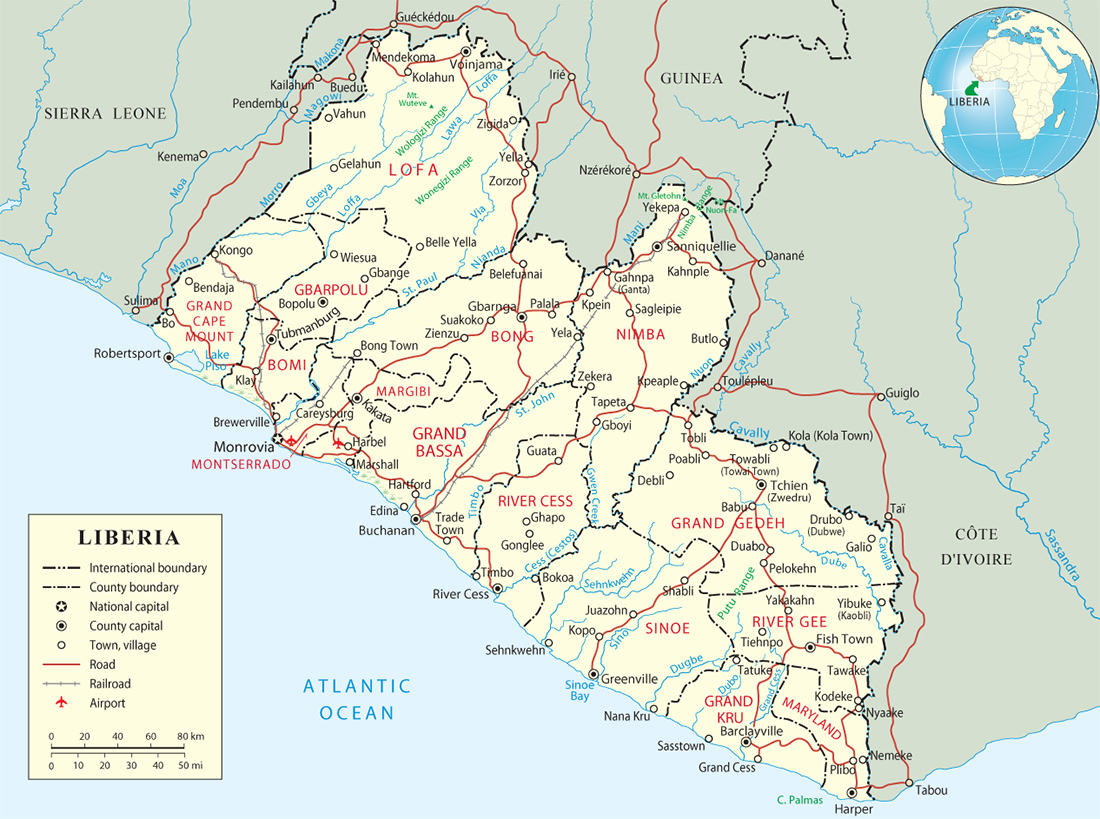
21 Facts About Liberia

map-liberia21 Facts About Liberia

(taken from the Monrovia newspaper with some added explanation)

  1. Liberia is the 4th poorest country in the world (United Nations ranking)
  2. Liberia is the 8th unhappiest and most miserable Country in the World (UNDP)
  3. Liberia is the 8th hungriest nation (Concern International)
  4. 230,000 Liberian children suffer from chronic malnutrition (UNICEF)
  5. Liberia ranks #1 among the 10 worst countries for business in Africa (Forbes magazine)
  6. Food insecurity effects 650,000 Liberians (World Food Program)
  7. 65 percent of Liberian children do not attend primary school (UNICEF)
  8. 76 percent of Liberians live on US$1.25 per day (United Nations)
  9. Teenage pregnancy accounts for 38 percent of all live births (United Nations)
  10. Youth unemployment is as high as 85 percent (United Nations)
  11. Monrovia is the worst capital city in the world with a City Prosperity Initiative (CPI) ranking of 0.313. (For comparison, Oslo is #1 at 86.76, New York is #23 at 74.43, Manila is #44 at 55.81 and Nairobi is #49 at 47.77 per UN Habitat data)
  12. Only 25 percent of Liberians have access to safe drinking water (WaterAid International)
  13. Over 80 percent of Liberians lack access to a decent toilet (WaterAid International)
  14. Out of a population of 4 million, 3.7 million Liberians lack access to adequate sanitation. (WaterAid International)
  15. Over 500 children die every year from diarrhea in Liberia (WaterAid International)
  16. Liberia has just 298 doctors for 4.6 million people. The doctor-patient ratio is 1:15,436 (Ministry of Health) [For comparison, Switzerland has 3.6 per 1,000, the United States has 2.3 per 1,000, Kenya has 0.14 per 1,000 and Liberia 0.03 per 1,000]
  17. Liberia imports over US$200 million worth of rice even though it has 4.6 million hectare of arable land (Food and Agriculture Organization of the UN)
  18. The infant mortality rate in Liberia is 52.2 deaths to every 1,000 live births (CIA World Factbook) [For comparison, the United States is 6.86 per 1,000 and Japan is 2.0 per 1,000]
  19. The maternal mortality rate in Liberia is 725deaths to every 100,000 live births (CIA World Factbook) [For comparison, while Sierra Leone is #1 at 1,360, the United States is #138 at 14, and Greece is #184 at just 3]
  20. Out of 111 countries, Liberia ranks 101on the Global Hunger Index (United Nations)
  21. Out of 188 countries, Liberia ranks 177 on the Human Development Index (United Nations)