
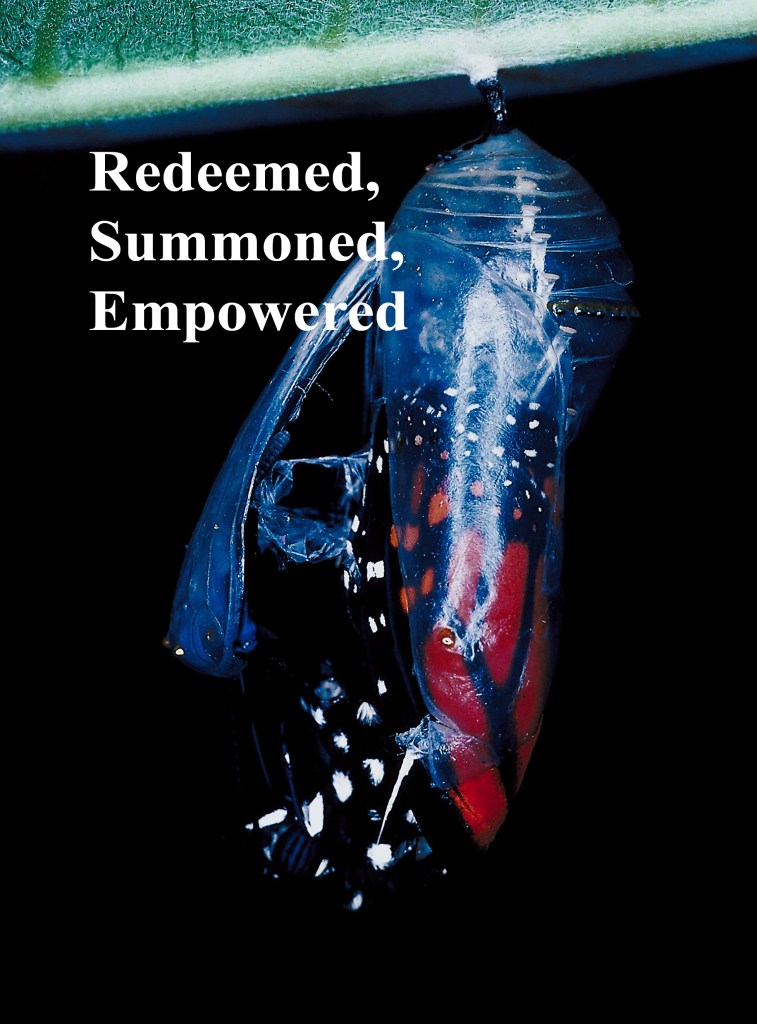
Redeemed, Summoned, Empowered

Redeemed, Summoned, Empowered

January 12, 2025*

By Pastor John Partridge

Isaiah 43:1-7 Luke 3:15-17, 21-22              Acts 8:14-17

In 1775, Robert Morris was elected to the Pennsylvania state assembly and served in that capacity alongside Benjamin Franklin. He then served as a member of the Committee of Safety, which was responsible for arming the state militia, building forts, and purchasing ammunition. In November of 1775, Morris was elected by the Pennsylvania legislature to be a delegate to the Continental Congress where he, once again, served on the Secret Committee which was responsible for arming the new Continental Army. Morris resigned that position in 1789 but then was appointed and served as the superintendent of finance for the Continental Congress from 1781 to 1784 and was thus in control of the finances of the American colonies as well as being responsible for funding George Washinton’s army. Morris’ activities in this capacity created what we now think of as the Department of the Treasury.

It was Morris who established a national bank, which was then chartered by the Continental Congress and began printing a single currency for the American colonies rather than thirteen different state currencies. As such, Morris was also the first to call for the creation of a national mint. But in 1792, Morris began speculating on the development of land, in which he would borrow money and buy millions of acres of land, in hopes of then selling the land for a profit as the new American nation grew westward. Unfortunately, his speculation was unsuccessful, he was convicted for his debts and thrown into debtor’s prison where George Washington and other wealthy and powerful friends often visited him.

Many of you are unfamiliar with the concept of debtor’s prison because such a thing no longer exists in our nation. Laws about bankruptcy were passed in 1800 that did away with debtor’s prison, and it is suspected that it was because of the many influential people who were friends with Robert Morris. In any case, the idea of debtor’s prison was that persons who were unable to pay their debts would be put into prison where the money they earned from their labor would be used to repay the debts that they had incurred. For a variety of reasons, the entire concept of debtor’s prison never really accomplished its purpose and instead created other problems.

In any case, with all that in mind, I want you to imagine for a moment that something like debtor’s prison still existed in the modern day. Next, imagine that you made a bad business deal and suddenly owe tens of millions of dollars to your partners for your mistake. Being unable to make payments on the debt that has been assigned to you, you are convicted and sentenced to debtor’s prison.  In prison, you work every day to make license plates for twelve dollars per hour and your income seized to make pitifully small incremental payments towards the millions that you owe. You have no hope of ever being released from prison in your lifetime. But one day, you are summoned to the prison warden’s office and informed that a wealthy billionaire has paid your entire debt, redeemed you from prison, and you are now free to go. The person that paid your debt has given you something that you had no hope of ever paying for yourself. And that is the story that we hear in today’s scriptures as we begin reading in Isaiah 43:1-7 where it says:

43:1 But now, this is what the Lord says—
    he who created you, Jacob,
    he who formed you, Israel:
“Do not fear, for I have redeemed you;
    I have summoned you by name; you are mine.
When you pass through the waters,
    I will be with you;
and when you pass through the rivers,
    they will not sweep over you.
When you walk through the fire,
    you will not be burned;
    the flames will not set you ablaze.
For I am the Lord your God,
    the Holy One of Israel, your Savior;
I give Egypt for your ransom,
    Cush and Seba in your stead.
Since you are precious and honored in my sight,
    and because I love you,
I will give people in exchange for you,
    nations in exchange for your life.
Do not be afraid, for I am with you;
    I will bring your children from the east
    and gather you from the west.
I will say to the north, ‘Give them up!’
    and to the south, ‘Do not hold them back.’
Bring my sons from afar
    and my daughters from the ends of the earth—
everyone who is called by my name,
    whom I created for my glory,
    whom I formed and made.”

Through the prophet Isaiah, God tells his people that he has redeemed them from their conviction for sin, summon us by name, and claimed us as his own. But God doesn’t stop there. Not only has God redeemed us, but he also promises to walk with us when we pass through challenging times and trials and will protect us from being swept away by our problems. God declares that we need not ever be afraid because he will always stand by us, and with us. But in the time of Isaiah, God’s people still knew that all these promises had not yet been fulfilled. They knew that God had not yet gathered his people together and returned all those who had been carried off into captivity or had fled Israel in times of war and persecution. And for that reason, God’s people still looked forward to the coming of the Messiah, and that is exactly what we hear in the story of Jesus’ baptism in Luke 3:15-17, 21-22:

15 The people were waiting expectantly and were all wondering in their hearts if John might possibly be the Messiah. 16 John answered them all, “I baptize you withwater. But one who is more powerful than I will come, the straps of whose sandals I am not worthy to untie. He will baptize you withthe Holy Spirit and fire. 17 His winnowing fork is in his hand to clear his threshing floor and to gather the wheat into his barn, but he will burn up the chaff with unquenchable fire.”

21 When all the people were being baptized, Jesus was baptized too. And as he was praying, heaven was opened 22and the Holy Spirit descended on him in bodily form like a dove. And a voice came from heaven: “You are my Son, whom I love; with you I am well pleased.”

It is important to remember that, in the time of Jesus, the emotions of the Jewish people were quite similar to what they were in Isaiah’s time. Although Israel was not facing destruction at the hands of the Babylonian army, it had already been conquered by a new Roman superpower. Rather than being slaughtered and taken into captivity as it had eight centuries earlier, at this time, Israel had been subjugated, occupied, and paid exorbitant taxes to Rome and to their occupying government. And so, Luke tells us that when they went out into the wilderness to hear John preach, they waited expectantly, hoping beyond hope that they would find God’s promised messiah and wondering if John might be him. The good news that they hear is that while John is not the messiah, he is there to introduce him. And moments later we see all three persons of the trinity in two sentences. As Jesus was praying, the Holy Spirit descended upon him like a dove, and the voice of the father came from heaven.  

We have all heard that story before. But God’s promise that we heard from Isaiah was not just a promise of the Messiah, but a promise that God would go with us, that we would belong to him, and that he would one day gather his people together. And so, while the coming of the messiah is a key part of that, it is not all that there is. In Luke we saw that the Holy Spirit came down from heaven like a dove at Jesus’ baptism, but Luke also tells us that the gift of the spirit wasn’t just a gift that God gave to Jesus. In Acts 8:14-17, Luke says:

14 When the apostles in Jerusalem heard that Samaria had accepted the word of God, they sent Peter and John to Samaria. 15 When they arrived, they prayed for the new believers there that they might receive the Holy Spirit, 16because the Holy Spirit had not yet come on any of them; they had simply been baptized in the name of the Lord Jesus. 17 Then Peter and John placed their hands on them, and they received the Holy Spirit.

I want to think about this and break it down because this is important for a couple of reasons. First, Luke tells us that the apostles in Jerusalem heard that the people of Samaria had heard the gospel message and accepted the word of God and so they sent Peter and John to Samaria. There are two important things that we can take away from this. One of these is that we should remember the Samaritan woman at the well that had a conversation with Jesus. After their conversation, she ran into town telling everyone that she had met a man that had told her everything that she had ever done, and she brought everyone out to the well to meet Jesus and to hear him teach. That seed, planted by Jesus and that first Samaritan missionary woman, had now grown, and the people of Samaria had heard the gospel and had chosen to follow Jesus. The other important thing that we should note, is that while the disciples had been not at all happy that Jesus was talking to a Samaritan woman, and that Jesus would defile himself by spending time in a Samaritan village, they had now set aside their ingrained prejudice and racism and now accepted the Samaritan believers as brothers and sisters in Jesus Christ.

The second reason that this is important, is that we see that the gift of God’s spirit was not exclusive to Jesus at the time of his baptism. The new believers in Samaria had been baptized in the name of Jesus and now, when Peter and John prayed for them, they also received the Holy Spirit. This is further evidence, beyond the story of Pentecost, that the gift of the spirit is given to every believer in Jesus Christ.

And that brings us back to where we began. Although debtor’s prisons are a thing of the past, we, like Robert Morris, owe a debt that is far beyond what we can ever pay. Our sins against God and man are a debt that we could never afford to pay and our eventual conviction for those debts was certain. But as we heard in Isaiah, God has summoned us, redeemed us, through his son, God has forgiven our debt, and through his spirit, God has filled us and empowered us with his strength and power so that we can be his agents and ambassadors is this world, and do the work that he has called us to do. We have been called, redeemed, and empowered to be Jesus to the people around us, and to share the good news with everyone who needs to hear it. We are never alone, and we need never rely upon our own strength, because God goes with us everywhere we go, and is with us through everything we experience.

May we, filled with God’s spirit and power, go out from this place, and do the work that we have been redeemed, summoned, and empowered to do.


Please LIKE and SHARE!

Click here to subscribe to Pastor John’s blog.

Click here if you would like to subscribe to Pastor John’s weekly messages.

Click here to visit Pastor John’s YouTube channel.


*You have been reading a message presented at Christ United Methodist Church on the date noted at the top of the first page.  Rev. John Partridge is the pastor at Christ UMC in Alliance, Ohio.  Duplication of this message is a part of our Media ministry, if you have received a blessing in this way, we would love to hear from you.  Letters and donations in support of the Media ministry or any of our other projects may be sent to Christ United Methodist Church, 470 East Broadway Street, Alliance, Ohio 44601.  These messages are available to any interested persons regardless of membership.  You may subscribe to these messages, in print or electronic formats, by writing to the address noted, or by contacting us at secretary@CUMCAlliance.org.  These messages can also be found online at https://pastorpartridge.com .  All Scripture quotations, unless otherwise indicated, are taken from the Holy Bible, New International Version®, NIV®. Copyright ©1973, 1978, 1984, 2011 by Biblica, Inc.™ Used by permission of Zondervan. All rights reserved worldwide. www.zondervan.comThe “NIV” and “New International Version” are trademarks registered in the United States Patent and Trademark Office by Biblica, Inc.™

Ultimate Water Rescue

Ultimate Water Rescue

February 18, 2024U

By Pastor John Partridge

Genesis 9:8-17           Mark 1:9-15               1 Peter 3:18-22

As human beings, our brains are funny things. We have perceptions and we make connections, and our memories are made in such a way that they are connected to our senses. It is said that if you study while listening to music, and you can replay that same music when you take a test, your recall is better than if you take the test without music. Likewise, certain smells trigger memories because those memories were made when we had that smell in our nostrils. The smell of a certain combination of bacon and eggs cooking in a cast iron pan will always transport me to my grandmother’s kitchen in Pennsylvania and the smell of chocolate fudge makes me think of my dad at Christmas.

I say all these things to ask this question: Where does your brain take you when you think about the ocean, or about water?  If you often spent summers at the beach, then you might think of the boardwalk or snow cones, or coney dogs, or tanning on your family’s big beach blanket. If you grew up sailing as some of my cousins did, or as Patti once did on Lake Huron, then you may think of boats, and coming about, and heeling hard over in a fair wind. But those memories may not be good ones if the ocean that you remember raged and tried its best to kill you. There’s an old saying that the sea must always be respected, or that one should never turn their back on the sea because the sea is a harsh mistress. The ocean can be beautiful one moment and trying to kill you in the next.

And this is how the memories of Israel, and the people of God were with their memories of water. There were many experiences with water in their national memory, and as a result, we still tell stories about water. And that’s why the writers of the New Testament use those memories to shape a new, institutional memory about how, and what, we should remember when we think of water. We begin in the book of Genesis at the end of the story of Noah and his ark. The water of the great flood had been deadly and Noah and his family, through the grace and the guidance of God, had barely escaped with their lives. In Genesis 9:8-17, we hear this: 

Then God said to Noah and to his sons with him: “I now establish my covenant with you and with your descendants after you 10 and with every living creature that was with you—the birds, the livestock and all the wild animals, all those that came out of the ark with you—every living creature on earth. 11 I establish my covenant with you: Never again will all life be destroyed by the waters of a flood; never again will there be a flood to destroy the earth.”

12 And God said, “This is the sign of the covenant I am making between me and you and every living creature with you, a covenant for all generations to come: 13 I have set my rainbow in the clouds, and it will be the sign of the covenant between me and the earth. 14 Whenever I bring clouds over the earth and the rainbow appears in the clouds, 15 I will remember my covenant between me and you and all living creatures of every kind. Never again will the waters become a flood to destroy all life. 16 Whenever the rainbow appears in the clouds, I will see it and remember the everlasting covenant between God and all living creatures of every kind on the earth.”

17 So God said to Noah, “This is the sign of the covenant I have established between me and all life on the earth.”

We all know the story. Humanity becomes so evil that God sees it as being unfixable, except for Noah and his family, and God brings a flood that covers the entire known world, and afterwards God promises Noah and his descendants that he will never again destroy all life with water. And so, in that way, water was, to the nation of Israel, both a memory of destruction but also a memory that God had provided care and rescue for his servants that had remained faithful. The next memory that we share this morning is from Mark 1:9-15, when Jesus was baptized in the Jordan River by John, and we hear this:

At that time Jesus came from Nazareth in Galilee and was baptized by John in the Jordan. 10 Just as Jesus was coming up out of the water, he saw heaven being torn open and the Spirit descending on him like a dove. 11 And a voice came from heaven: “You are my Son, whom I love; with you I am well pleased.”

12 At once the Spirit sent him out into the wilderness, 13 and he was in the wilderness forty days, being tempted by Satan. He was with the wild animals, and angels attended him.

14 After John was put in prison, Jesus went into Galilee, proclaiming the good news of God. 15 “The time has come,” he said. “The kingdom of God has come near. Repent and believe the good news!”

And so, for the followers of Jesus Christ, our memory of water is again a memory of rescue, the inauguration of the ministry of Jesus, a call for repentance, and the proclamation of the good news that the Kingdom of God had come to earth.

But so, what? What does that mean? How should we think about that? What should we do with those memories in our modern culture?

But of course, we are not the first people to ask those questions. As Peter wrote to the Gentile Christians in Asia minor in 1 Peter 3:18-22, he offers this interpretation of what we should do with these national and institutional memories, saying…       

18 For Christ also suffered once for sins, the righteous for the unrighteous, to bring you to God. He was put to death in the body but made alive in the Spirit. 19 After being made alive, he went and made proclamation to the imprisoned spirits— 20 to those who were disobedient long ago when God waited patiently in the days of Noah while the ark was being built. In it only a few people, eight in all, were saved through water, 21 and this water symbolizes baptism that now saves you also—not the removal of dirt from the body but the pledge of a clear conscience toward God. It saves you by the resurrection of Jesus Christ, 22 who has gone into heaven and is at God’s right hand—with angels, authorities, and powers in submission to him.

As a church, and as a people, what we should remember when we think about water, is that water has been, throughout scripture, in both the Old and the New Testaments, the vehicle that God used to bring about rescue. Noah was rescued through water. Moses and the people of Israel were rescued from the armies of Egypt by the parting of the Red Sea. Forty years later, Joshua led Israel into the Promised Land by crossing the Jordan River that was at flood stage during the Spring rains, but crosses on dry ground after the water “piled up” upstream. And, in the ultimate water rescue, Jesus marks the beginning of his ministry, calls for repentance, and proclaims the good news that the Kingdom of God had come to earth, after his baptism in the Jordan River.

As Peter said, we are to remember that water saves us, not by removing dirt from us, but by reminding us that we have a clear conscience before God because of the life, death, and resurrection of Jesus Christ, and because of our acceptance of that gift. Water saves us because it reminds us of our ultimate water rescue, the redemption and rescue that came to us in the person of Jesus Christ.

It’s exactly the kind of good news that hurting and struggling people in our world need right now.

The people around us really need to hear some good news.

How can we not share what we have?


Please LIKE and SHARE!

Click here to subscribe to Pastor John’s blog.

Click here if you would like to subscribe to Pastor John’s weekly messages.

Click here to visit Pastor John’s YouTube channel.


*You have been reading a message presented at Christ United Methodist Church on the date noted at the top of the first page.  Rev. John Partridge is the pastor at Christ UMC in Alliance, Ohio.  Duplication of this message is a part of our Media ministry, if you have received a blessing in this way, we would love to hear from you.  Letters and donations in support of the Media ministry or any of our other projects may be sent to Christ United Methodist Church, 470 East Broadway Street, Alliance, Ohio 44601.  These messages are available to any interested persons regardless of membership.  You may subscribe to these messages, in print or electronic formats, by writing to the address noted, or by contacting us at secretary@CUMCAlliance.org.  These messages can also be found online at https://pastorpartridge.com .  All Scripture quotations, unless otherwise indicated, are taken from the Holy Bible, New International Version®, NIV®. Copyright ©1973, 1978, 1984, 2011 by Biblica, Inc.™ Used by permission of Zondervan. All rights reserved worldwide. www.zondervan.comThe “NIV” and “New International Version” are trademarks registered in the United States Patent and Trademark Office by Biblica, Inc.™

Photo by jcsoup on Freeimages.com

Enemies No Longer

Click here to watch the video: https://youtu.be/wl1n0l9PKiw

Click here to watch the entire worship service: https://youtu.be/wdqWMNn7q8Q


Enemies No Longer

March 12, 2023*

(3rd Sunday of Lent)

By Pastor John Partridge

Exodus 17:1-7                        John 4:5-42                Romans 5:1-11

World War 1 began in June of 1914, but the United States didn’t issue a declaration of war until the spring of 1917.  Regardless of the argument that the results would have been the same without our participation, the first war to end all wars ended on November 11, 1918.  Similarly, World War 2 began in 1939, the United States issued declarations of war on Germany and on Japan in December of 1941, just days after the attack on Pearl Harbor.  And so, the second war to end all wars finally ended in 1945.  Peace was even more elusive this time as the United States and many of its allies, once again fought in the Korean conflict from 1950 to 1953. 

I suppose that this shouldn’t surprise us.  If we look at almost any time in history, we can almost be certain to find that warfare is common.  Over the last two semesters we have been diving deep into the history of Israel in the Old and New Testaments and, much like ours, a common thread running throughout Israel’s history is that of conquest, warfare, and shifting allegiances.  For me, the thing that stands out in our recent history is how quickly we resolved and reconciled our differences with our enemies.  Despite fighting two wars within the span a half a century, Germany is now one of our closest allies.  And much the same can be said about our relationship with Japan.  Korea is a little different but while North Korea remains an internationally isolated state, South Korea, which was once practically unknown, is now a close ally and, though we still have our political differences, China has become our biggest trading partner.

What does that have to do with us, our church, and the season of Lent?  Quite a lot.  But before we get to that part, let’s begin with the story of Exodus and the moment when the people were far enough away from Egypt to feel safe from its armies, forget their suffering, and start complaining about Moses and their current problems.  We read this in Exodus 17:1-7.

17:1 The whole Israelite community set out from the Desert of Sin, traveling from place to place as the Lord commanded. They camped at Rephidim, but there was no water for the people to drink. So they quarreled with Moses and said, “Give us water to drink.”

Moses replied, “Why do you quarrel with me? Why do you put the Lord to the test?”

But the people were thirsty for water there, and they grumbled against Moses. They said, “Why did you bring us up out of Egypt to make us and our children and livestock die of thirst?”

Then Moses cried out to the Lord, “What am I to do with these people? They are almost ready to stone me.”

The Lord answered Moses, “Go out in front of the people. Take with you some of the elders of Israel and take in your hand the staff with which you struck the Nile and go. I will stand there before you by the rock at Horeb. Strike the rock, and water will come out of it for the people to drink.” So, Moses did this in the sight of the elders of Israel. And he called the place Massah(which means testing) and Meribah  (which means quarreling) 9because the Israelites quarreled and because they tested the Lord saying, “Is the Lord among us or not?”

As the people of Israel follow Moses away from Egypt and toward the promised land, they pass through that dangerous time when they find themselves far enough away from slavery to feel safe, but not close enough to the Promised Land to feel the comfort of their new home.  They were far enough from their problems that they no longer needed to rely upon God and instead began to fight amongst one another, complain, and grumble against Moses because he wasn’t meeting their needs fast enough.  They were suspended between fear and comfort, and between slavery and freedom, and they asked themselves if God was with them, saying “Is the Lord among us or not?”

Is the Lord among us or not?

It is a question that we can easily find ourselves asking as individuals, or as a church, whenever we find ourselves far enough from our problems and our fears to feel comfortable, but not yet arrived at the destination for which we had hoped.

Hold on to that tension as we move on to the story of when Jesus met the Samaritan woman and brought an entire village to faith in God in John 4:5-42.

So he came to a town in Samaria called Sychar, near the plot of ground Jacob had given to his son Joseph. Jacob’s well was there, and Jesus, tired as he was from the journey, sat down by the well. It was about noon.

When a Samaritan woman came to draw water, Jesus said to her, “Will you give me a drink?” (His disciples had gone into the town to buy food.)

The Samaritan woman said to him, “You are a Jew, and I am a Samaritan woman. How can you ask me for a drink?” (For Jews do not associate with Samaritans.)

10 Jesus answered her, “If you knew the gift of God and who it is that asks you for a drink, you would have asked him, and he would have given you living water.”

11 “Sir,” the woman said, “you have nothing to draw with and the well is deep. Where can you get this living water? 12 Are you greater than our father Jacob, who gave us the well and drank from it himself, as did also his sons and his livestock?”

13 Jesus answered, “Everyone who drinks this water will be thirsty again, 14 but whoever drinks the water I give them will never thirst. Indeed, the water I give them will become in them a spring of water welling up to eternal life.”

15 The woman said to him, “Sir, give me this water so that I won’t get thirsty and have to keep coming here to draw water.”

16 He told her, “Go, call your husband and come back.”

17 “I have no husband,” she replied.

Jesus said to her, “You are right when you say you have no husband. 18 The fact is, you have had five husbands, and the man you now have is not your husband. What you have just said is quite true.”

19 “Sir,” the woman said, “I can see that you are a prophet. 20 Our ancestors worshiped on this mountain, but you Jews claim that the place where we must worship is in Jerusalem.”

21 “Woman,” Jesus replied, “believe me, a time is coming when you will worship the Father neither on this mountain nor in Jerusalem. 22 You Samaritans worship what you do not know; we worship what we do know, for salvation is from the Jews. 23 Yet a time is coming and has now come when the true worshipers will worship the Father in the Spirit and in truth, for they are the kind of worshipers the Father seeks. 24 God is spirit, and his worshipers must worship in the Spirit and in truth.”

25 The woman said, “I know that Messiah” (called Christ) “is coming. When he comes, he will explain everything to us.”

26 Then Jesus declared, “I, the one speaking to you—I am he.”

27 Just then his disciples returned and were surprised to find him talking with a woman. But no one asked, “What do you want?” or “Why are you talking with her?”

28 Then, leaving her water jar, the woman went back to the town and said to the people, 29 “Come, see a man who told me everything I ever did. Could this be the Messiah?” 30 They came out of the town and made their way toward him.

31 Meanwhile his disciples urged him, “Rabbi, eat something.”

32 But he said to them, “I have food to eat that you know nothing about.”

33 Then his disciples said to each other, “Could someone have brought him food?”

34 “My food,” said Jesus, “is to do the will of him who sent me and to finish his work. 35 Don’t you have a saying, ‘It’s still four months until harvest’? I tell you, open your eyes and look at the fields! They are ripe for harvest. 36 Even now the one who reaps draws a wage and harvests a crop for eternal life, so that the sower and the reaper may be glad together. 37 Thus the saying ‘One sows, and another reaps’ is true. 38 I sent you to reap what you have not worked for. Others have done the hard work, and you have reaped the benefits of their labor.”

39 Many of the Samaritans from that town believed in him because of the woman’s testimony, “He told me everything I ever did.” 40 So when the Samaritans came to him, they urged him to stay with them, and he stayed two days. 41 And because of his words many more became believers.

42 They said to the woman, “We no longer believe just because of what you said; now we have heard for ourselves, and we know that this man really is the Savior of the world.”

Despite generations of hatred between Jews and Samaritans, Jesus breaks the rules to talk to one, and then to an entire town, and even, again in violation of societal and priestly rules, stays with the Samaritans for two days to teach and to preach the Good News.  And, if we take a look at what Jesus said to his own disciples, “…open your eyes and look at the fields! They are ripe for harvest.”  Essentially, Jesus says, “Pay attention! The harvest is right in front of you.”  And then the Samaritans, the enemies of the Jews, hear the Good News, and are welcomed into the kingdom of God.

But God’s relationship with the Samaritans is not the only relationship that Jesus redeemed and reconciled.  In Romans 5:1-11, Paul says…

5:1 Therefore, since we have been justified through faith, we have peace with God through our Lord Jesus Christ, through whom we have gained access by faith into this grace in which we now stand. And we boast in the hope of the glory of God. Not only so, but wealso glory in our sufferings, because we know that suffering produces perseverance; perseverance, character; and character, hope. And hope does not put us to shame, because God’s love has been poured out into our hearts through the Holy Spirit, who has been given to us.

You see, at just the right time, when we were still powerless, Christ died for the ungodly. Very rarely will anyone die for a righteous person, though for a good person someone might possibly dare to die. But God demonstrates his own love for us in this: While we were still sinners, Christ died for us.

Since we have now been justified by his blood, how much more shall we be saved from God’s wrath through him! 10 For if, while we were God’s enemies, we were reconciled to him through the death of his Son, how much more, having been reconciled, shall we be saved through his life! 11 Not only is this so, but we also boast in God through our Lord Jesus Christ, through whom we have now received reconciliation.

We are immediately reminded of last week’s message “What Faith Isn’t,” and we remember that, like Abraham, whether we are Jews, Samaritans, or Gentiles, it is our faith that brings about our adoption as the children of God.  The way that Paul describes it, Jesus died for us while we were still living in sin, and while we were still the enemies of God.  But, because of Jesus’ death and resurrection, our relationship with God has been redeemed and reconciled so that we can be welcomed into God’s family.

We worry, grumble, and complain because, like the Israelites in the desert, we find ourselves far enough from our problems and our fears to feel comfortable, but have not yet arrived at the destination for which we had hoped.  But just as the Samaritans next door were not the enemies of Jesus, the people outside the doors of the church are not our enemies and neither are the Germans, Koreans, Chinese, Iranians, Iraqis, Mexicans, Russians, rich, poor, vaxxed, anti-vaxxers, Republicans, Democrats, or anybody else.

Much like Jesus reminded his disciples in Samaria, we too are reminded that the harvest is right in front of us. 

We must love our twenty-first century Samaritans.  There is no one who is beyond God’s grace.  There is no one who cannot be redeemed, reconciled, and welcomed into God’s family.  And so, no matter who it is toward which we aim our hatred, no matter who our modern day Samaritans may be, Jesus, and the Good News of the gospel is still bigger than our hatred.  Our mission, like the disciples, is to get past our hatred and our biases, and invite our enemies into the family.

To paraphrase Jesus, “Open your eyes! The harvest is right in front of you.”


Please LIKE and SHARE!

Click here to subscribe to Pastor John’s blog.

Click here if you would like to subscribe to Pastor John’s weekly messages.

Click here to visit Pastor John’s YouTube channel.


*You have been reading a message presented at Christ United Methodist Church on the date noted at the top of the first page.  Rev. John Partridge is the pastor at Christ UMC in Alliance, Ohio.  Duplication of this message is a part of our Media ministry, if you have received a blessing in this way, we would love to hear from you.  Letters and donations in support of the Media ministry or any of our other projects may be sent to Christ United Methodist Church, 470 East Broadway Street, Alliance, Ohio 44601.  These messages are available to any interested persons regardless of membership.  You may subscribe to these messages, in print or electronic formats, by writing to the address noted, or by contacting us at secretary@CUMCAlliance.org.  These messages can also be found online at https://pastorpartridge.com .  All Scripture quotations, unless otherwise indicated, are taken from the Holy Bible, New International Version®, NIV®. Copyright ©1973, 1978, 1984, 2011 by Biblica, Inc.™ Used by permission of Zondervan. All rights reserved worldwide. www.zondervan.comThe “NIV” and “New International Version” are trademarks registered in the United States Patent and Trademark Office by Biblica, Inc.™

Power in Distress

Click here to watch the livestream of this worship service: https://youtu.be/l-G8XgQToQw

(Note: Due to technical issues, no podcast is available for this service)


Power in Distress

January 01, 2023*

(New Year’s Day)

By Pastor John Partridge

Isaiah 63:7-9              Matthew 2:13-23                   Hebrews 2:10-18

When the magi arrive in Jerusalem, Matthew includes a curious phrase in his description of King Herod’s reaction.  Matthew says, “After Jesus was born in Bethlehem in Judea, during the time of King Herod, Magifrom the east came to Jerusalem and asked, “Where is the one who has been born king of the Jews? We saw his star when it rose and have come to worship him.”

When King Herod heard this he was disturbed, and all Jerusalem with him.” (Matthew 2:1-3)

Herod was disturbed… and all of Jerusalem was disturbed with him.

Obviously, there are many reasons why King Herod would have been disturbed, but why would the entire city be disturbed with him?  Historically and biblically, we know that Herod was incredibly paranoid about maintaining his grip on power.  He had at least one of his parents and some of his children killed because he felt threatened by them.  He was not a nice man.  And so, it isn’t surprising that he was disturbed by the arrival of the magi and their question about a new king being born.  There are several theories that have been forwarded about why the entire city would have been disturbed with him, and the simplest of these is that when the king wasn’t happy, everyone worried because… he was not a nice man.  There are other theories, and I have a favorite, but that will have to wait for another day.

And that leads us to our Old Testament reading in which we find that God, in addition to being good, kind, and compassionate, also feels distress when his people are distressed.  We begin this morning reading from Isaiah 63:7-9 where we hear this:

I will tell of the kindnesses of the Lord,
    the deeds for which he is to be praised,
    according to all the Lord has done for us—
yes, the many good things
    he has done for Israel,
    according to his compassion and many kindnesses.
He said, “Surely they are my people,
    children who will be true to me”;
    and so he became their Savior.
In all their distress he too was distressed,
    and the angel of his presence saved them.
In his love and mercy, he redeemed them;
    he lifted them up and carried them
    all the days of old.

God’s reaction to his feeling of distress, was to bring healing to those who were distressed. God chooses to bring rescue and redemption to all of humanity so that he could relieve our distress.  This is unlike how King Herod reacts to distress in Matthew 2:13-23 where we read this:

13 When they had gone, an angel of the Lord appeared to Joseph in a dream. “Get up,” he said, “take the child and his mother and escape to Egypt. Stay there until I tell you, for Herod is going to search for the child to kill him.”

14 So he got up, took the child and his mother during the night, and left for Egypt, 15 where he stayed until the death of Herod. And so was fulfilled what the Lord had said through the prophet: “Out of Egypt I called my son.”

16 When Herod realized that he had been outwitted by the Magi, he was furious, and he gave orders to kill all the boys in Bethlehem and its vicinity who were two years old and under, in accordance with the time he had learned from the Magi. 17 Then what was said through the prophet Jeremiah was fulfilled:

18 “A voice is heard in Ramah,
    weeping and great mourning,
Rachel weeping for her children
    and refusing to be comforted,
    because they are no more.”

19 After Herod died, an angel of the Lord appeared in a dream to Joseph in Egypt 20 and said, “Get up, take the child and his mother and go to the land of Israel, for those who were trying to take the child’s life are dead.”

21 So he got up, took the child and his mother, and went to the land of Israel. 22 But when he heard that Archelaus was reigning in Judea in place of his father Herod, he was afraid to go there. Having been warned in a dream, he withdrew to the district of Galilee, 23 and he went and lived in a town called Nazareth. So was fulfilled what was said through the prophets, that he would be called a Nazarene.

When God feels our distress, he feels distress as well, and chose to send a rescuer to relieve us.  But when Herod feels distress, his solution is to kill as many people as necessary to comfort himself that he has removed the source of his distress.  Throughout the story, God’s focus is on rescuing Mary and Joseph, rescuing Jesus, his appointed rescuer, and through him rescuing all of us.  The focus of God is on us, while the focus of Herod is only on himself.

We see that same focus in Hebrews 2:10-18 as God, through the rescue and restoration available through Jesus Christ, removes yet another source of fear and distress for his people, and for all who would come to him.

10 In bringing many sons and daughters to glory, it was fitting that God, for whom and through whom everything exists, should make the pioneer of their salvation perfect through what he suffered. 11 Both the one who makes people holy and those who are made holy are of the same family. So, Jesus is not ashamed to call them brothers and sisters. 12 He says,

“I will declare your name to my brothers and sisters; in the assembly I will sing your praises.”

13 And again,

“I will put my trust in him.”

And again, he says,

“Here am I, and the children God has given me.”

14 Since the children have flesh and blood, he too shared in their humanity so that by his death he might break the power of him who holds the power of death—that is, the devil— 15 and free those who all their lives were held in slavery by their fear of death. 16 For surely it is not angels he helps, but Abraham’s descendants. 17 For this reason he had to be made like them, fully human in every way, in order that he might become a merciful and faithful high priest in service to God, and that he might make atonement for the sins of the people. 18 Because he himself suffered when he was tempted, he is able to help those who are being tempted.

God perfected Jesus Christ through the suffering that he endured on earth, but because of his perfection, God created a path for his people to be purified, perfected, and made holy.  And through that holiness, we can become the brothers and sisters of Jesus, the children of a holy and perfect God.  Once again, if God was anything at all like King Herod, he could have easily eliminated his distress by eliminating us.  But instead of doing that, God chose to set us free from our anxiety and fear of the future by eliminating the power of death itself.

The writer of Hebrews reminds us that to accomplish that, God had to become like us.  Not a little bit like us, but exactly like us, fully human, so that he could make atonement for the sins of his people.  Jesus had to become like us, suffer like us, be tempted like us, fear like us, dream like us, feel loss like us, mourn and cry like us, worry like us, feel pain like us, bleed like us, die like us, and in every other way… know what it is to be human.  And because he has done those things, he knows what it is like to be us and he is able to offer us help, rescue, and restoration as no one else can.

When King Herod was in distress, he killed people until his worries went away.

But when God felt the distress of humanity, he suffered death himself so that he could rescue us and remove our distress.

And that is why, like Isaiah, we should be and say, I will tell of the kindnesses of the Lord, the deeds for which he is to be praised, according to all the Lord has done for us – yes, the many good things he has done for …”

…Us.


Did you enjoy this?

Please LIKE and SHARE!

Click here to subscribe to Pastor John’s blog.

Click here if you would like to subscribe to Pastor John’s weekly messages.

Click here to visit Pastor John’s YouTube channel.


*You have been reading a message presented at Christ United Methodist Church on the date noted at the top of the first page.  Rev. John Partridge is the pastor at Christ UMC in Alliance, Ohio.  Duplication of this message is a part of our Media ministry, if you have received a blessing in this way, we would love to hear from you.  Letters and donations in support of the Media ministry or any of our other projects may be sent to Christ United Methodist Church, 470 East Broadway Street, Alliance, Ohio 44601.  These messages are available to any interested persons regardless of membership.  You may subscribe to these messages, in print or electronic formats, by writing to the address noted, or by contacting us at secretary@CUMCAlliance.org.  These messages can also be found online at https://pastorpartridge.com .  All Scripture quotations, unless otherwise indicated, are taken from the Holy Bible, New International Version®, NIV®. Copyright ©1973, 1978, 1984, 2011 by Biblica, Inc.™ Used by permission of Zondervan. All rights reserved worldwide. www.zondervan.comThe “NIV” and “New International Version” are trademarks registered in the United States Patent and Trademark Office by Biblica, Inc.™

Life and Death Reversed

Click here to listen to the podcast

Click here to watch the livestream of this service: https://youtu.be/plQTN7ZhsS8


Life and Death Reversed

March 27, 2022*

By Pastor John Partridge

Joshua 5:9-12                         Luke 15:1-3, 11b-32              2 Corinthians 5:16-21

Some of you know may that we used to own a 1948 Farmall Cub tractor. I did not grow up in a home that worked on cars, motors, or machinery of any kind, and although my maternal grandfather was known to do be pretty handy, I didn’t learn any of those things from him. But with the arrival of that antique tractor, and a 1970’s era Cub Cadet, with not a lot of money, and a need to maintain our seven-acre mini-farm, I learned. I had all the manuals, I joined an online antique tractor forum, I asked lots of questions, and I learned. I got to the point where I split that tractor completely in half, replaced the clutch, and put it all back together.

There was still a lot that I didn’t, and don’t know, but I learned. And along the way, I gained an appreciation of the guys that could pull an abandoned piece of rusty iron out of a barn or a field, free a seized engine, sandblast the rust, replace, repair, renew, and eventually restore something that most people would see as a lost cause and transform it into a piece of art that looked like it just came off the showroom floor.

Now, on YouTube, I occasionally watch videos of people who rescue old tractors, bulldozers, and other things that have been left to rot away at the side of a road, out in the forest, field, desert, or other places. I love to watch shows like This Old House, and I’ve watched videos of a guy that bought an old missile silo and is transforming it into a home for his family. The transformation that happens as hopeless, discarded relics are restored so that they look and run as if they were new is nothing short of amazing.

And those are just machines and houses.

But what if we could do that for people?

What if lives could be rescued instead of tractors and houses?

And that’s the point of our message today as we begin in Joshua 5:9-12

Then the Lord said to Joshua, “Today I have rolled away the reproach of Egypt from you.” So, the place has been called Gilgal to this day. [Note: in Hebrew, Gilgal sounds like “roll”]

10 On the evening of the fourteenth day of the month, while camped at Gilgal on the plains of Jericho, the Israelites celebrated the Passover. 11 The day after the Passover, that very day, they ate some of the produce of the land: unleavened bread and roasted grain. 12 The manna stopped the day afterthey ate this food from the land; there was no longer any manna for the Israelites, but that year they ate the produce of Canaan.

For many of us, God’s word to Joshua hinges on the word “reproach.”  God says that he will roll away the reproach of Egypt for the people of Israel and, since “reproach” isn’t a word that we often use, many of us will read that and miss a good portion of the point. Reproach means criticism or disapproval. Egypt’s opinion of the Israelites was that they were “just slaves” and incapable of caring for themselves, that they needed overseers to guide them, direct them, and care for them even if their care was cruel, harsh, and unwanted. The Egyptians believed that the slaves who fled to freedom would surely wither away and die. But that wasn’t God’s plan. God brought the people to a place where they could plant and harvest crops and care for themselves. And on the day after Passover, the day after they started eating the food that they had harvested for themselves, God stopped providing food for them. God had finished his work of transforming them from slaves into a free people, and now he set them loose to care for themselves.

But in Luke 15:1-3, 11b-32, we read about an entirely different sort of transformation. In this story the transformation isn’t from slavery to freedom, but from ignorance to understanding.

15:1 Now the tax collectors and sinners were all gathering around to hear Jesus. But the Pharisees and the teachers of the law muttered, “This man welcomes sinners and eats with them.”

11 Jesus continued: “There was a man who had two sons. 12 The younger one said to his father, ‘Father, give me my share of the estate.’ So, he divided his property between them.

13 “Not long after that, the younger son got together all he had, set off for a distant country and there squandered his wealth in wild living. 14 After he had spent everything, there was a severe famine in that whole country, and he began to be in need. 15 So he went and hired himself out to a citizen of that country, who sent him to his fields to feed pigs. 16 He longed to fill his stomach with the pods that the pigs were eating, but no one gave him anything.

17 “When he came to his senses, he said, ‘How many of my father’s hired servants have food to spare, and here I am starving to death! 18 I will set out and go back to my father and say to him: Father, I have sinned against heaven and against you. 19 I am no longer worthy to be called your son; make me like one of your hired servants.’ 20 So he got up and went to his father.

“But while he was still a long way off, his father saw him and was filled with compassion for him; he ran to his son, threw his arms around him, and kissed him.

21 “The son said to him, ‘Father, I have sinned against heaven and against you. I am no longer worthy to be called your son.’

22 “But the father said to his servants, ‘Quick! Bring the best robe and put it on him. Put a ring on his finger and sandals on his feet. 23 Bring the fattened calf and kill it. Let’s have a feast and celebrate. 24 For this son of mine was dead and is alive again; he was lost and is found.’ So, they began to celebrate.

25 “Meanwhile, the older son was in the field. When he came near the house, he heard music and dancing. 26 So he called one of the servants and asked him what was going on. 27 ‘Your brother has come,’ he replied, ‘and your father has killed the fattened calf because he has him back safe and sound.’

28 “The older brother became angry and refused to go in. So, his father went out and pleaded with him. 29 But he answered his father, ‘Look! All these years I’ve been slaving for you and never disobeyed your orders. Yet you never gave me even a young goat so I could celebrate with my friends. 30 But when this son of yours who has squandered your property with prostitutes comes home, you kill the fattened calf for him!’

31 “‘My son,’ the father said, ‘you are always with me, and everything I have is yours. 32 But we had to celebrate and be glad, because this brother of yours was dead and is alive again; he was lost and is found.’”

The accusation against Jesus was that he was hanging out with, offering hospitality to, and even fraternizing with disreputable people who were enemy collaborators and outcasts. Sharing meals with people was seen as an act of intimacy that should only be enjoyed by your closest friends and it was shocking that Jesus would offer this level of inclusion and intimacy to people who were social pariahs.

And in reply to that sort of accusation, Jesus tells a story about a son who disrespected and dishonored his father, his family, and his community in every possible way. The son is so selfish and self-focused, that he says that he wished that his father was dead and wants to receive his inheritance now. This means that his father’s entire estate would be divided into thirds so that his older brother, as the firstborn, would receive two-thirds, and the younger one third.

But what he was demanding wasn’t just the money that he would, eventually, inherit, it represented his father’s security, his family honor, his retirement, and his assets that allowed him to care for his family, dependents, and employees. But not only did the son demand, and take, the money, he treated that money carelessly. He was shortsighted, thought of his present pleasure and comfort without any concern for the future. He did not plan and had no vision, and the price of his short-sightedness is that he ended up with nothing. No money, no home, no pride, and no purity. He ends up homeless, doing a job that no one else wanted, a Jew feeding religiously unclean pigs.

And in his misery, he realizes what he had given up and what he could have had if he had not been so selfish. He decides to beg for his father’s forgiveness and ask to hire him as a servant because he knew that what he had done was unforgivable. He understood that there was no hope of ever again finding acceptance as a family member, but even as a servant he would have food, clothing, and a place to live.

“And while he was still a long way off…” the father saw him. His father had been watching, waiting, and hoping that his son would one day return to him. There had been no word, no letters, no phone calls, no emails and for all that he knew, his son was dead. But, despite his hurt, disappointment, dishonor, and humiliation he still he watched the road and hoped that one day his son might return. And when he does, he casts aside propriety and does what no self-respecting eastern man would do, and he pulls up the hem of his robe like a little boy and he runs to put his arms around his son, he interrupts the prepared speech about being a servant, puts a ring on his finger, and welcomes him back into the family.  And, when the older son remains bitter, and complains, the father explains that relationships aren’t about money, but that there is joy in restoration and reconciliation.

And that is the same lesson that Paul teaches in 2 Corinthians 5:16-21 when he says:

16 So from now on we regard no one from a worldly point of view. Though we once regarded Christ in this way, we do so no longer. 17 Therefore, if anyone is in Christ, the new creation has come: The old has gone, the new is here! 18 All this is from God, who reconciled us to himself through Christ and gave us the ministry of reconciliation: 19 that God was reconciling the world to himself in Christ, not counting people’s sins against them. And he has committed to us the message of reconciliation. 20 We are therefore Christ’s ambassadors, as though God were making his appeal through us. We implore you on Christ’s behalf: Be reconciled to God. 21 God made him who had no sin to be sinfor us, so that in him we might become the righteousness of God.

Although he doesn’t mention it by name, Paul uses the imagery of Jesus’ parable of the lost son to explain how that story matters to the people of his church, and to us. Before we became his followers, we saw Jesus as someone who was a philosopher, preacher, and teacher. But as we chose to follow him, we are transformed. We are transformed in our opinions, attitudes, mind, body, and soul just as the lost son, in realizing what he had lost, suddenly gained more than he ever expected or imagined. When we became the followers of Jesus we became a new creation, death had been reversed, we were once dead, but are now alive. We are reconciled, renewed, restored, welcomed, included, and embraced into our new family as brothers and sister of Jesus Christ.

And that’s just the beginning because just as the lost son had to build a new life after his return to his family, our work begins when we come faith. Paul says that because we have been reconciled, we have all been given the message, mission, and ministry of reconciliation. We are sent into the world, as ambassadors of God’s kingdom, as if God were sharing his message through us. We cry out to the world to be reconciled to God, to realize what we lost because of our selfishness, to return to God, to his family, and be restored to life as a new creation.

You have to admit that restoring old pieces of unwanted, abandoned, and hopelessly rusted machines is an amazing process to watch. But rescuing and restoring unwanted, outcast, abandoned, and hopelessly lost people is way better.

God doesn’t send us to rescue the people around us because we’re good, or because we’re loyal.

God sends us to rescue the people around us because he once rescued us.


Did you enjoy this?

Please LIKE and SHARE!

Click here to subscribe to Pastor John’s blog.

Click here if you would like to subscribe to Pastor John’s weekly messages.

Click here to visit Pastor John’s YouTube channel.


*You have been reading a message presented at Christ United Methodist Church on the date noted at the top of the first page. Rev. John Partridge is the pastor at Christ UMC in Alliance, Ohio. Duplication of this message is a part of our Media ministry, if you have received a blessing in this way, we would love to hear from you. Letters and donations in support of the Media ministry or any of our other projects may be sent to Christ United Methodist Church, 470 East Broadway Street, Alliance, Ohio 44601. These messages are available to any interested persons regardless of membership. You may subscribe to these messages, in print or electronic formats, by writing to the address noted, or by contacting us at secretary@CUMCAlliance.org. If you have questions, you can ask them in our discussion forum on Facebook (search for Pastor John Online). These messages can also be found online at https://pastorpartridge.com . All Scripture references are from the New International Version unless otherwise noted.