Unexpected Rescue

Unexpected Rescue

(Palm Sunday)

Evening Community Worship

First Christian Church

April 13, 2025*

By Pastor John Partridge

Luke 23:32-43

I gave up watching the television news many years ago, though I am still an avid reader of the news through other sources. As such, while I am online, I sometimes watch a fair number of short YouTube videos that pop-up into my news feed. Among these, I have seen quite a few stories about unexpected rescues of one form or another. This week I saw a fisherman in New Zealand who, while he was out in his kayak, came upon two teenagers who had been out fishing, had trouble with their gear, somehow gotten a hole in their own kayak, and possibly lost one of their paddles as well. He loaned them a knife to cut away their fouled gear and took them under tow until he came upon a fisherman with a motorboat that could more easily assist them. These young men could have been in a lot of trouble if the first man had not come along when he did.

But this isn’t the only story like that on the internet. I have also seen stories of fishing charters in the middle of the Gulf of Mexico who rescued a dog that had gotten swept off his own boat and had been swimming, out of sight of land, for at least two days. I have also seen fishermen who rescued a stray kitten swimming in the bayou in Louisiana, or even wild animals that had no business being as far from shore as they were. In these cases, both humans and animals could very easily have lost their lives if the right person had not come along at just the right moment.

And it was those sorts of stories that came to mind as I read the scripture for this evening that is found in Luke 23:32-43. In this story, we find Jesus and two other men, hanging on three crosses, one on either side of him. All of them have been arrested by the appropriate authorities, all of them have had at least one trial, been convicted, and sentenced to death. But the conversations that we hear in this passage can teach us many things if we think carefully about them. As we join the story, we hear this:

32 Two other men, both criminals, were also led out with him to be executed.33 When they came to the place called the Skull, they crucified him there, along with the criminals—one on his right, the other on his left.34 Jesus said, “Father, forgive them, for they do not know what they are doing.” And they divided up his clothes by casting lots.

35 The people stood watching, and the rulers even sneered at him. They said, “He saved others; let him save himself if he is God’s Messiah, the Chosen One.”

36 The soldiers also came up and mocked him. They offered him wine vinegar37 and said, “If you are the king of the Jews, save yourself.”

38 There was a written notice above him, which read: this is the king of the jews.

39 One of the criminals who hung there, hurled insults at him: “Aren’t you the Messiah? Save yourself and us!”

40 But the other criminal rebuked him. “Don’t you fear God,” he said, “since you are under the same sentence?41 We are punished justly, for we are getting what our deeds deserve. But this man has done nothing wrong.”

42 Then he said, “Jesus, remember me when you come into your kingdom.”

43 Jesus answered him, “Truly I tell you, today you will be with me in paradise.”

While this is not the main point of tonight’s message, the first thing that I noticed about this story was that it immediately describes the men on either side of Jesus as criminals. Even though all three men have been arrested by the legal authorities (at least once), tried and convicted in court, and sentenced, the other two men are labeled as criminals, but Jesus is not.

Isn’t that curious?

Of course, Jesus is the hero of our story, and we believe that his arrest, trial, and conviction were all unfair and unjust, and so while we are willing to take Luke’s version of the story at face value and believe that the other men were criminals, we don’t think that Jesus was. In any case, we should perhaps consider the difference in the way that we describe Jesus and these two men when we think about our own judicial system and perhaps even the current rush to deport people who have been labeled as criminals but whose trials, if there were any, may have been unjust and unfair. Are we as willing to give modern persons in our judicial system the same grace that we give to Jesus as we read the story of the crucifixion? Again, this isn’t really the focus of my message, but it seems like something that we should think about.

The next things that I noticed in this passage, and this certainly is the focus of tonight’s message, is that three times Luke tells us that others press Jesus to save himself. First, people in the crowd watching the crucifixion say that if Jesus is really the Messiah, and since Jesus saved others, that he should now miraculously save himself. The second time it is the soldiers and the third time it is one of the criminals openly mocks Jesus and tells him to save himself and the two of them as well.

And that is where we begin to find the story of the unexpected rescue because, immediately after one of the two men hurls out insults in this way, the other comes to Jesus’ defense saying that while they are being punished justly for the things that they had actually done, Jesus had done nothing wrong. Having said that, the same man asks Jesus to remember him when he came into his kingdom.

It is here that we find the first unexpected and surprising thing, and that is that despite having the obvious understanding that all three of them were going to die before the sun set that evening, this man still has some expectation that Jesus would still come into his kingdom. That means that this man who was so easily labeled as a criminal has some understanding that Jesus’ kingdom lies beyond the boundaries of life and death. And that depth of understanding is something that Jesus had tried, unsuccessfully, to explain to those had come to hear him preach in the countryside, repeatedly to his disciples, and even to Pilate. It isn’t until well after the resurrection, and at least two meetings with the risen Jesus, that the disciples begin to understand what this thief grasps as he hangs on the cross.

The second unexpected and surprising thing is Jesus’ answer, “today you will be with me in paradise.”  Not only did this thief understand something about Jesus that few, if anyone else really did, Jesus accepts his request and tells him that his rescue has already been accomplished and he will stand with Jesus in paradise before the day is over. Just like the dog in the Gulf of Mexico, this man was certain to die before sunset, but suddenly, unexpectedly, his life was saved, he was pulled from the water and taken to a new home. Moreover, it is notable that the man on the cross did nothing else. Despite the attempts by any number of denominations and countless theologians to explain how it is that we can live with Jesus in paradise, this man does almost none of the things that are usually listed. He isn’t baptized, he doesn’t make any particular speech declaring his love, trust, or faith in Jesus, he doesn’t proclaim Jesus, or his love or faith in Jesus, in public or even to any of his friends in private. Jesus’ rescue of the thief on the cross breaks nearly every rule written by every denomination of what each of us must do to receive eternal life and live in paradise with Jesus.

Now, to be clear, I agree with many theologians who point out that just because there is an exception to a rule, doesn’t necessarily mean that the exception becomes, or defines, the rule. Just because the thief on the cross did nothing doesn’t mean that everyone else is accepted by God by doing nothing. Even so, we are struck by this story in which this man is unexpectedly rescued simply because he was in the right place, at the right time, and with the right attitude, even if it is extraordinarily odd that the right place, in this case, was hanging on a cross.

But, even if the exception doesn’t become the rule, there are still some things that we can, and should, take away from Luke’s story. First, no matter what you have done, no matter how many people have written you off, no matter how many times that you have been accused and even convicted, you are never so far from God that you cannot be rescued. Second, no matter how late it is, no matter how old you are, no matter how much that you have done, no matter how far that you have wandered from God, no matter how many times that you have turned your back on God, on the church, on your pastor, on your family, or anything else, it is never too late to return to God. God always stands ready to love you and accept you back into his family no matter what you have done or how long that you have done it.

Luke describes these men as criminals, and we often just refer to them collectively as the thieves on the cross, but I am not certain that we really know which crimes for which they may have been convicted. They may have been thieves, but they might also have been cutthroats, rapists, tax evaders, rebels, murderers, or any number of other things. The point is, once this man came to Jesus and, with sincerity, asked Jesus to remember him when he came into his kingdom, God stood ready to forgive him, accept him, and welcome him into paradise.

What about you?

God loves you.

It’s never too late to change the direction of your life. You can never be too far from God.

You can never be too bad, or too sinful, or too anything that God won’t welcome you back to his family.

All that you need to do to change the direction of your life and gain your invitation into paradise, is to come to Jesus and ask.

All the rest, as theologically important as they might be, are just details.


Please LIKE and SHARE!

Click here to subscribe to Pastor John’s blog.

Click here if you would like to subscribe to Pastor John’s weekly messages.

Click here to visit Pastor John’s YouTube channel.


*You have been reading a message presented at Christ United Methodist Church on the date noted at the top of the first page.  Rev. John Partridge is the pastor at Christ UMC in Alliance, Ohio.  Duplication of this message is a part of our Media ministry, if you have received a blessing in this way, we would love to hear from you.  Letters and donations in support of the Media ministry or any of our other projects may be sent to Christ United Methodist Church, 470 East Broadway Street, Alliance, Ohio 44601.  These messages are available to any interested persons regardless of membership.  You may subscribe to these messages, in print or electronic formats, by writing to the address noted, or by contacting us at secretary@CUMCAlliance.org.  These messages can also be found online at https://pastorpartridge.com .  All Scripture quotations, unless otherwise indicated, are taken from the Holy Bible, New International Version®, NIV®. Copyright ©1973, 1978, 1984, 2011 by Biblica, Inc.™ Used by permission of Zondervan. All rights reserved worldwide. www.zondervan.comThe “NIV” and “New International Version” are trademarks registered in the United States Patent and Trademark Office by Biblica, Inc.™

Photo by elussich on Freeimages.com

Rejoice: God’s Promise or Restoration and Joy

Rome, Religion, Remove, Rejoice

December 15, 2024*

By Pastor John Partridge

Zephaniah 3:14-20                Luke 3:7-18                Philippians 4:4-7

For much of Israel’s history, including today, things were not perfect. While there were lengthy periods of peace, those periods of peace were often under the rule of foreign empires or less than ideal kings. And, if we’re honest, the same thing can be said about much of the world and about much of history. Although we often speak fondly of American history, we also admit that those periods struggled with slavery, discrimination, and the mistreatment of women, minorities, and anyone who failed to fit the mold that society had declared to be normal, as well as denying opportunity and accessibility for persons with disabilities. Whenever we become wistful for “the good old days,” it is always worth considering for whom those days were good.

But all that is simply to say, that throughout history, we nearly always find ourselves looking forward to something better. No matter how good or how peaceful a time each generation finds itself in, there is almost always something that needs to be improved upon and some segment of that society that has been left out of whatever peace and prosperity everyone admires. But in looking forward to something better, we are reminded of the promises that God made to the nation of Israel, to the world, and to us.

We begin this morning reading one such promise recorded about seven hundred years before the birth of Jesus, by the prophet Zephaniah, a fourth-generation descendant of Israel’s King Hezekiah and likely a member of Israel’s royalty and frequent visitor to the halls of political power and the king’s court. But the message that Zephaniah delivers is not good news. It is, instead, an announcement of God’s judgement against Israel and the destruction that would come at the hands of the Babylonian empire. And yet, included alongside harsh and explicit descriptions of the suffering that Israel would endure, Zephaniah also proclaims God’s promises of mercy and restoration. And we find these as we read from Zephaniah 3:14-20:

14 Sing, Daughter Zion;
    shout aloud, Israel!
Be glad and rejoice with all your heart,
    Daughter Jerusalem!
15 The Lord has taken away your punishment,
    he has turned back your enemy.
The Lord, the King of Israel, is with you;
    never again will you fear any harm.
16 On that day
    they will say to Jerusalem,
“Do not fear, Zion;
    do not let your hands hang limp.
17 The Lord your God is with you,
    the Mighty Warrior who saves.
He will take great delight in you;
    in his love he will no longer rebuke you,
    but will rejoice over you with singing.”

18 “I will remove from you
    all who mourn over the loss of your appointed festivals,
    which is a burden and reproach for you.
19 At that time I will deal
    with all who oppressed you.
I will rescue the lame;
    I will gather the exiles.
I will give them praise and honor
    in every land where they have suffered shame.
20 At that time I will gather you;
    at that time I will bring you home.
I will give you honor and praise
    among all the peoples of the earth
when I restore your fortunes
    before your very eyes,”
says the Lord.

Although Zephaniah proclaims God’s judgement and Israel’s future destruction, he also tells of a time when God will take away their punishment, turn back their enemies, and once again brings peace to his people. Zephaniah says that a day will come when God will deal with all those who oppress the people of Israel, a day when God will rescue the lame, return the exiles from the four corners of the earth, restore their fortunes, and give them praise and honor among the nations of the world.

And God’s people remembered the words of Zephaniah as they waited for the fall of Babylon, and then again during the rule of the Persians, and then the Greeks, and then the Romans, and then a dozen other empires throughout history. But clearly, as Luke describes the ministry of Jesus, it is Rome that the people would have had in mind. And in that time, we hear these words in Luke 3:7-18:

John said to the crowds coming out to be baptized by him, “You brood of vipers! Who warned you to flee from the coming wrath? Produce fruit in keeping with repentance. And do not begin to say to yourselves, ‘We have Abraham as our father.’ For I tell you that out of these stones God can raise up children for Abraham. The ax is already at the root of the trees, and every tree that does not produce good fruit will be cut down and thrown into the fire.”

10 “What should we do then?” the crowd asked.

11 John answered, “Anyone who has two shirts should share with the one who has none, and anyone who has food should do the same.”

12 Even tax collectors came to be baptized. “Teacher,” they asked, “what should we do?”

13 “Don’t collect any more than you are required to,” he told them.

14 Then some soldiers asked him, “And what should we do?”

He replied, “Don’t extort money and don’t accuse people falsely—be content with your pay.”

15 The people were waiting expectantly and were all wondering in their hearts if John might possibly be the Messiah. 16 John answered them all, “I baptize you withwater. But one who is more powerful than I will come, the straps of whose sandals I am not worthy to untie. He will baptize you withthe Holy Spirit and fire. 17 His winnowing fork is in his hand to clear his threshing floor and to gather the wheat into his barn, but he will burn up the chaff with unquenchable fire.” 18 And with many other words John exhorted the people and proclaimed the good news to them.

Calling the people a brood of vipers is a harsh way of beginning a conversation, but I suspect that although John had been preaching and baptizing for some time, the moment that Luke records for us here is one in which it had become… shall we say… “popular” for people to say that they had seen John. If that is the case, then this is the moment when the politicians, religious leaders, and others who didn’t really care that much about repentance or renewal came to hear John. They hadn’t left their comfortable offices because they were particularly interested in John’s message but had done so because everybody was talking about him, their curiosity was aroused, and because they didn’t want to feel left out of the conversation because they were the only ones who hadn’t seen him.

And so, John sees those who were merely curious mixed in with those who were honestly seeking and he asks then, “Who warned you about the judgement and destruction that is coming?” John tells them that the thing to do is not to wander out into the desert to hear him preach, but to produce the real fruit of real repentance instead of resting on your family history because family history and faithful ancestors is not a plan that’s going to work. John says that God is already moving to cut down the family tree in which you live unless he finds that tree producing fruit.

In answer to several specific questions about what producing fruit looks like, John says that it looks like sharing what you have, not padding your billing, not stealing from others or using your power to extort money from others but to be content with what you are paid honestly. But John goes on to say that the long-awaited messiah is already on the way, and it is he that will bring in God’s harvest and burn up the chaff. And this is important. Everyone there had some idea of who the chaff would have been as God sorted through the people of Israel. They probably assumed that the chaff would be the military that occupied their nation, the politicians that constantly divided the people, and the religious leaders who divided into factions and confused the people about what God taught. But John’s message continued and in it he encouraged the people to repent and change their lives, to follow God, to produce fruit, and proclaimed the good news of God’s rescue.

And while we need to take all of John’s message to heart, today, as we celebrate the third Sunday of Advent, we particularly take note of that last bit about the good news of God’s rescue. It is this good news that the angel spoke of when appearing to shepherds saying, “I bring you good news that will cause great joy for all the people.”

And Paul expands upon that in his letter to the church in Philippi and gives all of us some advice on how we are to live as the followers of Jesus Christ. In Philippians 4:4-7 Paul says:

Rejoice in the Lord always. I will say it again: Rejoice! Let your gentleness be evident to all. The Lord is near. Do not be anxious about anything, but in every situation, by prayer and petition, with thanksgiving, present your requests to God. And the peace of God, which transcends all understanding, will guard your hearts and your minds in Christ Jesus.

Rejoice. Doesn’t that fit with the theme of joy that we remember on this third Sunday of Advent? Rejoice! Rejoice that we have heard the good news of Jesus Christ. Rejoice that we have been rescued from sin and death. Rejoice that we have been forgiven. Rejoice that we have an intimate relationship with the creator of the universe. Rejoice that we can lift our thoughts and our voices in prayer. Rejoice that we are not, and will never be, alone. Rejoice that we have been adopted as the sons and daughters of the king of the universe. Rejoice that we are God’s people and the brothers and sisters of Jesus Christ. We have ample reason to rejoice.

But, as God’s people, as a people who are called to rejoice and to live lives that are filled with joy, what does that look like? And to that, Paul says, be gentle. Be so gentle that it will be evident and obvious to everyone around you. Live your life so that the world will know that God is near to you. Do not be anxious, don’t let your life be filled with worry, but always take your concerns to God in prayer, always give thanks to God for what he has given to you, and always feel free to ask God for the things that you need. Be filled with God’s peace and guard your hearts and your minds so that you never allow yourself to turn away from Jesus, or from the path and the calling to which he has called you.

Rejoice. Be filled with joy. And live a life that honors God, produces fruit, and reflects your relationship with Jesus Christ so that through you, and through your actions, the people around you can see Jesus…

…and feel his love.


Please LIKE and SHARE!

Click here to subscribe to Pastor John’s blog.

Click here if you would like to subscribe to Pastor John’s weekly messages.

Click here to visit Pastor John’s YouTube channel.


*You have been reading a message presented at Christ United Methodist Church on the date noted at the top of the first page.  Rev. John Partridge is the pastor at Christ UMC in Alliance, Ohio.  Duplication of this message is a part of our Media ministry, if you have received a blessing in this way, we would love to hear from you.  Letters and donations in support of the Media ministry or any of our other projects may be sent to Christ United Methodist Church, 470 East Broadway Street, Alliance, Ohio 44601.  These messages are available to any interested persons regardless of membership.  You may subscribe to these messages, in print or electronic formats, by writing to the address noted, or by contacting us at secretary@CUMCAlliance.org.  These messages can also be found online at https://pastorpartridge.com .  All Scripture quotations, unless otherwise indicated, are taken from the Holy Bible, New International Version®, NIV®. Copyright ©1973, 1978, 1984, 2011 by Biblica, Inc.™ Used by permission of Zondervan. All rights reserved worldwide. www.zondervan.comThe “NIV” and “New International Version” are trademarks registered in the United States Patent and Trademark Office by Biblica, Inc.™

Photo by amber-jean on Freeimages.com

Plans, Plots, Phonies, and the Real Deal

Plans, Plots, Phonies, and the Real Deal

November 10, 2024*

By Pastor John Partridge

Ruth 3:1-5; 4:13-17               Mark 12:38-44                       Hebrews 9:24-28

Everyone here will some sort of reaction to the words “conspiracy theory.” In the last few years, we have heard conspiracy theories about all sorts of things from election interference, to immigration, to Covid drugs, to emergency management organizations, to church politics, and all sorts of other things. Weirder still, some of the things that have been labeled as discredited conspiracy theories turned out to be real conspiracies. All those things make us suspicious of all the news that we see, hear, and read as we move forward and that’s not necessarily a bad thing. But this morning, I want you to keep your “suspicion radar” turned on as we read scripture and as I read our first story, I want you to consider why Ruth and Naomi are doing the things that they are plotting to do.

We begin this morning by reading a part of the story of Ruth, in which Ruth, an immigrant widow, has followed her widowed mother-in-law, Naomi, back to Israel. But, with neither of them having male heirs, they do not have any legal access to the family lands to which they might have had access through their Israelite husbands. And so, they have been surviving by following the harvesters and gleaning what little grain they could find that the harvesters had left behind. Until the day that we join the story in Ruth 3:1-5; 4:13-17 where we hear this:

3:1 One day Ruth’s mother-in-law Naomi said to her, “My daughter, I must find a homefor you, where you will be well provided for. Now Boaz, with whose women you have worked, is a relative of ours. Tonight, he will be winnowing barley on the threshing floor. Wash, put on perfume, and get dressed in your best clothes. Then go down to the threshing floor, but don’t let him know you are there until he has finished eating and drinking. When he lies down, note the place where he is lying. Then go and uncover his feet and lie down. He will tell you what to do.”

4:13 So Boaz took Ruth, and she became his wife. When he made love to her, the Lord enabled her to conceive, and she gave birth to a son. 14 The women said to Naomi: “Praise be to the Lord, who this day has not left you without a guardian-redeemer. May he become famous throughout Israel! 15 He will renew your life and sustain you in your old age. For your daughter-in-law, who loves you and who is better to you than seven sons, has given him birth.”

16 Then Naomi took the child in her arms and cared for him. 17 The women living there said, “Naomi has a son!” And they named him Obed. He was the father of Jesse, the father of David.

Okay, did you understand the plot that Naomi had hatched? Naomi was smart. She was a Jew by birth, and she understood the law and culture and as such she guided her daughter-in-law Ruth in what to do and how to do it. First, it is important to understand that Boaz was a distant relation to Naomi’s husband and as such, could help them access any lands or wealth that belonged to them. Second, Boaz already had some measure of wealth and land and could afford to hire laborers to plant, tend, and harvest the lands under his control. Third, Boaz had already noticed Ruth and Naomi gleaning behind his harvesters and had already given his hired men instructions to leave a little “extra” behind for them. We might understand this as charity and generosity, but as the story develops, there is also good reason to understand that Boaz had, um, “noticed” Ruth because she was nice to look at.

And so, what happens is that Naomi tells Ruth to take a bath, put on some perfume, dress as nicely as she could, and then go down to where Boaz was working on the threshing floor winnowing his harvest and wait for him to go to bed. Once he had laid down for the night, in the dark, Ruth was to uncover his feet and lie down with him. And that, my friends, is a kind of “stop the presses” moment in the story. This is both sexual and provocative. For an unmarried woman to lay down with an unmarried man was scandalous and shocking. Although it may not sound like much to our twenty-first century sensitivities, this is symbolically the same kind of offer that we understand to be happening when James Bond finds a naked woman in his bed. Ruth’s actions were submissive, sexual, and represented an offer that Boaz clearly understood.

And so, in the part that we skipped, Boaz, who was an honorable man, knows that while he is a distant relation to Naomi’s husband, also knows that there is one other relative who is a closer relation, and legally should have what we would think of as the first right of refusal. But the thing is, although the women didn’t have the kind of rights that we would expect today, the law was written to protect the widows. As such, the nearest relative couldn’t just claim the family land, they had to marry the widow and give her children so that the land would stay in the family. As it happens, the nearest relative of Naomi’s husband was already married, and his wife had no interest in him having a second wife. And so, that man legally, in the sight of witnesses in the city gate, gives his rights to claim the land to Boaz who then invites both Ruth and Naomi into his family and becomes financially responsible for both of them, and also opening the door for Boaz to marry Ruth.

So now that you know the rest of the story, do you see how smart Naomi was and how she planned and plotted? She took Ruth to Boaz’ fields so that he would see her. She knew that Boaz had noticed how pretty Ruth was. She knew that he was a wealthy, eligible bachelor, and she knew throwing the suggestion of sex into the mix might just be enough to get him motivated enough to put a ring on it.

But in our next scripture, we see far more evil sorts of plots being committed by people in positions of power and authority, not just politicians, but leaders of the church. In Mark 12:38-44 we hear Jesus warn the people.

38 As he taught, Jesus said, “Watch out for the teachers of the law. They like to walk around in flowing robes and be greeted with respect in the marketplaces, 39 and have the most important seats in the synagogues and the places of honor at banquets. 40 They devour widows’ houses and for a show make lengthy prayers. These men will be punished most severely.”

41 Jesus sat down opposite the place where the offerings were put and watched the crowd putting their money into the temple treasury. Many rich people threw in large amounts. 42 But a poor widow came and put in two very small copper coins, worth only a few cents.

43 Calling his disciples to him, Jesus said, “Truly I tell you; this poor widow has put more into the treasury than all the others. 44 They all gave out of their wealth; but she, out of her poverty, put in everything—all she had to live on.”

Jesus said that the teachers of the law, who could have been any number of religious and political leaders, loved the deference and respect that people gave them when they walked about in public. They liked being treated as VIPs in the marketplaces, and synagogues, and public banquets. But these leaders who appeared to be both respectable and highly religious, and who made long and loud public prayers, were, at the same time, foreclosing on the homes of widows like Naomi, seizing their lands, selling them, and profiting from them. Oh, I’m sure that it was all nice and legal, but morally and ethically it was as shady as heck. In contrast, Jesus points out some rick folks who showed off by throwing large amounts of money, money that they could easily afford to give away, into the offering receptacles in front of an audience so that they could look good. They made so much noise with their giving that no one even noticed when this poor widow donated two copper coins that represented all the money that she had to live on.

Jesus’ message is clear. Between these two kinds of people, it was the poor that had greater generosity, and it was the poor who had greater faith, not to mention greater integrity. But it was the wealthy and respected, but absolutely phony, religious leaders who obeyed the laws of men while simultaneously violating the laws of God.

In contrast to these phony leaders who put on a show to gain respect while stealing from impoverished widows, Paul, in his letter to a group of Jews who had converted to become the followers of Jesus, writes about how Jesus was the authentic real deal. In Hebrews 9:24-28, Paul writes:

24 For Christ did not enter a sanctuary made with human hands that was only a copy of the true one; he entered heaven itself, now to appear for us in God’s presence. 25 Nor did he enter heaven to offer himself again and again, the way the high priest enters the Most Holy Place every year with blood that is not his own. 26 Otherwise Christ would have had to suffer many times since the creation of the world. But he has appeared once for all at the culmination of the ages to do away with sin by the sacrifice of himself. 27 Just as people are destined to die once, and after that to face judgment, 28 so Christ was sacrificed once to take away the sins of many; and he will appear a second time, not to bear sin, but to bring salvation to those who are waiting for him.

Paul reminds us that the priests in the temple offered sacrifices to God for the forgiveness of sins again and again, over and over again, day after day, and year after year. And on top of that, the high priest would offer an annual sacrifice for the forgiveness of the sins of the nation and for any other sins that might have been forgotten or overlooked by all the other sacrifices. And on top of that the high priest also had to offer sacrifices for any sins that he might have committed himself.

But Jesus was different.

Jesus was sinless. There was no need for him to sacrifice for his own sin because there wasn’t any. But Jesus sacrificed anyway and the sacrifice that he offered wasn’t grain, or wine, or the life of an animal. He offered his own sinless life as a sacrifice for the sins of others, for all of us, so that everyone’s sins could be taken away forever. Jesus’ sacrifice was the ultimate selfless act of generosity because he gave the most important thing he had, for something that he had no need of himself, in order to rescue the entire world.

Naomi plotted and carefully maneuvered Ruth through the tangle of culture, law, gender, and marriage to persuade Boaz to rescue the two of them and in doing so, became a part of the story of Israel’s greatest king and eventually bring about the rescue of the entire world. She didn’t know that, of course, but it was all a part of God’s greater plan.

Jesus warned the people that even their respected religious leaders often acted in their own selfish interests and used the legal system to steal from the most vulnerable in their society.

But Jesus was the real thing. Jesus’ gift to the world was completely selfless. Jesus gave up his own perfect life so that all of us, and the entire world, for all time and forever, could all be rescued from sin and death.

As we have watched the news and heard countless conspiracy theories, we have all become so suspicious and cynical that our natural inclination has become one that wants to follow the money or look for who benefits from the conspiracy. But that suspicion and cynicism breaks down with the story of Jesus. Jesus didn’t benefit from his gift. Jesus gave up the most valuable thing that he had s give the world something that we could never afford to purchase on our own. And, in the ultimate reversal of our suspicion and cynicism, Jesus asks, and even commands, us to share that gift with others. Because his great gift to the world can never be bought or sold, it can only be shared and given away, and it can only be accepted as a gift.

And this is where you fit. We tell the story of Abraham, Isaac, and Jacob. And we tell how the story continues through the grand arc of history through Naomi, Ruth, and Boaz, and how their family reached down to King David, and then through a thousand years of history to Jesus and the disciples. And now God is asking you to be a part of his story by sharing the good news and giving away the gift of rescue.

It isn’t a conspiracy. It is (sort of) a plot, and it’s definitely a plan.

God wants you to help save the world.


Please LIKE and SHARE!

Click here to subscribe to Pastor John’s blog.

Click here if you would like to subscribe to Pastor John’s weekly messages.

Click here to visit Pastor John’s YouTube channel.


*You have been reading a message presented at Christ United Methodist Church on the date noted at the top of the first page.  Rev. John Partridge is the pastor at Christ UMC in Alliance, Ohio.  Duplication of this message is a part of our Media ministry, if you have received a blessing in this way, we would love to hear from you.  Letters and donations in support of the Media ministry or any of our other projects may be sent to Christ United Methodist Church, 470 East Broadway Street, Alliance, Ohio 44601.  These messages are available to any interested persons regardless of membership.  You may subscribe to these messages, in print or electronic formats, by writing to the address noted, or by contacting us at secretary@CUMCAlliance.org.  These messages can also be found online at https://pastorpartridge.com .  All Scripture quotations, unless otherwise indicated, are taken from the Holy Bible, New International Version®, NIV®. Copyright ©1973, 1978, 1984, 2011 by Biblica, Inc.™ Used by permission of Zondervan. All rights reserved worldwide. www.zondervan.comThe “NIV” and “New International Version” are trademarks registered in the United States Patent and Trademark Office by Biblica, Inc.™

Finding Purpose (and Snakes)

Finding Purpose (and Snakes)

March 10, 2024*

By Pastor John Partridge

Numbers 21:4-9        John 3:14-21              Ephesians 2:1-10

Have you seen Raiders of the Lost Ark?

That was the original movie in which, Indiana Jones, an intrepid archaeologist, searches the world for ancient clues to the location of Israel’s lost Ark of the Covenant. In this movie, there is a climactic scene as Indy and his friend and guide Sallah, enter the Well of Souls where the Ark had been hidden several millennia ago. As Indy and Sallah look down into the room containing the ark, Sallah says, “Indy, why does the floor move?” And after Sallah gives Indiana Jones his torch, Indy says, “Snakes. Why’d it have to be snakes?” Although he has had a lifelong fear of snakes, Indy’s salvation, as it were, comes from the torches that they hold. With their flames, and little gasoline, they hold back the snakes until they can retrieve the Ark. Well, at least until the bad guys trap Indy in the pit and the torches burn out.

In any case, although Indiana Jones does not appear in today’s scripture, snakes, and the rescue of God’s people from those snakes, do. We begin this morning with the people of Israel on their journey from slavery in Egypt to freedom in the Promised Land. But along the way, they take a detour around the nation and the people of Edom who refuse to allow Israel to pass through. We join Moses and the people in Numbers 21:4-9, and hear these words:

They traveled from Mount Hor along the route to the Red Sea, to go around Edom. But the people grew impatient on the way; they spoke against God and against Moses, and said, “Why have you brought us up out of Egypt to die in the wilderness? There is no bread! There is no water! And we detest this miserable food!”

Then the Lord sent venomous snakes among them; they bit the people and many Israelites died. The people came to Moses and said, “We sinned when we spoke against the Lord and against you. Pray that the Lord will take the snakes away from us.” So, Moses prayed for the people.

The Lord said to Moses, “Make a snake and put it up on a pole; anyone who is bitten can look at it and live.” So Moses made a bronze snake and put it up on a pole. Then when anyone was bitten by a snake and looked at the bronze snake, they lived.

First, some of you are bound to ask, “Did God really send snakes to kill people?” And the answer to that is… maybe. To be clear, I’m not hedging my bets, it just that it isn’t necessarily all that clear cut. The people were whining and complaining and speaking out against God and against Moses, so yes, it’s definitely a possibility that God could have chosen to punish them and doing so really isn’t outside of our understanding of the nature of God. On the other hand, when we remember that the people of the Old Testament subscribed to a theology that assumed that anything that happened to you, whether that was good or bad, had been sent to you by God, then other possibilities also present themselves. If the same thing happened to us, or to Indiana Jones, today, we would say that we were traveling across the wilderness and encountered many snakes. And so, while it’s possible that God sent the snakes, it is also possible that they simply passed through a place that had many poisonous snakes. In either case, Israel’s understanding of God would have caused them to tell the story the way that we just read it, that God sent venomous snakes among them.

The important bit, however, is what happens next. The people come to Moses, repent of their sin against him and against God, and ask that Moses would pray for their deliverance so that God would take the snakes away from them. Moses does, but God does not take the snakes away. Instead, God offers a way for people who have been bitten to be rescued from death. All they had to do is to have faith in God and look toward the bronze snake that Moses had mounted on a pole in their camp. The salvation and rescue of God’s people was found in their faith in God, and their trust in the symbol that had been lifted up.

And that leads us directly to the teaching of Jesus that we find in John 3:14-21 when he says:

14 Just as Moses lifted up the snake in the wilderness, so the Son of Man must be lifted up, 15 that everyone who believes may have eternal life in him.”

16 For God so loved the world that he gave his one and only Son, that whoever believes in him shall not perish but have eternal life. 17 For God did not send his Son into the world to condemn the world, but to save the world through him. 18 Whoever believes in him is not condemned, but whoever does not believe stands condemned already because they have not believed in the name of God’s one and only Son. 19 This is the verdict: Light has come into the world, but people loved darkness instead of light because their deeds were evil. 20 Everyone who does evil hates the light, and will not come into the light for fear that their deeds will be exposed. 21 But whoever lives by the truth comes into the light, so that it may be seen plainly that what they have done has been done in the sight of God.

Jesus says that, like Moses “lifted up” the symbol of the snake in the wilderness, so must he, the Son of Man, be “lifted up.” It is likely that this is an intentional double meaning as “lifted up” means “exalted” as well as reflective of the bronze snake being lifted on a pole. Since Jesus often foretells his trial, crucifixion, and death, this may also be a foreshadowing of both the exaltation of Jesus and his physical lifting as his cross is put in place. But Jesus adds to the connection of the snakes in the wilderness, and says that just as the people were cured of their poison-induced illness when they had faith in the curative powers of the bronze snake, so too will those who put their faith in Jesus be cured of the poison of sin and death, and have eternal life. Whoever believes in Jesus will not be condemned before God, but those who do not believe have already been condemned.

And that lead us directly to Ephesians 2:1-10 where Paul uses that exact sort of imagery when he says that before we came to Jesus Christ, we were already dead:

2:1 As for you, you were dead in your transgressions and sins, in which you used to live when you followed the ways of this world and of the ruler of the kingdom of the air, the spirit who is now at work in those who are disobedient. All of us also lived among them at one time, gratifying the cravings of our flesh and following its desires and thoughts. Like the rest, we were by nature deserving of wrath. But because of his great love for us, God, who is rich in mercy, made us alive with Christ even when we were dead in transgressions—it is by grace you have been saved. And God raised us up with Christ and seated us with him in the heavenly realms in Christ Jesus, in order that in the coming ages he might show the incomparable riches of his grace, expressed in his kindness to us in Christ Jesus. For it is by grace you have been saved, through faith—and this is not from yourselves, it is the gift of God— not by works, so that no one can boast. 10 For we are God’s handiwork, created in Christ Jesus to do good works, which God prepared in advance for us to do.

Because, as Jesus taught, “whoever does not believe stands condemned already because they have not believed in the name of God’s one and only Son,” then Paul explains that before we came to faith in Christ we were, figuratively and spiritually, dead. Our selfish goals were centered on gratifying the cravings, desires, and thoughts of our human flesh. Those desires populate common phrases from our culture like “do whatever feels good,” “do whatever the heart wants,” “whoever has the most toys wins,” “the one with the most gold makes the rules,” “power corrupts,” “feeling are more important than facts,” and other similar sentiments. Selfishness is the basis of our human nature and that is why Paul says, “we were, by nature, deserving of wrath.”

We were, by our very nature, deserving of wrath, punishment, and death. But God, who is rich in mercy, made us alive with Christ and saved us through grace. Just like the bronze snake, Jesus was lifted up on the cross so that we could be raised up with him to the kingdom of God and his heavenly home.

But we’re not dead yet. Heaven may be our treasure and our future home, but as long as we are here, God still has a purpose for our lives. God didn’t save the people of Israel from snakes so that they could be idle, God saved them so that they could inhabit the Promised Land, be his people, establish a beachhead for God’s kingdom, and be a lighthouse of hope for the world. Likewise, God did not save us from sin and death so that we could sit back, drink margaritas, and look forward to our home in the sky, by and by.

As Paul said, we represent the craftsmanship and handiwork of God who created us to do good works. It isn’t good works that save us, but having put our faith in Jesus Christ, God has now, in advance, prepared work for us to do. Our mission, therefore, is twofold. First, dig into the bible, spend time in prayer and meditation, and figure out what it is that God is calling us to do, and what work God has prepared for us to do.

And second, once we figure out what that is…

                        …get busy and do it.


Please LIKE and SHARE!

Click here to subscribe to Pastor John’s blog.

Click here if you would like to subscribe to Pastor John’s weekly messages.

Click here to visit Pastor John’s YouTube channel.


*You have been reading a message presented at Christ United Methodist Church on the date noted at the top of the first page.  Rev. John Partridge is the pastor at Christ UMC in Alliance, Ohio.  Duplication of this message is a part of our Media ministry, if you have received a blessing in this way, we would love to hear from you.  Letters and donations in support of the Media ministry or any of our other projects may be sent to Christ United Methodist Church, 470 East Broadway Street, Alliance, Ohio 44601.  These messages are available to any interested persons regardless of membership.  You may subscribe to these messages, in print or electronic formats, by writing to the address noted, or by contacting us at secretary@CUMCAlliance.org.  These messages can also be found online at https://pastorpartridge.com .  All Scripture quotations, unless otherwise indicated, are taken from the Holy Bible, New International Version®, NIV®. Copyright ©1973, 1978, 1984, 2011 by Biblica, Inc.™ Used by permission of Zondervan. All rights reserved worldwide. www.zondervan.comThe “NIV” and “New International Version” are trademarks registered in the United States Patent and Trademark Office by Biblica, Inc.™

Ultimate Water Rescue

Ultimate Water Rescue

February 18, 2024U

By Pastor John Partridge

Genesis 9:8-17           Mark 1:9-15               1 Peter 3:18-22

As human beings, our brains are funny things. We have perceptions and we make connections, and our memories are made in such a way that they are connected to our senses. It is said that if you study while listening to music, and you can replay that same music when you take a test, your recall is better than if you take the test without music. Likewise, certain smells trigger memories because those memories were made when we had that smell in our nostrils. The smell of a certain combination of bacon and eggs cooking in a cast iron pan will always transport me to my grandmother’s kitchen in Pennsylvania and the smell of chocolate fudge makes me think of my dad at Christmas.

I say all these things to ask this question: Where does your brain take you when you think about the ocean, or about water?  If you often spent summers at the beach, then you might think of the boardwalk or snow cones, or coney dogs, or tanning on your family’s big beach blanket. If you grew up sailing as some of my cousins did, or as Patti once did on Lake Huron, then you may think of boats, and coming about, and heeling hard over in a fair wind. But those memories may not be good ones if the ocean that you remember raged and tried its best to kill you. There’s an old saying that the sea must always be respected, or that one should never turn their back on the sea because the sea is a harsh mistress. The ocean can be beautiful one moment and trying to kill you in the next.

And this is how the memories of Israel, and the people of God were with their memories of water. There were many experiences with water in their national memory, and as a result, we still tell stories about water. And that’s why the writers of the New Testament use those memories to shape a new, institutional memory about how, and what, we should remember when we think of water. We begin in the book of Genesis at the end of the story of Noah and his ark. The water of the great flood had been deadly and Noah and his family, through the grace and the guidance of God, had barely escaped with their lives. In Genesis 9:8-17, we hear this: 

Then God said to Noah and to his sons with him: “I now establish my covenant with you and with your descendants after you 10 and with every living creature that was with you—the birds, the livestock and all the wild animals, all those that came out of the ark with you—every living creature on earth. 11 I establish my covenant with you: Never again will all life be destroyed by the waters of a flood; never again will there be a flood to destroy the earth.”

12 And God said, “This is the sign of the covenant I am making between me and you and every living creature with you, a covenant for all generations to come: 13 I have set my rainbow in the clouds, and it will be the sign of the covenant between me and the earth. 14 Whenever I bring clouds over the earth and the rainbow appears in the clouds, 15 I will remember my covenant between me and you and all living creatures of every kind. Never again will the waters become a flood to destroy all life. 16 Whenever the rainbow appears in the clouds, I will see it and remember the everlasting covenant between God and all living creatures of every kind on the earth.”

17 So God said to Noah, “This is the sign of the covenant I have established between me and all life on the earth.”

We all know the story. Humanity becomes so evil that God sees it as being unfixable, except for Noah and his family, and God brings a flood that covers the entire known world, and afterwards God promises Noah and his descendants that he will never again destroy all life with water. And so, in that way, water was, to the nation of Israel, both a memory of destruction but also a memory that God had provided care and rescue for his servants that had remained faithful. The next memory that we share this morning is from Mark 1:9-15, when Jesus was baptized in the Jordan River by John, and we hear this:

At that time Jesus came from Nazareth in Galilee and was baptized by John in the Jordan. 10 Just as Jesus was coming up out of the water, he saw heaven being torn open and the Spirit descending on him like a dove. 11 And a voice came from heaven: “You are my Son, whom I love; with you I am well pleased.”

12 At once the Spirit sent him out into the wilderness, 13 and he was in the wilderness forty days, being tempted by Satan. He was with the wild animals, and angels attended him.

14 After John was put in prison, Jesus went into Galilee, proclaiming the good news of God. 15 “The time has come,” he said. “The kingdom of God has come near. Repent and believe the good news!”

And so, for the followers of Jesus Christ, our memory of water is again a memory of rescue, the inauguration of the ministry of Jesus, a call for repentance, and the proclamation of the good news that the Kingdom of God had come to earth.

But so, what? What does that mean? How should we think about that? What should we do with those memories in our modern culture?

But of course, we are not the first people to ask those questions. As Peter wrote to the Gentile Christians in Asia minor in 1 Peter 3:18-22, he offers this interpretation of what we should do with these national and institutional memories, saying…       

18 For Christ also suffered once for sins, the righteous for the unrighteous, to bring you to God. He was put to death in the body but made alive in the Spirit. 19 After being made alive, he went and made proclamation to the imprisoned spirits— 20 to those who were disobedient long ago when God waited patiently in the days of Noah while the ark was being built. In it only a few people, eight in all, were saved through water, 21 and this water symbolizes baptism that now saves you also—not the removal of dirt from the body but the pledge of a clear conscience toward God. It saves you by the resurrection of Jesus Christ, 22 who has gone into heaven and is at God’s right hand—with angels, authorities, and powers in submission to him.

As a church, and as a people, what we should remember when we think about water, is that water has been, throughout scripture, in both the Old and the New Testaments, the vehicle that God used to bring about rescue. Noah was rescued through water. Moses and the people of Israel were rescued from the armies of Egypt by the parting of the Red Sea. Forty years later, Joshua led Israel into the Promised Land by crossing the Jordan River that was at flood stage during the Spring rains, but crosses on dry ground after the water “piled up” upstream. And, in the ultimate water rescue, Jesus marks the beginning of his ministry, calls for repentance, and proclaims the good news that the Kingdom of God had come to earth, after his baptism in the Jordan River.

As Peter said, we are to remember that water saves us, not by removing dirt from us, but by reminding us that we have a clear conscience before God because of the life, death, and resurrection of Jesus Christ, and because of our acceptance of that gift. Water saves us because it reminds us of our ultimate water rescue, the redemption and rescue that came to us in the person of Jesus Christ.

It’s exactly the kind of good news that hurting and struggling people in our world need right now.

The people around us really need to hear some good news.

How can we not share what we have?


Please LIKE and SHARE!

Click here to subscribe to Pastor John’s blog.

Click here if you would like to subscribe to Pastor John’s weekly messages.

Click here to visit Pastor John’s YouTube channel.


*You have been reading a message presented at Christ United Methodist Church on the date noted at the top of the first page.  Rev. John Partridge is the pastor at Christ UMC in Alliance, Ohio.  Duplication of this message is a part of our Media ministry, if you have received a blessing in this way, we would love to hear from you.  Letters and donations in support of the Media ministry or any of our other projects may be sent to Christ United Methodist Church, 470 East Broadway Street, Alliance, Ohio 44601.  These messages are available to any interested persons regardless of membership.  You may subscribe to these messages, in print or electronic formats, by writing to the address noted, or by contacting us at secretary@CUMCAlliance.org.  These messages can also be found online at https://pastorpartridge.com .  All Scripture quotations, unless otherwise indicated, are taken from the Holy Bible, New International Version®, NIV®. Copyright ©1973, 1978, 1984, 2011 by Biblica, Inc.™ Used by permission of Zondervan. All rights reserved worldwide. www.zondervan.comThe “NIV” and “New International Version” are trademarks registered in the United States Patent and Trademark Office by Biblica, Inc.™

Photo by jcsoup on Freeimages.com

(Insert Your Name Here)

 (Insert Your Name Here)

December 24, 2023*

By Pastor John Partridge

2 Samuel 7:1-11, 16               Luke 1:26-38                          Romans 16:25-27

There is a scene in the 1978 movie, National Lampoon’s “Animal House,” where the new class of pledges for the Delta House are sworn into the fraternity. In it, they are asked to say “I… state your name… “and every single one of them says the words “state your name” instead of saying their name. And we all laughed because we all assume that everyone knows what to do in such a situation. Whenever we fill out forms for our schools, doctors, insurance companies, the Internal Revenue Service, retirement funds, and all sorts of other things, we encounter a box or a line that asks us for our name. At other times, we have been asked to include our names in a script where we take an oath of office, or are sworn into the military, or, in this case, a fraternity, we just include our own names where we are told to do so.

But as common as it is in our everyday lives, we often miss it when the same thing happens as we read scripture. And that’s a point that I want to make today. As we make our final preparations for Christmas tomorrow morning, it’s important for us to remember that we are included in the story of scripture. We aren’t everywhere, of course, because the story is about characters that are so familiar to us. This morning we will hear about King David, the prophet Nathan, the angel Gabriel, Elizabeth, Mary, the Apostle Paul, and… (insert your name here).

We begin with God’s words found in 2 Samuel 7:1-11, 16 where we hear God’s promise to King David given through his prophet Nathan:

7:1 After the king was settled in his palace and the Lord had given him rest from all his enemies around him, he said to Nathan the prophet, “Here I am, living in a house of cedar, while the ark of God remains in a tent.”

Nathan replied to the king, “Whatever you have in mind, go ahead and do it, for the Lord is with you.”

But that night the word of the Lord came to Nathan, saying:

“Go and tell my servant David, ‘This is what the Lord says: Are you the one to build me a house to dwell in? I have not dwelt in a house from the day I brought the Israelites up out of Egypt to this day. I have been moving from place to place with a tent as my dwelling. Wherever I have moved with all the Israelites, did I ever say to any of their rulers whom I commanded to shepherd my people Israel, “Why have you not built me a house of cedar?”’

“Now then, tell my servant David, ‘This is what the Lord Almighty says: I took you from the pasture, from tending the flock, and appointed you ruler over my people Israel. I have been with you wherever you have gone, and I have cut off all your enemies from before you. Now I will make your name great, like the names of the greatest men on earth. 10 And I will provide a place for my people Israel and will plant them so that they can have a home of their own and no longer be disturbed. Wicked people will not oppress them anymore, as they did at the beginning 11 and have done ever since the time I appointed leadersover my people Israel. I will also give you rest from all your enemies.

16 Your house and your kingdom will endure forever before me; your throne will be established forever.’”

David had finally become secure in his leadership of Israel. He has built a palace, united the twelve tribes, settled, and secured the borders with other nations, and at this moment he looks at the tent that houses God’s tabernacle and imagines that it is time to build a permanent dwelling place for the Ark of the Covenant and for Israel’s God. But God isn’t having any of that just yet. God’s words to David are that he is not the one who has been called to build God’s house. Instead, God reminds David of his roots and humble beginnings, how God brought David to this place, how God will place the name of David among the greatest men on the planet, and how God has plans that extend far beyond David’s lifetime. God promises that David’s family, and David’s kingdom will endure forever.

God’s message to David is, “Look how far you have come. Look at how far I have brought you. And I’m not even close to being done yet.”

And that leads us back to the Christmas story in Luke 1:26-38 where God sends the angel Gabriel to visit Mary and announce her pregnancy.

26 In the sixth month of Elizabeth’s pregnancy, God sent the angel Gabriel to Nazareth, a town in Galilee, 27 to a virgin pledged to be married to a man named Joseph, a descendant of David. The virgin’s name was Mary. 28 The angel went to her and said, “Greetings, you who are highly favored! The Lord is with you.”

29 Mary was greatly troubled at his words and wondered what kind of greeting this might be. 30 But the angel said to her, “Do not be afraid, Mary; you have found favor with God. 31 You will conceive and give birth to a son, and you are to call him Jesus. 32 He will be great and will be called the Son of the Most High. The Lord God will give him the throne of his father David, 33 and he will reign over Jacob’s descendants forever; his kingdom will never end.”

34 “How will this be,” Mary asked the angel, “since I am a virgin?”

35 The angel answered, “The Holy Spirit will come on you, and the power of the Most High will overshadow you. So, the holy one to be born will be calledthe Son of God. 36 Even Elizabeth your relative is going to have a child in her old age, and she who was said to be unable to conceive is in her sixth month. 37 For no word from God will ever fail.”

38 “I am the Lord’s servant,” Mary answered. “May your word to me be fulfilled.” Then the angel left her.

Mary wonders how this could happen. She knows where babies come from, but she also knows that she and Joseph have not yet slept together. Given that their two families do not live in the same town, the chances are good that she and Joseph rarely, if ever, see one another, and it’s quite possible that she hasn’t seen him at all since the contract was signed pledging them to be married. But as difficult as it is to believe, Mary accepts her role in this unfolding drama saying, “May your word to me be fulfilled.”

It is important to notice that Gabriel also affirms God’s promise to David, and Mary understands that she will be a part of the fulfillment of that promise. God promises that Mary’s son will inherit the throne of King David and become a part of a kingdom that will never end. And so, Mary clings to God’s promise. If God has come this far, over thousands of years, to fulfill his promise to David, Mary’s prayer is that God will do the same for his promise to her, saying, “May your word to me be fulfilled.”

But what does that have to do with us?

Where is the fill in the blank part?

And as we often do, we find the application in Romans 16:25-27, in the very last words of Paul’s letter to the church in Rome where he says…

25 Now to him who is able to establish you in accordance with my gospel, the message I proclaim about Jesus Christ, in keeping with the revelation of the mystery hidden for long ages past, 26 but now revealed and made known through the prophetic writings by the command of the eternal God, so that all the Gentiles might come to the obedience that comes fromfaith— 27 to the only wise God be glory forever through Jesus Christ! Amen.

And there it was. Did you hear it, or did you miss it?

Paul says that God has revealed his salvation, through his son Jesus Christ, through the writings of the prophets of Israel… so that… all the nations, or in another translation all the Gentiles, might come to obedience and faith. God says that the entire journey of the people of Israel, through Abraham, David, and to the Christmas story, Mary, Joseph, and Jesus, the entire story was commanded by God for the purpose of bringing hope to the world and calling the Gentiles, and all the nations of the world, to faith in Jesus.

That is where you can insert your name.

Paul said, “the message I proclaim about Jesus Christ, in keeping with the revelation of the mystery hidden for long ages past, 26 but now revealed and made known through the prophetic writings by the command of the eternal God, so that (insert your name here) might come to the obedience that comes fromfaith…”

But the story isn’t over.

The story wasn’t over when God brought David from herding sheep to unite the twelve tribes of Israel, and the story wasn’t over with the birth, life, death, and resurrection of Jesus. God did all these things so that all nations, and all people, might come to obedience and faith in Jesus Christ.

There is still work to do.

And God is calling each one of you, (insert your name here) to finish the job.


Please LIKE and SHARE!

Click here to subscribe to Pastor John’s blog.

Click here if you would like to subscribe to Pastor John’s weekly messages.

Click here to visit Pastor John’s YouTube channel.


*You have been reading a message presented at Christ United Methodist Church on the date noted at the top of the first page.  Rev. John Partridge is the pastor at Christ UMC in Alliance, Ohio.  Duplication of this message is a part of our Media ministry, if you have received a blessing in this way, we would love to hear from you.  Letters and donations in support of the Media ministry or any of our other projects may be sent to Christ United Methodist Church, 470 East Broadway Street, Alliance, Ohio 44601.  These messages are available to any interested persons regardless of membership.  You may subscribe to these messages, in print or electronic formats, by writing to the address noted, or by contacting us at secretary@CUMCAlliance.org.  These messages can also be found online at https://pastorpartridge.com .  All Scripture quotations, unless otherwise indicated, are taken from the Holy Bible, New International Version®, NIV®. Copyright ©1973, 1978, 1984, 2011 by Biblica, Inc.™ Used by permission of Zondervan. All rights reserved worldwide. www.zondervan.comThe “NIV” and “New International Version” are trademarks registered in the United States Patent and Trademark Office by Biblica, Inc.™

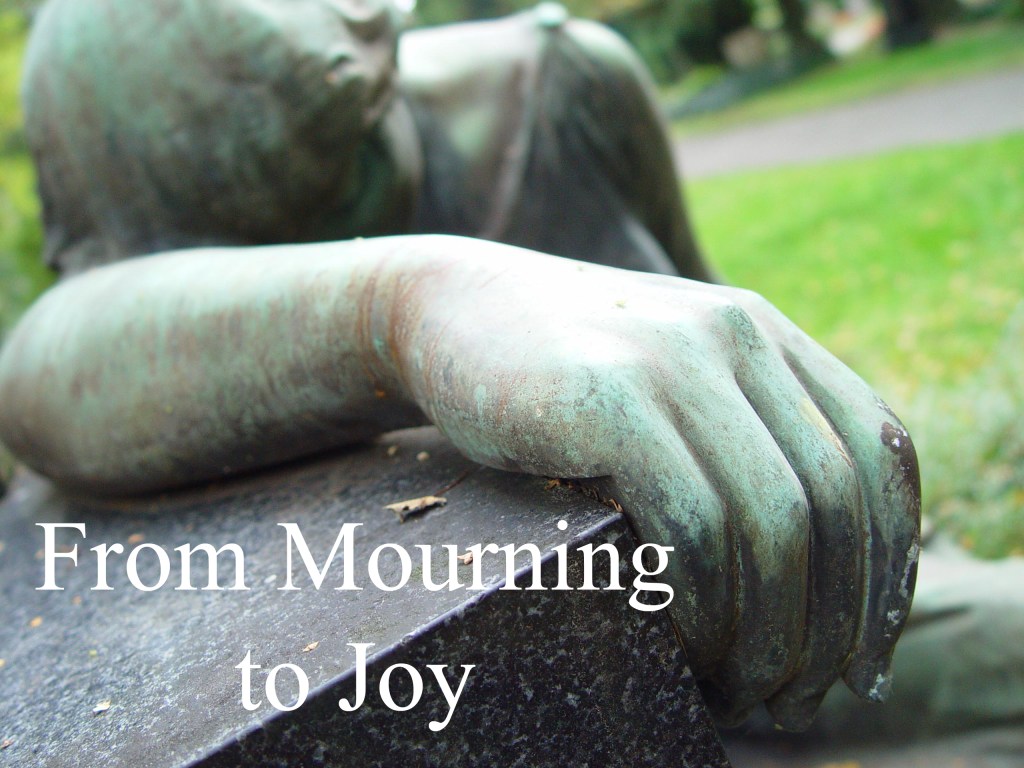
From Mourning to Joy

From Mourning to Joy

December 17, 2023*

By Pastor John Partridge

Isaiah 61:1-4, 8-11                 John 1:6-8, 19-28                          1 Thessalonians 5:16-24

On June second of 2022, seventeen-year-old Ethan Liming, the son of United Methodist Pastor Bill Liming, was beaten to death during an altercation at a basketball court in downtown Akron. This week we were notified that another of our East Ohio Conference colleagues, Beth Wilterdink, with whom Mike Greiner and I have served on the conference committee on camps and retreats, is mourning, with her husband and family, the loss of their barely two-year-old daughter Cora. I can read about these things, but I can’t begin to understand the pain and the grief that these families must feel.

But many of us have experienced our own kinds of loss. Some of you have lost children, many of us have lost parents or siblings. We each understand grief in our own way. And so, we have some insight into the lives of the people who heard God’s message through his prophet Isaiah. These were the people who had lost everything. They had lost sons, daughters, husbands, wives, brothers, sisters, parents, and grandparents, they had lost their nation and their freedom and had been carried off into captivity in Babylon. They were filled with grief. But God speaks to them through the writings of Isaiah and tells them that in the midst of their grief, there is good news. We hear these words in Isaiah 61:1-4, 8-11…

61:1 The Spirit of the Sovereign Lord is on me, because the Lord has anointed me
    to proclaim good news to the poor.
He has sent me to bind up the brokenhearted, to proclaim freedom for the captives
    and release from darkness for the prisoners,
to proclaim the year of the Lord’s favor and the day of vengeance of our God,
to comfort all who mourn,
    and provide for those who grieve in Zion— to bestow on them a crown of beauty
    instead of ashes, the oil of joy instead of mourning, and a garment of praise
    instead of a spirit of despair.
They will be called oaks of righteousness, a planting of the Lord for the display of his splendor.

They will rebuild the ancient ruins and restore the places long devastated;
they will renew the ruined cities that have been devastated for generations.

“For I, the Lord, love justice;I hate robbery and wrongdoing.
In my faithfulness I will reward my people and make an everlasting covenant with them.
Their descendants will be known among the nations and their offspring among the peoples.
All who see them will acknowledge that they are a people the Lord has blessed.”

10 I delight greatly in the Lord;my soul rejoices in my God.
For he has clothed me with garments of salvation and arrayed me in a robe of his righteousness,
as a bridegroom adorns his head like a priest, and as a bride adorns herself with her jewels.
11 For as the soil makes the sprout come up and a garden causes seeds to grow,
so the Sovereign Lord will make righteousness and praise spring up before all nations.

God says that there will be healing for the brokenhearted, release for prisoners, comfort for those who mourn, and God promises to transform the ashes of their grief into a crown of beauty. God promises to rebuild, restore, and renew, and to bring justice and faithfulness to replace their despair and loss. And in the end, God will use the nations of the world to raise up gardens of righteousness and praise.

In no way does God, or Isaiah, diminish the pain, loss, and grief that we experience today, God does not tell us to “get over it,” but God does promise that he will, one day, transform our grief into joy.

But, because John the Baptist had been quoting from the words of Isaiah, the priests and the leaders of Israel came out to the wilderness in John 1:6-8, 19-28 to ask if he was a resurrected Isaiah that God had sent to fulfill the promises that had been written so long ago.

There was a man sent from God whose name was John. He came as a witness to testify concerning that light, so that through him all might believe. He himself was not the light; he came only as a witness to the light.

19 Now this was John’s testimony when the Jewish leaders in Jerusalem sent priests and Levites to ask him who he was. 20 He did not fail to confess, but confessed freely, “I am not the Messiah.”

21 They asked him, “Then who are you? Are you Elijah?”

He said, “I am not.”

“Are you the Prophet?”

He answered, “No.”

22 Finally they said, “Who are you? Give us an answer to take back to those who sent us. What do you say about yourself?”

23 John replied in the words of Isaiah the prophet, “I am the voice of one calling in the wilderness, ‘Make straight the way for the Lord.’”

24 Now the Pharisees who had been sent 25 questioned him, “Why then do you baptize if you are not the Messiah, nor Elijah, nor the Prophet?”

26 “I baptize with water,” John replied, “but among you stands one you do not know. 27 He is the one who comes after me, the straps of whose sandals I am not worthy to untie.”

28 This all happened at Bethany on the other side of the Jordan, where John was baptizing.

But John says that he is not Isaiah, nor is he Elijah, nor is he the promised messiah. Instead, he has come to point to the Messiah, to announce his arrival, and to proclaim the fulfillment of God’s promises in Isaiah in the person of Jesus Christ.

But, knowing that Jesus is the Messiah, as we do, what does that mean for us today? What does that tell us about our grief, and our pain, and how we are to live our lives in the twenty-first century? In his letter to the church in Thessalonica, contained in 1 Thessalonians 5:16-24, Paul says this:

16 Rejoice always, 17 pray continually, 18 give thanks in all circumstances; for this is God’s will for you in Christ Jesus.

19 Do not quench the Spirit. 20 Do not treat prophecies with contempt 21 but test them all; hold on to what is good, 22 reject every kind of evil.

23 May God himself, the God of peace, sanctify you through and through. May your whole spirit, soul and body be kept blameless at the coming of our Lord Jesus Christ. 24 The one who calls you is faithful, and he will do it.

Paul says that God’s will for us is to live in anticipation of God’s final and ultimate victory. We are to live as if Christ has already returned, and God has already fulfilled his promises of rescue, rebuilding, restoration, renewal, and transformation. Rejoice always, pray continually, give thanks in all circumstances, test the prophecies of God to prove their truthfulness, reject every kind of evil, but hold on to all that is good.

In this world, we know that we will experience suffering, pain, grief, and death.

But one day God will transform our mourning into joy.

Until then…

…reject every kind of evil and…

                                    …hold on to what is good.


Please LIKE and SHARE!

Click here to subscribe to Pastor John’s blog.

Click here if you would like to subscribe to Pastor John’s weekly messages.

Click here to visit Pastor John’s YouTube channel.


*You have been reading a message presented at Christ United Methodist Church on the date noted at the top of the first page.  Rev. John Partridge is the pastor at Christ UMC in Alliance, Ohio.  Duplication of this message is a part of our Media ministry, if you have received a blessing in this way, we would love to hear from you.  Letters and donations in support of the Media ministry or any of our other projects may be sent to Christ United Methodist Church, 470 East Broadway Street, Alliance, Ohio 44601.  These messages are available to any interested persons regardless of membership.  You may subscribe to these messages, in print or electronic formats, by writing to the address noted, or by contacting us at secretary@CUMCAlliance.org.  These messages can also be found online at https://pastorpartridge.com .  All Scripture quotations, unless otherwise indicated, are taken from the Holy Bible, New International Version®, NIV®. Copyright ©1973, 1978, 1984, 2011 by Biblica, Inc.™ Used by permission of Zondervan. All rights reserved worldwide. www.zondervan.comThe “NIV” and “New International Version” are trademarks registered in the United States Patent and Trademark Office by Biblica, Inc.™

Alien Preparedness

Alien Preparedness

December 10, 2023*

By Pastor John Partridge

Isaiah 40:1-11                        Mark 1:1-8                             2 Peter 3:8-15

There is an old saying that says, “It doesn’t rain in the Army… it rains on the Army. It isn’t a particularly funny joke, but it’s a part of the dark humor that is often found while standing in the middle of a driving rainstorm. There is a similar saying in scouting, but because our scout motto is “Be Prepared,” the saying is changed to reflect that and says, “There is no bad weather in scouting, only scouts that are not prepared for the weather.” But that leads us to the title of today’s message, “Alien Preparedness.” No, this is not about preparing for an alien invasion or something that you might find on Ancient Aliens on the History Channel, but it is about preparedness.

My brother Dean used to point out that when we say we are “getting in shape” or that an athlete is “in shape,” it’s important to ask, “In shape for what?” No one doubts that NFL football players are in shape, but ask them to run a marathon, or race an Olympic swimmer, and suddenly, they are not ready because, despite all the physical conditioning that they have done, they are not prepared for that specific kind of physical competition. And so, when we say, like the scouts, that we must “Be Prepared,” we must also ask, “Prepared for what?”  When it is framed in that way, “Alien Preparedness” is not about preparing for an alien invasion, but to prepare for something you did not expect, or in a way that you hadn’t expected.

I am sure that’s still more than a little puzzling but hold on to that idea while we dive into our scriptures, and when we return to this later, I think it will be clearer.  We begin this morning with the words of the prophet Isaiah who speaks to Israel to tell of the imminent destruction of their nation at the hands of the Assyrian army but also speaks words of comfort and God’s promise that there would one day be restoration after Jerusalem’s destruction. We hear these words in Isaiah 40:1-11…

40:1 Comfort, comfort my people, says your God.
Speak tenderly to Jerusalem, and proclaim to her
that her hard service has been completed, that her sin has been paid for,
that she has received from the Lord’s hand double for all her sins.

A voice of one calling:
“In the wilderness prepare the way for the Lord,
make straight in the desert a highway for our God.
Every valley shall be raised up, every mountain and hill made low;
the rough ground shall become level, the rugged places a plain.
And the glory of the Lord will be revealed, and all people will see it together.
For the mouth of the Lord has spoken.”

A voice says, “Cry out.”
    And I said, “What shall I cry?”

“All people are like grass, and all their faithfulness is like the flowers of the field.
The grass withers and the flowers fall, because the breath of the Lord blows on them.
    Surely the people are grass.
The grass withers and the flowers fall, but the word of our God endures forever.”

You who bring good news to Zion, go up on a high mountain.
You who bring good news to Jerusalem,  lift up your voice with a shout,
lift it up, do not be afraid; say to the towns of Judah, “Here is your God!”
10 See, the Sovereign Lord comes with power, and he rules with a mighty arm.
See, his reward is with him, and his recompense accompanies him.
11 He tends his flock like a shepherd: He gathers the lambs in his arms
and carries them close to his heart; he gently leads those that have young.

Isaiah says that things are going to be terrible, and then worse than terrible, and then, just when they think that they are withering into death like the grass in summer, there will be a voice… one single voice… crying out in the desert to prepare for the arrival of their rescuer. Things will be terrible, but one day the rescuer will come. He will rule with a mighty arm, but he will tend his flock with gentleness like a shepherd.

And then, in the middle of the Roman occupation, as Israel once again prayed for God’s rescue, the voice of John the Baptizer is heard in the wilderness and Mark remembers, and quotes the words of Isaiah in Mark 1:1-8 saying…

1:1 The beginning of the good news about Jesus the Messiah, the Son of God, as it is written in Isaiah the prophet:

“I will send my messenger ahead of you,
    who will prepare your way”—
“a voice of one calling in the wilderness,
‘Prepare the way for the Lord,
    make straight paths for him.’”

And so John the Baptist appeared in the wilderness, preaching a baptism of repentance for the forgiveness of sins. The whole Judean countryside and all the people of Jerusalem went out to him. Confessing their sins, they were baptized by him in the Jordan River. John wore clothing made of camel’s hair, with a leather belt around his waist, and he ate locusts and wild honey. And this was his message: “After me comes the one more powerful than I, the straps of whose sandals I am not worthy to stoop down and untie. I baptize you with water, but he will baptize you with the Holy Spirit.”

John declares that God’s promised rescuer has come, and the people had better be prepared.

But what does that mean? How should the people prepare? We know that John’s message was one of repentance and called people to repent of their sins and recommit their lives to following God. But is that all there is to it? What kind of preparations are required for us in the twenty-first century as we remember John’s message and prepare ourselves for Jesus’ return. And that’s where Peter steps in to remind us of John’s message and apply it to our daily lives in the here and now. In 2 Peter 3:8-15 we hear this message about our future:

But do not forget this one thing, dear friends: With the Lord a day is like a thousand years, and a thousand years are like a day. The Lord is not slow in keeping his promise, as some understand slowness. Instead, he is patient with you, not wanting anyone to perish, but everyone to come to repentance.

10 But the day of the Lord will come like a thief. The heavens will disappear with a roar; the elements will be destroyed by fire, and the earth and everything done in it will be laid bare.

11 Since everything will be destroyed in this way, what kind of people ought you to be? You ought to live holy and godly lives 12 as you look forward to the day of God and speed its coming. That day will bring about the destruction of the heavens by fire, and the elements will melt in the heat. 13 But in keeping with his promise we are looking forward to a new heaven and a new earth, where righteousness dwells.

14 So then, dear friends, since you are looking forward to this, make every effort to be found spotless, blameless and at peace with him. 15 Bear in mind that our Lord’s patience means salvation, just as our dear brother Paul also wrote you with the wisdom that God gave him.

And this is where we find the alien preparation. This is not making sure to pack a raincoat, or warm winter clothes, and it’s more than just John’s message of repentance and baptism. This is, quite literally, preparation for the end of the world. The heavens will disappear, the earth will be destroyed, and the elements themselves will be melted in the heat of God’s judgement. On that day, God will make good on his promise to bring peace and justice, and from the ruins of this world will create a new heaven and a new earth filled with righteousness.

But how can we prepare for such a thing? What will be required of us? What must we do to be ready? And Peter’s answer is not so different from that of John the Baptizer. Repent, make straight paths for him, make every effort to live lives that are blameless so that your lives can be at peace with Jesus Christ by doing everything that he taught and modelled for us.

We absolutely must get this right.

Because we are not just preparing for the arrival of our rescuer and king.

We are, quite literally, preparing for the end of the world.


Please LIKE and SHARE!

Click here to subscribe to Pastor John’s blog.

Click here if you would like to subscribe to Pastor John’s weekly messages.

Click here to visit Pastor John’s YouTube channel.


*You have been reading a message presented at Christ United Methodist Church on the date noted at the top of the first page.  Rev. John Partridge is the pastor at Christ UMC in Alliance, Ohio.  Duplication of this message is a part of our Media ministry, if you have received a blessing in this way, we would love to hear from you.  Letters and donations in support of the Media ministry or any of our other projects may be sent to Christ United Methodist Church, 470 East Broadway Street, Alliance, Ohio 44601.  These messages are available to any interested persons regardless of membership.  You may subscribe to these messages, in print or electronic formats, by writing to the address noted, or by contacting us at secretary@CUMCAlliance.org.  These messages can also be found online at https://pastorpartridge.com .  All Scripture quotations, unless otherwise indicated, are taken from the Holy Bible, New International Version®, NIV®. Copyright ©1973, 1978, 1984, 2011 by Biblica, Inc.™ Used by permission of Zondervan. All rights reserved worldwide. www.zondervan.comThe “NIV” and “New International Version” are trademarks registered in the United States Patent and Trademark Office by Biblica, Inc.™

Half-Truths and Lies

Half-Truths and Lies

February 26, 2023*

(1st Sunday of Lent)

By Pastor John Partridge

Genesis 2:15-17; 3:1-7                      Matthew 4:1-11                     Romans 5:12-19

In Star Wars – Return of the Jedi, Luke encounters his mentor, Obi Wan Kenobi, and asks him why he lied and told him that Darth Vader had killed his father.  Obi Wan answers by saying “So, what I told you was true… from a certain point of view.” When Luke presses the issue, Obi Wan continues by saying, “Luke, you’re going to find that many of the truths we cling to depend greatly on our own point of view.”  We all find that history is often told by the victors, and that the same events, when recounted by participants and authors from opposite sides, are often described very differently.

But what makes matters worse, is that in an effort to make themselves look good, many writers and public speakers not only tell stories from differing points of view, they resort to telling those stories and filling them with half-truths, lies, and outright fabrications.  As sad as this situation may be, it isn’t new.  We see that very thing in the story of creation and the fall of Adam and Eve in Genesis 2:15-17; 3:1-7 when the serpent twists the truth to his own purposes.  In that story we hear this:

15 The Lord God took the man and put him in the Garden of Eden to work it and take care of it. 16 And the Lord God commanded the man, “You are free to eat from any tree in the garden; 17 but you must not eat from the tree of the knowledge of good and evil, for when you eat from it you will certainly die.”

3 Now the serpent was more crafty than any of the wild animals the Lord God had made. He said to the woman, “Did God really say, ‘You must not eat from any tree in the garden’?”

The woman said to the serpent, “We may eat fruit from the trees in the garden, but God did say, ‘You must not eat fruit from the tree that is in the middle of the garden, and you must not touch it, or you will die.’”

“You will not certainly die,” the serpent said to the woman. “For God knows that when you eat from it your eyes will be opened, and you will be like God, knowing good and evil.”

When the woman saw that the fruit of the tree was good for food and pleasing to the eye, and also desirable for gaining wisdom, she took some and ate it. She also gave some to her husband, who was with her, and he ate it. Then the eyes of both of them were opened, and they realized they were naked; so they sewed fig leaves together and made coverings for themselves.

The story is sadly familiar to us, and we have seen the process repeated every day in our news media.  God made a simple statement explaining the rules of living in the garden, “you are free to eat… but you must not eat from the tree of the knowledge of good and evil.”  But when the serpent quotes God’s instructions, he twists the words to say that God had forbidden them from eating the fruit of all the trees.  Eve argues, but having heard the serpent’s exaggeration, she also exaggerates, misunderstands, or misinterprets God’s instructions and claims that they cannot even touch the tree or God will strike them dead.  The serpent then escalates to outright lies and more half-truths, saying that surely, they would not die, but that by eating the fruit from the tree of the knowledge of good and evil, they would become like God.

Having believed the lie, sadly, after eating the fruit, Adam and Eve discovered that they were not like God.  Their eyes were opened, they gained understanding, but they had lost their innocence, their home, and their relationship with God.  And that was Satan’s intent all along.  His goal was, and is, to destroy the relationship between God and his people and true to form, we see him attempting to do exactly the same thing, using exactly the same methods, in the story of Jesus’ wilderness temptation in Matthew 4:1-11 where it says…

4:1 Then Jesus was led by the Spirit into the wilderness to be temptedby the devil. After fasting forty days and forty nights, he was hungry. The tempter came to him and said, “If you are the Son of God, tell these stones to become bread.”

Jesus answered, “It is written: ‘Man shall not live on bread alone, but on every word that comes from the mouth of God.’”

Then the devil took him to the holy city and had him stand on the highest point of the temple. “If you are the Son of God,” he said, “throw yourself down. For it is written:

“‘He will command his angels concerning you,
    and they will lift you up in their hands,
    so that you will not strike your foot against a stone.’”

Jesus answered him, “It is also written: ‘Do not put the Lord your God to the test.’”

Again, the devil took him to a very high mountain and showed him all the kingdoms of the world and their splendor. “All this I will give you,” he said, “if you will bow down and worship me.”

10 Jesus said to him, “Away from me, Satan! For it is written: ‘Worship the Lord your God, and serve him only.’”

11 Then the devil left him, and angels came and attended him.

Knowing that Jesus is too smart to believe his lies, but willing to try anyway, Satan begins by twisting the truth, and attempting to play on Jesus’ pride.  He challenges Jesus to prove who he is by saying “If you are the Son of God…” then prove it.  If you are who you say that you are, if you are who you believe yourself to be, then do this thing to prove it.  But Jesus doesn’t have anything to prove, and has the humility to realize that pride is a trap.  Instead of walking into that trap, Jesus replies that the scriptures that describe the Messiah and the Son of God, also say that he is obedient.  The Son of God doesn’t need to live on bread but genuinely needs to live on the word of God.  The Son of God may be protected by the angels of heaven, but he is wise enough to know that it would be sinful to test God by deliberately putting himself in danger.

Once again, Satan appeals to pride and to impatience, by offering Jesus the kingdoms of the world that are, by God’s grace, at his disposal.  But Jesus knows that all these will be his eventually, and in any case, regardless of Satan’s temporary control of the principalities of earth, God is the true king who creates, controls, and rules over the universe and everything in it, including Satan and his minions.  Jesus knew that the words of Satan were half-truths and lies, and so his enemy leaves him in hopes that he might try again at another time.

Time after time, the enemy of God has demonstrated a regular pattern of behavior that he uses to deceive the followers of God in an attempt to destroy their relationship with God and with one another.  The enemy of God is the original master of spin, who twists the truth, speaks half-truths, slander, and distributes lies and total fabrications wherever they might be believed.  The good news is that the enemy of God isn’t the only one with a pattern of behavior, and that’s exactly what Paul describes in his letter to the church in Rome that we find in Romans 5:12-19, where he says:

12 Therefore, just as sin entered the world through one man, and death through sin, and in this way death came to all people, because all sinned—

13 To be sure, sin was in the world before the law was given, but sin is not charged against anyone’s account where there is no law. 14 Nevertheless, death reigned from the time of Adam to the time of Moses, even over those who did not sin by breaking a command, as did Adam, who is a pattern of the one to come.

15 But the gift is not like the trespass. For if the many died by the trespass of the one man, how much more did God’s grace and the gift that came by the grace of the one man, Jesus Christ, overflow to the many! 16 Nor can the gift of God be compared with the result of one man’s sin: The judgment followed one sin and brought condemnation, but the gift followed many trespasses and brought justification. 17 For if, by the trespass of the one man, death reigned through that one man, how much more will those who receive God’s abundant provision of grace and of the gift of righteousness reign in life through the one man, Jesus Christ!

18 Consequently, just as one trespass resulted in condemnation for all people, so also one righteous act resulted in justification and life for all people. 19 For just as through the disobedience of the one man the many were made sinners, so also through the obedience of the one man the many will be made righteous.

Paul begins this conversation about sin with Adam and reminds us that it was with Adam and Eve that sin entered the world and into humanity.  But he also points out that before they ate the fruit of the tree of the knowledge of good and evil, their actions were not sinful because of their innocence.  Because they didn’t know the difference between good and evil, they were not guilty of sin.  But afterward, after they ate the fruit, they knew… and that knowledge was passed down from generation to generation into all of humanity.  Adam and Eve became the pattern for all of humanity.

And that is why Paul says that, ordinarily, human beings could not have been convicted of breaking the laws of God prior to God giving the law to Moses.  You simply cannot be convicted of breaking a law that hasn’t been passed, but we still can be found guilty of our conscience because, in our hearts, we know the difference between good and evil.  It is for this reason that all of humanity, from the time of Adam and Eve, is guilty of sin, and this is why, as Paul puts it, death reigned.

But… God sent a gift.  Through his grace, God sent his son to break the pattern that had been set by Adam and Eve.  Because of the gift and the sacrifice of one man, Jesus, a pathway to forgiveness and righteousness was opened to all of humanity.  The lies and half-truths of the enemy no longer need to entangle us, destroy our relationship with God, and drag us down into death.  God’s grace is now freely available at all times, to everyone, everywhere.

We must, of course, continue to be aware, and be wary.  The enemy of God still roams throughout the earth searching for those whom he may destroy.  He is still the grandmaster of spin.  He still speaks finely crafted half-truths, lies, and fabrications that are designed to appeal to our egos, our vanity, our impatience, our pride, and all our other shortcomings and vulnerabilities.  We will still drift off course.  We will still fall into his traps.  We will still make mistakes.  We will still fall short of God’s commands, teachings, and expectations.  But we are no longer doomed to repeat those mistakes and allow them to become the pattern of our lives. 

Grace awaits.

At any moment, in any place, we may go to God and ask for forgiveness and know that because of the obedience of Jesus, and his act of righteousness on the cross, our forgiveness is guaranteed.

The pattern of sin and death has been broken.

This is the Good News that we are called to share with the world.


Did you enjoy this?

Please LIKE and SHARE!

Click here to subscribe to Pastor John’s blog.

Click here if you would like to subscribe to Pastor John’s weekly messages.

Click here to visit Pastor John’s YouTube channel.


*You have been reading a message presented at Christ United Methodist Church on the date noted at the top of the first page.  Rev. John Partridge is the pastor at Christ UMC in Alliance, Ohio.  Duplication of this message is a part of our Media ministry, if you have received a blessing in this way, we would love to hear from you.  Letters and donations in support of the Media ministry or any of our other projects may be sent to Christ United Methodist Church, 470 East Broadway Street, Alliance, Ohio 44601.  These messages are available to any interested persons regardless of membership.  You may subscribe to these messages, in print or electronic formats, by writing to the address noted, or by contacting us at secretary@CUMCAlliance.org.  These messages can also be found online at https://pastorpartridge.com .  All Scripture quotations, unless otherwise indicated, are taken from the Holy Bible, New International Version®, NIV®. Copyright ©1973, 1978, 1984, 2011 by Biblica, Inc.™ Used by permission of Zondervan. All rights reserved worldwide. www.zondervan.comThe “NIV” and “New International Version” are trademarks registered in the United States Patent and Trademark Office by Biblica, Inc.™

Power in Distress

Click here to watch the livestream of this worship service: https://youtu.be/l-G8XgQToQw

(Note: Due to technical issues, no podcast is available for this service)


Power in Distress

January 01, 2023*

(New Year’s Day)

By Pastor John Partridge

Isaiah 63:7-9              Matthew 2:13-23                   Hebrews 2:10-18

When the magi arrive in Jerusalem, Matthew includes a curious phrase in his description of King Herod’s reaction.  Matthew says, “After Jesus was born in Bethlehem in Judea, during the time of King Herod, Magifrom the east came to Jerusalem and asked, “Where is the one who has been born king of the Jews? We saw his star when it rose and have come to worship him.”

When King Herod heard this he was disturbed, and all Jerusalem with him.” (Matthew 2:1-3)

Herod was disturbed… and all of Jerusalem was disturbed with him.

Obviously, there are many reasons why King Herod would have been disturbed, but why would the entire city be disturbed with him?  Historically and biblically, we know that Herod was incredibly paranoid about maintaining his grip on power.  He had at least one of his parents and some of his children killed because he felt threatened by them.  He was not a nice man.  And so, it isn’t surprising that he was disturbed by the arrival of the magi and their question about a new king being born.  There are several theories that have been forwarded about why the entire city would have been disturbed with him, and the simplest of these is that when the king wasn’t happy, everyone worried because… he was not a nice man.  There are other theories, and I have a favorite, but that will have to wait for another day.

And that leads us to our Old Testament reading in which we find that God, in addition to being good, kind, and compassionate, also feels distress when his people are distressed.  We begin this morning reading from Isaiah 63:7-9 where we hear this:

I will tell of the kindnesses of the Lord,
    the deeds for which he is to be praised,
    according to all the Lord has done for us—
yes, the many good things
    he has done for Israel,
    according to his compassion and many kindnesses.
He said, “Surely they are my people,
    children who will be true to me”;
    and so he became their Savior.
In all their distress he too was distressed,
    and the angel of his presence saved them.
In his love and mercy, he redeemed them;
    he lifted them up and carried them
    all the days of old.

God’s reaction to his feeling of distress, was to bring healing to those who were distressed. God chooses to bring rescue and redemption to all of humanity so that he could relieve our distress.  This is unlike how King Herod reacts to distress in Matthew 2:13-23 where we read this:

13 When they had gone, an angel of the Lord appeared to Joseph in a dream. “Get up,” he said, “take the child and his mother and escape to Egypt. Stay there until I tell you, for Herod is going to search for the child to kill him.”

14 So he got up, took the child and his mother during the night, and left for Egypt, 15 where he stayed until the death of Herod. And so was fulfilled what the Lord had said through the prophet: “Out of Egypt I called my son.”

16 When Herod realized that he had been outwitted by the Magi, he was furious, and he gave orders to kill all the boys in Bethlehem and its vicinity who were two years old and under, in accordance with the time he had learned from the Magi. 17 Then what was said through the prophet Jeremiah was fulfilled:

18 “A voice is heard in Ramah,
    weeping and great mourning,
Rachel weeping for her children
    and refusing to be comforted,
    because they are no more.”

19 After Herod died, an angel of the Lord appeared in a dream to Joseph in Egypt 20 and said, “Get up, take the child and his mother and go to the land of Israel, for those who were trying to take the child’s life are dead.”

21 So he got up, took the child and his mother, and went to the land of Israel. 22 But when he heard that Archelaus was reigning in Judea in place of his father Herod, he was afraid to go there. Having been warned in a dream, he withdrew to the district of Galilee, 23 and he went and lived in a town called Nazareth. So was fulfilled what was said through the prophets, that he would be called a Nazarene.

When God feels our distress, he feels distress as well, and chose to send a rescuer to relieve us.  But when Herod feels distress, his solution is to kill as many people as necessary to comfort himself that he has removed the source of his distress.  Throughout the story, God’s focus is on rescuing Mary and Joseph, rescuing Jesus, his appointed rescuer, and through him rescuing all of us.  The focus of God is on us, while the focus of Herod is only on himself.

We see that same focus in Hebrews 2:10-18 as God, through the rescue and restoration available through Jesus Christ, removes yet another source of fear and distress for his people, and for all who would come to him.

10 In bringing many sons and daughters to glory, it was fitting that God, for whom and through whom everything exists, should make the pioneer of their salvation perfect through what he suffered. 11 Both the one who makes people holy and those who are made holy are of the same family. So, Jesus is not ashamed to call them brothers and sisters. 12 He says,

“I will declare your name to my brothers and sisters; in the assembly I will sing your praises.”

13 And again,

“I will put my trust in him.”

And again, he says,

“Here am I, and the children God has given me.”

14 Since the children have flesh and blood, he too shared in their humanity so that by his death he might break the power of him who holds the power of death—that is, the devil— 15 and free those who all their lives were held in slavery by their fear of death. 16 For surely it is not angels he helps, but Abraham’s descendants. 17 For this reason he had to be made like them, fully human in every way, in order that he might become a merciful and faithful high priest in service to God, and that he might make atonement for the sins of the people. 18 Because he himself suffered when he was tempted, he is able to help those who are being tempted.

God perfected Jesus Christ through the suffering that he endured on earth, but because of his perfection, God created a path for his people to be purified, perfected, and made holy.  And through that holiness, we can become the brothers and sisters of Jesus, the children of a holy and perfect God.  Once again, if God was anything at all like King Herod, he could have easily eliminated his distress by eliminating us.  But instead of doing that, God chose to set us free from our anxiety and fear of the future by eliminating the power of death itself.

The writer of Hebrews reminds us that to accomplish that, God had to become like us.  Not a little bit like us, but exactly like us, fully human, so that he could make atonement for the sins of his people.  Jesus had to become like us, suffer like us, be tempted like us, fear like us, dream like us, feel loss like us, mourn and cry like us, worry like us, feel pain like us, bleed like us, die like us, and in every other way… know what it is to be human.  And because he has done those things, he knows what it is like to be us and he is able to offer us help, rescue, and restoration as no one else can.

When King Herod was in distress, he killed people until his worries went away.

But when God felt the distress of humanity, he suffered death himself so that he could rescue us and remove our distress.

And that is why, like Isaiah, we should be and say, I will tell of the kindnesses of the Lord, the deeds for which he is to be praised, according to all the Lord has done for us – yes, the many good things he has done for …”

…Us.


Did you enjoy this?

Please LIKE and SHARE!

Click here to subscribe to Pastor John’s blog.

Click here if you would like to subscribe to Pastor John’s weekly messages.

Click here to visit Pastor John’s YouTube channel.


*You have been reading a message presented at Christ United Methodist Church on the date noted at the top of the first page.  Rev. John Partridge is the pastor at Christ UMC in Alliance, Ohio.  Duplication of this message is a part of our Media ministry, if you have received a blessing in this way, we would love to hear from you.  Letters and donations in support of the Media ministry or any of our other projects may be sent to Christ United Methodist Church, 470 East Broadway Street, Alliance, Ohio 44601.  These messages are available to any interested persons regardless of membership.  You may subscribe to these messages, in print or electronic formats, by writing to the address noted, or by contacting us at secretary@CUMCAlliance.org.  These messages can also be found online at https://pastorpartridge.com .  All Scripture quotations, unless otherwise indicated, are taken from the Holy Bible, New International Version®, NIV®. Copyright ©1973, 1978, 1984, 2011 by Biblica, Inc.™ Used by permission of Zondervan. All rights reserved worldwide. www.zondervan.comThe “NIV” and “New International Version” are trademarks registered in the United States Patent and Trademark Office by Biblica, Inc.™