Do the Stuff

Do the Stuff

August 28, 2023

by John Partridge

This isn’t a particularly religious idea, but it’s one that has grown on me over the years and one that I frequently repeated this summer. In the early 1990’s Patti and I were in the Upper Peninsula of Michigan at a camp Patti had worked at during college, and which we often visited. What was unusual was that on this visit, my parents stopped to visit us and see the camp because they were also in the area. As it happened, had made a stop in Frankenmuth at Bronner’s the year-round Christmas store and were (I think) heading across the Canadian border to ride the train through the Agawa Canyon which Dad had read about for years in Model Railroader magazine.

That part makes sense. The part that never made sense to me was that later, when I asked them what they thought of the train ride… they didn’t go. They drove all the way to the Upper Peninsula, crossed the border into Canada, and… decided that the train ride was too expensive. They had a good time, I guess, but they didn’t do the thing. They didn’t do the thing that Dad had read about, and probably dreamed about, for years, all because the train tickets cost as much as a night in a hotel (they still cost around $100 CDN per person). I couldn’t get over it. It bugged me then, and it still bugs me now. There is a time to save money, but there are times when you just… do the stuff.

When Patti and I first went into ministry, we didn’t have much money and we did our best to squeeze what we could out of every penny. When we went to Annual Conference at Lakeside, we slept in a tent at the campground because that’s what we could afford. But we still would buy ice cream with the kids at least once during the week and play putt-putt golf and do other things with the kids just because we were there. There are times when you can make memories and there are other times when you can save money. Sometimes, you just… do the stuff.

This summer in Israel, our group made a choice of whether we wanted to stop for lunch each day, or just carry snacks in our backpacks and keep going so that we could see more archeological sites and spend more time at others. The choice for all of us was easy. We paid a lot of money to take this class, and to travel to Israel, to see and to learn… not to eat nice, sit-down lunches. In other words, we just wanted to… do the stuff.  On at least one evening, after we had been touring and hiking all day, and were already tired, we had the option of walking into downtown Bethlehem to do a little shopping and to get some falafel from a local vendor. I was already tired, but… my choice was to do the stuff.

At the National Scout Jamboree in July, there were also several times when I had the chance to walk less, to stay out of the heat and out of the sun instead of hiking an extra three or five miles… but sitting in the shade wasn’t why I was there. I made the extra effort because I wanted to do the stuff. I gave this same advice to several people during the Jamboree as they struggled with decisions about what they wanted to do with their day. I gave this advice because I knew, from watching my dad thirty years ago, that sometimes you only get one chance to do the stuff. Years from now no one will remember the time that you sat in the shade, but you will almost certainly remember climbing the rock wall, riding mountain bikes, or whatever else that you were daydreaming about.

This is also a part of the reason why I went back to school at a time when Patti and I are thinking seriously about our retirement. I always wondered if I had what it takes to earn an advanced degree. It was the stuff of daydreams, but could I do it? And a part of me said… do the stuff. I do not want to spend my retirement wondering if I could have done it. Yes, it’s hard. Yes, it’s time-consuming. Yes, at times it’s a giant pain in the keister. But I decided to try, and so every day I just… do the stuff.

One step at a time.

But, in the end, this does have an application to our spiritual life. As we move through our church year, especially as Christ Church sets goals for next year and considers a strategic plan and a new vision for our future, we will almost certainly arrive at moments when we must decide whether to continue doing what we’ve always done, or to do something different.

Sometimes rather than wondering how we might draw closer to God, or how we might find God’s purpose for our lives, or whether it might help to join a Bible study, have a daily devotion time, get back into the habit of reading scripture, attend church more regularly, join a Sunday school class, or do something entirely new and unexpected, what we ought to be thinking is whether we will regret NOT doing them later. Sometimes the best way out of our indecision, is simply to decide to just…

…do the stuff.


Please LIKE and SHARE!

Click here to subscribe to Pastor John’s blog.

Click here if you would like to subscribe to Pastor John’s weekly messages.

Click here to visit Pastor John’s YouTube channel.


Risk

Risk

August 27, 2023*

By Pastor John Partridge

Exodus 1:8 – 2:10                  

Matthew 16:13-20                            

Romans 12:1-8

If I said the word “Risk,” what do you think of?

Perhaps you think of gambling, or maybe the board game of “Risk.” Or maybe you think about a list of things that, in your head, you have classified as “risky.” But risk isn’t always about Las Vegas, and it isn’t always a bad thing. We take risks every day, from using a gas pump handle that hasn’t been cleaned for the last week, to eating gas station hot dogs, or just driving to church, our lives are full of risks. Every day we make a thousand decisions while, consciously or unconsciously, evaluating the level of risk that we’re willing to take. Some of us will throw away the food in the refrigerator as soon as it’s even close to its expiration date, and others of us will open the lid and give it a sniff regardless of the date on the package.

The question isn’t whether we are willing to take risks because we all do. The question we ask ourselves is, “How willing am I to take this particular risk?” And that’s what I want to think about as we read today’s scriptures. Each character in these stories is taking a risk, and each of them is weighing the cost of those risks and what those risks, and their potential cost, might mean to their future. We begin with the origin story of Moses in Exodus 1:8 – 2:10, where we hear these words:

Then a new king, to whom Joseph meant nothing, came to power in Egypt. “Look,” he said to his people, “the Israelites have become far too numerous for us. 10 Come, we must deal shrewdly with them, or they will become even more numerous and, if war breaks out, will join our enemies, fight against us, and leave the country.”

11 So they put slave masters over them to oppress them with forced labor, and they built Pithom and Rameses as store cities for Pharaoh. 12 But the more they were oppressed, the more they multiplied and spread; so, the Egyptians came to dread the Israelites 13 and worked them ruthlessly. 14 They made their lives bitter with harsh labor in brick and mortar and with all kinds of work in the fields; in all their harsh labor the Egyptians worked them ruthlessly.

15 The king of Egypt said to the Hebrew midwives, whose names were Shiphrah and Puah, 16 “When you are helping the Hebrew women during childbirth on the delivery stool, if you see that the baby is a boy, kill him; but if it is a girl, let her live.” 17 The midwives, however, feared God and did not do what the king of Egypt had told them to do; they let the boys live. 18 Then the king of Egypt summoned the midwives and asked them, “Why have you done this? Why have you let the boys live?”

19 The midwives answered Pharaoh, “Hebrew women are not like Egyptian women; they are vigorous and give birth before the midwives arrive.”

20 So God was kind to the midwives and the people increased and became even more numerous. 21 And because the midwives feared God, he gave them families of their own.

22 Then Pharaoh gave this order to all his people: “Every Hebrew boy that is born you must throw into the Nile but let every girl live.”

2:1 Now a man of the tribe of Levi married a Levite woman, and she became pregnant and gave birth to a son. When she saw that he was a fine child, she hid him for three months. But when she could hide him no longer, she got a papyrus basketfor him and coated it with tar and pitch. Then she placed the child in it and put it among the reeds along the bank of the Nile. His sister stood at a distance to see what would happen to him.

Then Pharaoh’s daughter went down to the Nile to bathe, and her attendants were walking along the riverbank. She saw the basket among the reeds and sent her female slave to get it. She opened it and saw the baby. He was crying, and she felt sorry for him. “This is one of the Hebrew babies,” she said.

Then his sister asked Pharaoh’s daughter, “Shall I go and get one of the Hebrew women to nurse the baby for you?”

“Yes, go,” she answered. So, the girl went and got the baby’s mother. Pharaoh’s daughter said to her, “Take this baby and nurse him for me, and I will pay you.” So, the woman took the baby and nursed him. 10 When the child grew older, she took him to Pharaoh’s daughter, and he became her son. She named him Moses, saying, “I drew him out of the water.”

Although we see Pharaoh as the bad guy in this story (and we should), we also understand that he was weighing his risks. The Egyptians were worried that the Israelites would soon outnumber them, if they didn’t already, and decide to ally themselves with Egypt’s enemies. And so, Pharaoh had to decide of it was better to risk a revolt, or to commit genocide.

The soldiers had to decide whether they should obey their orders and become murderers, or if it was more dangerous to disobey orders from the Pharoah. Unlike the soldiers, however, the midwives in this story chose to risk open defiance and disobedience of Pharoah’s orders and refused to murder the male children.

Moses’ mother and father took an incredible risk. In hiding him for three months they could easily have been discovered and suffered imprisonment or death for their disobedience. But despite the care that they took to waterproof the little basket and turn it into a tiny boat, the odds of success were incredibly slim. So slim, I think, that playing Russian roulette would be far safer in comparison. If the boat leaks, Moses drowns. If it doesn’t leak, he could get eaten by a crocodile, and if his boat goes safely down the river, he dies from dehydration, starvation, or exposure. This was the longest of longshots. There was almost no chance of success but, when they evaluated the risks, Moses’ parents decided that the risk of putting their baby in a boat were better than trying to hide him from the Egyptian soldiers.

Moses’ sister took a risk in following the basket down the river. Was she risking an encounter with crocodiles? Was it a risk to ask the princess about finding a wet nurse for the baby? And what risk did Pharaoh’s daughter take in accepting a Jewish baby into her home and adopting him as her own son?

Everyone in the story, in their own way, evaluated their options and took risks that led them to make the choices that they did. But Moses’ family put their trust in God. They took risks because they trusted that God was a part of their story and had a compassionate and loving interest in outcome.

In Matthew 16:13-20 where we read the story of Peter’s recognition of Jesus as the Messiah, and we can see the risk that he took to do so:

13 When Jesus came to the region of Caesarea Philippi, he asked his disciples, “Who do people say the Son of Man is?”

14 They replied, “Some say John the Baptist; others say Elijah; and still others, Jeremiah or one of the prophets.”

15 “But what about you?” he asked. “Who do you say I am?”

16 Simon Peter answered, “You are the Messiah, the Son of the living God.”

17 Jesus replied, “Blessed are you, Simon, son of Jonah, for this was not revealed to you by flesh and blood, but by my Father in heaven. 18 And I tell you that you are Peter, and on this rock, I will build my church, and the gates of Hadeswill not overcome it. 19 I will give you the keys of the kingdom of heaven; whatever you bind on earth will bebound in heaven, and whatever you loose on earth will beloosed in heaven.” 20 Then he ordered his disciples not to tell anyone that he was the Messiah.

Other disciples may have come to the same conclusion but, just as he did when he stepped out of the boat to walk on water, Peter took a risk and spoke up first. And, in accepting the appointment of being the head of Jesus’ church, Peter understood he might be painting a target on his back, and that was even more clear after Jesus’ crucifixion.

But what about us? What risks do we take? Or rather, what risks should we take? In Romans 12:1-8, Paul reminds us of a few things we should consider.

12:1 Therefore, I urge you, brothers and sisters, in view of God’s mercy, to offer your bodies as a living sacrifice, holy and pleasing to God—this is your true and proper worship. Do not conform to the pattern of this world, but be transformed by the renewing of your mind. Then you will be able to test and approve what God’s will is—his good, pleasing, and perfect will.

For by the grace given me I say to every one of you: Do not think of yourself more highly than you ought, but rather think of yourself with sober judgment, in accordance with the faith God has distributed to each of you. For just as each of us has one body with many members, and these members do not all have the same function, so in Christ we, though many, form one body, and each member belongs to all the others. We have different gifts, according to the grace given to each of us. If your gift is prophesying, then prophesy in accordance with yourfaith; if it is serving, then serve; if it is teaching, then teach; if it is to encourage, then give encouragement; if it is giving, then give generously; if it is to lead, do it diligently; if it is to show mercy, do it cheerfully.

Paul doesn’t use the word “risk,” but he does use the word “sacrifice.” He knew that our bodies, our actions, and the way that we spend our time and our energy, are all offerings and sacrifices that we give to God. Our everyday actions, the choices that we make, and the risks, large or small, that we take, are all offerings to God as our true and proper worship of what he has given to us and what he has done for us. But Paul’s caution in this is that we must not allow ourselves to be tempted or persuaded by what is perceived as “normal’ in the culture that surrounds us. Rather than committing ourselves to keeping up with the Joneses and trying to be like our neighbors, or keeping up with the Kardashians, instead we must remain intent upon the transformation and renewing of our minds so that instead of becoming more like the people of our culture, we increasingly reflect the character and the mind of God and of Jesus Christ.

Moses’ parents risked their lives because of their trust in God.

Peter risked humiliation to be the first to proclaim Jesus was the Messiah and risked death to be the leader of Christ’s church.

Paul says that every choice that we make, our every act, every demonstration of faith, every risk that we take on behalf of Jesus Christ, is an act of worship that transforms us, day by day, moment by moment, into the likeness of Christ.

What will you risk for him today?


Please LIKE and SHARE!

Click here to subscribe to Pastor John’s blog.

Click here if you would like to subscribe to Pastor John’s weekly messages.

Click here to visit Pastor John’s YouTube channel.


*You have been reading a message presented at Christ United Methodist Church on the date noted at the top of the first page.  Rev. John Partridge is the pastor at Christ UMC in Alliance, Ohio.  Duplication of this message is a part of our Media ministry, if you have received a blessing in this way, we would love to hear from you.  Letters and donations in support of the Media ministry or any of our other projects may be sent to Christ United Methodist Church, 470 East Broadway Street, Alliance, Ohio 44601.  These messages are available to any interested persons regardless of membership.  You may subscribe to these messages, in print or electronic formats, by writing to the address noted, or by contacting us at secretary@CUMCAlliance.org.  These messages can also be found online at https://pastorpartridge.com .  All Scripture quotations, unless otherwise indicated, are taken from the Holy Bible, New International Version®, NIV®. Copyright ©1973, 1978, 1984, 2011 by Biblica, Inc.™ Used by permission of Zondervan. All rights reserved worldwide. www.zondervan.comThe “NIV” and “New International Version” are trademarks registered in the United States Patent and Trademark Office by Biblica, Inc.™

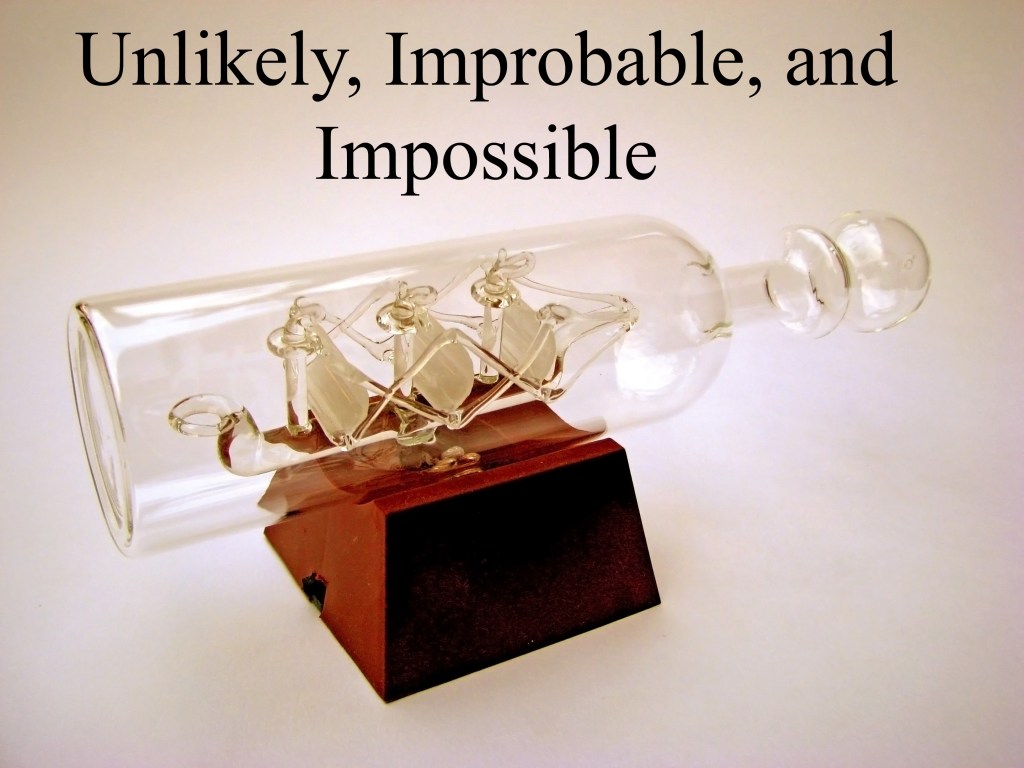
Unlikely, Improbable, and Impossible

Unlikely, Improbable, and Impossible

June 11, 2023*

By Pastor John Partridge

Genesis 12:1-9                       Matthew 9:9-13, 18-26                      Romans 4:13-25

Arthur Conan Doyle, through the voice of his detective Sherlock Holmes, often said when describing his method of observation and deduction, that, “when you have eliminated the impossible, whatever is left, however improbable, must be the truth.” Let me say that again, “When you have eliminated the impossible, whatever is left, however improbable, must be the truth.” This is good advice and often worth remembering as a part of the scientific process of testing, evaluation, and exploration. But in the church, despite our recognition of the importance of science, we also recognize the limitations of science. Many of the things that we hold to be true, are unlikely and improbable, and some of them are, outside of the work of an all-powerful God, would normally be assumed to be impossible.

For example, it is unlikely that the youngest son of family of sheep herders, from a small, little known, and often disrespected clan, would not only become the king of his clan, but would unite twelve clans into a unified nation that rivaled the strength and power of the largest superpowers of the world.

But David did.

It is improbable, that a man who was born into the right family, with all the right breeding, and all the right education, who had dedicated his life to persecuting the representatives of the schismatic movement whom he felt were polluting, desecrating, poisoning and destroying his church, would himself be converted to that sect and become the most prolific and well-known preacher, writer, and evangelist that the world has ever known.

But Paul did.

It is impossible for women of advanced age, well past the age of menopause, and especially past the age of 80, 90, or even 100 to become pregnant and bear children.

But Sarah did. And so did Rebekah and Rachael.

It is impossible for the dead to return to life, especially after the dead have been dead for many hours, or even days,

But Lazarus did. The widow’s son did. And, of course, Jesus did.

But sometimes the only difference between possible, unlikely, improbable, and impossible is trust.

We’ll explore that a little further in a few moments, but for now let’s begin with the story of God’s call to Abram in Genesis 12:1-9.

12:1 The Lord had said to Abram, “Go from your country, your people and your father’s household to the land I will show you.

“I will make you into a great nation, and I will bless you;
I will make your name great, and you will be a blessing.
I will bless those who bless you, and whoever curses you I will curse;
and all peoples on earth will be blessed through you.”

So Abram went, as the Lord had told him; and Lot went with him. Abram was seventy-five years old when he set out from Harran. He took his wife Sarai, his nephew Lot, all the possessions they had accumulated and the people they had acquired in Harran, and they set out for the land of Canaan, and they arrived there.

Abram traveled through the land as far as the site of the great tree of Moreh at Shechem. At that time the Canaanites were in the land. The Lord appeared to Abram and said, “To your offspring I will give this land.” So, he built an altar there to the Lord, who had appeared to him.

From there he went on toward the hills east of Bethel and pitched his tent, with Bethel on the west and Ai on the east. There he built an altar to the Lord and called on the name of the Lord.

Then Abram set out and continued toward the Negev.

You will notice that, at no time, was there a negotiation. God did not bribe Abram. Abram did not demand terms, nor did he place limits on his obedience.  Abram did not say that he was willing to follow God for 100 miles, or for two months, nor did he insist on periodic employee reviews or reassurances that he was going in the right direction, doing the right things, or just to make sure that the lines of communication between them remained open.

Abram’s obedience was so unlikely and improbable that it bordered on the impossible.

God said “go” and Abram went.

God said go to the place that I will show you, and Abram went… straight into the desert.

And then, in just a few verses of the ninth chapter of Matthew, we find the unlikely, the improbable, and the impossible, all jumbled together. (Matthew 9:9-13, 18-26)

As Jesus went on from there, he saw a man named Matthew sitting at the tax collector’s booth. “Follow me,” he told him, and Matthew got up and followed him.

10 While Jesus was having dinner at Matthew’s house, many tax collectors and sinners came and ate with him and his disciples. 11 When the Pharisees saw this, they asked his disciples, “Why does your teacher eat with tax collectors and sinners?”

12 On hearing this, Jesus said, “It is not the healthy who need a doctor, but the sick. 13 But go and learn what this means: ‘I desire mercy, not sacrifice.’ For I have not come to call the righteous, but sinners.”

18 While he was saying this, a synagogue leader came and knelt before him and said, “My daughter has just died. But come and put your hand on her, and she will live.” 19 Jesus got up and went with him, and so did his disciples.

20 Just then a woman who had been subject to bleeding for twelve years came up behind him and touched the edge of his cloak. 21 She said to herself, “If I only touch his cloak, I will be healed.”

22 Jesus turned and saw her. “Take heart, daughter,” he said, “your faith has healed you.” And the woman was healed at that moment.

23 When Jesus entered the synagogue leader’s house and saw the noisy crowd and people playing pipes, 24 he said, “Go away. The girl is not dead but asleep.” But they laughed at him. 25 After the crowd had been put outside, he went in and took the girl by the hand, and she got up. 26 News of this spread through all that region.

For a well-paid tax collector, on the Roman payroll, who is often accused by his countrymen as a thief, or as a traitor, to stand up, quit his job, and become the disciple of a poor, itinerant, homeless rabbi is both unlikely and improbable.

For a woman with an incurable disease, who had already been seen by every expert that could affordably be seen, to be completely healed simply by touching the hanging fringe of a rabbi’s jacket is utterly improbable.

For a synagogue leader to seek help from an itinerant rabbi that has been widely criticized by the leaders of the Pharisees, Sadducees, and a range of national church leaders is unlikely.

But a dead girl returning to life is completely impossible.

But, how do these things happen? Sure, a part of the answer is that Jesus was there, and that Jesus could do the impossible.

But is there more to it than that?

In Romans 4:13-25 Paul explains some of the things that happened to Abraham, why those things happened, how they happened, and why they matter to us.

13 It was not through the law that Abraham and his offspring received the promise that he would be heir of the world, but through the righteousness that comes by faith. 14 For if those who depend on the law are heirs, faith means nothing and the promise is worthless, 15 because the law brings wrath. And where there is no law there is no transgression.

16 Therefore, the promise comes by faith, so that it may be by grace and may be guaranteed to all Abraham’s offspring—not only to those who are of the law but also to those who have the faith of Abraham. He is the father of us all. 17 As it is written: “I have made you a father of many nations.” He is our father in the sight of God, in whom he believed—the God who gives life to the dead and calls into being things that were not.

18 Against all hope, Abraham in hope believed and so became the father of many nations, just as it had been said to him, “So shall your offspring be.” 19 Without weakening in his faith, he faced the fact that his body was as good as dead—since he was about a hundred years old—and that Sarah’s womb was also dead. 20 Yet he did not waver through unbelief regarding the promise of God, but was strengthened in his faith and gave glory to God, 21 being fully persuaded that God had power to do what he had promised. 22 This is why “it was credited to him as righteousness.” 23 The words “it was credited to him” were written not for him alone, 24 but also for us, to whom God will credit righteousness—for us who believe in him who raised Jesus our Lord from the dead. 25 He was delivered over to death for our sins and was raised to life for our justification.

Paul says that God did unlikely, improbable, and even impossible things in the life of Abraham, through the lives of his descendants, and through our lives in the twenty first century, because of the faith that Abraham had, and because of the faith of those who follow in his footsteps.

God blessed Abraham because he had the faith to do the unlikely, to walk away from his family, his friends, and his nation, and follow God into the desert, just because God said… “Go.”

An unlikely and improbable tax collector becomes an honored and revered member of the eleven disciples of Jesus because he had the faith to walk away from the comfortable life that he had.

A woman with an incurable disease was healed because she had the faith to seek out Jesus, fight through the crowd that surrounded him, crawl on the ground, reach out, and touch the fringe of his jacket.

The daughter of a respected synagogue leader was raised from the dead because that leader had the courage, and the faith, to rebel against the conventional wisdom of his peers, ignore the prevailing opinion of the movers and shakers and VIPs of his church, and ask Jesus for help.

Throughout scripture, we witness events that are unlikely, improbable, and utterly impossible.

And yet, with faith, through faith, and by the power of God, these things happened.

For God to do unlikely, improbable, and impossible things in our lives, and in the life of our church, we must be willing to demonstrate our faith by doing unlikely and improbable things.

Are we willing to walk away from our comfortable lives and follow him into the desert or into the unknown as Abraham and Matthew did?

Are we willing to fight the crowd to seek him the way that the bleeding woman did?

Are we willing to defy our peers, resist the status quo, and risk our occupation and our reputation so that we can seek Jesus as the synagogue leader did?

We often pray for Jesus to do the unlikely, the improbable, and the impossible in our lives and in the life of our church.

But are we willing to do what God asks of us, are we willing to risk what we have, in order to receive the gift that God has for us?

Do we have… and improbable faith?


Please LIKE and SHARE!

Click here to subscribe to Pastor John’s blog.

Click here if you would like to subscribe to Pastor John’s weekly messages.

Click here to visit Pastor John’s YouTube channel.


*You have been reading a message presented at Christ United Methodist Church on the date noted at the top of the first page.  Rev. John Partridge is the pastor at Christ UMC in Alliance, Ohio.  Duplication of this message is a part of our Media ministry, if you have received a blessing in this way, we would love to hear from you.  Letters and donations in support of the Media ministry or any of our other projects may be sent to Christ United Methodist Church, 470 East Broadway Street, Alliance, Ohio 44601.  These messages are available to any interested persons regardless of membership.  You may subscribe to these messages, in print or electronic formats, by writing to the address noted, or by contacting us at secretary@CUMCAlliance.org.  These messages can also be found online at https://pastorpartridge.com .  All Scripture quotations, unless otherwise indicated, are taken from the Holy Bible, New International Version®, NIV®. Copyright ©1973, 1978, 1984, 2011 by Biblica, Inc.™ Used by permission of Zondervan. All rights reserved worldwide. www.zondervan.comThe “NIV” and “New International Version” are trademarks registered in the United States Patent and Trademark Office by Biblica, Inc.™
No Love Without Risk

No Love Without Risk

April 25, 2021*

By Pastor John Partridge

John 10:11-18                                    Acts 4:5-12                             1 John 3:16-24

Would you risk your life to save your kids?

It’s a question that every parent understands and it’s one that Jonathan Honey, a father of three from Carbon County, Pennsylvania answered last week as he died trying to save his family from a house fire.  One child jumped from a second-floor window and was caught, barely, by a neighbor that jumped to meet him in the air, Kierstyn, the mother jumped out of a window cradling and protecting their baby, and Jonathan rushed into the house, found the third child, and put them in a closet before being overcome by carbon monoxide.  Kierstyn and the children are all in the hospital with broken bones or burns, but Jonathan lost his life trying to save his family.

It’s tragic, but nearly every parent has imagined what they would do in a similar situation, and nearly every one of us know that we would, without hesitation, risk our lives to save the life of one our children.  It difficult as it is to think about, we accept this reality, and we understand that there is no mystery to it.  We would risk our lives for our spouses or for our children… because we love them.  Our lives change when we have children.  We do everything differently.  We grocery shop differently, we drive differently, we dress differently, we spend our money and our time differently, we do without things that we like, that we want, and that we are accustomed to having so that our children can have the things that they need.  And we do all these things, we turn our adult lives upside down, because we love them.

And it is that understanding of parental love, and risk, that Jesus uses to describe God’s radical and sacrificial love for us in John 10:11-18 when he says:

11 “I am the good shepherd. The good shepherd lays down his life for the sheep. 12 The hired hand is not the shepherd and does not own the sheep. So, when he sees the wolf coming, he abandons the sheep and runs away. Then the wolf attacks the flock and scatters it. 13 The man runs away because he is a hired hand and cares nothing for the sheep.

14 “I am the good shepherd; I know my sheep and my sheep know me— 15 just as the Father knows me and I know the Father—and I lay down my life for the sheep. 16 I have other sheep that are not of this sheep pen. I must bring them also. They too will listen to my voice, and there shall be one flock and one shepherd. 17 The reason my Father loves me is that I lay down my life—only to take it up again. 18 No one takes it from me, but I lay it down of my own accord. I have authority to lay it down and authority to take it up again. This command I received from my Father.”

After thousands of years of Jewish and Christian influence, in the twenty-first century, we miss the radical nature of what Jesus was saying.  The gods of the world, in the cultures that surrounded Israel were selfish, arrogant, violent, and uncaring.  The gods of the Philistines had routinely demanded that parents sacrifice their children for the fertility of their fields and good harvests, the gods of Greece and Rome considered humans to be inferior, unimportant, and without consequence except for use as pawns as they battled against one another.  It was common in many of the world’s religions to consider human worshippers to be resources to be spent rather than treasure to be valued.  But in that culture, and within that understanding of the relationship between gods and humans, Jesus proclaims a radical idea that he, and Israel’s God, love us in the sacrificial and selfless way that parents love their children.  Jesus says that he, like a true shepherd, is willing to lay down his life to protect his sheep.

And in Acts 4:5-12, Peter also preaches that because our God is a god of compassion and love, his disciples and followers are willing to risk their own security to care for those in need.  Luke writes this story:

The next day the rulers, the elders and the teachers of the law met in Jerusalem. Annas the high priest was there, and so were Caiaphas, John, Alexander, and others of the high priest’s family. They had Peter and John brought before them and began to question them: “By what power or what name did you do this?”

Then Peter, filled with the Holy Spirit, said to them: “Rulers and elders of the people! If we are being called to account today for an act of kindness shown to a man who was lame and are being asked how he was healed, 10 then know this, you and all the people of Israel: It is by the name of Jesus Christ of Nazareth, whom you crucified but whom God raised from the dead, that this man stands before you healed. 11 Jesus is

“‘the stone you builders rejected,
    which has become the cornerstone.’

12 Salvation is found in no one else, for there is no other name under heaven given to mankind by which we must be saved.”

Peter and John are legally detained by the authorities and forcibly brought in front of the high priest, his powerful family, and the rulers, elders, and teachers of Jerusalem.  All the movers and shakers and powerful people were there.  And the question that they ask is, who gave you the power, or permission, to heal a man who was born lame?  Peter knows that these men have the power to convict them, punish them, or imprison them if they don’t like their answers.  This is a speech that is filled with risk.  And yet, Peter does not mince words and without hesitation, proclaims that they have been dragged into court in retribution for an act of compassion.  Peter goes on to preach and proclaim the name and the power of Jesus Christ and states, unequivocally, that there is no other name than Jesus, there is no other man, and no other god, on the face of the earth that can rescue humanity before God.

Peter and John knew that healing the lame man carried risk.  They knew that telling the truth in front of the power brokers of Israel risked their health and their freedom.  But Jesus taught and demonstrated that love and compassion were always worth the risk.

And in his letter to the churches and believers in Asia, John explains this idea of love and risk in more detail in 1 John 3:16-24 saying:

16 This is how we know what love is: Jesus Christ laid down his life for us. And we ought to lay down our lives for our brothers and sisters. 17 If anyone has material possessions and sees a brother or sister in need but has no pity on them, how can the love of God be in that person? 18 Dear children, let us not love with words or speech but with actions and in truth.

19 This is how we know that we belong to the truth and how we set our hearts at rest in his presence: 20 If our hearts condemn us, we know that God is greater than our hearts, and he knows everything. 21 Dear friends, if our hearts do not condemn us, we have confidence before God 22 and receive from him anything we ask, because we keep his commands and do what pleases him. 23 And this is his command: to believe in the name of his Son, Jesus Christ, and to love one another as he commanded us. 24 The one who keeps God’s commands lives in him, and he in them. And this is how we know that he lives in us: We know it by the Spirit he gave us.

John boils it down to the simplest of terms.  Jesus demonstrated to us what love is supposed to look like and Jesus gave up his life for us.  That example means that that we should be prepared to give up our lives, for the people around us.  We must be prepared to risk everything for others.  We can’t hold too tightly to any of our material possessions or even to our own lives.  If fellow believers are in need, we cannot just heartlessly keep what is ours and allow them to do without.  Instead, we must be prepared to risk, to give up some of our possession, some of our creature comforts, some of our rights, or whatever else it might take to meet their needs because Jesus has taught us, and shown us, that this is what true love looks like.  Loving with our words and making grand and eloquent speeches is not enough if we don’t risk the things that we have and demonstrate our love through our actions.

Love, real love, true love, isn’t an idea and it isn’t just a feeling.

True love is an action.

And because actions have consequences, we can’t play it safe.

            There is no love… without risk.


You can find the video of this worship service here: https://youtu.be/nvhcnF-CUd4

Did you enjoy reading this?

Click here if you would like to subscribe to Pastor John’s weekly messages.

Click here to subscribe to Pastor John’s blog.

Click here to visit Pastor John’s YouTube channel.


*You have been reading a message presented at Christ United Methodist Church on the date noted at the top of the first page.  Rev. John Partridge is the pastor at Christ UMC in Alliance, Ohio.  Duplication of this message is a part of our Media ministry, if you have received a blessing in this way, we would love to hear from you.  Letters and donations in support of the Media ministry or any of our other projects may be sent to Christ United Methodist Church, 470 East Broadway Street, Alliance, Ohio 44601. These messages are available to any interested persons regardless of membership.  You may subscribe to these messages, in print or electronic formats, by writing to the address noted, or by contacting us at secretary@CUMCAlliance.org.  If you have questions, you can ask them in our discussion forum on Facebook (search for Pastor John Online).  These messages can also be found online at https://pastorpartridge.wordpress.com/. All Scripture references are from the New International Version unless otherwise noted.