
Is Your Religion a Spuddle?

Is Your Religion a Spuddle?
or, Whose Religion Counts?

September 01, 2024*

By Pastor John Partridge

Song of Solomon 2:8-13        Mark 7:1-8, 14-15, 21-23                  James 1:17-27

Okay, this morning we’re going to do something different. We’re going to begin today’s message with a vocabulary quiz.

I’m serious. Sort of. Go ahead and get a pencil or a pen or get your phone to a place where you can take a quick note or two. It’s okay if you can’t, I only have three questions. If you can, write down the definition of the following words:

Fudgel.

Spuddle.

And the last one, which is likely to be more familiar… Boondoggle.

Did you get that? Let me repeat it. Fudgel, Spuddle, and Boondoggle.

The secret here, is that the meaning of these three words is almost the same.

Fudgel is an 18th century English word that means “to pretend to be busy while actually doing nothing.”

Spuddle is a 17th century word that means ‘to work ineffectively’ or to be extremely busy whilst achieving absolutely nothing.

And finally, Boondoggle is a modern word that describes doing work of little or no practical value for the purpose of simply keeping or looking busy.

How did you do?

All these words attempt to describe work that doesn’t matter or work that isn’t work at all. The use of these words is not to be confused with a great word like ‘putter’ or ‘puttering’ because when you putter, you might be doing several small things, but any or all of them might be needed and necessary.

Why is any of that important? Because as we read our scriptures for today, we will discover that, if we aren’t careful, our religion might be described as a fudgel, a spuddle, or a boondoggle. We begin in the Song of Solomon, in which the bride describes her beloved and, it might be supposed, that this is also an allegory that describes God’s love for us. Reading from Song of Solomon 2:8-13, we hear this:

8 Listen! My beloved!
    Look! Here he comes,
leaping across the mountains,
    bounding over the hills.
9 My beloved is like a gazelle or a young stag.
    Look! There he stands behind our wall,
gazing through the windows,
    peering through the lattice.
10 My beloved spoke and said to me,
    “Arise, my darling,
    my beautiful one, come with me.
11 See! The winter is past;
    the rains are over and gone.
12 Flowers appear on the earth;
    the season of singing has come,
the cooing of doves
    is heard in our land.

If, in these words, we hear a description of God’s relationship with us, then when we hear, “Arise, my darling,my beautiful one, come with me.” We hear God calling us to be with him. The winter is past, the rains are over, flowers appear on the earth, the season of singing has come. The darkness, the cold, and the gray ugliness is over and hope returns.

The coming of God, or the following of God, is described as the arrival of hope.

Keep that in mind as we listen to Jesus describe the religion of the Pharisees, men who had dedicated their lives to doing everything the way that God wanted them to do it. Hear what Jesus says in Mark 7:1-8, 14-15, 21-23.

7:1 The Pharisees and some of the teachers of the law who had come from Jerusalem gathered around Jesus and saw some of his disciples eating food with hands that were defiled, that is, unwashed. (The Pharisees and all the Jews do not eat unless they give their hands a ceremonial washing, holding to the tradition of the elders. When they come from the marketplace they do not eat unless they wash. And they observe many other traditions, such as the washing of cups, pitchers, and kettles.)

So the Pharisees and teachers of the law asked Jesus, “Why don’t your disciples live according to the tradition of the elders instead of eating their food with defiled hands?”

He replied, “Isaiah was right when he prophesied about you hypocrites. As it is written:

“‘These people honor me with their lips,
    but their hearts are far from me.
They worship me in vain;
    their teachings are merely human rules.’

You have let go of the commands of God and are holding on to human traditions.”

14 Again Jesus called the crowd to him and said, “Listen to me, everyone, and understand this. 15 Nothing outside a person can defile them by going into them. Rather, it is what comes out of a person that defiles them.”

21 For it is from within, out of a person’s heart, that evil thoughts come—sexual immorality, theft, murder, 22adultery, greed, malice, deceit, lewdness, envy, slander, arrogance, and folly. 23 All these evils come from inside and defile a person.”

The intention of the Pharisees was to reform Judaism. They believed that for Israel to be blessed by God, that they must follow the law to the best of their ability. But with those good intentions, what they did was not to just teach the law so that everyone knew where God’s had drawn the lines around their behavior, but to draw boundaries and write rules that would prevent them from ever coming close to those boundaries. Two weeks ago, I said that rather than just avoiding sin, we should avoid the offramps that lead us to sin. And while that is good advice, and that might have been the original intention of the Pharisees, what they did instead was, over time, establish rules and traditions that went much farther than that, and applied those rules to everyone regardless of whether they had a problem with a particular sin. And then, after more time had passed, those rules, as well-intentioned as they might have been, became even more important than the original commandments of God. As a result, Jesus calls them hypocrites that honor God with their lips but whose hearts are far away. In other words, their religion had become a spuddle. It kept everyone extraordinarily busy but failed to achieve the intended goal.

Jesus’ brother James offers similar advice to the Jewish Christians who were spread across the Roman Empire and the known world in James 1:17-27.

17 Every good and perfect gift is from above, coming down from the Father of the heavenly lights, who does not change like shifting shadows. 18 He chose to give us birth through the word of truth, that we might be a kind of firstfruits of all he created.

19 My dear brothers and sisters, take note of this: Everyone should be quick to listen, slow to speak and slow to become angry, 20because human anger does not produce the righteousness that God desires. 21 Therefore, get rid of all moral filth and the evil that is so prevalent and humbly accept the word planted in you, which can save you.

22 Do not merely listen to the word, and so deceive yourselves. Do what it says. 23 Anyone who listens to the word but does not do what it says is like someone who looks at his face in a mirror 24and, after looking at himself, goes away and immediately forgets what he looks like. 25 But whoever looks intently into the perfect law that gives freedom, and continues in it—not forgetting what they have heard, but doing it—they will be blessed in what they do.

26 Those who consider themselves religious and yet do not keep a tight rein on their tongues deceive themselves, and their religion is worthless. 27 Religion that God our Father accepts as pure and faultless is this: to look after orphans and widows in their distress and to keep oneself from being polluted by the world.

James reminds the church that God does not change like shifting shadows. But we were created to be God’s firstfruits, a gift from creation itself to God, and a gift that represents our hope for the future harvest. Like a gift of firstfruits, we are not the whole gift, but a gift at the beginning of the harvest that represents our hope in the abundance of the full harvest that is yet to come. But what does that look like? James says that our gift of hope does not look like anger, immorality, and evil but instead looks like the words of Jesus Christ that have been planted within us.

James says that anyone who listens, but does not do what they are taught, is fudgelling. They’re busy, but they are uselessly busy like someone forgets what they looked like in the mirror. Real religion, real faith, is looking at the law and the words of Jesus Christ and then… doing something about it. The religion that God accepts isn’t the religion of studying, listening and learning, it is the religion of caring for widows and orphans, keeping ourselves pure, being careful about what comes out of our mouths and careful to avoid thoughts of immorality, theft, murder, adultery, greed, malice, deceit, lewdness, envy, slander, arrogance, and folly.

Real religion isn’t a boondoggle that keeps us busy without producing anything of value.

Solomon said that the arrival of God, and the following of God, produces hope.

Real religion, the religion that God accepts as pure and faultless, does that. It is not an academic exercise. It is not something that keeps us busy listening and learning. It is a religion that looks after orphans and widows, feeds the hungry, clothes the naked, houses the homeless, speaks for the voiceless, protects the vulnerable, and otherwise does the things that Jesus taught.

Real religion is not just a religion of hearing, but a religion of doing, so that we become agents of hope.

Anything else is just a spuddle.


Please LIKE and SHARE!

Click here to subscribe to Pastor John’s blog.

Click here if you would like to subscribe to Pastor John’s weekly messages.

Click here to visit Pastor John’s YouTube channel.


*You have been reading a message presented at Christ United Methodist Church on the date noted at the top of the first page.  Rev. John Partridge is the pastor at Christ UMC in Alliance, Ohio.  Duplication of this message is a part of our Media ministry, if you have received a blessing in this way, we would love to hear from you.  Letters and donations in support of the Media ministry or any of our other projects may be sent to Christ United Methodist Church, 470 East Broadway Street, Alliance, Ohio 44601.  These messages are available to any interested persons regardless of membership.  You may subscribe to these messages, in print or electronic formats, by writing to the address noted, or by contacting us at secretary@CUMCAlliance.org.  These messages can also be found online at https://pastorpartridge.com .  All Scripture quotations, unless otherwise indicated, are taken from the Holy Bible, New International Version®, NIV®. Copyright ©1973, 1978, 1984, 2011 by Biblica, Inc.™ Used by permission of Zondervan. All rights reserved worldwide. www.zondervan.comThe “NIV” and “New International Version” are trademarks registered in the United States Patent and Trademark Office by Biblica, Inc.™

Rediscover Church

Rediscover Church

Being around small children as they discover the world helps us to see the world the way that they see it, to set aside our skeptical, world weary cynicism and rediscover… wonder.  After a few dozen laps around the sun, it’s easy to forget how amazing our world really is.  But in the company of a child that is seeing the world for the first time, we rediscover how amazing butterflies are, or a weed fighting for survival in the crack of a sidewalk, a chick hatching from an egg, or a million other things.  When they see it, point to it, and marvel at it, we suddenly remember how amazing those things really are as well.

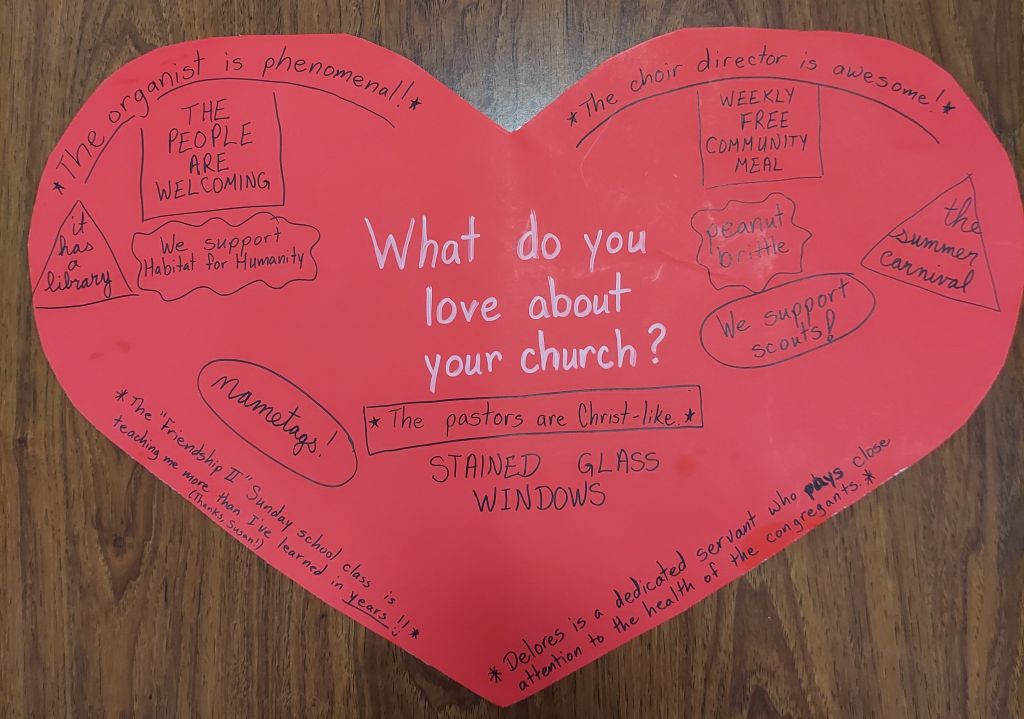
And thanks to last month’s stewardship campaign, the people of Christ Church were able to experience something that was very similar.  As a part of learning about Extravagant Generosity, everyone was asked to return cards asking them to “name a person who made a spiritual difference in your life,” or “What do you love about your church,” or “What is God asking you to do?”, or “Name one hope for our church in the future.”  And, while not everyone participated, the answers helped all of us to see our church through the eyes of others.  After years, or dozens of years, of membership, it’s easy to fall into a routine and see the church as the “same old – same old.”  But reading the answers, and seeing the things for which others were grateful, helped all of us to rediscover church that otherwise seemed so familiar.  In a way, all of us were able to rediscover church.

We remembered how extraordinary our worship services are, how much we love our Sunday school classes, Sunday sermons, small groups, being surrounded by people of faith, the encouragement of others, the friendships that we’ve made, the spirit of service that infuses everything, the way that our friends have become family to us, and even the opportunities that we have to work together making peanut brittle, working on Habitat projects, and other things.

One week we were asked to think about what God was asking us to do.  That was harder.  We had a more difficult time thinking about, and answering that question, and fewer people did.  But the answers that came showed that God was, and is, at work here and calls us to a renewed commitment to help others, serve others, give of our time, our talents, and our presence, and to be in tune with the needs of others.

And finally, we were asked to name one hope that we had for the future of our church.  Not surprisingly, some of us hoped that we would see better attendance, more members, more youth, more children, but we also hoped for more opportunities to pray, to do good in our neighborhood, and to be of service to others.

First, I want to thank everyone for having the courage to think about, and write down, their answers to these questions each week.  But also, I want to thank you for helping me, and for helping each other, to rediscover church.  We hope that more people would find faith in Jesus, and we hope that more children, youth, and adults would come here.  But why wouldn’t they?  Why wouldn’t anyone want to come here?  There are so many things that make our church special, vital, and important that many of the people that we know would love to be a part of it, and would undoubtedly be blessed, strengthened, and encouraged by it.  Of course, Christ Church would be a blessing to the lives of others.  If only they knew what they were missing. 

So, why don’t we invite them?

As we have rediscovered the gifts and blessings that our presence at Christ church is to us, it seems more obvious than ever that we would be selfish to keep it to ourselves.  People need what we have.  Many of the people we know are desperately searching for the sense of belonging, the purpose, the family, and the other blessings that we found at Christ church.  What we have is so good, and so important, that we have an obligation to share what we have with the people around us.  You’ve show us how much you love our church, you’ve told us.

Now go and tell your neighbors, your friends, and the people around you.

We have here is far too good to keep to ourselves.

People need what we have.

We need to share it.


Did you enjoy reading this?

Please LIKE and SHARE!

Click here to subscribe to Pastor John’s blog.

Click here if you would like to subscribe to Pastor John’s weekly messages.

Click here to visit Pastor John’s YouTube channel.

Out of Darkness

The video of this service can be found here: https://youtu.be/TF7bDRrEhMY.

Out of Darkness

(Christmas Eve)

December 24, 2021*

By Pastor John Partridge

Isaiah 9:2-7             Titus 2:11-14              Luke 2:1-20

Scripture Readings

Isaiah 9:2-7

The people who walked in darkness
    have seen a great light;
those who lived in a land of deep darkness—
    on them light has shined.
You have multiplied the nation,
    you have increased its joy;
they rejoice before you
    as with joy at the harvest,
    as people exult when dividing plunder.
For the yoke of their burden,
    and the bar across their shoulders,
    the rod of their oppressor,
    you have broken as on the day of Midian.
For all the boots of the tramping warriors
    and all the garments rolled in blood
    shall be burned as fuel for the fire.
For a child has been born for us,
    a son given to us;
authority rests upon his shoulders;
    and he is named
Wonderful Counselor, Mighty God,
    Everlasting Father, Prince of Peace.
His authority shall grow continually,
    and there shall be endless peace
for the throne of David and his kingdom.
    He will establish and uphold it
with justice and with righteousness
    from this time onward and forevermore.
The zeal of the Lord of hosts will do this.

Luke 2:1-20

2:1 In those days a decree went out from Emperor Augustus that all the world should be registered.  This was the first registration and was taken while Quirinius was governor of Syria.  All went to their own towns to be registered.  Joseph also went from the town of Nazareth in Galilee to Judea, to the city of David called Bethlehem, because he was descended from the house and family of David.  He went to be registered with Mary, to whom he was engaged and who was expecting a child.  While they were there, the time came for her to deliver her child.  And she gave birth to her firstborn son and wrapped him in bands of cloth, and laid him in a manger, because there was no place for them in the inn.

In that region there were shepherds living in the fields, keeping watch over their flock by night.  Then an angel of the Lord stood before them, and the glory of the Lord shone around them, and they were terrified.  10 But the angel said to them, “Do not be afraid; for see—I am bringing you good news of great joy for all the people: 11 to you is born this day in the city of David a Savior, who is the Messiah, the Lord.  12 This will be a sign for you: you will find a child wrapped in bands of cloth and lying in a manger.” 13 And suddenly there was with the angel a multitude of the heavenly host, praising God and saying,

14 “Glory to God in the highest heaven,
    and on earth peace among those whom he favors!”

15 When the angels had left them and gone into heaven, the shepherds said to one another, “Let us go now to Bethlehem and see this thing that has taken place, which the Lord has made known to us.” 16 So they went with haste and found Mary and Joseph, and the child lying in the manger.  17 When they saw this, they made known what had been told them about this child; 18 and all who heard it were amazed at what the shepherds told them.  19 But Mary treasured all these words and pondered them in her heart.  20 The shepherds returned, glorifying, and praising God for all they had heard and seen, as it had been told them.


Out of Darkness

(Christmas Eve)

December 24, 2021

By Pastor John Partridge

Eight hundred years before the birth of Jesus, the prophet Isaiah told of a messiah that would bring light to a people who walked in darkness, a savior that would bring light, joy, freedom, and the end of violence, a child that would bring endless peace, justice, and righteousness that would last forever.  After hearing Isaiah’s words, generation after generation watched for the coming of the Messiah.  The promise of God’s rescuer and redeemer was ever-present in the minds of the people of Israel, and even more precious, during times of hardship and suffering.  And so, after a civil war that divided the country, and the arrival of an occupying Roman army, as well as a burden of taxation and mistreatment at the hands of the Romans and their (often corrupt) tax collectors, the people were starved for good news and dreamed of the day when the Messiah would rescue them and change the world.

And then, as we heard in the story of Luke, on a dark hillside, probably in the springtime (because that’s when shepherds and their flocks would have been in the mountains), darkness is overcome by the light and the glory of God.  It isn’t difficult to imagine that in a world where candles and oil lamps were the state of the art, the lighting of an entire hillside was a terrifying experience.  But the message that they shepherds heard was, “Do not be afraid; for see – I am bringing you good news of great joy for all the people; to you is born this day in the city of David a Savior, who is the Messiah, the Lord.”  The light had come.  Darkness was being overthrown.  The Messiah had arrived. 

And when the angels had left them, even without instructions, the shepherds knew exactly what to do. 

The people had been hoping and praying for this to happen for eight hundred years.  Especially now, with the Roman occupation, the people needed to hear, they needed to know, because this was indeed “good news of great joy for all the people.”  The shepherds knew that they couldn’t keep this news to themselves.  They needed to go, immediately, with haste.  They hurried so that they could see this miracle for themselves and so that they could share the good news with everyone that they could find.

But what does it mean for us two thousand years later?  Of course, it is still “good news of great joy.”  It is still news that gives us hope for a future, and an eternity, filled with light, joy, freedom, and peace.  But what else?  As Paul writes to Titus in Crete, he describes the arrival of Jesus this way (Titus 2:11-14):

11 For the grace of God has appeared, bringing salvation to all, 12 training us to renounce impiety and worldly passions, and in the present age to live lives that are self-controlled, upright, and godly, 13 while we wait for the blessed hope and the manifestation of the glory of our great God and Savior, Jesus Christ.  14 He it is who gave himself for us that he might redeem us from all iniquity and purify for himself a people of his own who are zealous for good deeds.

Paul says that the arrival of Jesus brings salvation and rescue to all people, but that Jesus also came to train us to turn our backs on sin, immorality, vice and worldly passions and instead live lives that are filled with self-control, righteousness, and godliness.  The Messiah, Paul says, sacrificed himself so that we could be rescued from sin and made into a nation of people who are purified and eager to do good.

Every year, we meet at this time to remember.  We spend weeks celebrating the season of Advent, singing Christmas carols, watching Christmas specials on television, listening to Christmas music, decorating our homes, and whole neighborhoods, having Christmas parties at work, at home, at school, and at all sorts of clubs to which we belong.  And there’s nothing wrong with that.  This is, of course, good news of great joy for all the people.  There is every reason to remember and celebrate.  But let’s not forget God’s purpose.  Let’s not forget the reason that Jesus came was not just to rescue us from sin, but to train us to turn our backs on sin, immorality, and the worldly passions that our culture passes off as normal.  Instead, Jesus calls us to live lives that are filled with self-control, righteousness, and godliness.  Jesus sacrificed himself so that we, the church, could be transformed into a nation of people who are eager to do good.

Let us never forget that the angel said that this was “good news of great joy for all the people.”  Not just the Israeli people, not just the Jewish people, not just the Christian people, but for all the people.  And so, our mission, the mission of the church and of every person in it, is to remember the shepherds; to go out from this place praising God, sharing this good news with everyone that we can find, and doing everything that we can to become a people who are eager to do good.

Merry Christmas everyone.


Did you enjoy reading this?

Please LIKE and SHARE!

Click here to subscribe to Pastor John’s blog.

Click here if you would like to subscribe to Pastor John’s weekly messages.

Click here to visit Pastor John’s YouTube channel.


*You have been reading a message presented at Christ United Methodist Church on the date noted at the top of the first page.  Rev. John Partridge is the pastor at Christ UMC in Alliance, Ohio.  Duplication of this message is a part of our Media ministry, if you have received a blessing in this way, we would love to hear from you.  Letters and donations in support of the Media ministry or any of our other projects may be sent to Christ United Methodist Church, 470 East Broadway Street, Alliance, Ohio 44601.  These messages are available to any interested persons regardless of membership.  You may subscribe to these messages, in print or electronic formats, by writing to the address noted, or by contacting us at secretary@CUMCAlliance.org.  If you have questions, you can ask them in our discussion forum on Facebook (search for Pastor John Online).  These messages can also be found online at https://pastorpartridge.wordpress.com/.  All Scripture references are from the New International Version unless otherwise noted.

Who’s Your Daddy (The Path from Guilt to Glory)

Who’s Your Daddy?

(The Path from Guilt to Glory)

May 30, 2021*

(Trinity Sunday)

By Pastor John Partridge

Isaiah 6:1-8                            John 3:1-17                            Romans 8:12-17

For a time, there was a well-known taunt that asked, “Who’s your daddy?”  That phrase was popular enough to appear on playgrounds, high school hallways, pick-up basketball games, sitcoms, and Hollywood movies.  Sometimes it was intended as an insult, often it was used in good humor, but there is truth buried inside of it.  If we are to be secure, confident, and comfortable in who we are, is important for us to know where we came from.  Likewise, knowing where we came from can help to stay out of trouble, and guide us toward our goals for the future.  And so, as the followers of Jesus Christ, it is helpful for us understand where we came from and how we got where we are, so that we can better understand where we are going and toward what goals we should aspire.  We begin this morning with God’s call of the prophet Isaiah that we read in Isaiah 6:1-8>

6:1 In the year that King Uzziah died, I saw the Lord, high and exalted, seated on a throne; and the train of his robe filled the temple. Above him were seraphim, each with six wings: With two wings they covered their faces, with two they covered their feet, and with two they were flying. And they were calling to one another:

“Holy, holy, holy is the Lord Almighty;
    the whole earth is full of his glory.”

At the sound of their voices the doorposts and thresholds shook, and the temple was filled with smoke.

“Woe to me!” I cried. “I am ruined! For I am a man of unclean lips, and I live among a people of unclean lips, and my eyes have seen the King, the Lord Almighty.”

Then one of the seraphim flew to me with a live coal in his hand, which he had taken with tongs from the altar. With it he touched my mouth and said, “See, this has touched your lips; your guilt is taken away and your sin atoned for.”

Then I heard the voice of the Lord saying, “Whom shall I send? And who will go for us?”

And I said, “Here am I. Send me!”

Isaiah knew that he was unqualified to speak for God because of his sin and imperfection.  But God came to Isaiah and did for him what he could not do for himself.  He purified his lips, took away his guilt, and atoned for his sin so that Isaiah could speak for God.  And afterwards, Isaiah relents and says, “Here am I, Send me.”

But as we’ve been discussing for the last couple of weeks, the birth, death, and resurrection of Jesus, and the coming of the Spirit of God bring about a transformation in the way that God relates and communicates with his people and with his church.  We hear Jesus explain a part of that transformation to the Pharisee, Nicodemus, in John 3:1-17:

3:1 Now there was a Pharisee, a man named Nicodemus who was a member of the Jewish ruling council. He came to Jesus at night and said, “Rabbi, we know that you are a teacher who has come from God. For no one could perform the signs you are doing if God were not with him.”

Jesus replied, “Very truly I tell you, no one can see the kingdom of God unless they are born again.”

“How can someone be born when they are old?” Nicodemus asked. “Surely they cannot enter a second time into their mother’s womb to be born!”

Jesus answered, “Very truly I tell you, no one can enter the kingdom of God unless they are born of water and the Spirit. Flesh gives birth to flesh, but the Spiritgives birth to spirit. You should not be surprised at my saying, ‘Youmust be born again.’ The wind blows wherever it pleases. You hear its sound, but you cannot tell where it comes from or where it is going. So, it is with everyone born of the Spirit.”

“How can this be?” Nicodemus asked.

10 “You are Israel’s teacher,” said Jesus, “and do you not understand these things? 11 Very truly I tell you, we speak of what we know, and we testify to what we have seen, but still, you people do not accept our testimony. 12 I have spoken to you of earthly things, and you do not believe; how then will you believe if I speak of heavenly things? 13 No one has ever gone into heaven except the one who came from heaven—the Son of Man. 14 Just as Moses lifted up the snake in the wilderness, so the Son of Man must be lifted up, 15 that everyone who believes may have eternal life in him.”

16 For God so loved the world that he gave his one and only Son, that whoever believes in him shall not perish but have eternal life. 17 For God did not send his Son into the world to condemn the world, but to save the world through him.

Jesus says that following God is not enough but that the followers of God must be born again by being born of the Spirit by putting their faith and trust in Jesus.  This is the extension of what we saw in Isaiah as an individual, to all of God’s people collectively.  God came to Isaiah, purified him, and atoned for his sin so that he could serve and speak for God.  But through his life, death, and resurrection, Jesus atoned for our sins, and purified us, so that we can serve God and do his work.  And, with the gift of the baptism of the Spirit of God, we are given the strength of God and equipped for service.

But that’s exactly what we’ve been talking about for the last two weeks so none of that is particularly surprising.  We discover the interesting part when we start tracing our lineage, finding our history, and begin to understand how that heritage, a how that path through history, helps us to understand who we are.  In Romans 8:12-17 Paul begins to connect those dots for us when he says:

12 Therefore, brothers and sisters, we have an obligation—but it is not to the flesh, to live according to it. 13 For if you live according to the flesh, you will die; but if by the Spirit you put to death the misdeeds of the body, you will live.

14 For those who are led by the Spirit of God are the children of God. 15 The Spirit you received does not make you slaves, so that you live in fear again; rather, the Spirit you received brought about your adoption to sonship. And by him we cry, “Abba, Father.” 16 The Spirit himself testifies with our spirit that we are God’s children. 17 Now if we are children, then we are heirs—heirs of God and co-heirs with Christ, if indeed we share in his sufferings in order that we may also share in his glory.

Paul says that the coming of the Spirit of God is evidence of our adoption, by God, as brothers and sisters of Jesus Christ and heirs of God.  Which, incidentally, means that God is our Daddy.  And that adoption completes the lineage that scripture has been drawing for us since the time of the prophets in the Old Testament where we first discover God at work for, and among, his people.  But then God sends Jesus to bring removal of guilt, and atonement for sin and after his ascension into heaven, Jesus, in turn, sends the Spirit and the Spirit brings about our adoption as sons and daughters of God.  Put another way, scripture describes how God has moved us from condemnation and guilt and toward our perfection and our eternal home.  We are moved from guilt, to adoption, from adoption to inheritance, and from inheritance to glory.

But, Paul says, our adoption also brings us an obligation for the indescribable gift that we have been given.  But Paul also notes that this obligation is not an obligation to flesh, that is, not an obligation to principalities, or powers or, people, or priests, or pastors, but it is an obligation to live by the Spirit of God, to live the way that God calls us to live, to do the work of the Kingdom of heaven, to share in the suffering of Jesus, so that we might also share in his glory in our eternal home.

It is that obligation that brings us full circle from where we started because as we move from guilt to adoption, from adoption to inheritance, from inheritance to glory, and from glory to service, we hear God asking us the same question that he asked Isaiah:

“Whom shall I send?  And who will go for us?”

And because we our guilt has been atoned for, our sin has been washed away, and we have been adopted by God as sons and daughters, with God as our Daddy, as co-heirs with Jesus Christ, and filled, equipped, and strengthened with the Spirit of God, we hear Paul urging us to answer as Isaiah did:

“Here am I.  Send me.”


You can find the video of this worship service here: https://youtu.be/0qlBh7ZpXvY

Did you enjoy reading this?

Click here to subscribe to Pastor John’s blog.

Click here if you would like to subscribe to Pastor John’s weekly messages.

Click here to visit Pastor John’s YouTube channel.


*You have been reading a message presented at Christ United Methodist Church on the date noted at the top of the first page.  Rev. John Partridge is the pastor at Christ UMC in Alliance, Ohio.  Duplication of this message is a part of our Media ministry, if you have received a blessing in this way, we would love to hear from you.  Letters and donations in support of the Media ministry or any of our other projects may be sent to Christ United Methodist Church, 470 East Broadway Street, Alliance, Ohio 44601. These messages are available to any interested persons regardless of membership.  You may subscribe to these messages, in print or electronic formats, by writing to the address noted, or by contacting us at secretary@CUMCAlliance.org.  If you have questions, you can ask them in our discussion forum on Facebook (search for Pastor John Online).  These messages can also be found online at https://pastorpartridge.wordpress.com/. All Scripture references are from the New International Version unless otherwise noted.