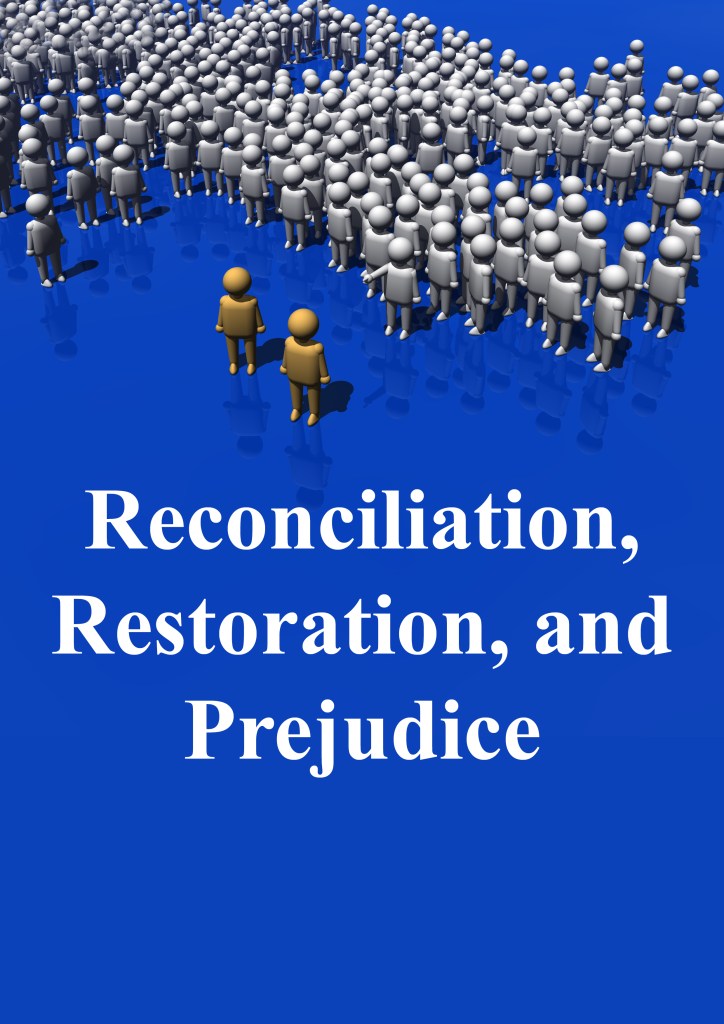
Reconciliation, Restoration, and Prejudice

Reconciliation, Restoration, and Prejudice

March 30, 2025*

By Pastor John Partridge

Joshua 5:9-12             Luke 15:1-3, 11b-32              2 Corinthians 5:16-21

Have you ever done major, even irreversible damage to a relationship? You said the wrong thing, spoke hastily in anger, didn’t show up when you needed to be there, failed to stand up for a friend, or walked out when you should have given a hug instead? There are many things that we can do, or fail to do, that can damage our relationships with the people that we care about. But if we want those people in our lives, then we need to find a way to make amends, to apologize, mend fences, and rebuild the trust that was broken. Sometimes that isn’t possible, but you can never know for sure if you don’t try. But sometimes the relationship that was damaged was the one between us and God. And when that happens, we have some choices to make about how we go about restoring our relationship and rebuilding trust. And so, this morning, we take a look at several scriptures that speak to restoration, reconciliation, and the obstacles that can stand between us, distance us from God, and cause damage to our relationship.

We begin this morning reading from Joshua 5:9-12 and we hear about the return of Israel to the land that God had promised to them from the time of Abraham, Isaac, and Jacob.

Then the Lord said to Joshua, “Today I have rolled away the reproach of Egypt from you.” So, the place has been called Gilgal to this day.

10 On the evening of the fourteenth day of the month, while camped at Gilgal on the plains of Jericho, the Israelites celebrated the Passover. 11 The day after the Passover, that very day, they ate some of the produce of the land: unleavened bread and roasted grain. 12 The manna stopped the day afterthey ate this food from the land; there was no longer any manna for the Israelites, but that year they ate the produce of Canaan.

On the day of Passover, everyone eats a meal that is laid out in the tradition of that celebration: green vegetables or potatoes symbolizing the coming of spring, Haroset, a combination of fruits, wine or honey, and nuts, symbolizing the mortar that the Israelites used to built the temples in Egypt, bitter herbs symbolizing the bitterness of slavery, boiled eggs symbolizing hope, a roasted beet symbolizing the blood of the Temple sacrifice, and matzah or unleavened bread symbolizing the bread of affliction that the Israelites ate during their time in Egypt. But as the people celebrate Passover, and the fulfillment of God’s promise seen in their arrival in the Promised Land, the very next day, the manna that had fed them for forty years in the desert… stopped.

And now, rather than eat the manna that God provided, the intermediate necessity given to aid in their survival, the people now ate the food that God provided by means of the land itself. No longer were they wandering in the desert, now they were home in a fertile land that could provide them with the food that they needed. Now, God had fulfilled his promise, and the people were restored to the land. The ending of God’s daily provision of manna represented their restoration to the land and the restoration of their relationship with God.

The problem that we have, as the people of God, is when we get in our own way and decide that groups of people aren’t good enough even when God hasn’t said any such thing. Jesus makes this point in Luke 15:1-3, 11b-32 and exposes the prejudice of the Pharisees as he tells the parable about the prodigal son saying:

15:1 Now the tax collectors and sinners were all gathering around to hear Jesus. But the Pharisees and the teachers of the law muttered, “This man welcomes sinners and eats with them.”

Then Jesus told them this parable:

“There was a man who had two sons. 12 The younger one said to his father, Father, give me my share of the estate.’ So, he divided his property between them.

13 “Not long after that, the younger son got together all he had, set off for a distant country and there squandered his wealth in wild living. 14 After he had spent everything, there was a severe famine in that whole country, and he began to be in need. 15 So he went and hired himself out to a citizen of that country, who sent him to his fields to feed pigs. 16 He longed to fill his stomach with the pods that the pigs were eating, but no one gave him anything.

17 “When he came to his senses, he said, ‘How many of my father’s hired servants have food to spare, and here I am starving to death! 18 I will set out and go back to my father and say to him: Father, I have sinned against heaven and against you. 19 I am no longer worthy to be called your son; make me like one of your hired servants.’ 20 So he got up and went to his father.

“But while he was still a long way off, his father saw him and was filled with compassion for him; he ran to his son, threw his arms around him, and kissed him.

21 “The son said to him, ‘Father, I have sinned against heaven and against you. I am no longer worthy to be called your son.’

22 “But the father said to his servants, ‘Quick! Bring the best robe and put it on him. Put a ring on his finger and sandals on his feet. 23 Bring the fattened calf and kill it. Let’s have a feast and celebrate. 24 For this son of mine was dead and is alive again; he was lost and is found.’ So, they began to celebrate.

25 “Meanwhile, the older son was in the field. When he came near the house, he heard music and dancing. 26 So he called one of the servants and asked him what was going on. 27 ‘Your brother has come,’ he replied, ‘and your father has killed the fattened calf because he has him back safe and sound.’

28 “The older brother became angry and refused to go in. So, his father went out and pleaded with him. 29 But he answered his father, ‘Look! All these years I’ve been slaving for you and never disobeyed your orders. Yet you never gave me even a young goat so I could celebrate with my friends. 30 But when this son of yours who has squandered your property with prostitutes comes home, you kill the fattened calf for him!’

31 “‘My son,’ the father said, ‘you are always with me, and everything I have is yours. 32 But we had to celebrate and be glad, because this brother of yours was dead and is alive again; he was lost and is found.’”

Let’s review the highlights of that conversation. The Pharisees accuse Jesus of consorting with the wrong kind of people whereupon Jesus tells them a story in which the son that was always faithful and who did everything right, and the son who clearly represented the Pharisees in this case, got angry because the father, who represents God, chose to be merciful to the son that made mistakes, repented, and returned to his father. The elder son goes as far as to declare that the younger son is not his brother, but his father gently reminds him that his brother was once dead but is alive again. The critical piece is that while the father is willing to forgive and reconcile with his lost son, the older brother’s prejudice corrupts his heart into excluding the people that don’t fit into the roles that he expects them to fill. It is his prejudice that excludes his brother and not the sins of which he believes his brother to be guilty.

By means of this story, Jesus was telling the Pharisees that their attitude towards those that they labelled as sinners was the same prejudice seen in the older brother. It was that prejudice that prevented them from extending God’s grace and forgiveness to the people who wanted to repent and return to God. But how does that extend to us? In 2 Corinthians 5:16-21, Paul tells us how this applies to the work of the church and how it applies to us in our modern day lives. Paul says:

16 So from now on we regard no one from a worldly point of view. Though we once regarded Christ in this way, we do so no longer. 17 Therefore, if anyone is in Christ, the new creation has come: The old has gone, the new is here! 18 All this is from God, who reconciled us to himself through Christ and gave us the ministry of reconciliation: 19 that God was reconciling the world to himself in Christ, not counting people’s sins against them. And he has committed to us the message of reconciliation. 20 We are therefore Christ’s ambassadors, as though God were making his appeal through us. We implore you on Christ’s behalf: Be reconciled to God. 21 God made him who had no sin to be sinfor us, so that in him we might become the righteousness of God.

Paul says that we all need to stop looking at the people around us the way that the world looks at people. Instead, we must see the people around us as the new creations of Jesus Christ. Each person who repents and comes to Jesus is reconciled to God because of the sacrifice that was made on the cross. Jesus’ sacrifice made it possible for all of us… and the emphasis here should not be missed, all of us… to become the righteousness of God.

But as Paul warned the church in Corinth, we must be careful that we see the people around us as new creations in Jesus Christ and not to judge them with the prejudice of the world. We cannot see people as sinners and outcasts as the Pharisees did, or as traitors and scoundrels as the older brother did, or even as Democrats, Republicans, poor, rich, immigrants, or any other label that our modern culture wants to use, but instead we must see the people around us as the Jesus and as the prodigal son’s father did, and be open to forgiveness, grace, reconciliation, restoration, peace, and love. Holding on to our prejudice, as the older brother did, will prevent us from receiving the grace, forgiveness, and the blessings that God intends for us.

We are therefore Christ’s ambassadors, as though God were making his appeal through us.

May the people around us see God in us… and not our prejudice and bias.


Please LIKE and SHARE!

Click here to subscribe to Pastor John’s blog.

Click here if you would like to subscribe to Pastor John’s weekly messages.

Click here to visit Pastor John’s YouTube channel.


*You have been reading a message presented at Christ United Methodist Church on the date noted at the top of the first page.  Rev. John Partridge is the pastor at Christ UMC in Alliance, Ohio.  Duplication of this message is a part of our Media ministry, if you have received a blessing in this way, we would love to hear from you.  Letters and donations in support of the Media ministry or any of our other projects may be sent to Christ United Methodist Church, 470 East Broadway Street, Alliance, Ohio 44601.  These messages are available to any interested persons regardless of membership.  You may subscribe to these messages, in print or electronic formats, by writing to the address noted, or by contacting us at secretary@CUMCAlliance.org.  These messages can also be found online at https://pastorpartridge.com .  All Scripture quotations, unless otherwise indicated, are taken from the Holy Bible, New International Version®, NIV®. Copyright ©1973, 1978, 1984, 2011 by Biblica, Inc.™ Used by permission of Zondervan. All rights reserved worldwide. www.zondervan.comThe “NIV” and “New International Version” are trademarks registered in the United States Patent and Trademark Office by Biblica, Inc.™

Photo by roijaune on Freeimages.com

Unmasked!

Click here to listen to the podcast

Click here to watch the livestream: https://youtu.be/7_DJBw967X8

Unmasked!

February 27, 2022*

By Pastor John Partridge

Exodus 34:29-35             Luke 9:28-36                       2 Corinthians 3:12 – 4:2

Have you ever felt self-conscious?  Have you worried that you don’t look quite right, or suddenly notice that everyone seems to be looking at you?  Maybe you have food stuck in your teeth, or your fly is unzipped, or your skin broke out and have a big zit or something.  It happens to everyone.  There even a powerful photograph of President Carter, Menachem Begin, and Anwar Sadat moments before they went in front of the cameras to sign the Camp David Accords.  In that moment, all three of these men, presidents of powerful nations, simultaneously and self-consciously stop to straighten their neckties before stepping out into the glare of the public eye.  And, I wonder if what we see in Exodus 34:29-35, was caused, at least in part, by Moses being self-conscious about everyone looking at him.

29 When Moses came down from Mount Sinai with the two tablets of the covenant law in his hands, he was not aware that his face was radiant because he had spoken with the Lord. 30 When Aaron and all the Israelites saw Moses, his face was radiant, and they were afraid to come near him. 31 But Moses called to them; so, Aaron and all the leaders of the community came back to him, and he spoke to them. 32 Afterward all the Israelites came near him, and he gave them all the commands the Lord had given him on Mount Sinai.

33 When Moses finished speaking to them, he put a veil over his face. 34 But whenever he entered the Lord’s presence to speak with him, he removed the veil until he came out. And when he came out and told the Israelites what he had been commanded, 35 they saw that his face was radiant. Then Moses would put the veil back over his face until he went in to speak with the Lord.

After Moses met with God, he was outwardly, and visibly, changed.  Our scripture says that his face was radiant, and from the description, that doesn’t seem to mean that he was happy in the way that we say, “the bride was radiant.”  We are, apparently, to understand that Moses’ face was… glowing… with a light of its own and that light, not surprisingly, was at least disconcerting, if not frightening, to the people around him.  The world didn’t seem any different to Moses, but Moses’ appearance was different, and it was noticeable, even shocking, to everyone who saw him.  And so, either to calm the fears of everyone else, or to calm his own feelings of self-consciousness, Moses began to wear a mask in public after each of his meetings with God.  There was something about being in the presence of God, that changes human beings.  And we see something similar in Luke 9:28-36.

28 About eight days after Jesus said this, he took Peter, John, and James with him and went up onto a mountain to pray. 29 As he was praying, the appearance of his face changed, and his clothes became as bright as a flash of lightning. 30 Two men, Moses, and Elijah, appeared in glorious splendor, talking with Jesus. 31 They spoke about his departure, which he was about to bring to fulfillment at Jerusalem. 32 Peter and his companions were very sleepy, but when they became fully awake, they saw his glory and the two men standing with him. 33 As the men were leaving Jesus, Peter said to him, “Master, it is good for us to be here. Let us put up three shelters—one for you, one for Moses and one for Elijah.” (He did not know what he was saying.)

34 While he was speaking, a cloud appeared and covered them, and they were afraid as they entered the cloud. 35 A voice came from the cloud, saying, “This is my Son, whom I have chosen; listen to him.” 36 When the voice had spoken, they found that Jesus was alone. The disciples kept this to themselves and did not tell anyone at that time what they had seen.

The disciples had become accustomed to traveling with Jesus and it was probably not uncommon for them to wake up early and be walking before the sun had risen.  But whatever the case on this day, whether morning or evening, the disciples that were walking with Jesus were half asleep.  But as Jesus prayed, the appearance of his face changed… and even his clothes changed so that they became as bright as a flash of lightning.  And then Moses and Elijah appeared, and they shone in “glorious splendor” perhaps, in a way, that was similar to the way that Moses’ face had shone when he met God.  And so now, obviously, Peter, James, and John were absolutely, completely, 100 percent awake and were, in a sense, in shock.  As soon as Moses and Elijah began to leave, Peter just begins to babble nonsense about building houses, worship centers, or something.  And then, as if this hadn’t been enough, suddenly a cloud appears, envelops them, and the voice of God announces that the disciples should listen to Jesus because he is his son.  And then, just as suddenly as it began, it was over, and they found themselves standing, on the mountainside, alone.

What I find interesting, is that even though Peter had been babbling about building shelters, and although Peter was often prone to shoot off his mouth, and to say things without thinking, after this incredible experience, none of these three disciples say… anything.  They don’t tell their families, they don’t tell the other disciples, they don’t tell anybody… anything.  And again, I think this has a lot to do with the disciples feeling self-conscious.  What they had just experienced was powerful, incredible, and probably more than a little… unbelievable.  Even for people who had witnessed Jesus heal the sick and raise the dead, who would believe what they had just seen?  Who would believe that they had seen the glory of God radiating from the face of Jesus?  Who would believe that they had been surrounded by the holy cloud of God that they had read about in the scriptures, or that they had met Moses and Elijah?  Who would believe that they had heard God’s own voice proclaiming that Jesus was his son?  Would anyone believe them?  Would they think they were crazy?  Would the Pharisees and other church leaders declare that they were heretics and throw them out of the Temple?

And regardless of their self-consciousness or fear, the disciples could not un-see what they had seen.  Like Moses, they had spent time in the presence of God, and they had been changed.

But what does that mean for us?  What do we take away from these stories of Moses, Jesus, the disciples, and the transfiguration?  In 2 Corinthians 3:12 – 4:2, Paul explained it to his church this way:

12 Therefore, since we have such a hope, we are very bold. 13 We are not like Moses, who would put a veil over his face to prevent the Israelites from seeing the end of what was passing away. 14 But their minds were made dull, for to this day the same veil remains when the old covenant is read. It has not been removed, because only in Christ is it taken away. 15 Even to this day when Moses is read, a veil covers their hearts. 16 But whenever anyone turns to the Lord, the veil is taken away. 17 Now the Lord is the Spirit, and where the Spirit of the Lord is, there is freedom. 18 And we all, who with unveiled faces contemplate the Lord’s glory, are being transformed into his image with ever-increasing glory, which comes from the Lord, who is the Spirit.

4:1 Therefore, since through God’s mercy we have this ministry, we do not lose heart. Rather, we have renounced secret and shameful ways; we do not use deception, nor do we distort the word of God. On the contrary, by setting forth the truth plainly we commend ourselves to everyone’s conscience in the sight of God.

Obviously, Paul’s understanding of why Moses wore a veil is not he same as mine and, I think, not the same as the reason given in Exodus.  Exodus simply says that people were afraid to look at Moses because he glowed or radiated but Paul interprets that to mean that Moses wore a mask so that people couldn’t see that the radiance of God in him faded over time.  Those are not at all the same things and, I think, Paul’s interpretation is unfair, and a little unkind, to Moses.  But I also think that Paul says this to make a point.  Paul makes the point of saying that accepting Christ is like tearing away the veil, or unmasking God so that we can see his glory more clearly.  Christians, Paul says, are the “unveiled faces” that can see God more clearly and something happens to us because of it.

As I said before, human beings that have spent time in the presence of God, are changed by the experience.  Moses glowed.  He was both outwardly and inwardly different because he met God.  Peter and James and John, and all the other disciples, were changed because of the time that they spent in the presence of both God and his son, Jesus.  Paul met Jesus on the road to Damascus, his entire life was turned upside down, and he was never the same afterwards.  Paul says that because we have met Jesus, and because we have been unmasked, and have seen the glory of God, our lives have also been changed.  We don’t give up, we are encouraged, we no longer deceive other people or distort the word of God.  Instead, we tell the truth as plainly as we can, and we tell the truth all the time, so that everyone will know that we can be trusted.

But there’s one more thing worth mentioning, I think.  Paul believed that when Moses met God face to face, the glory of God that radiated from Moses’ face faded over time.  And while I’m not sure that’s how I would interpret it, there is some sense to it.  Human beings are not God.  We do not, and we cannot, contain God’s glory.  Being in the presence of God changes us, but the effect in us fades if we aren’t deliberate in doing things that bring us back into God’s presence.  That’s why setting times of regular Bible study, prayer, and church attendance are so vital.  Nearly every Sunday, we pray that God would be at work changing us into the people that he created us to be.  But for that to happen, we need to do two things.  First, we need to give God permission to change us, and be willing to change.  And second, we must, regularly and deliberately, invite God into our lives, and set aside time for us to spend time in God’s presence.

But we warned: Just as Moses, Peter, James, John, Paul, and the disciples discovered, being in God’s presence changes people. 

And maybe that’s why so many people seem to be afraid to do it.


Did you enjoy reading this?

Please LIKE and SHARE!

Click here to subscribe to Pastor John’s blog.

Click here if you would like to subscribe to Pastor John’s weekly messages.

Click here to visit Pastor John’s YouTube channel.


*You have been reading a message presented at Christ United Methodist Church on the date noted at the top of the first page.  Rev. John Partridge is the pastor at Christ UMC in Alliance, Ohio.  Duplication of this message is a part of our Media ministry, if you have received a blessing in this way, we would love to hear from you.  Letters and donations in support of the Media ministry or any of our other projects may be sent to Christ United Methodist Church, 470 East Broadway Street, Alliance, Ohio 44601.  These messages are available to any interested persons regardless of membership.  You may subscribe to these messages, in print or electronic formats, by writing to the address noted, or by contacting us at secretary@CUMCAlliance.org.  If you have questions, you can ask them in our discussion forum on Facebook (search for Pastor John Online).  These messages can also be found online at https://pastorpartridge.com/.  All Scripture references are from the New International Version unless otherwise noted.

Dimensional Rifts, and You

Dimensional Rifts and You*

February 14, 2021

by Pastor John Partridge

2 Kings 2:1-12                        Mark 9:2-9                             2 Corinthians 4:3-6

If you are a fan of Star Trek, science fiction, comic books, the Marvel moviemaking universe, or physics, you have almost certainly heard of dimensional rifts.  For those of you who have not, the basic idea is that other universes exist, within the same space as our own, but slightly out of phase with ours in some way, or more to the point, in a slightly different dimension than our own.  In comic books this is used to explain how Captain Marvel and Superman can both exist on a planet known as Earth but have never met one another or how Doctor Strange can magically travel from one place to another.  In Star Trek, it provides an opportunity for the heroes to encounter strange new aliens, or the basis of cloaking technology, or for the famous episode in which a good Captain Kirk fights with an evil Captain Kirk as well as how we remember Mr. Spock with a goatee.  In all these cases, a dimensional rift is place where, by accident or design, two different worlds that are ordinarily separated can meet, and even interact, with one another.

But since none of us are characters in comic books, television, or movies, what does any of that have to do with us?  And the answer is that these examples from our imagination might aid our understanding of a few unusual moments that we encounter in scripture.  Our first example of this for today if found in 2 Kings 2:1-12 where we read about the last day of the prophet Elijah’s life on earth.

2:1 When the Lord was about to take Elijah up to heaven in a whirlwind, Elijah and Elisha were on their way from Gilgal. Elijah said to Elisha, “Stay here; the Lord has sent me to Bethel.”

But Elisha said, “As surely as the Lord lives and as you live, I will not leave you.” So, they went down to Bethel.

The company of the prophets at Bethel came out to Elisha and asked, “Do you know that the Lord is going to take your master from you today?”

“Yes, I know,” Elisha replied, “so be quiet.”

Then Elijah said to him, “Stay here, Elisha; the Lord has sent me to Jericho.”

And he replied, “As surely as the Lord lives and as you live, I will not leave you.” So, they went to Jericho.

The company of the prophets at Jericho went up to Elisha and asked him, “Do you know that the Lord is going to take your master from you today?”

“Yes, I know,” he replied, “so be quiet.”

Then Elijah said to him, “Stay here; the Lord has sent me to the Jordan.”

And he replied, “As surely as the Lord lives and as you live, I will not leave you.” So, the two of them walked on.

Fifty men from the company of the prophets went and stood at a distance, facing the place where Elijah and Elisha had stopped at the Jordan. Elijah took his cloak, rolled it up and struck the water with it. The water divided to the right and to the left, and the two of them crossed over on dry ground.

When they had crossed, Elijah said to Elisha, “Tell me, what can I do for you before I am taken from you?”

“Let me inherit a double portion of your spirit,” Elisha replied.

10 “You have asked a difficult thing,” Elijah said, “yet if you see me when I am taken from you, it will be yours—otherwise, it will not.”

11 As they were walking along and talking together, suddenly a chariot of fire and horses of fire appeared and separated the two of them, and Elijah went up to heaven in a whirlwind. 12 Elisha saw this and cried out, “My father! My father! The chariots and horsemen of Israel!” And Elisha saw him no more. Then he took hold of his garment and tore it in two.

While the spiritual world is normally invisible to those of us in the physical world, there are moments, like this one, when a dimensional rift seems to open between them, and the spiritual world breaks out into ours.  As Elisha cries out in amazement, a chariot, and horses of fire emerge into our physical world and separate Elijah and Elisha just as Elijah is carried into heaven by a tornado of swirling winds.  And, just as suddenly as they appeared, the horses, the chariot, and the whirlwind, disappear back through the rift taking Elijah with them.

At least a part of the message for us is something that both Elijah and Elisha were well aware, that although it is most often unseen by us in the physical world, the spiritual world is just as real as ours and what happens in the spiritual world has an impact on the physical world as well as those of us who inhabit it.  The message of scripture is that the spiritual world is connected to our world, and influences the events of our world, even if it only occasionally breaks through in such a way that it can be seen by us.

Perhaps the most well-known dimensional rift between the spiritual and physical worlds is recorded for us in Mark 9:2-9 where we read the story of Jesus’ transfiguration:

After six days Jesus took Peter, James, and John with him and led them up a high mountain, where they were all alone. There he was transfigured before them. His clothes became dazzling white, whiter than anyone in the world could bleach them. And there appeared before them Elijah and Moses, who were talking with Jesus.

Peter said to Jesus, “Rabbi, it is good for us to be here. Let us put up three shelters—one for you, one for Moses and one for Elijah.” (He did not know what to say, they were so frightened.)

Then a cloud appeared and covered them, and a voice came from the cloud: “This is my Son, whom I love. Listen to him!”

Suddenly, when they looked around, they no longer saw anyone with them except Jesus.

As they were coming down the mountain, Jesus gave them orders not to tell anyone what they had seen until the Son of Man had risen from the dead. 10 They kept the matter to themselves, discussing what “rising from the dead” meant.

Because much like the angels, Jesus is himself a spiritual creature, during the time of his ministry on earth, he existed in both the spiritual and the physical worlds.  Despite that dual existence, his spiritual presence was not visible to the physical world, until a rift between the two opened on the top of that mountain.  At that moment, and in that place, both the physical and spiritual worlds existed, and were visible in the physical world, at the same time.  Although Mark describes Jesus as being “transfigured” in the presence of Peter, James, and John, we might also think of this as a moment in which the Disciples were simply able to see Jesus as he really was, or how he would ordinarily appear to be in the spiritual world.  And, because our two worlds collided in that moment, the disciples were also able to see Elijah and Moses, men who were long dead in the physical world, but whose lives had continued, uninterrupted, in the spiritual world.

But why does any of that matter to us?

It matters because it has implications for the people, and for the church, in the first, and in the twenty-first centuries.  In 2 Corinthians 4:3-6, Paul writes to the church to explain our role in sharing the gospel and explains how we, as the followers of Jesus Christ, can be the agents of the spiritual world in the creation of “dimensional rifts.”  Paul says:

And even if our gospel is veiled, it is veiled to those who are perishing. The god of this age has blinded the minds of unbelievers, so that they cannot see the light of the gospel that displays the glory of Christ, who is the image of God. For what we preach is not ourselves, but Jesus Christ as Lord, and ourselves as your servants for Jesus’ sake. For God, who said, “Let light shine out of darkness,” made his light shine in our hearts to give us the light of the knowledge of God’s glory displayed in the face of Christ.

While it may be helpful to think of the spiritual world as being in another dimension or on the “other side” of a dimensional rift the truth, Paul says, is that the “god of this age” that blinds unbelievers to the truth.  And, while some have taught that the “god of this age” is Satan, Paul never describes the enemy of God in this way and likely would never have elevated one of God’s enemies to the status of a “god.”  But what Paul has described as a god, are things like wealth, money, sex, power, selfishness, culture, princes, governments, and other things that can be worshiped in place of the one true God.  Our own sin is what blinds us to the truth of the gospel and to the nearness of the spiritual world.  But, as the followers of Jesus Christ, we have the power to be “dimensional rifts” between the spiritual and the physical worlds.  We have the ability and the power to let light shine out of darkness, to let the light and truth of the spiritual world break out into the darkness of the physical world in which we live.  As the followers of Jesus Christ, we can let his spiritual light shine in our hearts so that we can see the truth and so that God’s glory can be revealed to the people around us.

We are the “dimensional rifts.” We are called to be the sources of light and the sources of truth.  We are the ones who can fight against the gods of this age, who can fight against the worship of self, money, power, pleasure, and everything else.  We are the ones who can help our neighbors to see the light of the gospel by letting the light of Jesus shine in our hearts and break through into our spiritual dimension.

You may not be the captain of a starship and it may not be quite like what you might find in an episode of Star Trek, a movie from the Marvel Universe, or a Doctor Strange comic book.  But you are called to be a dimensional rift, and let the light, love, and truth of the spiritual world fill your heart and break out into your neighborhood and your community so that the people around you can see and hear the truth of the gospel of Jesus.

Make it so.


You can find the video of this worship service here: https://youtu.be/QhG52V8fQE0

Did you enjoy reading this?

Click here if you would like to subscribe to Pastor John’s weekly messages.

Click here to subscribe to Pastor John’s blog.

Click here to visit Pastor John’s YouTube channel.


*You have been reading a message presented at Christ United Methodist Church on the date noted at the top of the first page.  Rev. John Partridge is the pastor at Christ UMC in Alliance, Ohio.  Duplication of this message is a part of our Media ministry, if you have received a blessing in this way, we would love to hear from you.  Letters and donations in support of the Media ministry or any of our other projects may be sent to Christ United Methodist Church, 470 East Broadway Street, Alliance, Ohio 44601. These messages are available to any interested persons regardless of membership.  You may subscribe to these messages, in print or electronic formats, by writing to the address noted, or by contacting us at secretary@CUMCAlliance.org.  If you have questions, you can ask them in our discussion forum on Facebook (search for Pastor John Online).  These messages can also be found online at https://pastorpartridge.wordpress.com/. All Scripture references are from the New International Version unless otherwise noted.