The Reward of Faithfulness

The Reward of Faithfulness

December 31, 2023*

By Pastor John Partridge

Isaiah 61:10 – 62:3                 Luke 2:22-40                          Galatians 4:4-7

The world had changed. The world in which I have worked as an adult bears little resemblance to the working world that my grandfather knew, only some resemblance to the world that my father knew, and I’m certain that the world in which my grandchildren eventually work will similarly be different. Once upon a time, it was common for men, because it was men, to get hired, work their entire lives, and retire from the same company, and get a gold watch or something similarly symbolic after 30 or 40 years of their lives at that employer. That sort of thing is rare rather than common today, although retirees might still get gold watch watches or similar retirement gifts in some places. It was once common for those retirees to receive pensions at their retirement, but again, employers that even offer a pension are rare rather common in today’s working world.

But if there aren’t gold watches and pensions given at retirement, then what is the reward for thirty or forty years of faithfulness? And, since we’re asking the question, what reward do we receive for a lifetime of service and faithfulness to God? We gain some insight into this as we read the words contained in Isaiah 61:10 – 62:3 where it says:

10 I delight greatly in the Lord;
    my soul rejoices in my God.
For he has clothed me with garments of salvation
    and arrayed me in a robe of his righteousness,
as a bridegroom adorns his head like a priest,
    and as a bride adorns herself with her jewels.
11 For as the soil makes the sprout come up
    and a garden causes seeds to grow,
so the Sovereign Lord will make righteousness
    and praise spring up before all nations.

62:1 For Zion’s sake I will not keep silent,
    for Jerusalem’s sake I will not remain quiet,
till her vindication shines out like the dawn,
    her salvation like a blazing torch.
The nations will see your vindication,
    and all kings your glory;
you will be called by a new name
    that the mouth of the Lord will bestow.
You will be a crown of splendor in the Lord’s hand,
    a royal diadem in the hand of your God.

Isaiah says that God has deliberately set the people and the nation of Israel apart from the rest of the world and clothed them in salvation and righteousness. God’s mysterious and irresistible spirit is at work planting a garden of righteousness and praise throughout the nations of the world so that one day, Israel will be exonerated and declared innocent of all accusations that have been made against her and she will be called by a new name, given to her by God. On that day Jerusalem will be a jewel in the crown of God almighty. But, given the news from Israel that we see each day today, that day has not yet come. But God is not done with human history, and we see signs in Luke 2:22-40 that foreshadow the future as we meet several characters of the Christmas story, see their faithfulness before God, and hear how God rewards them:

22 When the days for their purification were completed according to the Law of Moses, they brought the child up to Jerusalem to present him to the Lord, 23 as it is prescribed in the Law of the Lord: “Every firstborn male shall be consecrated to the Lord,” 24 and to offer a sacrifice in accordance with what is stated in the Law of the Lord, “a pair of turtledoves or two young pigeons.”

25 At that time, there was a man in Jerusalem whose name was Simeon. This upright and devout man was awaiting the consolation of Israel, and the Holy Spirit rested on him. 26 It had been revealed to him by the Holy Spirit that he would not experience death before he had seen the Christ of the Lord.

27 Prompted by the Spirit, Simeon came into the temple. When the parents brought in the child Jesus to do for him what was required by the Law, 28 he took him in his arms and praised God, saying:

29 “Now, Lord, you may dismiss your servant in peace,
    according to your word;
30 for my eyes have seen your salvation,
31     which you have prepared in the sight of all the peoples,
32 a light of revelation to the Gentiles
    and glory for your people Israel.”

33 The child’s father and mother marveled at what was being said about him. 34 Then Simeon blessed them and said to Mary his mother: “This child is destined for the fall and rise of many in Israel, and to be a sign that will be opposed, 35 so that the secret thoughts of many will be revealed, and you yourself a sword will pierce.”

36 There was also present a prophetess, Anna, the daughter of Phanuel, of the tribe of Asher. She was very advanced in years, having lived with her husband for seven years after their marriage, 37 and then as a widow to the age of eighty-four. She never left the temple but worshiped with fasting and prayer night and day. 38 At that moment, she came forward and began to praise God, while she spoke about the child to all who were looking forward to the deliverance of Jerusalem.

39 When they had fulfilled everything required by the Law of the Lord, they returned to Galilee, to their own town of Nazareth. 40 The child grew and became strong, filled with wisdom, and God’s favor was upon him.

The first people that we encounter in this story are Mary and Joseph who, being the faithful people that we already know them to be, bring Jesus, their firstborn son, to the temple to present him before God. There, the law required the sacrifice of either two doves or two young pigeons. One thing of which we can be certain from history, is that Mary and Joseph were poor. They, and 90 percent of Israel’s population, existed at a subsistence level. They earned, or grew, just enough to stay alive. It is likely that the purchase of two doves was more than they could have afforded, and even two common street pigeons was probably a financial stretch unless there was a way for them to catch their own but, given the corruption that we see surrounding temple sacrifices during Jesus’ adult ministry… probably not. But in any case, despite the financial strain that it placed on the family, Mary and Joseph do whatever needs to be done so that they can follow the law and start their son off right before God.

Next, we meet Simeon who had been a faithful, upright, and devout follower of God for his entire life, in whom God’s spirit rested, and to whom God’s spirit had revealed the coming of the promised Messiah. Simeon is led, by God, to the temple courts on this specific day, for this specific moment, and when he sees Mary and Joseph, he takes their baby in his arms, gives thanks, and praises God for keeping his promises to Israel, to the world, and to him personally.

Likewise, Mary and Joseph also meet Anna, a woman who had tragically been widowed only seven years after her marriage, left destitute and penniless, and, as was sometimes done in charity, had moved into the temple as a servant. But somewhere along the way, her faithfulness to God had been rewarded by God with the gift of prophecy. And she also was led by God, at that specific moment, to meet this holy family and lift praises to God for sending the Messiah, deliverer, and rescuer of Jerusalem.

Each of these people had arrived at the temple because of their faithfulness. Simeon and Anna were both rewarded by being among the first people on earth to see the fulfillment of God’s promises and to meet, in person, the Messiah, rescuer, and redeemer of Israel. Mary and Joseph were able to hear, and to witness, these saints of God proclaim the truth of who their son would become, and they later witnessed their son grow in strength, wisdom, and in the favor of God.

But again, what about us?

What does all this mean to us two thousand years later?

To put it simply, now, as it was then, there is a reward for our faithfulness to God. In Paul’s letter to the church in Galatia (Galatians 4:4-7), he writes this:

However, when the fullness of time had come, God sent his Son, born of a woman, born under the Law, in order to redeem those who were under the Law, so that we might receive adoption as sons.

And because you are sons, God has sent into our hearts the Spirit of his Son, crying out “Abba! Father!” Therefore, you are no longer a slave but a son; and if you are a son, then through God you are also an heir.

The Messiah, rescuer, and redeemer that was promised in the words of Isaiah, who was born to Mary and Joseph, and who lived, died, and rose again, whose story is contained in the gospels, came to earth so that we might be adopted into God’s family. Because of him, our relationship with God is not the relationship of a master and a servant, or boss and employee, or military leader and a subordinate. Our relationship is one in which we can call on God as our Abba, Papa, or Daddy, a beloved father who loves us so much he was willing to give his life for us. We are no longer strangers or slaves, but children of God, brothers and sisters of Jesus Christ, and heirs who will inherit the kingdom of God.

Like Mary and Joseph, Simeon, Anna, and countless millions who have gone on to glory ahead of us, we rest in God’s promise, and in the examples that he has given to us. Because of these witnesses we find comfort and assurance that there is, and will be, a reward for our faithfulness.


Please LIKE and SHARE!

Click here to subscribe to Pastor John’s blog.

Click here if you would like to subscribe to Pastor John’s weekly messages.

Click here to visit Pastor John’s YouTube channel.


*You have been reading a message presented at Christ United Methodist Church on the date noted at the top of the first page.  Rev. John Partridge is the pastor at Christ UMC in Alliance, Ohio.  Duplication of this message is a part of our Media ministry, if you have received a blessing in this way, we would love to hear from you.  Letters and donations in support of the Media ministry or any of our other projects may be sent to Christ United Methodist Church, 470 East Broadway Street, Alliance, Ohio 44601.  These messages are available to any interested persons regardless of membership.  You may subscribe to these messages, in print or electronic formats, by writing to the address noted, or by contacting us at secretary@CUMCAlliance.org.  These messages can also be found online at https://pastorpartridge.com .  All Scripture quotations, unless otherwise indicated, are taken from the Holy Bible, New International Version®, NIV®. Copyright ©1973, 1978, 1984, 2011 by Biblica, Inc.™ Used by permission of Zondervan. All rights reserved worldwide. www.zondervan.comThe “NIV” and “New International Version” are trademarks registered in the United States Patent and Trademark Office by Biblica, Inc.™ Photo by user danjaeger on Freeimages.com


Waiting for Hope

Waiting for Hope

December 24, 2023*

(Christmas Eve)

By Pastor John Partridge

Isaiah 9:2-7                Luke 2:1-20                Titus 2:11-14

READING 1:

Isaiah 9:2-7

The people walking in darkness have seen a great light;
on those living in the land of deep darkness a light has dawned.
You have enlarged the nation and increased their joy;
they rejoice before you as people rejoice at the harvest,
as warriors rejoice when dividing the plunder.
For as in the day of Midian’s defeat, you have shattered
the yoke that burdens them, the bar across their shoulders,
    the rod of their oppressor.
Every warrior’s boot used in battle and every garment rolled in blood
will be destined for burning, will be fuel for the fire.
For to us a child is born, to us a son is given, and the government will be on his shoulders.
And he will be called Wonderful Counselor, Mighty God, Everlasting Father, Prince of Peace.
Of the greatness of his government and peace there will be no end.
He will reign on David’s throne and over his kingdom, establishing and upholding it
    with justice and righteousness from that time on and forever.
The zeal of the Lord Almighty will accomplish this.

READING 2:

Luke 2:1-7
2:1
 In those days Caesar Augustus issued a decree that a census should be taken of the entire Roman world. (This was the first census that took place while[a] Quirinius was governor of Syria.) And everyone went to their own town to register.

So Joseph also went up from the town of Nazareth in Galilee to Judea, to Bethlehem the town of David, because he belonged to the house and line of David. He went there to register with Mary, who was pledged to be married to him and was expecting a child. While they were there, the time came for the baby to be born, 7and she gave birth to her firstborn, a son. She wrapped him in cloths and placed him in a manger, because there was no guest room available for them.

READING 3:

Luke 2:8-14

And there were shepherds living out in the fields nearby, keeping watch over their flocks at night. An angel of the Lord appeared to them, and the glory of the Lord shone around them, and they were terrified. 10 But the angel said to them, “Do not be afraid. I bring you good news that will cause great joy for all the people. 11 Today in the town of David a Savior has been born to you; he is the Messiah, the Lord. 12 This will be a sign to you: You will find a baby wrapped in cloths and lying in a manger.”

13 Suddenly a great company of the heavenly host appeared with the angel, praising God, and saying,

14 “Glory to God in the highest heaven,
    and on earth peace to those on whom his favor rests.”

READING 4:

Luke 2:15-20

15 When the angels had left them and gone into heaven, the shepherds said to one another, “Let’s go to Bethlehem and see this thing that has happened, which the Lord has told us about.”

16 So they hurried off and found Mary and Joseph, and the baby, who was lying in the manger. 17 When they had seen him, they spread the word concerning what had been told them about this child, 18and all who heard it were amazed at what the shepherds said to them. 19 But Mary treasured up all these things and pondered them in her heart. 20 The shepherds returned, glorifying, and praising God for all the things they had heard and seen, which were just as they had been told.

Waiting for Hope

By Pastor John Partridge

Well… we’ve arrived.

For many of us, Christmas is our favorite season of the year. For some of you here, I have seen your posts on social media counting down to tonight and tomorrow morning. We might have hoped for a white Christmas, but I’m certain that we’ll have enough of that soon enough. We’ve sung the songs, we’ve heard the children, the pipe organ, the choir, and the bells. In a few minutes we will light the candles and welcome Christmas as we sing Silent Night. For many of us that is the moment that we know that Christmas has arrived and our hearts, and our souls are, even if only for a moment… at peace.

But what does it all mean?

Yes, we’ve heard the story. Yes, we know that the King of Kings was born to a virgin, entered into our earthly existence, and begun the journey that led to our salvation and rescue, but what about the here and now? We know the first century story, but what is the twenty-first century story? What does the Christmas story mean to us in our hectic, helter-skelter, world of rushed deadlines, underfunded budgets, and overscheduled calendars?

As much as we love the Christmas story, we all know that it represents just the very beginning of God’s invasion of the world and our work to tell humanity of Christ’s coming and call everyone to repentance and reconciliation with God. The disciples knew that too. And in his letter to his friend, we hear Paul helping Titus to grapple with the message of Jesus Christ and understand his, and our, role in the world around us. Titus was one of Paul’s missionary partners, a pastor, capable church administrator, responsible ally, evangelist, and a trusted friend. And, in Paul’s letter he tells Titus that what we are doing in the post-resurrection world, is… waiting for hope. That’s a puzzling idea, and so let’s read a larger passage from Titus 2:11-14, to hear, in context, what Paul is saying. He says:

11 For the grace of God has appeared that offers salvation to all people. 12 It teaches us to say “No” to ungodliness and worldly passions, and to live self-controlled, upright and godly lives in this present age, 13 while we wait for the blessed hope—the appearing of the glory of our great God and Savior, Jesus Christ, 14 who gave himself for us to redeem us from all wickedness and to purify for himself a people that are his very own, eager to do what is good.

Paul says that the coming of Jesus Christ was, for us, the appearance of God’s grace to the world and offers salvation to all people. That grace, and that rescue, teaches us to navigate the chaos of the world around us. We surrounded by a culture that admires and idolizes lives that are at least, or often completely, out of control and burning with ungodly and worldly passions that worship sex, drugs, gambling, power, and excesses of every kind and flavor. But God’s grace guides us toward lives that are moral, ethical, upright, and self-controlled… which absolutely is not saying that we live lives that are boring, humorless, or without fun or other enjoyment, but that find fun and enjoyment in ways that honor God.

The odd part of Paul’s writing is where it says that we live these lives “while we wait for the blessed hope – the appearing of… Jesus Christ.” I’m certain that Paul isn’t saying that we live without hope, because Jesus Christ is our hope. Rather, I think what he is saying, when he says that we wait for the “blessed hope,” is that we live these lives while we wait for the fulfillment of our hope and return of Jesus Christ.

And so, as we celebrate the birth of our Savior, we must remember not just that he came, but why he came. Jesus came to earth to call the world to repentance, to rescue us from sin and death, to teach us how to live moral, ethical, upright, and godly lives in the middle of a world that is immoral, unethical, out of control, and ungodly. Our mission is to tell the people around us that God offers them a better way and a better life. And we must live and love in such a way, that the people around us can see that better life in us, know that God’s offer is real, and want what we have.

Merry Christmas everyone.


Please LIKE and SHARE!

Click here to subscribe to Pastor John’s blog.

Click here if you would like to subscribe to Pastor John’s weekly messages.

Click here to visit Pastor John’s YouTube channel.


*You have been reading a message presented at Christ United Methodist Church on the date noted at the top of the first page.  Rev. John Partridge is the pastor at Christ UMC in Alliance, Ohio.  Duplication of this message is a part of our Media ministry, if you have received a blessing in this way, we would love to hear from you.  Letters and donations in support of the Media ministry or any of our other projects may be sent to Christ United Methodist Church, 470 East Broadway Street, Alliance, Ohio 44601.  These messages are available to any interested persons regardless of membership.  You may subscribe to these messages, in print or electronic formats, by writing to the address noted, or by contacting us at secretary@CUMCAlliance.org.  These messages can also be found online at https://pastorpartridge.com .  All Scripture quotations, unless otherwise indicated, are taken from the Holy Bible, New International Version®, NIV®. Copyright ©1973, 1978, 1984, 2011 by Biblica, Inc.™ Used by permission of Zondervan. All rights reserved worldwide. www.zondervan.comThe “NIV” and “New International Version” are trademarks registered in the United States Patent and Trademark Office by Biblica, Inc.™

(Insert Your Name Here)

 (Insert Your Name Here)

December 24, 2023*

By Pastor John Partridge

2 Samuel 7:1-11, 16               Luke 1:26-38                          Romans 16:25-27

There is a scene in the 1978 movie, National Lampoon’s “Animal House,” where the new class of pledges for the Delta House are sworn into the fraternity. In it, they are asked to say “I… state your name… “and every single one of them says the words “state your name” instead of saying their name. And we all laughed because we all assume that everyone knows what to do in such a situation. Whenever we fill out forms for our schools, doctors, insurance companies, the Internal Revenue Service, retirement funds, and all sorts of other things, we encounter a box or a line that asks us for our name. At other times, we have been asked to include our names in a script where we take an oath of office, or are sworn into the military, or, in this case, a fraternity, we just include our own names where we are told to do so.

But as common as it is in our everyday lives, we often miss it when the same thing happens as we read scripture. And that’s a point that I want to make today. As we make our final preparations for Christmas tomorrow morning, it’s important for us to remember that we are included in the story of scripture. We aren’t everywhere, of course, because the story is about characters that are so familiar to us. This morning we will hear about King David, the prophet Nathan, the angel Gabriel, Elizabeth, Mary, the Apostle Paul, and… (insert your name here).

We begin with God’s words found in 2 Samuel 7:1-11, 16 where we hear God’s promise to King David given through his prophet Nathan:

7:1 After the king was settled in his palace and the Lord had given him rest from all his enemies around him, he said to Nathan the prophet, “Here I am, living in a house of cedar, while the ark of God remains in a tent.”

Nathan replied to the king, “Whatever you have in mind, go ahead and do it, for the Lord is with you.”

But that night the word of the Lord came to Nathan, saying:

“Go and tell my servant David, ‘This is what the Lord says: Are you the one to build me a house to dwell in? I have not dwelt in a house from the day I brought the Israelites up out of Egypt to this day. I have been moving from place to place with a tent as my dwelling. Wherever I have moved with all the Israelites, did I ever say to any of their rulers whom I commanded to shepherd my people Israel, “Why have you not built me a house of cedar?”’

“Now then, tell my servant David, ‘This is what the Lord Almighty says: I took you from the pasture, from tending the flock, and appointed you ruler over my people Israel. I have been with you wherever you have gone, and I have cut off all your enemies from before you. Now I will make your name great, like the names of the greatest men on earth. 10 And I will provide a place for my people Israel and will plant them so that they can have a home of their own and no longer be disturbed. Wicked people will not oppress them anymore, as they did at the beginning 11 and have done ever since the time I appointed leadersover my people Israel. I will also give you rest from all your enemies.

16 Your house and your kingdom will endure forever before me; your throne will be established forever.’”

David had finally become secure in his leadership of Israel. He has built a palace, united the twelve tribes, settled, and secured the borders with other nations, and at this moment he looks at the tent that houses God’s tabernacle and imagines that it is time to build a permanent dwelling place for the Ark of the Covenant and for Israel’s God. But God isn’t having any of that just yet. God’s words to David are that he is not the one who has been called to build God’s house. Instead, God reminds David of his roots and humble beginnings, how God brought David to this place, how God will place the name of David among the greatest men on the planet, and how God has plans that extend far beyond David’s lifetime. God promises that David’s family, and David’s kingdom will endure forever.

God’s message to David is, “Look how far you have come. Look at how far I have brought you. And I’m not even close to being done yet.”

And that leads us back to the Christmas story in Luke 1:26-38 where God sends the angel Gabriel to visit Mary and announce her pregnancy.

26 In the sixth month of Elizabeth’s pregnancy, God sent the angel Gabriel to Nazareth, a town in Galilee, 27 to a virgin pledged to be married to a man named Joseph, a descendant of David. The virgin’s name was Mary. 28 The angel went to her and said, “Greetings, you who are highly favored! The Lord is with you.”

29 Mary was greatly troubled at his words and wondered what kind of greeting this might be. 30 But the angel said to her, “Do not be afraid, Mary; you have found favor with God. 31 You will conceive and give birth to a son, and you are to call him Jesus. 32 He will be great and will be called the Son of the Most High. The Lord God will give him the throne of his father David, 33 and he will reign over Jacob’s descendants forever; his kingdom will never end.”

34 “How will this be,” Mary asked the angel, “since I am a virgin?”

35 The angel answered, “The Holy Spirit will come on you, and the power of the Most High will overshadow you. So, the holy one to be born will be calledthe Son of God. 36 Even Elizabeth your relative is going to have a child in her old age, and she who was said to be unable to conceive is in her sixth month. 37 For no word from God will ever fail.”

38 “I am the Lord’s servant,” Mary answered. “May your word to me be fulfilled.” Then the angel left her.

Mary wonders how this could happen. She knows where babies come from, but she also knows that she and Joseph have not yet slept together. Given that their two families do not live in the same town, the chances are good that she and Joseph rarely, if ever, see one another, and it’s quite possible that she hasn’t seen him at all since the contract was signed pledging them to be married. But as difficult as it is to believe, Mary accepts her role in this unfolding drama saying, “May your word to me be fulfilled.”

It is important to notice that Gabriel also affirms God’s promise to David, and Mary understands that she will be a part of the fulfillment of that promise. God promises that Mary’s son will inherit the throne of King David and become a part of a kingdom that will never end. And so, Mary clings to God’s promise. If God has come this far, over thousands of years, to fulfill his promise to David, Mary’s prayer is that God will do the same for his promise to her, saying, “May your word to me be fulfilled.”

But what does that have to do with us?

Where is the fill in the blank part?

And as we often do, we find the application in Romans 16:25-27, in the very last words of Paul’s letter to the church in Rome where he says…

25 Now to him who is able to establish you in accordance with my gospel, the message I proclaim about Jesus Christ, in keeping with the revelation of the mystery hidden for long ages past, 26 but now revealed and made known through the prophetic writings by the command of the eternal God, so that all the Gentiles might come to the obedience that comes fromfaith— 27 to the only wise God be glory forever through Jesus Christ! Amen.

And there it was. Did you hear it, or did you miss it?

Paul says that God has revealed his salvation, through his son Jesus Christ, through the writings of the prophets of Israel… so that… all the nations, or in another translation all the Gentiles, might come to obedience and faith. God says that the entire journey of the people of Israel, through Abraham, David, and to the Christmas story, Mary, Joseph, and Jesus, the entire story was commanded by God for the purpose of bringing hope to the world and calling the Gentiles, and all the nations of the world, to faith in Jesus.

That is where you can insert your name.

Paul said, “the message I proclaim about Jesus Christ, in keeping with the revelation of the mystery hidden for long ages past, 26 but now revealed and made known through the prophetic writings by the command of the eternal God, so that (insert your name here) might come to the obedience that comes fromfaith…”

But the story isn’t over.

The story wasn’t over when God brought David from herding sheep to unite the twelve tribes of Israel, and the story wasn’t over with the birth, life, death, and resurrection of Jesus. God did all these things so that all nations, and all people, might come to obedience and faith in Jesus Christ.

There is still work to do.

And God is calling each one of you, (insert your name here) to finish the job.


Please LIKE and SHARE!

Click here to subscribe to Pastor John’s blog.

Click here if you would like to subscribe to Pastor John’s weekly messages.

Click here to visit Pastor John’s YouTube channel.


*You have been reading a message presented at Christ United Methodist Church on the date noted at the top of the first page.  Rev. John Partridge is the pastor at Christ UMC in Alliance, Ohio.  Duplication of this message is a part of our Media ministry, if you have received a blessing in this way, we would love to hear from you.  Letters and donations in support of the Media ministry or any of our other projects may be sent to Christ United Methodist Church, 470 East Broadway Street, Alliance, Ohio 44601.  These messages are available to any interested persons regardless of membership.  You may subscribe to these messages, in print or electronic formats, by writing to the address noted, or by contacting us at secretary@CUMCAlliance.org.  These messages can also be found online at https://pastorpartridge.com .  All Scripture quotations, unless otherwise indicated, are taken from the Holy Bible, New International Version®, NIV®. Copyright ©1973, 1978, 1984, 2011 by Biblica, Inc.™ Used by permission of Zondervan. All rights reserved worldwide. www.zondervan.comThe “NIV” and “New International Version” are trademarks registered in the United States Patent and Trademark Office by Biblica, Inc.™

Pastor’s Christmas Letter

Pastor’s Christmas Letter

by John Partridge

Dear Friends,

This year the Advent season seemed to sneak up on us faster than I remember others in the past and we are already racing towards Christmas. This seems to race even faster when our fourth Sunday of Advent falls on Christmas Eve morning. This feeling of hectic scheduling makes it even more important that we be deliberate in preparing ourselves for the celebration of our Lord’s birth. I don’t just mean buying presents and decorating our homes, but preparing our hearts and our souls so that we can enjoy and appreciate the arrival of the newborn king.

I admit that since I was in my twenties, and in most ordinary years, I struggled (past tense) and still struggle (present tense) with being a humbug. I just don’t “feel” Christmas-y.  Before Patti and I were married, I discovered that one way to fight back, and to start feeling the warmth of the holiday was to start listening to Christmas music after Thanksgiving, even if I didn’t feel like it.  More recently, with the loss of my hearing and music often sounding off-key, music hasn’t been as effective and so instead I make sure to decorate our Christmas tree, turn on the lights, and look at it for a while every evening.

But that isn’t enough. Because the Spirit of God dwells within each one of us as the followers of Jesus, when we are together, we feel the presence, not only of other people, but also the presence of God himself. And so, every Sunday, but especially during Advent, it is important for all of us to worship together, to simply be together, so that we can feel that sensation of closeness to God and prepare our hearts for Christmas. That closeness to God is real and, as important as it is to us personally, it’s important that we don’t keep it to ourselves.

Statistically, about one-third of, or one in three, people say that they would be willing to attend or visit a church if they were invited. That willingness is often highest at Christmastime. Christmas Eve is easily one of the most attended worship services of the year in almost every church in North America. And so, as I have in the past, I hope that each one of you will invite at least five others to join us. Toward that end, we have printed business cards that you can give to your friends, classmates, business associates, barber, hairdresser, grocery store clerk, or anybody else, and invite them to join us as we worship and celebrate Christmas Eve.

Christmas Eve and Christmas are a time when we draw close to one another, and draw close to God, in a way that is both special and memorable not just because of the people, but because it is a time when we encounter the Spirit of God in a special way. Of course, we will share the extraordinary experience of hearing our choirs, bell choirs, pipe organ, and singing traditional and meaningful carols of Christmas together. But most importantly, we will remember the story of God’s invasion of the earth and the arrival of the Christ child, who would become the rescuer and redeemer of all humanity.

I hope that you will join us as we draw closer one another, and closer to God, together.

Blessings,

Pastor John


Please LIKE and SHARE!

Click here to subscribe to Pastor John’s blog.

Click here if you would like to subscribe to Pastor John’s weekly messages.

Click here to visit Pastor John’s YouTube channel.

Challenging the Comfortable

Challenging the Comfortable

by John Partridge

Years ago, I was told that the job of a pastor is to “Comfort the afflicted and afflict the comfortable.” While that’s used jokingly, it is often true. We need to be comforted when we hurt, but often get stuck when we’re comfortable and need someone to give us a shove if we hope to move forward again. Those of us who have changed jobs, moved to new communities, started businesses, gone back to school, or otherwise made changes to our lives can attest to that. Sometimes getting something that we want, or something better than what we have, requires that we leave behind some of what we know, some of the things that make us comfortable, and launch out into the unknown and the uncomfortable.

Similarly, it has been said that “Ships in harbor are safe, but that’s not what ships were built for.” Sometimes launching our on a new adventure is something that we choose for ourselves, but other times we get drafted and dragged into those adventures kicking and screaming all the way. This past year has seen some of that for us at Christ Church. We are doing some things differently, and with different people, simply because some of the people who have always done them are no longer with us. In the last few years, people have moved away, gone to college, found other churches, or passed from this life and into the next. But we are also having conversations about other changes that we might choose for our future.

I saw a quote this week from the book Fusion, by Nelson Searcy, which suggests three markers to measure your church’s “guest flow.” It said that a church in “Maintenance mode” needed three first-time guests for every one hundred in worship attendance just to stay in the same place in worship attendance. To be in “Growth mode” required five first-time guests for every one hundred, and “Rapid-growth mode” required seven first-time guests for every one hundred. That’s a lot, and I’m not sure that I believe that the numbers are that high (especially if those are weekly figures) … as long as at least some of those visitors can be attracted to stay. But even so, our experience says that there is some truth to it. In the last few years, we’ve had more visitors, and each year more of those visitors have decided to stay. For each of the last several years we’ve been bringing in a few new members. But we haven’t… yet… been able to bring in more new members than we have lost.

I emphasize the word “yet” because I see change happening. Our worship attendance, since the Covid-19 shutdowns, is once again increasing. And, as we move forward into a New Year, we are, at least occasionally, doing things to move out of our comfort zones and try new things. And that brings me to my challenge for the people of Christ Church. I challenge you to be uncomfortable… at least occasionally. I challenge you to have conversations with friends, neighbors, family, coworkers, and yes, even strangers, about your faith and what it means to you. I challenge you to tell them why you come here and why you like it and invite some of those people to sit with you on Sunday morning, or volunteer and work with you on one of our work projects. I challenge our Sunday school teachers to teach a series on how to share your faith and how to have those kinds of conversations.

We all know that Christ Church is a great church family and is full of compassionate, loving people. But we don’t always do a good job of telling our neighbors about who we are and what we do. And we don’t always do as much as we might do to help the people around us. And so, my challenge is not only to invite people, but to continue pushing ourselves to be a little uncomfortable. To keep trying new things and finding new ways to reach out to the people in our community. God has put us in this place, at this moment, to be his hands and feet to the people of Alliance and beyond. Let us listen to his voice and consider where God is leading us.

Staying in the harbor, and doing what we’ve always done, is safe.

But that isn’t what God built churches to do.

Blessings,

Pastor John


Please LIKE and SHARE!

Click here to subscribe to Pastor John’s blog.

Click here if you would like to subscribe to Pastor John’s weekly messages.

Click here to visit Pastor John’s YouTube channel.

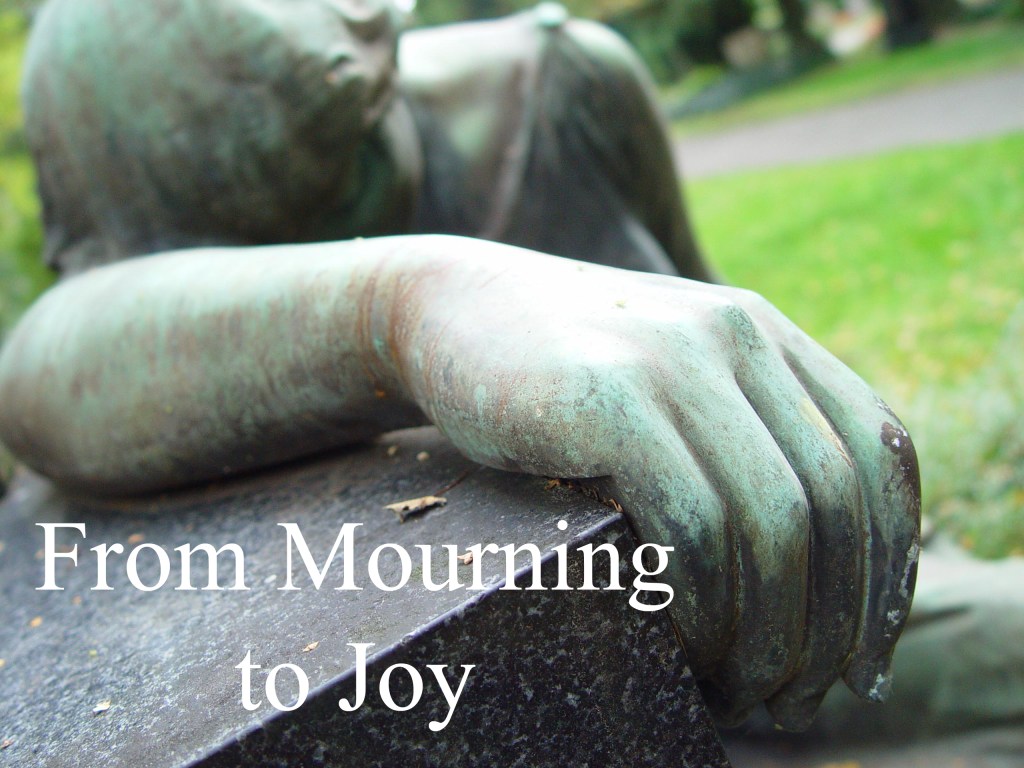
From Mourning to Joy

From Mourning to Joy

December 17, 2023*

By Pastor John Partridge

Isaiah 61:1-4, 8-11                 John 1:6-8, 19-28                          1 Thessalonians 5:16-24

On June second of 2022, seventeen-year-old Ethan Liming, the son of United Methodist Pastor Bill Liming, was beaten to death during an altercation at a basketball court in downtown Akron. This week we were notified that another of our East Ohio Conference colleagues, Beth Wilterdink, with whom Mike Greiner and I have served on the conference committee on camps and retreats, is mourning, with her husband and family, the loss of their barely two-year-old daughter Cora. I can read about these things, but I can’t begin to understand the pain and the grief that these families must feel.

But many of us have experienced our own kinds of loss. Some of you have lost children, many of us have lost parents or siblings. We each understand grief in our own way. And so, we have some insight into the lives of the people who heard God’s message through his prophet Isaiah. These were the people who had lost everything. They had lost sons, daughters, husbands, wives, brothers, sisters, parents, and grandparents, they had lost their nation and their freedom and had been carried off into captivity in Babylon. They were filled with grief. But God speaks to them through the writings of Isaiah and tells them that in the midst of their grief, there is good news. We hear these words in Isaiah 61:1-4, 8-11…

61:1 The Spirit of the Sovereign Lord is on me, because the Lord has anointed me
    to proclaim good news to the poor.
He has sent me to bind up the brokenhearted, to proclaim freedom for the captives
    and release from darkness for the prisoners,
to proclaim the year of the Lord’s favor and the day of vengeance of our God,
to comfort all who mourn,
    and provide for those who grieve in Zion— to bestow on them a crown of beauty
    instead of ashes, the oil of joy instead of mourning, and a garment of praise
    instead of a spirit of despair.
They will be called oaks of righteousness, a planting of the Lord for the display of his splendor.

They will rebuild the ancient ruins and restore the places long devastated;
they will renew the ruined cities that have been devastated for generations.

“For I, the Lord, love justice;I hate robbery and wrongdoing.
In my faithfulness I will reward my people and make an everlasting covenant with them.
Their descendants will be known among the nations and their offspring among the peoples.
All who see them will acknowledge that they are a people the Lord has blessed.”

10 I delight greatly in the Lord;my soul rejoices in my God.
For he has clothed me with garments of salvation and arrayed me in a robe of his righteousness,
as a bridegroom adorns his head like a priest, and as a bride adorns herself with her jewels.
11 For as the soil makes the sprout come up and a garden causes seeds to grow,
so the Sovereign Lord will make righteousness and praise spring up before all nations.

God says that there will be healing for the brokenhearted, release for prisoners, comfort for those who mourn, and God promises to transform the ashes of their grief into a crown of beauty. God promises to rebuild, restore, and renew, and to bring justice and faithfulness to replace their despair and loss. And in the end, God will use the nations of the world to raise up gardens of righteousness and praise.

In no way does God, or Isaiah, diminish the pain, loss, and grief that we experience today, God does not tell us to “get over it,” but God does promise that he will, one day, transform our grief into joy.

But, because John the Baptist had been quoting from the words of Isaiah, the priests and the leaders of Israel came out to the wilderness in John 1:6-8, 19-28 to ask if he was a resurrected Isaiah that God had sent to fulfill the promises that had been written so long ago.

There was a man sent from God whose name was John. He came as a witness to testify concerning that light, so that through him all might believe. He himself was not the light; he came only as a witness to the light.

19 Now this was John’s testimony when the Jewish leaders in Jerusalem sent priests and Levites to ask him who he was. 20 He did not fail to confess, but confessed freely, “I am not the Messiah.”

21 They asked him, “Then who are you? Are you Elijah?”

He said, “I am not.”

“Are you the Prophet?”

He answered, “No.”

22 Finally they said, “Who are you? Give us an answer to take back to those who sent us. What do you say about yourself?”

23 John replied in the words of Isaiah the prophet, “I am the voice of one calling in the wilderness, ‘Make straight the way for the Lord.’”

24 Now the Pharisees who had been sent 25 questioned him, “Why then do you baptize if you are not the Messiah, nor Elijah, nor the Prophet?”

26 “I baptize with water,” John replied, “but among you stands one you do not know. 27 He is the one who comes after me, the straps of whose sandals I am not worthy to untie.”

28 This all happened at Bethany on the other side of the Jordan, where John was baptizing.

But John says that he is not Isaiah, nor is he Elijah, nor is he the promised messiah. Instead, he has come to point to the Messiah, to announce his arrival, and to proclaim the fulfillment of God’s promises in Isaiah in the person of Jesus Christ.

But, knowing that Jesus is the Messiah, as we do, what does that mean for us today? What does that tell us about our grief, and our pain, and how we are to live our lives in the twenty-first century? In his letter to the church in Thessalonica, contained in 1 Thessalonians 5:16-24, Paul says this:

16 Rejoice always, 17 pray continually, 18 give thanks in all circumstances; for this is God’s will for you in Christ Jesus.

19 Do not quench the Spirit. 20 Do not treat prophecies with contempt 21 but test them all; hold on to what is good, 22 reject every kind of evil.

23 May God himself, the God of peace, sanctify you through and through. May your whole spirit, soul and body be kept blameless at the coming of our Lord Jesus Christ. 24 The one who calls you is faithful, and he will do it.

Paul says that God’s will for us is to live in anticipation of God’s final and ultimate victory. We are to live as if Christ has already returned, and God has already fulfilled his promises of rescue, rebuilding, restoration, renewal, and transformation. Rejoice always, pray continually, give thanks in all circumstances, test the prophecies of God to prove their truthfulness, reject every kind of evil, but hold on to all that is good.

In this world, we know that we will experience suffering, pain, grief, and death.

But one day God will transform our mourning into joy.

Until then…

…reject every kind of evil and…

                                    …hold on to what is good.


Please LIKE and SHARE!

Click here to subscribe to Pastor John’s blog.

Click here if you would like to subscribe to Pastor John’s weekly messages.

Click here to visit Pastor John’s YouTube channel.


*You have been reading a message presented at Christ United Methodist Church on the date noted at the top of the first page.  Rev. John Partridge is the pastor at Christ UMC in Alliance, Ohio.  Duplication of this message is a part of our Media ministry, if you have received a blessing in this way, we would love to hear from you.  Letters and donations in support of the Media ministry or any of our other projects may be sent to Christ United Methodist Church, 470 East Broadway Street, Alliance, Ohio 44601.  These messages are available to any interested persons regardless of membership.  You may subscribe to these messages, in print or electronic formats, by writing to the address noted, or by contacting us at secretary@CUMCAlliance.org.  These messages can also be found online at https://pastorpartridge.com .  All Scripture quotations, unless otherwise indicated, are taken from the Holy Bible, New International Version®, NIV®. Copyright ©1973, 1978, 1984, 2011 by Biblica, Inc.™ Used by permission of Zondervan. All rights reserved worldwide. www.zondervan.comThe “NIV” and “New International Version” are trademarks registered in the United States Patent and Trademark Office by Biblica, Inc.™

Advent Adventure

Advent Adventure

by John Partridge

The first Sunday in December is the beginning of Advent and our celebration of the birth of Jesus Christ. During that season we will journey together, as Mary and Joseph did, but rather than making a hard journey (probably on foot and not on a donkey) of eighty or ninety miles, we will journey through stories of hope, angels, shepherds, prophecy, and love. Many of our traditional decorations have been added but there will undoubtedly be a surprise or two along the way as well.

Since the shutdown of the Covid-19 epidemic, much has changed. One thing that changed was our church attendance. During the shutdown we all moved online, and afterward, not everyone returned. But since then, we’ve been growing, and changing. I hope to say more about that in the next month or two, but if you have been paying attention, some things at Christ Church are different than they were in 2020 and these changes are encouraging.

In any case, during the season of Advent, we will be journeying together, remembering the events that unfolded so long ago, walking with Mary and Joseph, grieving, and celebrating with Elizabeth and Zechariah, sharing the awe and wonder of the shepherds keeping watch on a dark hillside, and in all these things, we remember who we are, where we came from, and why we are here.

As we do during the season of Lent, and as I have said before, Advent is a journey, a time of preparation, a time that we set aside to remember. It is more than just the pre-game show for the big game because we are meant to be more than just spectators in this drama. The Super Bowl would be terrible if the players only showed up for the game in January and had not spent the entire season preparing for it. I invite you all to join us during this Advent season to sing some songs, to hear the stories, to consider what those stories mean, and to prepare our hearts so that we can be truly ready to receive the message of Christmas.

Christmas isn’t just a day on the calendar. It isn’t just a single family gathering and a shared meal like Thanksgiving. It’s bigger, wider, and deeper with more nuance and layers of meaning. I invite you to join us on our Advent adventure during this season of preparation, especially as our church family itself is changing, so that when we arrive at Christmas, we will feel a deeper joy as we draw closer to God, closer to Jesus, closer to our church family, and closer to the people of God.


Please LIKE and SHARE!

Click here to subscribe to Pastor John’s blog.

Click here if you would like to subscribe to Pastor John’s weekly messages.

Click here to visit Pastor John’s YouTube channel.

Alien Preparedness

Alien Preparedness

December 10, 2023*

By Pastor John Partridge

Isaiah 40:1-11                        Mark 1:1-8                             2 Peter 3:8-15

There is an old saying that says, “It doesn’t rain in the Army… it rains on the Army. It isn’t a particularly funny joke, but it’s a part of the dark humor that is often found while standing in the middle of a driving rainstorm. There is a similar saying in scouting, but because our scout motto is “Be Prepared,” the saying is changed to reflect that and says, “There is no bad weather in scouting, only scouts that are not prepared for the weather.” But that leads us to the title of today’s message, “Alien Preparedness.” No, this is not about preparing for an alien invasion or something that you might find on Ancient Aliens on the History Channel, but it is about preparedness.

My brother Dean used to point out that when we say we are “getting in shape” or that an athlete is “in shape,” it’s important to ask, “In shape for what?” No one doubts that NFL football players are in shape, but ask them to run a marathon, or race an Olympic swimmer, and suddenly, they are not ready because, despite all the physical conditioning that they have done, they are not prepared for that specific kind of physical competition. And so, when we say, like the scouts, that we must “Be Prepared,” we must also ask, “Prepared for what?”  When it is framed in that way, “Alien Preparedness” is not about preparing for an alien invasion, but to prepare for something you did not expect, or in a way that you hadn’t expected.

I am sure that’s still more than a little puzzling but hold on to that idea while we dive into our scriptures, and when we return to this later, I think it will be clearer.  We begin this morning with the words of the prophet Isaiah who speaks to Israel to tell of the imminent destruction of their nation at the hands of the Assyrian army but also speaks words of comfort and God’s promise that there would one day be restoration after Jerusalem’s destruction. We hear these words in Isaiah 40:1-11…

40:1 Comfort, comfort my people, says your God.
Speak tenderly to Jerusalem, and proclaim to her
that her hard service has been completed, that her sin has been paid for,
that she has received from the Lord’s hand double for all her sins.

A voice of one calling:
“In the wilderness prepare the way for the Lord,
make straight in the desert a highway for our God.
Every valley shall be raised up, every mountain and hill made low;
the rough ground shall become level, the rugged places a plain.
And the glory of the Lord will be revealed, and all people will see it together.
For the mouth of the Lord has spoken.”

A voice says, “Cry out.”
    And I said, “What shall I cry?”

“All people are like grass, and all their faithfulness is like the flowers of the field.
The grass withers and the flowers fall, because the breath of the Lord blows on them.
    Surely the people are grass.
The grass withers and the flowers fall, but the word of our God endures forever.”

You who bring good news to Zion, go up on a high mountain.
You who bring good news to Jerusalem,  lift up your voice with a shout,
lift it up, do not be afraid; say to the towns of Judah, “Here is your God!”
10 See, the Sovereign Lord comes with power, and he rules with a mighty arm.
See, his reward is with him, and his recompense accompanies him.
11 He tends his flock like a shepherd: He gathers the lambs in his arms
and carries them close to his heart; he gently leads those that have young.

Isaiah says that things are going to be terrible, and then worse than terrible, and then, just when they think that they are withering into death like the grass in summer, there will be a voice… one single voice… crying out in the desert to prepare for the arrival of their rescuer. Things will be terrible, but one day the rescuer will come. He will rule with a mighty arm, but he will tend his flock with gentleness like a shepherd.

And then, in the middle of the Roman occupation, as Israel once again prayed for God’s rescue, the voice of John the Baptizer is heard in the wilderness and Mark remembers, and quotes the words of Isaiah in Mark 1:1-8 saying…

1:1 The beginning of the good news about Jesus the Messiah, the Son of God, as it is written in Isaiah the prophet:

“I will send my messenger ahead of you,
    who will prepare your way”—
“a voice of one calling in the wilderness,
‘Prepare the way for the Lord,
    make straight paths for him.’”

And so John the Baptist appeared in the wilderness, preaching a baptism of repentance for the forgiveness of sins. The whole Judean countryside and all the people of Jerusalem went out to him. Confessing their sins, they were baptized by him in the Jordan River. John wore clothing made of camel’s hair, with a leather belt around his waist, and he ate locusts and wild honey. And this was his message: “After me comes the one more powerful than I, the straps of whose sandals I am not worthy to stoop down and untie. I baptize you with water, but he will baptize you with the Holy Spirit.”

John declares that God’s promised rescuer has come, and the people had better be prepared.

But what does that mean? How should the people prepare? We know that John’s message was one of repentance and called people to repent of their sins and recommit their lives to following God. But is that all there is to it? What kind of preparations are required for us in the twenty-first century as we remember John’s message and prepare ourselves for Jesus’ return. And that’s where Peter steps in to remind us of John’s message and apply it to our daily lives in the here and now. In 2 Peter 3:8-15 we hear this message about our future:

But do not forget this one thing, dear friends: With the Lord a day is like a thousand years, and a thousand years are like a day. The Lord is not slow in keeping his promise, as some understand slowness. Instead, he is patient with you, not wanting anyone to perish, but everyone to come to repentance.

10 But the day of the Lord will come like a thief. The heavens will disappear with a roar; the elements will be destroyed by fire, and the earth and everything done in it will be laid bare.

11 Since everything will be destroyed in this way, what kind of people ought you to be? You ought to live holy and godly lives 12 as you look forward to the day of God and speed its coming. That day will bring about the destruction of the heavens by fire, and the elements will melt in the heat. 13 But in keeping with his promise we are looking forward to a new heaven and a new earth, where righteousness dwells.

14 So then, dear friends, since you are looking forward to this, make every effort to be found spotless, blameless and at peace with him. 15 Bear in mind that our Lord’s patience means salvation, just as our dear brother Paul also wrote you with the wisdom that God gave him.

And this is where we find the alien preparation. This is not making sure to pack a raincoat, or warm winter clothes, and it’s more than just John’s message of repentance and baptism. This is, quite literally, preparation for the end of the world. The heavens will disappear, the earth will be destroyed, and the elements themselves will be melted in the heat of God’s judgement. On that day, God will make good on his promise to bring peace and justice, and from the ruins of this world will create a new heaven and a new earth filled with righteousness.

But how can we prepare for such a thing? What will be required of us? What must we do to be ready? And Peter’s answer is not so different from that of John the Baptizer. Repent, make straight paths for him, make every effort to live lives that are blameless so that your lives can be at peace with Jesus Christ by doing everything that he taught and modelled for us.

We absolutely must get this right.

Because we are not just preparing for the arrival of our rescuer and king.

We are, quite literally, preparing for the end of the world.


Please LIKE and SHARE!

Click here to subscribe to Pastor John’s blog.

Click here if you would like to subscribe to Pastor John’s weekly messages.

Click here to visit Pastor John’s YouTube channel.


*You have been reading a message presented at Christ United Methodist Church on the date noted at the top of the first page.  Rev. John Partridge is the pastor at Christ UMC in Alliance, Ohio.  Duplication of this message is a part of our Media ministry, if you have received a blessing in this way, we would love to hear from you.  Letters and donations in support of the Media ministry or any of our other projects may be sent to Christ United Methodist Church, 470 East Broadway Street, Alliance, Ohio 44601.  These messages are available to any interested persons regardless of membership.  You may subscribe to these messages, in print or electronic formats, by writing to the address noted, or by contacting us at secretary@CUMCAlliance.org.  These messages can also be found online at https://pastorpartridge.com .  All Scripture quotations, unless otherwise indicated, are taken from the Holy Bible, New International Version®, NIV®. Copyright ©1973, 1978, 1984, 2011 by Biblica, Inc.™ Used by permission of Zondervan. All rights reserved worldwide. www.zondervan.comThe “NIV” and “New International Version” are trademarks registered in the United States Patent and Trademark Office by Biblica, Inc.™

Meditations for the Week of Thanksgiving

Monday: Prosperous and Ungrateful

(Click here to watch this video: https://youtu.be/82TwLpKusaI)

*****

Each day this week I wanted to record a short meditation as we prepare for our national celebration of Thanksgiving. Today I want to read a short passage from Deuteronomy and then briefly reflect on what it means to us today.

Deuteronomy 8:7-18 includes a caution from Moses as the people of Israel are about to enter the Promised Land after forty years of wandering in the wilderness.

For the Lord your God is bringing you into a good land—a land with brooks, streams, and deep springs gushing out into the valleys and hills; a land with wheat and barley, vines and fig trees, pomegranates, olive oil and honey; a land where bread will not be scarce and you will lack nothing; a land where the rocks are iron and you can dig copper out of the hills.

10 When you have eaten and are satisfied, praise the Lord your God for the good land he has given you. 11 Be careful that you do not forget the Lord your God, failing to observe his commands, his laws, and his decrees that I am giving you this day. 12 Otherwise, when you eat and are satisfied, when you build fine houses and settle down, 13 and when your herds and flocks grow large and your silver and gold increase and all you have is multiplied, 14 then your heart will become proud and you will forget the Lord your God, who brought you out of Egypt, out of the land of slavery. 15 He led you through the vast and dreadful wilderness, that thirsty and waterless land, with its venomous snakes and scorpions. He brought you water out of hard rock. 16 He gave you manna to eat in the wilderness, something your ancestors had never known, to humble and test you so that in the end it might go well with you. 17 You may say to yourself, “My power and the strength of my hands have produced this wealth for me.” 18 But remember the Lord your God, for it is he who gives you the ability to produce wealth, and so confirms his covenant, which he swore to your ancestors, as it is today.

Moses reminds the people that God is giving them a great gift. A land to call home, a land that is rich with resources, and a place where they could build families and increase in numbers and in wealth. But Moses also warns them that when they become prosperous and wealthy, they risk losing everything by forgetting that it was God who gave it to them. They run the risk of arrogance and deceiving themselves into believing that they were personally responsible for their wealth and their prosperity and in so doing, forget that it was God.

As we celebrate and give thanks this week, let us not fall into the trap that Moses warned us about. We give thanks for what we have, we give thanks for our prosperity and our wealth, but we must never forget we didn’t do it all by ourselves. We give thanks for what we have because it was God that gave us the ability to do it.

Tuesday: Joyful and Forgetful

(Click here to watch this video: https://youtu.be/_31XUwmwYa0)

*****

Today’s meditation comes from Luke 17:11-19 and remembers the time when Jesus met ten men who were cast out from society because they were afflicted with leprosy. Check this out, because most of us don’t have a disease that removes us from society, there is still an important word for us to consider as we prepare for Thanksgiving.

11 Now on his way to Jerusalem, Jesus traveled along the border between Samaria and Galilee. 12 As he was going into a village, ten men who had leprosy met him. They stood at a distance 13 and called out in a loud voice, “Jesus, Master, have pity on us!”

14 When he saw them, he said, “Go, show yourselves to the priests.” And as they went, they were cleansed.

15 One of them, when he saw he was healed, came back, praising God in a loud voice. 16 He threw himself at Jesus’ feet and thanked him—and he was a Samaritan.

17 Jesus asked, “Were not all ten cleansed? Where are the other nine? 18 Has no one returned to give praise to God except this foreigner?” 19 Then he said to him, “Rise and go; your faith has made you well.”

These men knew that Jesus was coming, and they called to him from a distance, as the law required, because of their leprosy. But, after they were healed, only one of the ten came back to say thank you. We are also told that the one who said thank you, was a Samaritan, a people who were despised by the Jews and that feeling was mutual. Nonetheless, he came back to give thanks for the incredible gift that he had received.

If we are charitable, we could say that the other nine were so filled with joy that they rushed to rejoin their families and return to a normal life and simply “forgot” to give thanks. But even when we consider that charitably, these nine men appear to be, and act as if, they are ungrateful.

As we celebrate and give thanks this week for the things that God has given to us, let us not be so joyful that we forget to give thanks to the one who is responsible for what we have been given.


Wednesday: The Blessing of Generosity

(Click here to watch this video: https://youtu.be/56D4XZztPdg)

*****

Today’s meditation comes from Paul’s second letter to the church in Corinth, found in 2 Corinthians 9:6-15. Paul wants the church to know that true gratitude can be found in generosity. Listen to Paul’s words:

Remember this: Whoever sows sparingly will also reap sparingly, and whoever sows generously will also reap generously. Each of you should give what you have decided in your heart to give, not reluctantly or under compulsion, for God loves a cheerful giver. And God is able to bless you abundantly, so that in all things at all times, having all that you need, you will abound in every good work. As it is written:

“They have freely scattered their gifts to the poor;
    their righteousness endures forever.”

10 Now he who supplies seed to the sower and bread for food will also supply and increase your store of seed and will enlarge the harvest of your righteousness. 11 You will be enriched in every way so that you can be generous on every occasion, and through us your generosity will result in thanksgiving to God.

12 This service that you perform is not only supplying the needs of the Lord’s people but is also overflowing in many expressions of thanks to God. 13 Because of the service by which you have proved yourselves, others will praise God for the obedience that accompanies your confession of the gospel of Christ, and for your generosity in sharing with them and with everyone else. 14 And in their prayers for you their hearts will go out to you, because of the surpassing grace God has given you. 15 Thanks be to God for his indescribable gift!

Paul says that in God’s system of mathematics, God will be stingy with stingy people and generous with generous people simply because he desires that he be repaid in praise and thanksgiving for his generosity to us. But this isn’t some sort of prosperity gospel where God promises to make you rich. Instead, God says that your generosity is a demonstration of your faithfulness and so, by being generous, God will bless you “in every way.” Yes, that might mean some sort of financial wealth, but it might also mean physical or mental health, family, friends, resilience, courage, strength, love, compassion, faith, peace, hope, or any other sort of blessing that God might choose. But whatever form it takes, Paul says that the purpose of God’s blessing is so that you can be generous with whatever it is that God has given you in abundance.

We aren’t meant to hoard the blessings and gifts of God but to allow our abundance to overflow into the lives of the people around us. And, by sharing God’s gifts with others, they will also give thanks and praise to God.

This week, as we set aside a day to give thanks, let us remember that it’s supposed to be a two-step process. Give thanks for whatever it is that God has given to you, and then pass your blessing on to the people around you.


Thursday, Thanksgiving Day

King David’s Prayer

(Click here to watch this video: https://youtu.be/_PKDvwwmyFE)

*****

Since today is Thanksgiving Day, I just want to share with you this prayer of thanks from King David found in Psalm 65:

Praise awaits you, our God, in Zion;
    to you our vows will be fulfilled.
You who answer prayer,
    to you all people will come.
When we were overwhelmed by sins,
    you forgave our transgressions.
Blessed are those you choose
    and bring near to live in your courts!
We are filled with the good things of your house,
    of your holy temple.

You answer us with awesome and righteous deeds,
    God our Savior,
the hope of all the ends of the earth
    and of the farthest seas,
who formed the mountains by your power,
    having armed yourself with strength,
who stilled the roaring of the seas,
    the roaring of their waves,
    and the turmoil of the nations.
The whole earth is filled with awe at your wonders;
    where morning dawns, where evening fades,
    you call forth songs of joy.

You care for the land and water it;
    you enrich it abundantly.
The streams of God are filled with water
    to provide the people with grain,
    for so you have ordained it.
10 You drench its furrows and level its ridges;
    you soften it with showers and bless its crops.
11 You crown the year with your bounty,
    and your carts overflow with abundance.
12 The grasslands of the wilderness overflow;
    the hills are clothed with gladness.
13 The meadows are covered with flocks
    and the valleys are mantled with grain;
    they shout for joy and sing.

David’s words, simply say, “Since we are blessed, then we must give thanks to God.”

That’s good advice.

Faithful, Trustworthy, and Wide Awake

Faithful, Trustworthy, and Wide Awake

November 19, 2023*

By Pastor John Partridge

Judges 4:1-7               Matthew 25:14-30                             1 Thessalonians 5:1-11

This week our nation sets aside a day to celebrate Thanksgiving. We will gather with family, probably eat too much, likely gain a little weight, and hopefully pause for a few moments to consider those things for which we have to be grateful, to whom we should be grateful for those things, and give thanks for what we have been given. This morning’s message is not specifically a Thanksgiving message. Instead, this morning’s message looks at three stories of faith and thanksgiving, but each is different from the other. None of them specifically mention thanksgiving, or giving thanks, or gratitude, but the idea is found there all the same.

We begin with the story of Deborah the prophet, the undisputed leader of Israel during this part of the period of the Judges. During that period, Israel would wander from God, and then, in times of trouble and distress, cry out for God’s help, follow one of God’s leaders, grow close to God again, and then repeat the cycle… over and over again. And so, in Judges 4:1-7, we read this:

4:1 Again the Israelites did evil in the eyes of the Lord, now that Ehud was dead. So the Lord sold them into the hands of Jabin king of Canaan, who reigned in Hazor. Sisera, the commander of his army, was based in Harosheth Haggoyim. Because he had nine hundred chariots fitted with iron and had cruelly oppressed the Israelites for twenty years, they cried to the Lord for help.

Now Deborah, a prophet, the wife of Lappidoth, was leading Israel at that time. She held court under the Palm of Deborah between Ramah and Bethel in the hill country of Ephraim, and the Israelites went up to her to have their disputes decided. She sent for Barak son of Abinoam from Kedesh in Naphtali and said to him, “The Lord, the God of Israel, commands you: ‘Go, take with you ten thousand men of Naphtali and Zebulun and lead them up to Mount Tabor. I will lead Sisera, the commander of Jabin’s army, with his chariots and his troops to the Kishon River and give him into your hands.’”

Ehud had rescued Israel from their domination by the king of Moab, but now that Ehud had died, Israel had again fallen away from God. This time, it was the Canaanites who began to oppress Israel, with Sisera as the commander of their army. The wealth of Canaan was displayed in their ownership of nine hundred chariots and their widespread use of iron during a time, during the Bronze Age, when bronze was the common metal used in weapons and tools. Steel had not yet been invented and iron was relatively rare and expensive. Canaan’s possession of nine hundred chariots fitted with iron was a display of wealth, power, and superior technology.

Horses were, and are, expensive to maintain, and Israel had very few, and no chariots at all. They wouldn’t have any until hundreds of years later in the time of King Solomon. But Deborah was smart, and this passage is evidence that she knew a thing or two about military tactics. Chariots are great weapons on the plains but not so good on rough terrain or mountains where they can’t maneuver. And so, her plan was to send an Israelite army of ten thousand to the top of Mount Tabor, and then draw Sisera and his chariots to the river at the bottom of that same mountain. In so doing, she created a battle in which the chariots have a difficult time maneuvering, can’t easily retreat across the river, and are forced to fight a superior force that is fighting from the high ground.

But the point that I want to make is that when much of Israel fell away from God, Deborah remained faithful. Deborah’s way of giving thanks to God is found in her faithfulness. She remembered what God had done, and she remained faithful to God, even when many others did not. And it was her thankfulness, and her faithfulness, that saved her entire nation.

We find an entirely different story of thanksgiving in Jesus’ parable of the ungrateful and unfaithful servant in Matthew 25:14-30. Once again, Jesus is telling a story of what things will be like on the day of judgement and says this:

 14 “Again, it will be like a man going on a journey, who called his servants and entrusted his wealth to them. 15 To one he gave five bags of gold, to another two bags, and to another one bag, each according to his ability. Then he went on his journey. 16 The man who had received five bags of gold went at once and put his money to work and gained five bags more. 17 So also, the one with two bags of gold gained two more. 18 But the man who had received one bag went off, dug a hole in the ground and hid his master’s money.

19 “After a long time the master of those servants returned and settled accounts with them. 20 The man who had received five bags of gold brought the other five. ‘Master,’ he said, ‘you entrusted me with five bags of gold. See, I have gained five more.’

21 “His master replied, ‘Well done, good and faithful servant! You have been faithful with a few things; I will put you in charge of many things. Come and share your master’s happiness!’

22 “The man with two bags of gold also came. ‘Master,’ he said, ‘you entrusted me with two bags of gold; see, I have gained two more.’

23 “His master replied, ‘Well done, good and faithful servant! You have been faithful with a few things; I will put you in charge of many things. Come and share your master’s happiness!’

24 “Then the man who had received one bag of gold came. ‘Master,’ he said, ‘I knew that you are a hard man, harvesting where you have not sown and gathering where you have not scattered seed. 25 So I was afraid and went out and hid your gold in the ground. See, here is what belongs to you.’

26 “His master replied, ‘You wicked, lazy servant! So you knew that I harvest where I have not sown and gather where I have not scattered seed? 27 Well then, you should have put my money on deposit with the bankers, so that when I returned I would have received it back with interest.

28 “‘So take the bag of gold from him and give it to the one who has ten bags. 29 For whoever has will be given more, and they will have an abundance. Whoever does not have, even what they have will be taken from them. 30 And throw that worthless servant outside, into the darkness, where there will be weeping and gnashing of teeth.’

We could say all kinds of things about our relationships with employers and employees and most of these that would likely be wrong… if we didn’t first remember that Jesus began this series of illustrations by saying “the kingdom of heaven will be like…” And so, as we read this parable, we must remember that the man who went on a journey is God, or perhaps Jesus, and the servants to whom he entrusted his wealth, are us. Next, it is important to note that the wealth entrusted to these servants is not a small amount. The New International translation obscures this by measuring the gold by the “bagful”, which I dislike, but other translations are only a little more helpful by using the original measure of “talents.”

This is one of those cases when reading the footnotes is helpful. A “Talent” is a measure of weight, and one talent is approximately 75 pounds. When we measure gold, we measure by the Troy ounce and there are 12 Troy ounces per pound. I checked at the beginning of this week and the current spot price of gold is $1,941.96 per ounce. That means that, in today’s dollars, each talent, or “bag” of gold would be worth $1,747,764, three talents are $5.2 million, and five talents are $8.7 million. I think it’s worth doing the math so that we understand that this is not chump change. These are sizable investments and even the servant who is given one talent has been entrusted with a lot of cash. Clearly, all three of these servants were highly trusted and believed to be capable of handling these substantial investments.

You may not be able to do much with a few tens of thousands of dollars, but there are a lot of investment options $1.7 million. You can buy land, buy businesses, hire caravans, start your own business, invest in other people’s businesses, or, as the man said upon his return, the very least that you could do is put it on deposit with the bank and collect interest.

But he didn’t. The unfaithful servant did nothing. He did zero work. He did no planning. There is no evidence that he asked for help. He only thought of himself. And, chances are, even though he didn’t spend the gold, he continued to draw his salary or otherwise live off the wealth of his master. And these are the reasons that the servant was, and is, considered to be untrustworthy and unfaithful.

It is also important to note that when Jesus says, “Whoever does not have, even what they have will be taken from them” he is not talking about the poor. He is talking about those that have buried what they have been given. Faithful servants demonstrate their faith, and their thankfulness, by being trustworthy.

We find our last example of thanksgiving in 1 Thessalonians 5:1-11 as Paul writes to the church in Thessalonica, where he says:

5:1 Now, brothers and sisters, about times and dates we do not need to write to you, for you know very well that the day of the Lord will come like a thief in the night. While people are saying, “Peace and safety,” destruction will come on them suddenly, as labor pains on a pregnant woman, and they will not escape.

But you, brothers and sisters, are not in darkness so that this day should surprise you like a thief. You are all children of the light and children of the day. We do not belong to the night or to the darkness. So then, let us not be like others, who are asleep, but let us be awake and sober. For those who sleep, sleep at night, and those who get drunk, get drunk at night. But since we belong to the day, let us be sober, putting on faith and love as a breastplate, and the hope of salvation as a helmet. For God did not appoint us to suffer wrath but to receive salvation through our Lord Jesus Christ. 10 He died for us so that, whether we are awake or asleep, we may live together with him. 11 Therefore encourage one another and build each other up, just as in fact you are doing.

In this short passage, Paul has three pieces of advice for the church. First, always live and act as if everyone can see you. Second, don’t sleepwalk through life. And third, always encourage one another and build each other up.

And so, what did we hear about thankfulness today?

First, Like Deborah, demonstrate your thankfulness to God by being faithful even when your culture and all the people around you are losing their faith.

Second, like the two faithful servants, demonstrate your thankfulness for what God has given you by being trustworthy and using whatever it is that God has given you, whether that is talent, money, skill, education, perseverance, compassion, love, health, or anything else. Do not bury the gifts that God has given you, but always use God’s gifts to expand his kingdom.

And third, demonstrate your thankfulness by being awake. Never sleepwalk through life. Every minute of every day, act as if the world is watching. And remember that life is hard. You aren’t the only person with problems so always encourage the people around you, encourage the people in your church and in your family of faith. Instead of being critical, do whatever you can, whenever you can, to build each other up.

I hope that you will think about these things as we gather with family and friends and sit around our Thanksgiving tables this week.


Please LIKE and SHARE!

Click here to subscribe to Pastor John’s blog.

Click here if you would like to subscribe to Pastor John’s weekly messages.

Click here to visit Pastor John’s YouTube channel.


*You have been reading a message presented at Christ United Methodist Church on the date noted at the top of the first page.  Rev. John Partridge is the pastor at Christ UMC in Alliance, Ohio.  Duplication of this message is a part of our Media ministry, if you have received a blessing in this way, we would love to hear from you.  Letters and donations in support of the Media ministry or any of our other projects may be sent to Christ United Methodist Church, 470 East Broadway Street, Alliance, Ohio 44601.  These messages are available to any interested persons regardless of membership.  You may subscribe to these messages, in print or electronic formats, by writing to the address noted, or by contacting us at secretary@CUMCAlliance.org.  These messages can also be found online at https://pastorpartridge.com .  All Scripture quotations, unless otherwise indicated, are taken from the Holy Bible, New International Version®, NIV®. Copyright ©1973, 1978, 1984, 2011 by Biblica, Inc.™ Used by permission of Zondervan. All rights reserved worldwide. www.zondervan.comThe “NIV” and “New International Version” are trademarks registered in the United States Patent and Trademark Office by Biblica, Inc.™