God’s Choice

God’s Choice

July 14, 2024*

By Pastor John Partridge

2 Samuel 6:1-5, 12b-19                     Mark 6:14-29                         Ephesians 1:3-14

What choices have you made so far today? It seems obvious to say that everyone here chose to wake up, get out of bed, get dressed, and come to church. Most of us also chose to take a shower, brush our teeth, and otherwise make ourselves presentable. But those are the easy choices.  We like to eat and have the money to pay for things, so we choose to go to work. But occasionally, at work, at home, and elsewhere, we must make harder choices. Do we go along with the crowd, do we follow our friends, even when what they are doing is not honoring to God? Do we stand up against our own political party, or our own church denomination, or our alumni association, or the club to which we’ve belonged for many years, when those groups choose a path that runs against the instructions of scripture? Or do we sometimes elevate our need to belong, or our allegiance to some organization, above our obedience to God and, in doing so, make it into an idol?

Our scriptures for today are dramatically different from one another and have little in common except that, in each one, the people in the story had to make choices, and the choices that they made defined them and revealed who they were at heart. We begin by returning once again to the story of David contained in 2 Samuel 6:1-5, 12b-19 in which, with Israel now unified and at peace, David and his army retrieve the Ark of the Covenant and bring it to Jerusalem.

6:1 David again brought together all the able young men of Israel—thirty thousand. He and all his men went to Baalahin Judah to bring up from there the ark of God, which is called by the Name, the name of the Lord Almighty, who is enthroned between the cherubim on the ark. They set the ark of God on a new cart and brought it from the house of Abinadab, which was on the hill. Uzzah and Ahio, sons of Abinadab, were guiding the new cart with the ark of God on it, and Ahio was walking in front of it. David and all Israel were celebrating with all their might before the Lord, with castanets, harps, lyres, timbrels, sistrums [an Egyptian shaker/rattle instrument] and cymbals.

So, David went to bring up the ark of God from the house of Obed-Edom to the City of David with rejoicing. 13 When those who were carrying the ark of the Lord had taken six steps, he sacrificed a bull and a fattened calf. 14 Wearing a linen ephod, David was dancing before the Lord with all his might, 15 while he and all Israel were bringing up the ark of the Lord with shouts and the sound of trumpets.

16 As the ark of the Lord was entering the City of David, Michal, the daughter of Saul, watched from a window. And when she saw King David leaping and dancing before the Lord, she despised him in her heart.

17 They brought the ark of the Lord and set it in its place inside the tent that David had pitched for it, and David sacrificed burnt offerings and fellowship offerings before the Lord. 18 After he had finished sacrificing the burnt offerings and fellowship offerings, he blessed the people in the name of the Lord Almighty. 19 Then he gave a loaf of bread, a cake of dates and a cake of raisins to each person in the whole crowd of Israelites, both men and women. And all the people went to their homes.

David had been anointed as king and had unified all twelve tribes of Israel. Together they had conquered the Jebusites and declared Jerusalem as the capitol of their unified nation. David had choices. He could do anything that he wanted to do, but among the first things that he does is to take his entire army, travel to Baalah in Judah, take possession of the Ark of the Covenant, and bring it, with much celebration, to their new home. But watching from a window was David’s wife, Michal, who was the daughter of King Saul. As she watched David singing, and dancing before God in celebration, she did not approve. To her, it was undignified for the king to sing and dance and act with joyful abandon in public. But David had made a choice. David could have built a palace, or set out to conquer his neighbors, or undertake projects that would make Israel, and him, richer. But David wanted to honor God first and chose obedience and faithfulness instead of wealth, power, prestige, or even dignity. David chose joy and thankfulness over appearances, respectability, and decorum. And it was those choices, among many others, that defined who David was, and revealed his heart to God and to the world.

In an entirely different story, of an entirely different sort of king, we read the story of king Herod Antipas and the death of John the Baptist in Mark 6:14-29. And in this story, like David, Herod makes some choices that defined him, and revealed his heart.

14 King Herod [Antipas who ruled over Galilee and Perea, the areas east of the Jordan River] heard about this, for Jesus’ name had become well known. Some were saying, “John the Baptist has been raised from the dead, and that is why miraculous powers are at work in him.”

15 Others said, “He is Elijah.”

And still others claimed, “He is a prophet, like one of the prophets of long ago.”

16 But when Herod heard this, he said, “John, whom I beheaded, has been raised from the dead!”

17 For Herod himself had given orders to have John arrested, and he had him bound and put in prison. He did this because of Herodias, his brother Philip’s wife, whom he had married. 18 For John had been saying to Herod, “It is not lawful for you to have your brother’s wife.” [Herod Philip who ruled over Ceasarea Phillip and the area north and west of Galilee] 19 So Herodias nursed a grudge against John and wanted to kill him. But she was not able to, 20 because Herod feared John and protected him, knowing him to be a righteous and holy man. When Herod heard John, he was greatly puzzled; yet he liked to listen to him.

21 Finally the opportune time came. On his birthday Herod gave a banquet for his high officials and military commanders and the leading men of Galilee. 22 When the daughter ofHerodias came in and danced, she pleased Herod and his dinner guests.

The king said to the girl, “Ask me for anything you want, and I’ll give it to you.” 23 And he promised her with an oath, “Whatever you ask I will give you, up to half my kingdom.”

24 She went out and said to her mother, “What shall I ask for?”

“The head of John the Baptist,” she answered.

25 At once the girl hurried in to the king with the request: “I want you to give me right now the head of John the Baptist on a platter.”

26 The king was greatly distressed, but because of his oaths and his dinner guests, he did not want to refuse her. 27 So he immediately sent an executioner with orders to bring John’s head. The man went, beheaded John in the prison, 28 and brought back his head on a platter. He presented it to the girl, and she gave it to her mother. 29 On hearing of this, John’s disciples came and took his body and laid it in a tomb.

Although Herod was distressed by the choice that he was forced to make because of the unwise oath that he had taken in front of his guests, rather than choosing what was right, he chose violence. Rather than choosing repentance and righteousness, Herod chose his reputation. For Herod, it was more important to look good than to be good.

And now we come to Paul’s letter to the church in Ephesus and the words of Ephesians 1:3-14, where Paul reminds us of what God chose. God’s choices were, and are, limitless. God is the creator of at least one universe and all that we know. God could do anything, but Paul reminds us that the choice God makes is utterly astounding and, as it did in the case of David and Herod, God’s choice reveals his heart. Paul says:

Praise be to the God and Father of our Lord Jesus Christ, who has blessed us in the heavenly realms with every spiritual blessing in Christ. For he chose us in him before the creation of the world to be holy and blameless in his sight. In love hepredestined us for adoption to sonshipthrough Jesus Christ, in accordance with his pleasure and will— to the praise of his glorious grace, which he has freely given us in the One he loves. In him we have redemption through his blood, the forgiveness of sins, in accordance with the riches of God’s grace that he lavished on us. With all wisdom and understanding, hemade known to us the mystery of his will according to his good pleasure, which he purposed in Christ, 10 to be put into effect when the times reach their fulfillment—to bring unity to all things in heaven and on earth under Christ.

11 In him we were also chosen, having been predestined according to the plan of him who works out everything in conformity with the purpose of his will, 12 in order that we, who were the first to put our hope in Christ, might be for the praise of his glory. 13 And you also were included in Christ when you heard the message of truth, the gospel of your salvation. When you believed, you were marked in him with a seal, the promised Holy Spirit, 14 who is a deposit guaranteeing our inheritance until the redemption of those who are God’s possession—to the praise of his glory.

As I said a moment ago, God’s choices were, and are, limitless, and Paul’s point is that with infinite power at his fingertips, God chose… us. Paul says that before the creation of the world, God intended for us to be holy and blameless and planned to adopt us into sonship. And it is worth a moment of explanation that the phrase that Paul uses, “adoption to sonship” isn’t just flowery or emotional language, it is a Greek legal term that describes a legal and binding adoption. God, through Jesus Christ, legally adopts us as his children, with all the rights of inheritance that implies, forgives our sins, and pours out his grace on us. Paul says that we were chosen to be a part of God’s plan to bring about the will of God. And, when we chose to believe, we were marked with the Holy Spirit as a deposit and downpayment of our future inheritance as God’s children.

When David became king, his choices revealed his heart and his character and, instead of choosing to pursue wealth, power, notoriety, or ego stroking building projects, David chose to make his first act an act of faithfulness, obedience, and joy.

In contrast, when asked for the head of John the Baptist, Herod Antipas chose violence and reputation over repentance and righteousness.

But God, the king of the universe, with infinite power to do whatever comes to his mind…

… chooses us. And not only does God choose us, but he also plans, in advance, even before creation, to make us holy and blameless through the sacrifice of his son Jesus Christ, and to legally adopt us as his heirs, as sons and daughters of the king. And just to be sure that that we know that he loves us, and see his intentions for us, God marks us with a seal, and leaves us with a deposit guaranteeing our inheritance, by sending the Holy Spirit to live with us, and in us.

David chose obedience.

Herod chose his reputation.

God… (pause) …chose us.

Like David, and like Herod, God’s choice reveals his heart and his character and leaves us with a choice.

Will we choose God, and follow him?

________________________________________________

Please LIKE and SHARE!

Click here to subscribe to Pastor John’s blog.

Click here if you would like to subscribe to Pastor John’s weekly messages.

Click here to visit Pastor John’s YouTube channel.


*You have been reading a message presented at Christ United Methodist Church on the date noted at the top of the first page.  Rev. John Partridge is the pastor at Christ UMC in Alliance, Ohio.  Duplication of this message is a part of our Media ministry, if you have received a blessing in this way, we would love to hear from you.  Letters and donations in support of the Media ministry or any of our other projects may be sent to Christ United Methodist Church, 470 East Broadway Street, Alliance, Ohio 44601.  These messages are available to any interested persons regardless of membership.  You may subscribe to these messages, in print or electronic formats, by writing to the address noted, or by contacting us at secretary@CUMCAlliance.org.  These messages can also be found online at https://pastorpartridge.com .  All Scripture quotations, unless otherwise indicated, are taken from the Holy Bible, New International Version®, NIV®. Copyright ©1973, 1978, 1984, 2011 by Biblica, Inc.™ Used by permission of Zondervan. All rights reserved worldwide. www.zondervan.comThe “NIV” and “New International Version” are trademarks registered in the United States Patent and Trademark Office by Biblica, Inc.™

Photo by Comstock on Freeimages.com
Hellen Who?

Hellen Who?

 (or Why History Matters)

by John Partridge

For the last few weeks, I have been reading several accounts of Israel’s history. None of this is contained in the Bible because the particular histories that I have been reading describe the “Hellenization” of Israel that occurred between Malachi, the last book of the Old Testament, and Matthew, the first book of the New Testament. But what is Hellenization?  And, why does it matter if it isn’t in the Bible?

First, let me explain a little about Hellenism. Quite simply, “Hellenic” is just a synonym for “Greek.” Greek people can be known as Hellenes, and one of the first democracies was known as the Hellenic Republic. Greek government and culture was widely known in the ancient world and, when Alexander the Great (who was technically Macedonian) conquered much of the ancient world, including Israel, both the culture and the style of government of Greece spread with the empire. This influence is seen in the way that governments were organized, the language that people spoke, the types of art that became popular, the architecture that was used, and a host of other things as well.

But you still might ask why that matters if the empire that we find in the New Testament is Roman and not Greek. It matters because the Greek empire, in one form or another, was around for a long time and when the Romans finally became the dominant force, old political divisions of the Greek empire were still felt in the Roman empire. Even so, the Romans so admired Greek culture that they kept much of it. In the Roman empire, Greek was the language of business (and even in some military units), much of Roman government was modeled after the system used by the Greeks, and so was much of their art, philosophy, educational system, sporting events, and architecture. These two cultures were so tied together, and the Romans so influenced by Greek culture, that we often see them referred to not as Greek culture, or Roman culture separately, but as Greco-Roman culture collectively.

Because of their faith, their relationship with God, and their own unique history, Israel resisted some of these changes, but adopted others. Some crept in little by little, some were fought by religious leaders, but others, at least among the wealthy and political leaders, were adopted wholeheartedly. Learning about this cultural shift helps us to better grasp what happened between Malachi and Matthew and better understand the world that we enter as we read the New Testament. Even if these things aren’t described in the pages of scripture, their influence is felt everywhere on those pages. Learning about this inter-testamental history helps us to better understand the tensions between the rich and the poor, between the political leaders and the religious leaders, and between the various religious sects like the Pharisees, Sadducees, Essenes, and the new teachings of Jesus.

But history tells us more than that, and understanding history makes the stories of the New Testament richer, deeper, and more three-dimensional. Learning about the history of the intertestamental period (the time between Malachi and Matthew) helps us to see that King Herod was more three-dimensional than the tyrant that we see in a handful of verses in the gospels. This history tells us where Herod came from, who his family was, how he came to power, why he was so loyal to the Roman government, why his loyalties sometimes shifted, how Herod was politically astute in the extreme, and why he appears to be so incredibly paranoid when we meet him in the New Testament. And understanding Herod just scratches the surface because he and his family only really appear a few decades before Jesus. Before Herod and his father Antipater, there was an entire line of Jews that governed Israel known as the Hasmonean empire. And understanding that history explains more about Herod’s family and both why, and how, the Romans came to occupy, and then rule over Israel as well as how Herod conspired to murder the last of the Hasmoneans. This last thing also explains some of the ill will, and even outright hatred, that some Jews had for Herod.

As we read scripture, we become familiar with the Temple in Jerusalem, and many of us know that this was a magnificent engineering achievement of King Herod and possibly his crowning achievement. But what we don’t find in scripture is that the Temple in Jerusalem isn’t the only temple that Herod built. In fact, it isn’t the only temple that Herod built in Israel. Herod also built temples to Augustus, to Roma, and to Saturn in places like Caesarea, Sebaste in Samaria, Paneaus north of Galilee, and other Greek cities in Israel, as well as temples and municipal building projects in other countries of the Roman Empire. As a result, people across the Roman world knew of, and were grateful to Israel’s King Herod and, by extension, knew of, and were grateful to, the nation of Israel herself.

Understanding the history of the ancient world also helps us to understand the stories of the New Testament beyond the gospel stories. As we read Paul’s letters, and the stories of his travels, imprisonments, beatings, and trials, a knowledge of extra-biblical history helps us to understand why people sometimes listened to his preaching but at other times the crowds tried to kill him or the local authorities arrested and imprisoned him. We know from scripture that Paul was a Roman citizen, but history offers several possibilities surrounding how Paul, and his family, might have acquired Roman citizenship.  Likewise, connecting to my original point, while we know that Paul was well educated, what scholars still debate is just how much Greek (or Hellenizing) influence there was in Paul’s education. There are hints in Paul’s writings that might suggest an understanding, or at least the influence, of Greek philosophy and the structure used in public Greek and Roman debate. So, if even Paul, who described himself as a Jew among Jews, and a Pharisee among Pharisees felt the influence of Hellenism, then yes, it’s worth stretching ourselves to learn more about history outside of what we find in the pages of scripture.

Because… history matters.


Please LIKE and SHARE!

Click here to subscribe to Pastor John’s blog.

Click here if you would like to subscribe to Pastor John’s weekly messages.

Click here to visit Pastor John’s YouTube channel.


Moving on Up… to Caesarea

View of the Mediterranean Sea from Caesarea

Moving on Up… to Caesarea

I remember watching situation comedy, “The Jeffersons” on television in the late 1970’s. The show was a spin-off of All in the Family and centered around the lives George and Louise Jefferson after George builds a chain of dry cleaners and his newfound upper-middle class income allows him to move into a luxury high-rise apartment instead of the old neighborhood in which he had grown up. The show was reliably funny but, for me and many others, one of the memorable things that stuck with us was the theme song, “Moving on Up.” (I hope you’ll forgive me if you get that song stuck in your head for the rest of the day.)

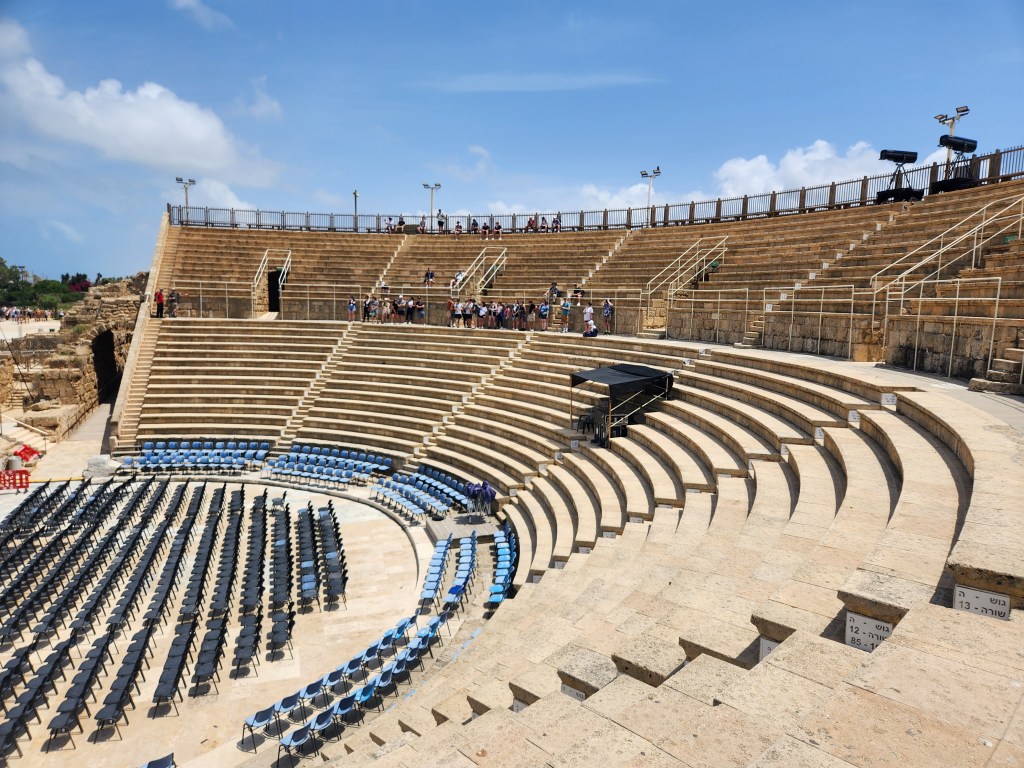
Theater at Caesarea

It was that song that has been stuck in my head as I think about the things that I saw in Caesarea by the Sea, or Caesarea Maritima, on the shores of the Mediterranean Sea in Israel. I had been there before but having spent a significant amount of time over the last couple semesters reading and studying, seeing it all again from this new perspective, and touring those ruins with other students, led by our professor,Dr. David deSilva, I saw many things differently. But while travel always changes us, we can’t always anticipate how we will be changed.

During this visit, the thing that struck me at many of the sites we visited, but particularly at Caesarea, was the incredible gulf that existed between the rich and the poor before, and during, the New Testament period. I’d read about it, and I thought that I understood it, and prior to this trip I certainly could have explained and even preached about it. But this time something was different.

The inner harbor at Caesarea by the Sea

Certainly, Caesarea has a lot going for it and King Herod had every reason to want to build a city, and a palace, here. Being on the sea it has a beautiful view, and an agreeable climate, and with the construction of one of the ancient world’s largest seaports, Caesarea became a center of trade and travel, a center of government, and along with those things became quite wealthy. Caesarea had a beautiful theater, concert hall (an Odeon), an almost impossibly enormous temple of Augustus that dominated the city, an oval track for horse (or human) racing (known as a circus), and even a 10 mile (15 km) long aqueduct to fill the ornate public fountains, flush the toilets, and make sure that no one would ever run out of drinking water. Many buildings were architecturally, over the top gorgeous, and some were known to be covered in imported marble. Fish, wine, and delicacies imported from around the known world were available.

Caesarea Aqueducts

Herod built his palace on a spit of land protruding into the sea just around the corner from the theater and had every luxury available including a cold pool, sauna, and an almost Olympic sized, freshwater swimming pool that was carved out of solid bedrock. After Herod’s death, his palace was used by the governors, procurators of the Judaea Province. Among these were the prefect Pontius Pilate, and Governor Antoninus Felix, that we read about during Paul’s trial in Acts 23, and Governor Porcius Festus who heard Paul’s defense there in Acts 25.

Ruins of Herod’s Palace with mosaic floors and pool.

It was the goal for local and provincial elites to move up to places like Caesarea. There was an enormous disparity between the “haves” and the “have nots” and even between the “wealthy” and “average.” Most of the population were rural peasants that eked out a subsistence level of survival, farming, and fishing in rural areas like Nazareth. There, it wasn’t uncommon for a house to only have one room for an entire family, while larger families might have two, or even four. In Jerusalem, the home of an important, and somewhat wealthy person, might have four rooms and possibly a little larger. Wealthy rulers and government officials made up only 2 percent of the population. Perhaps another 5 percent were “retainers,” career military, lower government functionaries, and household servants for the 2 percent. Merchants and most of the priestly class were basically just “less poor” than peasants, but not anything close to wealthy, and artisans may have had even less income than the peasants.[1]

While we might consider the accommodation in Caesarea to be primitive, and they certainly would not meet our standards of sanitation, many of us would still find it to be nicer than many twenty-first century cities. Caesarea was the place that important and wealthy people dreamed of living. But the lifestyle of the wealthy was so far removed from the experience and expectation of the average person, that it wasn’t even a dream. There was no “middle” class. Two percent were fabulously wealthy and lived a life of luxury, five percent lived well in service to those wealthy people, and everyone else barely made enough money to eat. There was no upward mobility. There was no “moving on up.”

There was only grinding poverty.

Seeing that, understanding that, and grappling with what that means, changes the way that we read the gospels, the stories of the New Testament, and all of scripture.


Please LIKE and SHARE!

Click here to subscribe to Pastor John’s blog.

Click here if you would like to subscribe to Pastor John’s weekly messages.

Click here to visit Pastor John’s YouTube channel.


[1] Sakari Häkkinen, Poverty in the first-century Galilee, Department of New Testament Studies, Faculty of Theology, University of Pretoria, South Africa

Power in Distress

Click here to watch the livestream of this worship service: https://youtu.be/l-G8XgQToQw

(Note: Due to technical issues, no podcast is available for this service)


Power in Distress

January 01, 2023*

(New Year’s Day)

By Pastor John Partridge

Isaiah 63:7-9              Matthew 2:13-23                   Hebrews 2:10-18

When the magi arrive in Jerusalem, Matthew includes a curious phrase in his description of King Herod’s reaction.  Matthew says, “After Jesus was born in Bethlehem in Judea, during the time of King Herod, Magifrom the east came to Jerusalem and asked, “Where is the one who has been born king of the Jews? We saw his star when it rose and have come to worship him.”

When King Herod heard this he was disturbed, and all Jerusalem with him.” (Matthew 2:1-3)

Herod was disturbed… and all of Jerusalem was disturbed with him.

Obviously, there are many reasons why King Herod would have been disturbed, but why would the entire city be disturbed with him?  Historically and biblically, we know that Herod was incredibly paranoid about maintaining his grip on power.  He had at least one of his parents and some of his children killed because he felt threatened by them.  He was not a nice man.  And so, it isn’t surprising that he was disturbed by the arrival of the magi and their question about a new king being born.  There are several theories that have been forwarded about why the entire city would have been disturbed with him, and the simplest of these is that when the king wasn’t happy, everyone worried because… he was not a nice man.  There are other theories, and I have a favorite, but that will have to wait for another day.

And that leads us to our Old Testament reading in which we find that God, in addition to being good, kind, and compassionate, also feels distress when his people are distressed.  We begin this morning reading from Isaiah 63:7-9 where we hear this:

I will tell of the kindnesses of the Lord,
    the deeds for which he is to be praised,
    according to all the Lord has done for us—
yes, the many good things
    he has done for Israel,
    according to his compassion and many kindnesses.
He said, “Surely they are my people,
    children who will be true to me”;
    and so he became their Savior.
In all their distress he too was distressed,
    and the angel of his presence saved them.
In his love and mercy, he redeemed them;
    he lifted them up and carried them
    all the days of old.

God’s reaction to his feeling of distress, was to bring healing to those who were distressed. God chooses to bring rescue and redemption to all of humanity so that he could relieve our distress.  This is unlike how King Herod reacts to distress in Matthew 2:13-23 where we read this:

13 When they had gone, an angel of the Lord appeared to Joseph in a dream. “Get up,” he said, “take the child and his mother and escape to Egypt. Stay there until I tell you, for Herod is going to search for the child to kill him.”

14 So he got up, took the child and his mother during the night, and left for Egypt, 15 where he stayed until the death of Herod. And so was fulfilled what the Lord had said through the prophet: “Out of Egypt I called my son.”

16 When Herod realized that he had been outwitted by the Magi, he was furious, and he gave orders to kill all the boys in Bethlehem and its vicinity who were two years old and under, in accordance with the time he had learned from the Magi. 17 Then what was said through the prophet Jeremiah was fulfilled:

18 “A voice is heard in Ramah,
    weeping and great mourning,
Rachel weeping for her children
    and refusing to be comforted,
    because they are no more.”

19 After Herod died, an angel of the Lord appeared in a dream to Joseph in Egypt 20 and said, “Get up, take the child and his mother and go to the land of Israel, for those who were trying to take the child’s life are dead.”

21 So he got up, took the child and his mother, and went to the land of Israel. 22 But when he heard that Archelaus was reigning in Judea in place of his father Herod, he was afraid to go there. Having been warned in a dream, he withdrew to the district of Galilee, 23 and he went and lived in a town called Nazareth. So was fulfilled what was said through the prophets, that he would be called a Nazarene.

When God feels our distress, he feels distress as well, and chose to send a rescuer to relieve us.  But when Herod feels distress, his solution is to kill as many people as necessary to comfort himself that he has removed the source of his distress.  Throughout the story, God’s focus is on rescuing Mary and Joseph, rescuing Jesus, his appointed rescuer, and through him rescuing all of us.  The focus of God is on us, while the focus of Herod is only on himself.

We see that same focus in Hebrews 2:10-18 as God, through the rescue and restoration available through Jesus Christ, removes yet another source of fear and distress for his people, and for all who would come to him.

10 In bringing many sons and daughters to glory, it was fitting that God, for whom and through whom everything exists, should make the pioneer of their salvation perfect through what he suffered. 11 Both the one who makes people holy and those who are made holy are of the same family. So, Jesus is not ashamed to call them brothers and sisters. 12 He says,

“I will declare your name to my brothers and sisters; in the assembly I will sing your praises.”

13 And again,

“I will put my trust in him.”

And again, he says,

“Here am I, and the children God has given me.”

14 Since the children have flesh and blood, he too shared in their humanity so that by his death he might break the power of him who holds the power of death—that is, the devil— 15 and free those who all their lives were held in slavery by their fear of death. 16 For surely it is not angels he helps, but Abraham’s descendants. 17 For this reason he had to be made like them, fully human in every way, in order that he might become a merciful and faithful high priest in service to God, and that he might make atonement for the sins of the people. 18 Because he himself suffered when he was tempted, he is able to help those who are being tempted.

God perfected Jesus Christ through the suffering that he endured on earth, but because of his perfection, God created a path for his people to be purified, perfected, and made holy.  And through that holiness, we can become the brothers and sisters of Jesus, the children of a holy and perfect God.  Once again, if God was anything at all like King Herod, he could have easily eliminated his distress by eliminating us.  But instead of doing that, God chose to set us free from our anxiety and fear of the future by eliminating the power of death itself.

The writer of Hebrews reminds us that to accomplish that, God had to become like us.  Not a little bit like us, but exactly like us, fully human, so that he could make atonement for the sins of his people.  Jesus had to become like us, suffer like us, be tempted like us, fear like us, dream like us, feel loss like us, mourn and cry like us, worry like us, feel pain like us, bleed like us, die like us, and in every other way… know what it is to be human.  And because he has done those things, he knows what it is like to be us and he is able to offer us help, rescue, and restoration as no one else can.

When King Herod was in distress, he killed people until his worries went away.

But when God felt the distress of humanity, he suffered death himself so that he could rescue us and remove our distress.

And that is why, like Isaiah, we should be and say, I will tell of the kindnesses of the Lord, the deeds for which he is to be praised, according to all the Lord has done for us – yes, the many good things he has done for …”

…Us.


Did you enjoy this?

Please LIKE and SHARE!

Click here to subscribe to Pastor John’s blog.

Click here if you would like to subscribe to Pastor John’s weekly messages.

Click here to visit Pastor John’s YouTube channel.


*You have been reading a message presented at Christ United Methodist Church on the date noted at the top of the first page.  Rev. John Partridge is the pastor at Christ UMC in Alliance, Ohio.  Duplication of this message is a part of our Media ministry, if you have received a blessing in this way, we would love to hear from you.  Letters and donations in support of the Media ministry or any of our other projects may be sent to Christ United Methodist Church, 470 East Broadway Street, Alliance, Ohio 44601.  These messages are available to any interested persons regardless of membership.  You may subscribe to these messages, in print or electronic formats, by writing to the address noted, or by contacting us at secretary@CUMCAlliance.org.  These messages can also be found online at https://pastorpartridge.com .  All Scripture quotations, unless otherwise indicated, are taken from the Holy Bible, New International Version®, NIV®. Copyright ©1973, 1978, 1984, 2011 by Biblica, Inc.™ Used by permission of Zondervan. All rights reserved worldwide. www.zondervan.comThe “NIV” and “New International Version” are trademarks registered in the United States Patent and Trademark Office by Biblica, Inc.™

A New Dawn

A New Dawn

January 03, 2021*

By Pastor John Partridge

Isaiah 60:1-6                          Ephesians 3:1-12                   Matthew 2:1-12

We don’t often take the time to sit and watch the sunrise but when we do, we are often rewarded bountifully for our patience.  This is especially true if we are in a place where there is an unobstructed view to the east.  Recently, Patti and I went to South Carolina to attend our nephew’s wedding and on the way, we stayed at a hotel in Myrtle Beach in a room that faced the beach.  Getting up just a little bit early, making a cup of tea, and sitting on the balcony watching the dawn was almost as memorable a moment as the wedding.  The beauty and serenity of the sunrise, combined with the sound and movement of the surf, was a life-giving moment that fed my soul.

It’s a little odd that a sunrise can be so staggering because it happens every day.  Every day, for millions upon millions of years, the sun rises in the east and sets in the west.  It seems as if it should feel as ordinary as every other moment of every other day.  But every sunrise is different, and every sunrise, just like every New Year’s Day, is meaningful to us because it represents a new day, a moment filled with possibilities, a moment saturated with our dreams and filled with hope.  It is for exactly that reason, that dawn is often used in literature, biblical and otherwise, to represent hopes, dreams, and new beginnings.  And that is what we find as we read Isaiah’s prophecy about the coming messiah, a vision for the future that would, for hundreds of years, fill God’s people with hope.  (Isaiah 60:1-6)

60:1 “Arise, shine, for your light has come, and the glory of the Lord rises upon you.
See, darkness covers the earth and thick darkness is over the peoples,
but the Lord rises upon you and his glory appears over you.
Nations will come to your light, and kings to the brightness of your dawn.

“Lift up your eyes and look about you: All assemble and come to you;
your sons come from afar, and your daughters are carried on the hip.
Then you will look and be radiant, your heart will throb and swell with joy;
the wealth on the seas will be brought to you, to you the riches of the nations will come.
Herds of camels will cover your land, young camels of Midian and Ephah.
And all from Sheba will come, bearing gold and incense and proclaiming the praise of the Lord.

Isaiah describes the coming of the messiah as if the entire world had been living in darkness and was now experiencing the dawn for the first time.  But rather than seeing the rising of the sun, the world would stand as witnesses as the Lord himself would rise over them and the light that they would see would be the glory of God.  Kings would be drawn to that light and they would bring gifts of gold, and incense as they bring praise and worship to God.

And hundreds of years later, we see Isaiah’s vision fulfilled in Matthew 2:1-12 as the Magi see the glory of God in the heavens and follow his star to the house in Nazareth (not Bethlehem, because this was a year or three later) where Mary and Joseph and Jesus lived.

2:1 After Jesus was born in Bethlehem in Judea, during the time of King Herod, Magifrom the east came to Jerusalem and asked, “Where is the one who has been born king of the Jews? We saw his star when it rose and have come to worship him.”

When King Herod heard this he was disturbed, and all Jerusalem with him. When he had called together all the people’s chief priests and teachers of the law, he asked them where the Messiah was to be born. “In Bethlehem in Judea,” they replied, “for this is what the prophet has written:

“‘But you, Bethlehem, in the land of Judah,
    are by no means least among the rulers of Judah;
for out of you will come a ruler
    who will shepherd my people Israel.’”

Then Herod called the Magi secretly and found out from them the exact time the star had appeared. He sent them to Bethlehem and said, “Go and search carefully for the child. As soon as you find him, report to me, so that I too may go and worship him.”

After they had heard the king, they went on their way, and the star they had seen when it rose went ahead of them until it stopped over the place where the child was. 10 When they saw the star, they were overjoyed. 11 On coming to the house, they saw the child with his mother Mary, and they bowed down and worshiped him. Then they opened their treasures and presented him with gifts of gold, frankincense, and myrrh. 12 And having been warned in a dream not to go back to Herod, they returned to their country by another route.

Just as Isaiah had said, the future ruler and shepherd of Israel had been born in Bethlehem, and after Mary, Joseph, and Jesus had returned to Nazareth, the Magi found them and again, just as Isaiah had foretold, they recognized Jesus as a king, worshipped him, and brought gifts of gold and incense.  But look at how they arrived there.  First, they stopped in the capitol, assuming that a king would have been born in the palace.  From there, they likely started toward Bethlehem, but we don’t really know that Jesus was there.  Since Joseph’s home had been in Nazareth, it seems reasonable to assume that they returned there after the census was over. 

But even if they had chosen to stay in Bethlehem, we would be right to ask how the Magi found them, but Matthew’s answer leaves us with even more questions.  Matthew says, “After they had heard the king, they went on their way, and the star they had seen when it rose went ahead of them until it stopped over the place where the child was.”  Listen to that again, “the star they had seen… went ahead of them until it stopped over the place where the child was.”  That’s the only explanation that Matthew offers.  But clearly, since stars, and even planetary conjunctions, simply do not, and cannot, guide us from one town to another, and certainly do not lead us to distinguish one house over another, we have no idea what it was that the Magi were following.  Except that in some way, they were following God.  And we see that every step led them to the fulfillment of Isaiah’s prophecies.

And the arrival of the Magi fulfilled one more prophecy that is a little less obvious, but which is of vital importance to you and me.  Paul recognized its importance, and explains it to the Greek church in Ephesus this way (Ephesians 3:1-12):

3:1 For this reason I, Paul, the prisoner of Christ Jesus for the sake of you Gentiles—

Surely you have heard about the administration of God’s grace that was given to me for you, that is, the mystery made known to me by revelation, as I have already written briefly. In reading this, then, you will be able to understand my insight into the mystery of Christ, which was not made known to people in other generations as it has now been revealed by the Spirit to God’s holy apostles and prophets. This mystery is that through the gospel the Gentiles are heirs together with Israel, members together of one body, and sharers together in the promise in Christ Jesus.

I became a servant of this gospel by the gift of God’s grace given me through the working of his power. Although I am less than the least of all the Lord’s people, this grace was given me: to preach to the Gentiles the boundless riches of Christ, and to make plain to everyone the administration of this mystery, which for ages past was kept hidden in God, who created all things. 10 His intent was that now, through the church, the manifold wisdom of God should be made known to the rulers and authorities in the heavenly realms, 11 according to his eternal purpose that he accomplished in Christ Jesus our Lord. 12 In him and through faith in him we may approach God with freedom and confidence.

The arrival of the magi signifies the fulfillment of God’s promise to break out of the confines of Israel, to break out into the world, to adopt the Gentiles into God’s family as well as the Jews, and to become the rescuer of all humanity.  Paul says that the miracle that is revealed in the gospel is that the Gentiles have become heirs together with Israel, members together of one body, and sharers in the promise of Jesus Christ.  The arrival of the magi is indeed the moment of a new dawn, the beginning of God’s new work in the world.  It is at this moment when our families, and we ourselves, were invited into, and indeed adopted into, God’s family.  And, with the adoption of the Gentiles, we can easily visualize the vast number of nations, kings, presidents, prime ministers, and others around the world who have, and who now worship Israel’s king.

But why?  As impressive as it was, and as impressive as it still is, why did it happen and why does it matter?

And Paul provides the answer to that as well saying, “His intent was that now, through the church, the manifold wisdom of God should be made known to the rulers and authorities in the heavenly realms, 11 according to his eternal purpose that he accomplished in Christ Jesus our Lord. 12 In him and through faith in him we may approach God with freedom and confidence.”

His intent was that now, through the church, the wisdom of God would be made known because it is in him, and through faith in him, that we have the freedom and confidence to approach God, to share our joys, our troubles, our sorrows, and our prayers with him, and to become, and to participate, in our new family. 

It is a new dawn.

And today our mission remains the same.  God intent, God’s mission, is for us to make the wisdom of God known to rulers, to authorities, and to everyone that has not heard the Good News.

Because it is, indeed, good news, of great joy… for all the people.


You can find the video of this worship service here: https://youtu.be/t-yzH9sS9xs

Did you enjoy reading this?

Click here if you would like to subscribe to Pastor John’s weekly messages.

Click here to subscribe to Pastor John’s blog.

Click here to visit Pastor John’s YouTube channel.


*You have been reading a message presented at Christ United Methodist Church on the date noted at the top of the first page.  Rev. John Partridge is the pastor at Christ UMC in Alliance, Ohio.  Duplication of this message is a part of our Media ministry, if you have received a blessing in this way, we would love to hear from you.  Letters and donations in support of the Media ministry or any of our other projects may be sent to Christ United Methodist Church, 470 East Broadway Street, Alliance, Ohio 44601. These messages are available to any interested persons regardless of membership.  You may subscribe to these messages, in print or electronic formats, by writing to the address noted, or by contacting us at secretary@CUMCAlliance.org.  If you have questions, you can ask them in our discussion forum on Facebook (search for Pastor John Online).  These messages can also be found online at https://pastorpartridge.wordpress.com/. All Scripture references are from the New International Version unless otherwise noted.