How Are You Finishing?

How Are You Finishing?

June 2025

by John Partridge

At least twice (and probably more like ten times) in the last few weeks I have been asked about my retirement. Most notably, when I had my annual consultation with our district superintendent, Rev. Edgar Brady, we discussed my plans, whether I wanted to continue for another year at Christ Church, and my thoughts about my eventual retirement. I assured him, as I have for the last six years, that Patti and I are happy at Christ Church and, if Christ Church is happy for us to stay, then we are in no hurry to retire. After that, we spent some time discussing how long it might be until we decided to make such a change. I had a few thoughts on that subject, but no specific plans, and he noted that he was turning seventy and thought that he still had a few good years left, especially since he will begin a new pastoral appointment in July.

The second most notable instance was during my semi-annual meeting with our financial advisor. In the middle of our discussion, I mentioned something general about retirement, possibly as we discussed our search for a house in which to live. It was at that point that he looked at me and pointedly asked, “Why haven’t you retired yet?” My answer was the same as the one I gave to Edgar, “I’m not finished yet.”

But these questions got me to thinking. I’m not ready to retire because I have some things that I’d like to do first. I want to finish my doctoral thesis, we need to find a house that we like that will accommodate all the stuff we want to do at home for the next couple of decades, and I have a few more things that I’d like to accomplish at Christ Church. But those things led me down a train of thought that eventually led me to think more generally about how we are finishing. Regardless of age, when we transition from one thing to another, we finish the first thing before we can get started on the next one. We wind down our projects, we wrap up details, and we prepare for the next chapter. Our inability to do these things is one reason that being suddenly laid off or fired can be so painful, and the same is true for divorce, or the death of a family member.

And that train of thought started me thinking about how all of us are managing our transition from this life to the next. We know that it is coming, though for some of us that transition will be sooner than for others. But how are we preparing for it? If we were planning a camping trip, as our scouts are preparing for summer camp, we would have a list of things that need to be done. Food must be purchased, tents mended, fees collected, service hours recorded, wood collected, physical forms signed by family doctors and turned in, rank advancement done, clothing packed, practice swimming for the camp swim test, and so on.

But as we consider our eventual transition from this life into the next, even if that day is quite far off, we should consider how we are preparing for it. One day we will stand before the throne of God on the day of judgement, and we might imagine being asked “What have you done with my son, Jesus?” How will we answer? How have we prepared? What have we done? With what things have we filled our lives?

I have things that I want to do before I retire, and more things that I want to do afterwards. And just as our scouts are preparing for summer camp, all of us have some time to prepare for our eventual transition from this life into the next. It is my hope that when that day comes, we will be able to say, as Paul did, “I have fought the good fight, I have finished the race, I have kept the faith” (2 Timothy 4:7). Likewise, we hope that upon our arrival, we might hear God say, “Well done, good and faithful servant! (Matthew 25:21)

But until that day comes, we should consider how we spend our time, and with what things we fill our lives.

How are you finishing?

Of Messages and Messengers

Of Messages and Messengers

December 08, 2024*

By Pastor John Partridge

Malachi 3:1-4             Luke 3:1-6                  Philippians 1:3-11

This week I realized that it would be necessary, at the beginning of today’s message, to explain what a messenger does. To me, it seems obvious, but technology, cell phones, and phone and computer applications, or “apps,” have borrowed and popularized their own use of the language that the meaning that was once assumed might easily be misunderstood today. And so, as we read today’s scriptures, I want to be sure that everyone understands that a messenger is a person and not a piece of software or a cell phone application. Once upon a time, messages were carried, and delivered, by people much like the United States Postal Service still does.

If you were in a hurry, you could send a telegram through a company like Western Union. Telegrams were pioneered by the railroads in the 1850’s and originally employed the transmission of Morse Code, transcription on the receiving end, and then delivery by a human being. Western Union delivered many of the death notices for the United States military during the second world war, sold off the telegram business in 2006, and now exists only as a financial services company. Today, if we say that we sent something via messenger, many people will assume that we used text, email, or some kind of messaging app. on your phone. Electronic delivery is so common today that if you intend to hire a human being to carry your message, then you wouldn’t search online for a messenger, but for a “private courier,” or even for a “personal courier.” In any case, as obvious as it may seem, as we read scripture today, the word “messenger” should be understood as a human or angelic being and not simply a type of message.

We begin this morning by reading God’s words to the nation of Israel delivered by the prophet Malachi, whose name, literally translated, means, “my messenger.” We begin reading in Malachi 3:1-4 and hear this:

3:1 “I will send my messenger, who will prepare the way before me. Then suddenly the Lord you are seeking will come to his temple; the messenger of the covenant, whom you desire, will come,” says the Lord Almighty.

But who can endure the day of his coming? Who can stand when he appears? For he will be like a refiner’s fire or a launderer’s soap. He will sit as a refiner and purifier of silver; he will purify the Levites and refine them like gold and silver. Then the Lord will have men who will bring offerings in righteousness, and the offerings of Judah and Jerusalem will be acceptable to the Lord, as in days gone by, as in former years.

Malachi says that the job of God’s messenger will not only be to deliver a message, but to go ahead of God and prepare the people for God’s arrival. This preparation is necessary, we are told, because God’s arrival will be sudden and when he appears, he will refine his people with fire and heat just as silver and gold are purified.

Several hundred years later, Luke uses similar language to describe the arrival, and the mission, of John the Baptist and Luke describes John by quoting from the prophet Isaiah. As we read Luke 3:1-6 we hear this:

3:1 In the fifteenth year of the reign of Tiberius Caesar—when Pontius Pilate was governor of Judea, Herod tetrarch of Galilee, his brother Philip tetrarch of Iturea and Traconitis, and Lysanias tetrarch of Abilene— during the high-priesthood of Annas and Caiaphas, the word of God came to John son of Zechariah in the wilderness. He went into all the country around the Jordan, preaching a baptism of repentance for the forgiveness of sins. As it is written in the book of the words of Isaiah the prophet:

“A voice of one calling in the wilderness,
‘Prepare the way for the Lord,
    make straight paths for him.
Every valley shall be filled in,
    every mountain and hill made low.
The crooked roads shall become straight,
    the rough ways smooth.
And all people will see God’s salvation.’”

Luke describes John’s mission as a preparation for Jesus’ arrival. It was common for kings to plan their journeys and before their arrival, roads would be repaired and improved, potholes filled, trash picked up, buildings cleaned, grass mowed, brass polished, etcetera. And that is what Luke says that John’s words were intended to do, to prepare the people, the hearts of the people, and to prepare the nation itself for the arrival of the Messiah so that “all people will see God’s salvation.”

Malachi warned that the messiah would come.

John warned that the messiah had already arrived.

And then, in Philippians 1:3-11, Paul writes to tell the church what they should do about it now that Jesus had risen from the dead and returned to his father’s house in heaven. Paul says…

I thank my God every time I remember you. In all my prayers for all of you, I always pray with joy because of your partnership in the gospel from the first day until now, being confident of this, that he who began a good work in you will carry it on to completion until the day of Christ Jesus.

It is right for me to feel this way about all of you, since I have you in my heart and, whether I am in chains or defending and confirming the gospel, all of you share in God’s grace with me. God can testify how I long for all of you with the affection of Christ Jesus.

And this is my prayer: that your love may abound more and more in knowledge and depth of insight, 10 so that you may be able to discern what is best and may be pure and blameless for the day of Christ, 11 filled with the fruit of righteousness that comes through Jesus Christ—to the glory and praise of God.

There are several important things for us to note in this short passage. First. Paul is always filled with joy as he remembers the people in the church in Philippi because of the partnership that they had built and the work that they had done together. Because of all that they had done as partners, Paul was fully confident that God was not done with them and would continue to work in them and through them until the work that God intended to do had been completed. Next, Paul prays that the love of the church would be abundant and that their love would grow in knowledge, wisdom, and insight so that they would be discerning and choose a path forward that would bring about the best result possible and allow the people of the church to stand before Jesus on the day of judgement as people who were pure, blameless, and filled with righteousness because of their relationship with Jesus Christ.

Malachi told God’s people of the Messiah that was to come.

John told God’s people that the Messiah had already arrived.

And Paul tells us that the mission of the church, today, is to tell the world that the Messiah has come, to pray that we would grow in love, knowledge, wisdom, and insight so that we will be prepared to stand before Jesus Christ on the day of judgement.


Please LIKE and SHARE!

Click here to subscribe to Pastor John’s blog.

Click here if you would like to subscribe to Pastor John’s weekly messages.

Click here to visit Pastor John’s YouTube channel.


*You have been reading a message presented at Christ United Methodist Church on the date noted at the top of the first page.  Rev. John Partridge is the pastor at Christ UMC in Alliance, Ohio.  Duplication of this message is a part of our Media ministry, if you have received a blessing in this way, we would love to hear from you.  Letters and donations in support of the Media ministry or any of our other projects may be sent to Christ United Methodist Church, 470 East Broadway Street, Alliance, Ohio 44601.  These messages are available to any interested persons regardless of membership.  You may subscribe to these messages, in print or electronic formats, by writing to the address noted, or by contacting us at secretary@CUMCAlliance.org.  These messages can also be found online at https://pastorpartridge.com .  All Scripture quotations, unless otherwise indicated, are taken from the Holy Bible, New International Version®, NIV®. Copyright ©1973, 1978, 1984, 2011 by Biblica, Inc.™ Used by permission of Zondervan. All rights reserved worldwide. www.zondervan.comThe “NIV” and “New International Version” are trademarks registered in the United States Patent and Trademark Office by Biblica, Inc.™

Photo by Comstock on Freeimages.com

David’s Faith… in David

David’s Faith in… David

June 25, 2024

by Pastor John Partridge

This past week at our church Annual Conference meeting, our Bishop, Tracy Smith Malone, preached a message in which she shared the story of David and Goliath, and framed David’s self-confidence as being a matter of David’s faith in God.

And that’s true.

But it’s more than that.

We can all agree that the story of David and Goliath is clear that while King Saul, and his entire army, were in fear and panic of the size, strength, skill, and power of the Philistine warrior Goliath, David’s faith enabled him to be the only one who had the self-confidence and faith to meet Goliath in single combat, one on one and man-to-man.

But David’s confidence wasn’t entirely faith-based. There was more to it than that and while we usually do a respectable job of preaching the faith part, the other part is just as important. Let me back up and lay some groundwork before I go any farther.

First, it was well-known that a skilled slinger could outrange an archer, strike a moving target at two hundred yards, and were said to be so accurate that they could aim for a specific part of a target’s face. Typical sling stones were 2 to 3 inches in diameter (5-7 cm) and weighed as much as a half-pound (0.25kg). These projectiles would be flung at 100 to 150 miles per hour (160 to 240 kph). Stones of that size, thrown at that speed, could kill by a blow to the head, or by rupturing an organ. Second, we also know that David, spending years in the fields watching his father’s sheep, had ample time, and plenty of rocks, with which to practice his skills with a sling and to become proficient. Third, the stories that we have of David rescuing his sheep by killing a bear and a lion can be offered as evidence of his skill, his fearlessness, and his faith.

And so, you see, David not only had confidence in God, but he also had confidence in… David. He had done the work of preparation. David had practiced during all those lonely years in the wilderness with his father’s sheep. David knew what he could do. He had developed, and honed, his skill with his sling, and he had been battle tested in his encounters with both a lion and a bear.

Yes, David had faith in God. But David had done the work of preparation, and he knew that those two things combined would bring victory against Goliath.

David wasn’t foolish. He didn’t just leap into a fight that he couldn’t hope to win and put all his eggs in the basket of his faith. David did the work of preparation. He developed his skill, and he tested it against deadly opponents. David knew that he had what it took to win, but he also knew that in a fight against a skilled adversary, anything can happen. David did the work of preparation; he did everything that he could to be ready… and the rest he trusted to God.

That was David’s faith… and it’s a model that we would do well to remember.

Faith isn’t jumping off a cliff and hoping that God will save you. Faith is buying a parachute, learning how to use it, and then jumping off a cliff… and trusting that God will use and guide your skill to bring about the desired result.

Faith is important.

But God still expects us to do the work of preparation.

________________________________________________

Please LIKE and SHARE!

Click here to subscribe to Pastor John’s blog.

Click here if you would like to subscribe to Pastor John’s weekly messages.

Click here to visit Pastor John’s YouTube channel.

(Insert Your Name Here)

 (Insert Your Name Here)

December 24, 2023*

By Pastor John Partridge

2 Samuel 7:1-11, 16               Luke 1:26-38                          Romans 16:25-27

There is a scene in the 1978 movie, National Lampoon’s “Animal House,” where the new class of pledges for the Delta House are sworn into the fraternity. In it, they are asked to say “I… state your name… “and every single one of them says the words “state your name” instead of saying their name. And we all laughed because we all assume that everyone knows what to do in such a situation. Whenever we fill out forms for our schools, doctors, insurance companies, the Internal Revenue Service, retirement funds, and all sorts of other things, we encounter a box or a line that asks us for our name. At other times, we have been asked to include our names in a script where we take an oath of office, or are sworn into the military, or, in this case, a fraternity, we just include our own names where we are told to do so.

But as common as it is in our everyday lives, we often miss it when the same thing happens as we read scripture. And that’s a point that I want to make today. As we make our final preparations for Christmas tomorrow morning, it’s important for us to remember that we are included in the story of scripture. We aren’t everywhere, of course, because the story is about characters that are so familiar to us. This morning we will hear about King David, the prophet Nathan, the angel Gabriel, Elizabeth, Mary, the Apostle Paul, and… (insert your name here).

We begin with God’s words found in 2 Samuel 7:1-11, 16 where we hear God’s promise to King David given through his prophet Nathan:

7:1 After the king was settled in his palace and the Lord had given him rest from all his enemies around him, he said to Nathan the prophet, “Here I am, living in a house of cedar, while the ark of God remains in a tent.”

Nathan replied to the king, “Whatever you have in mind, go ahead and do it, for the Lord is with you.”

But that night the word of the Lord came to Nathan, saying:

“Go and tell my servant David, ‘This is what the Lord says: Are you the one to build me a house to dwell in? I have not dwelt in a house from the day I brought the Israelites up out of Egypt to this day. I have been moving from place to place with a tent as my dwelling. Wherever I have moved with all the Israelites, did I ever say to any of their rulers whom I commanded to shepherd my people Israel, “Why have you not built me a house of cedar?”’

“Now then, tell my servant David, ‘This is what the Lord Almighty says: I took you from the pasture, from tending the flock, and appointed you ruler over my people Israel. I have been with you wherever you have gone, and I have cut off all your enemies from before you. Now I will make your name great, like the names of the greatest men on earth. 10 And I will provide a place for my people Israel and will plant them so that they can have a home of their own and no longer be disturbed. Wicked people will not oppress them anymore, as they did at the beginning 11 and have done ever since the time I appointed leadersover my people Israel. I will also give you rest from all your enemies.

16 Your house and your kingdom will endure forever before me; your throne will be established forever.’”

David had finally become secure in his leadership of Israel. He has built a palace, united the twelve tribes, settled, and secured the borders with other nations, and at this moment he looks at the tent that houses God’s tabernacle and imagines that it is time to build a permanent dwelling place for the Ark of the Covenant and for Israel’s God. But God isn’t having any of that just yet. God’s words to David are that he is not the one who has been called to build God’s house. Instead, God reminds David of his roots and humble beginnings, how God brought David to this place, how God will place the name of David among the greatest men on the planet, and how God has plans that extend far beyond David’s lifetime. God promises that David’s family, and David’s kingdom will endure forever.

God’s message to David is, “Look how far you have come. Look at how far I have brought you. And I’m not even close to being done yet.”

And that leads us back to the Christmas story in Luke 1:26-38 where God sends the angel Gabriel to visit Mary and announce her pregnancy.

26 In the sixth month of Elizabeth’s pregnancy, God sent the angel Gabriel to Nazareth, a town in Galilee, 27 to a virgin pledged to be married to a man named Joseph, a descendant of David. The virgin’s name was Mary. 28 The angel went to her and said, “Greetings, you who are highly favored! The Lord is with you.”

29 Mary was greatly troubled at his words and wondered what kind of greeting this might be. 30 But the angel said to her, “Do not be afraid, Mary; you have found favor with God. 31 You will conceive and give birth to a son, and you are to call him Jesus. 32 He will be great and will be called the Son of the Most High. The Lord God will give him the throne of his father David, 33 and he will reign over Jacob’s descendants forever; his kingdom will never end.”

34 “How will this be,” Mary asked the angel, “since I am a virgin?”

35 The angel answered, “The Holy Spirit will come on you, and the power of the Most High will overshadow you. So, the holy one to be born will be calledthe Son of God. 36 Even Elizabeth your relative is going to have a child in her old age, and she who was said to be unable to conceive is in her sixth month. 37 For no word from God will ever fail.”

38 “I am the Lord’s servant,” Mary answered. “May your word to me be fulfilled.” Then the angel left her.

Mary wonders how this could happen. She knows where babies come from, but she also knows that she and Joseph have not yet slept together. Given that their two families do not live in the same town, the chances are good that she and Joseph rarely, if ever, see one another, and it’s quite possible that she hasn’t seen him at all since the contract was signed pledging them to be married. But as difficult as it is to believe, Mary accepts her role in this unfolding drama saying, “May your word to me be fulfilled.”

It is important to notice that Gabriel also affirms God’s promise to David, and Mary understands that she will be a part of the fulfillment of that promise. God promises that Mary’s son will inherit the throne of King David and become a part of a kingdom that will never end. And so, Mary clings to God’s promise. If God has come this far, over thousands of years, to fulfill his promise to David, Mary’s prayer is that God will do the same for his promise to her, saying, “May your word to me be fulfilled.”

But what does that have to do with us?

Where is the fill in the blank part?

And as we often do, we find the application in Romans 16:25-27, in the very last words of Paul’s letter to the church in Rome where he says…

25 Now to him who is able to establish you in accordance with my gospel, the message I proclaim about Jesus Christ, in keeping with the revelation of the mystery hidden for long ages past, 26 but now revealed and made known through the prophetic writings by the command of the eternal God, so that all the Gentiles might come to the obedience that comes fromfaith— 27 to the only wise God be glory forever through Jesus Christ! Amen.

And there it was. Did you hear it, or did you miss it?

Paul says that God has revealed his salvation, through his son Jesus Christ, through the writings of the prophets of Israel… so that… all the nations, or in another translation all the Gentiles, might come to obedience and faith. God says that the entire journey of the people of Israel, through Abraham, David, and to the Christmas story, Mary, Joseph, and Jesus, the entire story was commanded by God for the purpose of bringing hope to the world and calling the Gentiles, and all the nations of the world, to faith in Jesus.

That is where you can insert your name.

Paul said, “the message I proclaim about Jesus Christ, in keeping with the revelation of the mystery hidden for long ages past, 26 but now revealed and made known through the prophetic writings by the command of the eternal God, so that (insert your name here) might come to the obedience that comes fromfaith…”

But the story isn’t over.

The story wasn’t over when God brought David from herding sheep to unite the twelve tribes of Israel, and the story wasn’t over with the birth, life, death, and resurrection of Jesus. God did all these things so that all nations, and all people, might come to obedience and faith in Jesus Christ.

There is still work to do.

And God is calling each one of you, (insert your name here) to finish the job.


Please LIKE and SHARE!

Click here to subscribe to Pastor John’s blog.

Click here if you would like to subscribe to Pastor John’s weekly messages.

Click here to visit Pastor John’s YouTube channel.


*You have been reading a message presented at Christ United Methodist Church on the date noted at the top of the first page.  Rev. John Partridge is the pastor at Christ UMC in Alliance, Ohio.  Duplication of this message is a part of our Media ministry, if you have received a blessing in this way, we would love to hear from you.  Letters and donations in support of the Media ministry or any of our other projects may be sent to Christ United Methodist Church, 470 East Broadway Street, Alliance, Ohio 44601.  These messages are available to any interested persons regardless of membership.  You may subscribe to these messages, in print or electronic formats, by writing to the address noted, or by contacting us at secretary@CUMCAlliance.org.  These messages can also be found online at https://pastorpartridge.com .  All Scripture quotations, unless otherwise indicated, are taken from the Holy Bible, New International Version®, NIV®. Copyright ©1973, 1978, 1984, 2011 by Biblica, Inc.™ Used by permission of Zondervan. All rights reserved worldwide. www.zondervan.comThe “NIV” and “New International Version” are trademarks registered in the United States Patent and Trademark Office by Biblica, Inc.™

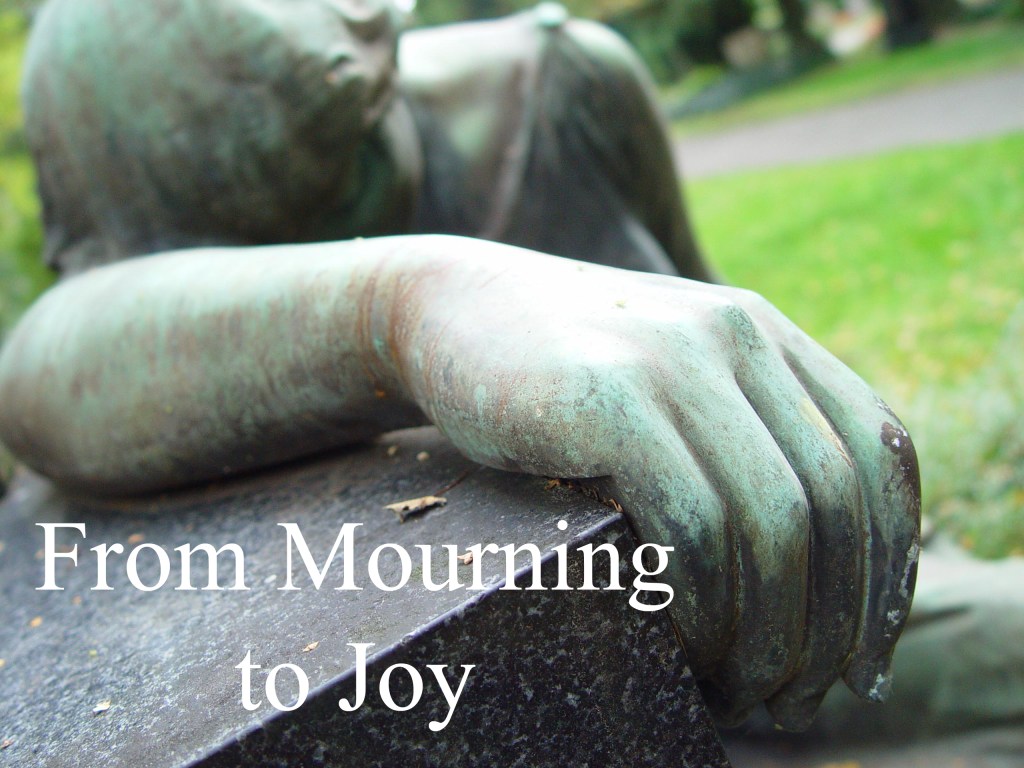
From Mourning to Joy

From Mourning to Joy

December 17, 2023*

By Pastor John Partridge

Isaiah 61:1-4, 8-11                 John 1:6-8, 19-28                          1 Thessalonians 5:16-24

On June second of 2022, seventeen-year-old Ethan Liming, the son of United Methodist Pastor Bill Liming, was beaten to death during an altercation at a basketball court in downtown Akron. This week we were notified that another of our East Ohio Conference colleagues, Beth Wilterdink, with whom Mike Greiner and I have served on the conference committee on camps and retreats, is mourning, with her husband and family, the loss of their barely two-year-old daughter Cora. I can read about these things, but I can’t begin to understand the pain and the grief that these families must feel.

But many of us have experienced our own kinds of loss. Some of you have lost children, many of us have lost parents or siblings. We each understand grief in our own way. And so, we have some insight into the lives of the people who heard God’s message through his prophet Isaiah. These were the people who had lost everything. They had lost sons, daughters, husbands, wives, brothers, sisters, parents, and grandparents, they had lost their nation and their freedom and had been carried off into captivity in Babylon. They were filled with grief. But God speaks to them through the writings of Isaiah and tells them that in the midst of their grief, there is good news. We hear these words in Isaiah 61:1-4, 8-11…

61:1 The Spirit of the Sovereign Lord is on me, because the Lord has anointed me
    to proclaim good news to the poor.
He has sent me to bind up the brokenhearted, to proclaim freedom for the captives
    and release from darkness for the prisoners,
to proclaim the year of the Lord’s favor and the day of vengeance of our God,
to comfort all who mourn,
    and provide for those who grieve in Zion— to bestow on them a crown of beauty
    instead of ashes, the oil of joy instead of mourning, and a garment of praise
    instead of a spirit of despair.
They will be called oaks of righteousness, a planting of the Lord for the display of his splendor.

They will rebuild the ancient ruins and restore the places long devastated;
they will renew the ruined cities that have been devastated for generations.

“For I, the Lord, love justice;I hate robbery and wrongdoing.
In my faithfulness I will reward my people and make an everlasting covenant with them.
Their descendants will be known among the nations and their offspring among the peoples.
All who see them will acknowledge that they are a people the Lord has blessed.”

10 I delight greatly in the Lord;my soul rejoices in my God.
For he has clothed me with garments of salvation and arrayed me in a robe of his righteousness,
as a bridegroom adorns his head like a priest, and as a bride adorns herself with her jewels.
11 For as the soil makes the sprout come up and a garden causes seeds to grow,
so the Sovereign Lord will make righteousness and praise spring up before all nations.

God says that there will be healing for the brokenhearted, release for prisoners, comfort for those who mourn, and God promises to transform the ashes of their grief into a crown of beauty. God promises to rebuild, restore, and renew, and to bring justice and faithfulness to replace their despair and loss. And in the end, God will use the nations of the world to raise up gardens of righteousness and praise.

In no way does God, or Isaiah, diminish the pain, loss, and grief that we experience today, God does not tell us to “get over it,” but God does promise that he will, one day, transform our grief into joy.

But, because John the Baptist had been quoting from the words of Isaiah, the priests and the leaders of Israel came out to the wilderness in John 1:6-8, 19-28 to ask if he was a resurrected Isaiah that God had sent to fulfill the promises that had been written so long ago.

There was a man sent from God whose name was John. He came as a witness to testify concerning that light, so that through him all might believe. He himself was not the light; he came only as a witness to the light.

19 Now this was John’s testimony when the Jewish leaders in Jerusalem sent priests and Levites to ask him who he was. 20 He did not fail to confess, but confessed freely, “I am not the Messiah.”

21 They asked him, “Then who are you? Are you Elijah?”

He said, “I am not.”

“Are you the Prophet?”

He answered, “No.”

22 Finally they said, “Who are you? Give us an answer to take back to those who sent us. What do you say about yourself?”

23 John replied in the words of Isaiah the prophet, “I am the voice of one calling in the wilderness, ‘Make straight the way for the Lord.’”

24 Now the Pharisees who had been sent 25 questioned him, “Why then do you baptize if you are not the Messiah, nor Elijah, nor the Prophet?”

26 “I baptize with water,” John replied, “but among you stands one you do not know. 27 He is the one who comes after me, the straps of whose sandals I am not worthy to untie.”

28 This all happened at Bethany on the other side of the Jordan, where John was baptizing.

But John says that he is not Isaiah, nor is he Elijah, nor is he the promised messiah. Instead, he has come to point to the Messiah, to announce his arrival, and to proclaim the fulfillment of God’s promises in Isaiah in the person of Jesus Christ.

But, knowing that Jesus is the Messiah, as we do, what does that mean for us today? What does that tell us about our grief, and our pain, and how we are to live our lives in the twenty-first century? In his letter to the church in Thessalonica, contained in 1 Thessalonians 5:16-24, Paul says this:

16 Rejoice always, 17 pray continually, 18 give thanks in all circumstances; for this is God’s will for you in Christ Jesus.

19 Do not quench the Spirit. 20 Do not treat prophecies with contempt 21 but test them all; hold on to what is good, 22 reject every kind of evil.

23 May God himself, the God of peace, sanctify you through and through. May your whole spirit, soul and body be kept blameless at the coming of our Lord Jesus Christ. 24 The one who calls you is faithful, and he will do it.

Paul says that God’s will for us is to live in anticipation of God’s final and ultimate victory. We are to live as if Christ has already returned, and God has already fulfilled his promises of rescue, rebuilding, restoration, renewal, and transformation. Rejoice always, pray continually, give thanks in all circumstances, test the prophecies of God to prove their truthfulness, reject every kind of evil, but hold on to all that is good.

In this world, we know that we will experience suffering, pain, grief, and death.

But one day God will transform our mourning into joy.

Until then…

…reject every kind of evil and…

                                    …hold on to what is good.


Please LIKE and SHARE!

Click here to subscribe to Pastor John’s blog.

Click here if you would like to subscribe to Pastor John’s weekly messages.

Click here to visit Pastor John’s YouTube channel.


*You have been reading a message presented at Christ United Methodist Church on the date noted at the top of the first page.  Rev. John Partridge is the pastor at Christ UMC in Alliance, Ohio.  Duplication of this message is a part of our Media ministry, if you have received a blessing in this way, we would love to hear from you.  Letters and donations in support of the Media ministry or any of our other projects may be sent to Christ United Methodist Church, 470 East Broadway Street, Alliance, Ohio 44601.  These messages are available to any interested persons regardless of membership.  You may subscribe to these messages, in print or electronic formats, by writing to the address noted, or by contacting us at secretary@CUMCAlliance.org.  These messages can also be found online at https://pastorpartridge.com .  All Scripture quotations, unless otherwise indicated, are taken from the Holy Bible, New International Version®, NIV®. Copyright ©1973, 1978, 1984, 2011 by Biblica, Inc.™ Used by permission of Zondervan. All rights reserved worldwide. www.zondervan.comThe “NIV” and “New International Version” are trademarks registered in the United States Patent and Trademark Office by Biblica, Inc.™

Advent Adventure

Advent Adventure

by John Partridge

The first Sunday in December is the beginning of Advent and our celebration of the birth of Jesus Christ. During that season we will journey together, as Mary and Joseph did, but rather than making a hard journey (probably on foot and not on a donkey) of eighty or ninety miles, we will journey through stories of hope, angels, shepherds, prophecy, and love. Many of our traditional decorations have been added but there will undoubtedly be a surprise or two along the way as well.

Since the shutdown of the Covid-19 epidemic, much has changed. One thing that changed was our church attendance. During the shutdown we all moved online, and afterward, not everyone returned. But since then, we’ve been growing, and changing. I hope to say more about that in the next month or two, but if you have been paying attention, some things at Christ Church are different than they were in 2020 and these changes are encouraging.

In any case, during the season of Advent, we will be journeying together, remembering the events that unfolded so long ago, walking with Mary and Joseph, grieving, and celebrating with Elizabeth and Zechariah, sharing the awe and wonder of the shepherds keeping watch on a dark hillside, and in all these things, we remember who we are, where we came from, and why we are here.

As we do during the season of Lent, and as I have said before, Advent is a journey, a time of preparation, a time that we set aside to remember. It is more than just the pre-game show for the big game because we are meant to be more than just spectators in this drama. The Super Bowl would be terrible if the players only showed up for the game in January and had not spent the entire season preparing for it. I invite you all to join us during this Advent season to sing some songs, to hear the stories, to consider what those stories mean, and to prepare our hearts so that we can be truly ready to receive the message of Christmas.

Christmas isn’t just a day on the calendar. It isn’t just a single family gathering and a shared meal like Thanksgiving. It’s bigger, wider, and deeper with more nuance and layers of meaning. I invite you to join us on our Advent adventure during this season of preparation, especially as our church family itself is changing, so that when we arrive at Christmas, we will feel a deeper joy as we draw closer to God, closer to Jesus, closer to our church family, and closer to the people of God.


Please LIKE and SHARE!

Click here to subscribe to Pastor John’s blog.

Click here if you would like to subscribe to Pastor John’s weekly messages.

Click here to visit Pastor John’s YouTube channel.

Alien Preparedness

Alien Preparedness

December 10, 2023*

By Pastor John Partridge

Isaiah 40:1-11                        Mark 1:1-8                             2 Peter 3:8-15

There is an old saying that says, “It doesn’t rain in the Army… it rains on the Army. It isn’t a particularly funny joke, but it’s a part of the dark humor that is often found while standing in the middle of a driving rainstorm. There is a similar saying in scouting, but because our scout motto is “Be Prepared,” the saying is changed to reflect that and says, “There is no bad weather in scouting, only scouts that are not prepared for the weather.” But that leads us to the title of today’s message, “Alien Preparedness.” No, this is not about preparing for an alien invasion or something that you might find on Ancient Aliens on the History Channel, but it is about preparedness.

My brother Dean used to point out that when we say we are “getting in shape” or that an athlete is “in shape,” it’s important to ask, “In shape for what?” No one doubts that NFL football players are in shape, but ask them to run a marathon, or race an Olympic swimmer, and suddenly, they are not ready because, despite all the physical conditioning that they have done, they are not prepared for that specific kind of physical competition. And so, when we say, like the scouts, that we must “Be Prepared,” we must also ask, “Prepared for what?”  When it is framed in that way, “Alien Preparedness” is not about preparing for an alien invasion, but to prepare for something you did not expect, or in a way that you hadn’t expected.

I am sure that’s still more than a little puzzling but hold on to that idea while we dive into our scriptures, and when we return to this later, I think it will be clearer.  We begin this morning with the words of the prophet Isaiah who speaks to Israel to tell of the imminent destruction of their nation at the hands of the Assyrian army but also speaks words of comfort and God’s promise that there would one day be restoration after Jerusalem’s destruction. We hear these words in Isaiah 40:1-11…

40:1 Comfort, comfort my people, says your God.
Speak tenderly to Jerusalem, and proclaim to her
that her hard service has been completed, that her sin has been paid for,
that she has received from the Lord’s hand double for all her sins.

A voice of one calling:
“In the wilderness prepare the way for the Lord,
make straight in the desert a highway for our God.
Every valley shall be raised up, every mountain and hill made low;
the rough ground shall become level, the rugged places a plain.
And the glory of the Lord will be revealed, and all people will see it together.
For the mouth of the Lord has spoken.”

A voice says, “Cry out.”
    And I said, “What shall I cry?”

“All people are like grass, and all their faithfulness is like the flowers of the field.
The grass withers and the flowers fall, because the breath of the Lord blows on them.
    Surely the people are grass.
The grass withers and the flowers fall, but the word of our God endures forever.”

You who bring good news to Zion, go up on a high mountain.
You who bring good news to Jerusalem,  lift up your voice with a shout,
lift it up, do not be afraid; say to the towns of Judah, “Here is your God!”
10 See, the Sovereign Lord comes with power, and he rules with a mighty arm.
See, his reward is with him, and his recompense accompanies him.
11 He tends his flock like a shepherd: He gathers the lambs in his arms
and carries them close to his heart; he gently leads those that have young.

Isaiah says that things are going to be terrible, and then worse than terrible, and then, just when they think that they are withering into death like the grass in summer, there will be a voice… one single voice… crying out in the desert to prepare for the arrival of their rescuer. Things will be terrible, but one day the rescuer will come. He will rule with a mighty arm, but he will tend his flock with gentleness like a shepherd.

And then, in the middle of the Roman occupation, as Israel once again prayed for God’s rescue, the voice of John the Baptizer is heard in the wilderness and Mark remembers, and quotes the words of Isaiah in Mark 1:1-8 saying…

1:1 The beginning of the good news about Jesus the Messiah, the Son of God, as it is written in Isaiah the prophet:

“I will send my messenger ahead of you,
    who will prepare your way”—
“a voice of one calling in the wilderness,
‘Prepare the way for the Lord,
    make straight paths for him.’”

And so John the Baptist appeared in the wilderness, preaching a baptism of repentance for the forgiveness of sins. The whole Judean countryside and all the people of Jerusalem went out to him. Confessing their sins, they were baptized by him in the Jordan River. John wore clothing made of camel’s hair, with a leather belt around his waist, and he ate locusts and wild honey. And this was his message: “After me comes the one more powerful than I, the straps of whose sandals I am not worthy to stoop down and untie. I baptize you with water, but he will baptize you with the Holy Spirit.”

John declares that God’s promised rescuer has come, and the people had better be prepared.

But what does that mean? How should the people prepare? We know that John’s message was one of repentance and called people to repent of their sins and recommit their lives to following God. But is that all there is to it? What kind of preparations are required for us in the twenty-first century as we remember John’s message and prepare ourselves for Jesus’ return. And that’s where Peter steps in to remind us of John’s message and apply it to our daily lives in the here and now. In 2 Peter 3:8-15 we hear this message about our future:

But do not forget this one thing, dear friends: With the Lord a day is like a thousand years, and a thousand years are like a day. The Lord is not slow in keeping his promise, as some understand slowness. Instead, he is patient with you, not wanting anyone to perish, but everyone to come to repentance.

10 But the day of the Lord will come like a thief. The heavens will disappear with a roar; the elements will be destroyed by fire, and the earth and everything done in it will be laid bare.

11 Since everything will be destroyed in this way, what kind of people ought you to be? You ought to live holy and godly lives 12 as you look forward to the day of God and speed its coming. That day will bring about the destruction of the heavens by fire, and the elements will melt in the heat. 13 But in keeping with his promise we are looking forward to a new heaven and a new earth, where righteousness dwells.

14 So then, dear friends, since you are looking forward to this, make every effort to be found spotless, blameless and at peace with him. 15 Bear in mind that our Lord’s patience means salvation, just as our dear brother Paul also wrote you with the wisdom that God gave him.

And this is where we find the alien preparation. This is not making sure to pack a raincoat, or warm winter clothes, and it’s more than just John’s message of repentance and baptism. This is, quite literally, preparation for the end of the world. The heavens will disappear, the earth will be destroyed, and the elements themselves will be melted in the heat of God’s judgement. On that day, God will make good on his promise to bring peace and justice, and from the ruins of this world will create a new heaven and a new earth filled with righteousness.

But how can we prepare for such a thing? What will be required of us? What must we do to be ready? And Peter’s answer is not so different from that of John the Baptizer. Repent, make straight paths for him, make every effort to live lives that are blameless so that your lives can be at peace with Jesus Christ by doing everything that he taught and modelled for us.

We absolutely must get this right.

Because we are not just preparing for the arrival of our rescuer and king.

We are, quite literally, preparing for the end of the world.


Please LIKE and SHARE!

Click here to subscribe to Pastor John’s blog.

Click here if you would like to subscribe to Pastor John’s weekly messages.

Click here to visit Pastor John’s YouTube channel.


*You have been reading a message presented at Christ United Methodist Church on the date noted at the top of the first page.  Rev. John Partridge is the pastor at Christ UMC in Alliance, Ohio.  Duplication of this message is a part of our Media ministry, if you have received a blessing in this way, we would love to hear from you.  Letters and donations in support of the Media ministry or any of our other projects may be sent to Christ United Methodist Church, 470 East Broadway Street, Alliance, Ohio 44601.  These messages are available to any interested persons regardless of membership.  You may subscribe to these messages, in print or electronic formats, by writing to the address noted, or by contacting us at secretary@CUMCAlliance.org.  These messages can also be found online at https://pastorpartridge.com .  All Scripture quotations, unless otherwise indicated, are taken from the Holy Bible, New International Version®, NIV®. Copyright ©1973, 1978, 1984, 2011 by Biblica, Inc.™ Used by permission of Zondervan. All rights reserved worldwide. www.zondervan.comThe “NIV” and “New International Version” are trademarks registered in the United States Patent and Trademark Office by Biblica, Inc.™

Who Wants a Raw Christmas?

Who Wants a Raw Christmas?

A Message for Advent 2022

Imagine that you sit down to Thanksgiving dinner and what’s passed around the table is a big raw turkey, a bowl of dirty, cold, fresh out of the ground potatoes, a loaf of stale bread, some bullion cubes, and a few bowls with flour, sugar, cocoa powder, and butter. Sure, all the ingredients are there to make a fine meal, but there’s clearly something missing and that thing is…

Preparation.

We can buy all the ingredients for a Thanksgiving feast, but without investing the time and the care that it takes to adequately prepare them, they aren’t anywhere near as good as they should be, or as good as we expected them to be.  Preparation is the thing that puts the pieces together, measures out the ingredients, mixes them, and warms them to precise temperatures for a measured amount of time.  Without that preparation, we end up with raw meat and stale bread instead of a succulent roasted turkey with stuffing, mashed potatoes, gravy, and dessert.  It is the preparation that makes the house smell so good, and drool with anticipation.

It seems so obvious when we think about Thanksgiving and food.

So, why does it seem so hard to understand when we think about the season of Advent?  These four weeks are a time that has been deliberately set aside as… a season of preparation.  It is a time for us to set out the ingredients, Jesus, Mary, Joseph, hope, faith, joy, love, prophets, shepherds, angels, and everything else, measure them out in the right proportions, mix and season them, and warm them in the love of our community of faith.  And then, at just the right time, it all comes together, and what is served is just what we imagined and just we needed to fill our souls to overflowing. 

During this season of preparation, we invite you to come into the kitchen with us.  Join us as we set out the ingredients, measure, share news of family and friends, mix, season, and warm it all, and us, in the love of faith and community.  The result, on Christmas Eve and Christmas morning, will be much more satisfying and fulfilling than raw turkey and bowls of uncooked ingredients.  Like Thanksgiving dinner, the thing that makes us drool with the anticipation of Christmas, and so deeply satisfies our souls, is found in setting aside the time to prepare it, together.

Won’t you join us for this season of preparation?

Blessings,

Pastor John 


Did you enjoy this?

Please LIKE and SHARE!

Click here to subscribe to Pastor John’s blog.

Click here if you would like to subscribe to Pastor John’s weekly messages.

Click here to visit Pastor John’s YouTube channel.

Should We Rejoice or Flee?

(Video of this service can be found here: https://youtu.be/IOd2NYgjGNk)

Should We Rejoice or Flee?

(Third Sunday of Advent)

December 12, 2021*

By Pastor John Partridge

Zephaniah 3:14-20 Luke 3:7-18 Philippians 4:4-7

What does it cost, and what is it worth to be a member of something?

Many of you will remember the advertising campaign that was used by American Express from 1974 to 1987 that said, “Membership has its privileges.”  Membership, of course, cost money, but for many frequent travelers, the membership benefits were, and are, worth far more than the annual fee for the card.

Similarly, joining the local Country Club can be worthwhile if you like to play golf on a regular basis and if you use the benefits that come with membership.

If you just want to show off, you can probably find someone that will, for a small fee, make you a fake American Express Gold Card or a fake Country Club membership card that you can show off at parties.  But your fake card isn’t going to give you any of the benefits that you get with the real thing.  You won’t get 24 hour concierge service, or emergency airline ticketing, or collect reward points, you won’t get to play golf or even get in the door to eat in the country club banquet room.  A fake card lets you pretend that you’re a member, but does not give you any of the benefits of actual membership.

All that may seem to be an odd thing to think about during Advent, but it may help us to understand some of the things we hear in our scripture passages this morning.  We begin with God’s words about the coming messiah, to the people of Israel, recorded by the prophet Zephaniah (Zephaniah 3:14-20)

14 Sing aloud, O daughter Zion;
    shout, O Israel!
Rejoice and exult with all your heart,
    O daughter Jerusalem!
15 The Lord has taken away the judgments against you,
    he has turned away your enemies.
The king of Israel, the Lord, is in your midst;
    you shall fear disaster no more.
16 On that day it shall be said to Jerusalem:
Do not fear, O Zion;
    do not let your hands grow weak.
17 The Lord, your God, is in your midst,
    a warrior who gives victory;
he will rejoice over you with gladness,
    he will renew youin his love;
he will exult over you with loud singing
18     as on a day of festival.
I will remove disaster from you,
    so that you will not bear reproach for it.
19 I will deal with all your oppressors
    at that time.
And I will save the lame
    and gather the outcast,
and I will change their shame into praise
    and renown in all the earth.
20 At that time I will bring you home,
    at the time when I gather you;
for I will make you renowned and praised
    among all the peoples of the earth,
when I restore your fortunes
    before your eyes, says the Lord.

God makes it clear that the coming of the Messiah will be a reason for rejoicing and happiness.  On that day fear will be taken away and replaced with joy, gladness, and love.  Shame will be transformed into praise as the people who have been dispersed around the world will return and be welcomed home at last.

That fits with the joyful themes that we expect as we prepare for Christmas during the season of Advent.  But we might be a little confused when we discover that this isn’t at all the picture that John the Baptist paints as he preaches in the wilderness in Luke 3:7-18.

John said to the crowds that came out to be baptized by him, “You brood of vipers! Who warned you to flee from the wrath to come? Bear fruits worthy of repentance. Do not begin to say to yourselves, ‘We have Abraham as our ancestor’; for I tell you, God is able from these stones to raise up children to Abraham. Even now the ax is lying at the root of the trees; every tree therefore that does not bear good fruit is cut down and thrown into the fire.”

10 And the crowds asked him, “What then should we do?” 11 In reply he said to them, “Whoever has two coats must share with anyone who has none; and whoever has food must do likewise.” 12 Even tax collectors came to be baptized, and they asked him, “Teacher, what should we do?” 13 He said to them, “Collect no more than the amount prescribed for you.” 14 Soldiers also asked him, “And we, what should we do?” He said to them, “Do not extort money from anyone by threats or false accusation and, be satisfied with your wages.”

15 As the people were filled with expectation, and all were questioning in their hearts concerning John, whether he might be the Messiah, 16 John answered all of them by saying, “I baptize you with water; but one who is more powerful than I is coming; I am not worthy to untie the thong of his sandals. He will baptize you withthe Holy Spirit and fire. 17 His winnowing fork is in his hand, to clear his threshing floor and to gather the wheat into his granary; but the chaff he will burn with unquenchable fire.”

18 So, with many other exhortations, he proclaimed the good news to the people.

John starts with, “You brood of vipers” and a warning to flee from God’s punishment and anger, but still ends with Luke describing his words as “good news.”  How does that work?  Much of John’s message is about God uprooting unproductive followers, and a reminder that we cannot rest on the faith and work of our parents or other ancestors, and he cautions everyone to be fair to others regardless of their profession, and to honor God in all that they do.  But still, how does this get summarized as “good news?”

And, as it that wasn’t confusing enough, Paul seems to echo the optimism of Zephaniah as he writes to the church in Philippi (Philippians 4:4-7) saying:

Rejoice in the Lord always; again, I will say, Rejoice.  5 Let your gentleness be known to everyone. The Lord is near.  Do not worry about anything, but in everything by prayer and supplication with thanksgiving let your requests be made known to God. And the peace of God, which surpasses all understanding, will guard your hearts and your minds in Christ Jesus.

So, which is it?  Should we rejoice or flee?  Should we have peace, or should we be worried about God’s wrath, anger, and punishment?

And the answer is just as simple as it was for American Express or the country club across town.  Membership has its privileges but the card you carry in your pocket needs to be the real one.  Coming to church on Sunday just so that you can tell your friends that you are a Christian isn’t going to be enough if you live the rest of the week as if Jesus, and everything that he teaches, doesn’t matter.  Putting money in the offering plate won’t make a bit of difference if your faith doesn’t change the way that you live your life when you aren’t in the church building.  Saying that you are a Christian doesn’t make you one.  Being a genuine follower of Jesus Christ means living a life that models the teachings of Jesus.  Love your neighbor, love those how hate you and who persecute you, feed the hungry, clothe the naked, welcome the stranger and the foreigner, care for the poor, and all those other things that you find in the Gospel message that we talk about here every week.

We can’t just go to church; we have to be the church.  We can’t just say that we love Jesus, we have to live, and we have to love, like Jesus.

Once we manage that, then we will be the people that Paul was describing.  Our gentleness will be known to everyone, we won’t need to worry, and we can rest in the peace of God.  John’s message is that fake membership cards aren’t going to be enough, but that genuine membership is free.

And it is for that reason that we rejoice.   Because this is indeed good news, of great joy, for all the people.


Did you enjoy reading this?

Please LIKE and SHARE!

Click here to subscribe to Pastor John’s blog.

Click here if you would like to subscribe to Pastor John’s weekly messages.

Click here to visit Pastor John’s YouTube channel.


*You have been reading a message presented at Christ United Methodist Church on the date noted at the top of the first page.  Rev. John Partridge is the pastor at Christ UMC in Alliance, Ohio.  Duplication of this message is a part of our Media ministry, if you have received a blessing in this way, we would love to hear from you.  Letters and donations in support of the Media ministry or any of our other projects may be sent to Christ United Methodist Church, 470 East Broadway Street, Alliance, Ohio 44601.  These messages are available to any interested persons regardless of membership.  You may subscribe to these messages, in print or electronic formats, by writing to the address noted, or by contacting us at secretary@CUMCAlliance.org.  If you have questions, you can ask them in our discussion forum on Facebook (search for Pastor John Online).  These messages can also be found online at https://pastorpartridge.wordpress.com/.  All Scripture references are from the New International Version unless otherwise noted.

Prepare the… What?

(Video of this service can be found here: https://youtu.be/RJ4_5liF5cs )

Prepare the… What?

(Second Sunday of Advent)

December 05, 2021*

By Pastor John Partridge

Malachi 3:1-4 Luke 3:1-6 Philippians 1:3-11

This morning we need to talk about preparation.  We know that the motto of our Troops 50 scouts is to always “Be Prepared.”  But for what should we prepare?  If we look at how we often use the world preparation, it appears in quite a few places and means something different in each case. 

If a restaurant advertises for a Prep Cook, what they need is someone to get their day started, to make the ingredients for meals, so that food can be made to order later.  Prep cooks might make bread dough, or mix batches of pancake batter in the morning, or they could be peeling potatoes or chopping vegetables that will be used later.

If we go shopping and we buy “prepared food,” what we’ve purchased is food that has already had most of the work done for us.  If we cook from scratch, as we read through our cookbooks or online recipes, we find that each one often tells us how much “prep time,” or preparation time, is required before we start cooking.  And, if we’re trying to pass an upcoming state board exam, we might sign up, and pay, for a “test prep” class to make sure that all the most important information is fresh on our minds. 

All these things are important and I want you to keep them in mind as we read today’s scriptures and consider what it is for which we are preparing.  We begin this morning with the Old Testament prophecy of the coming messiah found in Malachi 3:1-4 where we hear these words:

3:1 See, I am sending my messenger to prepare the way before me, and the Lord whom you seek will suddenly come to his temple. The messenger of the covenant in whom you delight—indeed, he is coming, says the Lord of hosts. But who can endure the day of his coming, and who can stand when he appears?

For he is like a refiner’s fire and like fullers’ soap; he will sit as a refiner and purifier of silver, and he will purify the descendants of Levi and refine them like gold and silver, until they present offerings to the Lord in righteousness.  4 Then the offering of Judah and Jerusalem will be pleasing to the Lord as in the days of old and as in former years.

Malachi says that God is sending a messenger to prepare the way ahead of his arrival and when he arrives, he will refine and purify his people until they become suitable and righteous offerings that are pleasing to God.  And then in Luke 3:1-6, we hear Isaiah’s words used to describe John the Baptist as a person who has come to prepare the way before the arrival of the Lord when he says…

3:1 In the fifteenth year of the reign of Emperor Tiberius, when Pontius Pilate was governor of Judea, and Herod was rulerof Galilee, and his brother Philip rulerof the region of Ituraea and Trachonitis, and Lysanias rulerof Abilene, during the high priesthood of Annas and Caiaphas, the word of God came to John, son of Zechariah, in the wilderness. He went into all the region around the Jordan, proclaiming a baptism of repentance for the forgiveness of sins, as it is written in the book of the words of the prophet Isaiah,

“The voice of one crying out in the wilderness:
‘Prepare the way of the Lord, make his paths straight.
Every valley shall be filled, and every mountain and hill shall be made low,
and the crooked shall be made straight, and the rough ways made smooth;
and all flesh shall see the salvation of God.’”

Luke says that John’s mission was to prepare for the arrival of the Messiah that had been foretold by Malachi, Isaiah, and other Old Testament prophets, and the purpose of his preparations were so that every human being could see the salvation and rescue of God.  John’s appearance as the fulfillment of scripture, as the person whom God sent to prepare the way for the arrival of the Messiah, is an important part of Advent and the story of Christmas.  But we all know that the Messiah, Jesus came.  So, what does that mean for each of us?  The arrival of Jesus happened more than two thousand years ago.  We can’t take John’s job; we can no longer prepare for the arrival of Jesus… or can we?

In Paul’s letter to the church in Philippi, he writes to a church that was established well after Jesus’ life, death, and resurrection.  Like us, they knew the Christmas story and they knew, as we do, that they could not prepare for Jesus’ arrival.  But there was still something that God was calling them to do, and we hear that calling in the words of Philippians 1:3-11 when Paul says:

I thank my God every time I remember you, constantly praying with joy in every one of my prayers for all of you, because of your sharing in the gospel from the first day until now. I am confident of this, that the one who began a good work among you will bring it to completion by the day of Jesus Christ. It is right for me to think this way about all of you, because you hold me in your heart, for all of you share in God’s gracewith me, both in my imprisonment and in the defense and confirmation of the gospel. For God is my witness, how I long for all of you with the compassion of Christ Jesus. And this is my prayer, that your love may overflow more and more with knowledge and full insight 10 to help you to determine what is best, so that in the day of Christ you may be pure and blameless, 11 having produced the harvest of righteousness that comes through Jesus Christ for the glory and praise of God.

Paul says that the calling of the church is not to prepare for Jesus’s arrival, but to be so filled with the love of Jesus that our love overflows into the world and into the lives of the people around us.  But our calling to love is in addition to our calling to prepare.  While we are no longer called to prepare for the arrival of the Messiah, we now have three callings instead.  We are now called to prepare our minds so that we will increase our knowledge, gain insight, and grow in faith, to prepare our hearts so that we will be pure and righteous, and to prepare our actions so that we will share the message of Jesus and produce a harvest of righteousness that brings glory and praise to God.

As we walk through the season of Advent and as we read the story of Christmas, let us remember that it is not just a story from long ago and far away.  It is a story of here and now, of you and me, and it is a calling for us to have hope, to have faith, and to prepare the way with just as much joy and passion as John the Baptist did two thousand years ago.  But while John was called to prepare for the arrival of the Messiah, we are called to prepare ourselves, our neighbors, our friends, our communities, our nation, and our world for the King that will rule for all eternity.


(Video of this service can be found here: https://youtu.be/RJ4_5liF5cs )


Did you enjoy reading this?

Please LIKE and SHARE!

Click here to subscribe to Pastor John’s blog.

Click here if you would like to subscribe to Pastor John’s weekly messages.

Click here to visit Pastor John’s YouTube channel.


*You have been reading a message presented at Christ United Methodist Church on the date noted at the top of the first page.  Rev. John Partridge is the pastor at Christ UMC in Alliance, Ohio.  Duplication of this message is a part of our Media ministry, if you have received a blessing in this way, we would love to hear from you.  Letters and donations in support of the Media ministry or any of our other projects may be sent to Christ United Methodist Church, 470 East Broadway Street, Alliance, Ohio 44601.  These messages are available to any interested persons regardless of membership.  You may subscribe to these messages, in print or electronic formats, by writing to the address noted, or by contacting us at secretary@CUMCAlliance.org.  If you have questions, you can ask them in our discussion forum on Facebook (search for Pastor John Online).  These messages can also be found online at https://pastorpartridge.wordpress.com/.  All Scripture references are from the New International Version unless otherwise noted.