
Isaiah 43:1-7 Luke 3:15-17, 21-22 Acts 8:14-17
In 1775, Robert Morris was elected to the Pennsylvania state assembly and served in that capacity alongside Benjamin Franklin. He then served as a member of the Committee of Safety, which was responsible for arming the state militia, building forts, and purchasing ammunition. In November of 1775, Morris was elected by the Pennsylvania legislature to be a delegate to the Continental Congress where he, once again, served on the Secret Committee which was responsible for arming the new Continental Army. Morris resigned that position in 1789 but then was appointed and served as the superintendent of finance for the Continental Congress from 1781 to 1784 and was thus in control of the finances of the American colonies as well as being responsible for funding George Washinton’s army. Morris’ activities in this capacity created what we now think of as the Department of the Treasury.
It was Morris who established a national bank, which was then chartered by the Continental Congress and began printing a single currency for the American colonies rather than thirteen different state currencies. As such, Morris was also the first to call for the creation of a national mint. But in 1792, Morris began speculating on the development of land, in which he would borrow money and buy millions of acres of land, in hopes of then selling the land for a profit as the new American nation grew westward. Unfortunately, his speculation was unsuccessful, he was convicted for his debts and thrown into debtor’s prison where George Washington and other wealthy and powerful friends often visited him.
Many of you are unfamiliar with the concept of debtor’s prison because such a thing no longer exists in our nation. Laws about bankruptcy were passed in 1800 that did away with debtor’s prison, and it is suspected that it was because of the many influential people who were friends with Robert Morris. In any case, the idea of debtor’s prison was that persons who were unable to pay their debts would be put into prison where the money they earned from their labor would be used to repay the debts that they had incurred. For a variety of reasons, the entire concept of debtor’s prison never really accomplished its purpose and instead created other problems.
In any case, with all that in mind, I want you to imagine for a moment that something like debtor’s prison still existed in the modern day. Next, imagine that you made a bad business deal and suddenly owe tens of millions of dollars to your partners for your mistake. Being unable to make payments on the debt that has been assigned to you, you are convicted and sentenced to debtor’s prison. In prison, you work every day to make license plates for twelve dollars per hour and your income seized to make pitifully small incremental payments towards the millions that you owe. You have no hope of ever being released from prison in your lifetime. But one day, you are summoned to the prison warden’s office and informed that a wealthy billionaire has paid your entire debt, redeemed you from prison, and you are now free to go. The person that paid your debt has given you something that you had no hope of ever paying for yourself. And that is the story that we hear in today’s scriptures as we begin reading in Isaiah 43:1-7 where it says:
43:1 But now, this is what the Lord says—
he who created you, Jacob,
he who formed you, Israel:
“Do not fear, for I have redeemed you;
I have summoned you by name; you are mine.
2 When you pass through the waters,
I will be with you;
and when you pass through the rivers,
they will not sweep over you.
When you walk through the fire,
you will not be burned;
the flames will not set you ablaze.
3 For I am the Lord your God,
the Holy One of Israel, your Savior;
I give Egypt for your ransom,
Cush and Seba in your stead.
4 Since you are precious and honored in my sight,
and because I love you,
I will give people in exchange for you,
nations in exchange for your life.
5 Do not be afraid, for I am with you;
I will bring your children from the east
and gather you from the west.
6 I will say to the north, ‘Give them up!’
and to the south, ‘Do not hold them back.’
Bring my sons from afar
and my daughters from the ends of the earth—
7 everyone who is called by my name,
whom I created for my glory,
whom I formed and made.”
Through the prophet Isaiah, God tells his people that he has redeemed them from their conviction for sin, summon us by name, and claimed us as his own. But God doesn’t stop there. Not only has God redeemed us, but he also promises to walk with us when we pass through challenging times and trials and will protect us from being swept away by our problems. God declares that we need not ever be afraid because he will always stand by us, and with us. But in the time of Isaiah, God’s people still knew that all these promises had not yet been fulfilled. They knew that God had not yet gathered his people together and returned all those who had been carried off into captivity or had fled Israel in times of war and persecution. And for that reason, God’s people still looked forward to the coming of the Messiah, and that is exactly what we hear in the story of Jesus’ baptism in Luke 3:15-17, 21-22:
15 The people were waiting expectantly and were all wondering in their hearts if John might possibly be the Messiah. 16 John answered them all, “I baptize you withwater. But one who is more powerful than I will come, the straps of whose sandals I am not worthy to untie. He will baptize you withthe Holy Spirit and fire. 17 His winnowing fork is in his hand to clear his threshing floor and to gather the wheat into his barn, but he will burn up the chaff with unquenchable fire.”
21 When all the people were being baptized, Jesus was baptized too. And as he was praying, heaven was opened 22and the Holy Spirit descended on him in bodily form like a dove. And a voice came from heaven: “You are my Son, whom I love; with you I am well pleased.”
It is important to remember that, in the time of Jesus, the emotions of the Jewish people were quite similar to what they were in Isaiah’s time. Although Israel was not facing destruction at the hands of the Babylonian army, it had already been conquered by a new Roman superpower. Rather than being slaughtered and taken into captivity as it had eight centuries earlier, at this time, Israel had been subjugated, occupied, and paid exorbitant taxes to Rome and to their occupying government. And so, Luke tells us that when they went out into the wilderness to hear John preach, they waited expectantly, hoping beyond hope that they would find God’s promised messiah and wondering if John might be him. The good news that they hear is that while John is not the messiah, he is there to introduce him. And moments later we see all three persons of the trinity in two sentences. As Jesus was praying, the Holy Spirit descended upon him like a dove, and the voice of the father came from heaven.
We have all heard that story before. But God’s promise that we heard from Isaiah was not just a promise of the Messiah, but a promise that God would go with us, that we would belong to him, and that he would one day gather his people together. And so, while the coming of the messiah is a key part of that, it is not all that there is. In Luke we saw that the Holy Spirit came down from heaven like a dove at Jesus’ baptism, but Luke also tells us that the gift of the spirit wasn’t just a gift that God gave to Jesus. In Acts 8:14-17, Luke says:
14 When the apostles in Jerusalem heard that Samaria had accepted the word of God, they sent Peter and John to Samaria. 15 When they arrived, they prayed for the new believers there that they might receive the Holy Spirit, 16because the Holy Spirit had not yet come on any of them; they had simply been baptized in the name of the Lord Jesus. 17 Then Peter and John placed their hands on them, and they received the Holy Spirit.
I want to think about this and break it down because this is important for a couple of reasons. First, Luke tells us that the apostles in Jerusalem heard that the people of Samaria had heard the gospel message and accepted the word of God and so they sent Peter and John to Samaria. There are two important things that we can take away from this. One of these is that we should remember the Samaritan woman at the well that had a conversation with Jesus. After their conversation, she ran into town telling everyone that she had met a man that had told her everything that she had ever done, and she brought everyone out to the well to meet Jesus and to hear him teach. That seed, planted by Jesus and that first Samaritan missionary woman, had now grown, and the people of Samaria had heard the gospel and had chosen to follow Jesus. The other important thing that we should note, is that while the disciples had been not at all happy that Jesus was talking to a Samaritan woman, and that Jesus would defile himself by spending time in a Samaritan village, they had now set aside their ingrained prejudice and racism and now accepted the Samaritan believers as brothers and sisters in Jesus Christ.
The second reason that this is important, is that we see that the gift of God’s spirit was not exclusive to Jesus at the time of his baptism. The new believers in Samaria had been baptized in the name of Jesus and now, when Peter and John prayed for them, they also received the Holy Spirit. This is further evidence, beyond the story of Pentecost, that the gift of the spirit is given to every believer in Jesus Christ.
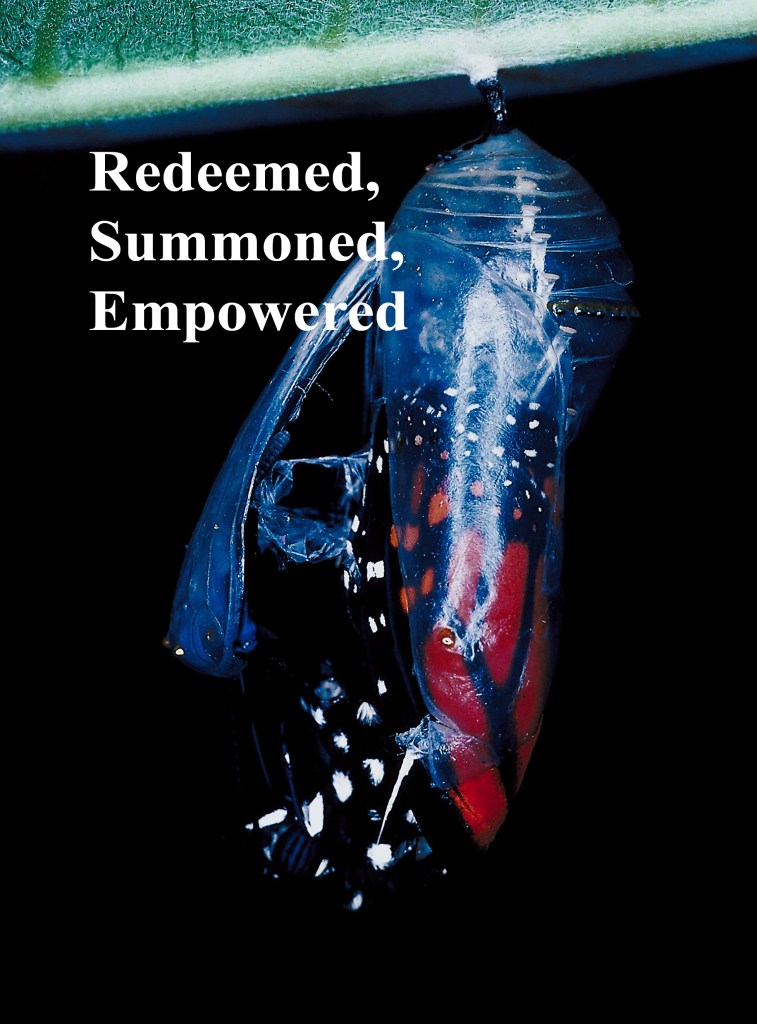
And that brings us back to where we began. Although debtor’s prisons are a thing of the past, we, like Robert Morris, owe a debt that is far beyond what we can ever pay. Our sins against God and man are a debt that we could never afford to pay and our eventual conviction for those debts was certain. But as we heard in Isaiah, God has summoned us, redeemed us, through his son, God has forgiven our debt, and through his spirit, God has filled us and empowered us with his strength and power so that we can be his agents and ambassadors is this world, and do the work that he has called us to do. We have been called, redeemed, and empowered to be Jesus to the people around us, and to share the good news with everyone who needs to hear it. We are never alone, and we need never rely upon our own strength, because God goes with us everywhere we go, and is with us through everything we experience.
May we, filled with God’s spirit and power, go out from this place, and do the work that we have been redeemed, summoned, and empowered to do.
Please LIKE and SHARE!
Click here to subscribe to Pastor John’s blog.
Click here if you would like to subscribe to Pastor John’s weekly messages.
Click here to visit Pastor John’s YouTube channel.
*You have been reading a message presented at Christ United Methodist Church on the date noted at the top of the first page. Rev. John Partridge is the pastor at Christ UMC in Alliance, Ohio. Duplication of this message is a part of our Media ministry, if you have received a blessing in this way, we would love to hear from you. Letters and donations in support of the Media ministry or any of our other projects may be sent to Christ United Methodist Church, 470 East Broadway Street, Alliance, Ohio 44601. These messages are available to any interested persons regardless of membership. You may subscribe to these messages, in print or electronic formats, by writing to the address noted, or by contacting us at secretary@CUMCAlliance.org. These messages can also be found online at https://pastorpartridge.com . All Scripture quotations, unless otherwise indicated, are taken from the Holy Bible, New International Version®, NIV®. Copyright ©1973, 1978, 1984, 2011 by Biblica, Inc.™ Used by permission of Zondervan. All rights reserved worldwide. www.zondervan.comThe “NIV” and “New International Version” are trademarks registered in the United States Patent and Trademark Office by Biblica, Inc.™

 Pastor Partridge