Plans, Plots, Phonies, and the Real Deal

Plans, Plots, Phonies, and the Real Deal

November 10, 2024*

By Pastor John Partridge

Ruth 3:1-5; 4:13-17               Mark 12:38-44                       Hebrews 9:24-28

Everyone here will some sort of reaction to the words “conspiracy theory.” In the last few years, we have heard conspiracy theories about all sorts of things from election interference, to immigration, to Covid drugs, to emergency management organizations, to church politics, and all sorts of other things. Weirder still, some of the things that have been labeled as discredited conspiracy theories turned out to be real conspiracies. All those things make us suspicious of all the news that we see, hear, and read as we move forward and that’s not necessarily a bad thing. But this morning, I want you to keep your “suspicion radar” turned on as we read scripture and as I read our first story, I want you to consider why Ruth and Naomi are doing the things that they are plotting to do.

We begin this morning by reading a part of the story of Ruth, in which Ruth, an immigrant widow, has followed her widowed mother-in-law, Naomi, back to Israel. But, with neither of them having male heirs, they do not have any legal access to the family lands to which they might have had access through their Israelite husbands. And so, they have been surviving by following the harvesters and gleaning what little grain they could find that the harvesters had left behind. Until the day that we join the story in Ruth 3:1-5; 4:13-17 where we hear this:

3:1 One day Ruth’s mother-in-law Naomi said to her, “My daughter, I must find a homefor you, where you will be well provided for. Now Boaz, with whose women you have worked, is a relative of ours. Tonight, he will be winnowing barley on the threshing floor. Wash, put on perfume, and get dressed in your best clothes. Then go down to the threshing floor, but don’t let him know you are there until he has finished eating and drinking. When he lies down, note the place where he is lying. Then go and uncover his feet and lie down. He will tell you what to do.”

4:13 So Boaz took Ruth, and she became his wife. When he made love to her, the Lord enabled her to conceive, and she gave birth to a son. 14 The women said to Naomi: “Praise be to the Lord, who this day has not left you without a guardian-redeemer. May he become famous throughout Israel! 15 He will renew your life and sustain you in your old age. For your daughter-in-law, who loves you and who is better to you than seven sons, has given him birth.”

16 Then Naomi took the child in her arms and cared for him. 17 The women living there said, “Naomi has a son!” And they named him Obed. He was the father of Jesse, the father of David.

Okay, did you understand the plot that Naomi had hatched? Naomi was smart. She was a Jew by birth, and she understood the law and culture and as such she guided her daughter-in-law Ruth in what to do and how to do it. First, it is important to understand that Boaz was a distant relation to Naomi’s husband and as such, could help them access any lands or wealth that belonged to them. Second, Boaz already had some measure of wealth and land and could afford to hire laborers to plant, tend, and harvest the lands under his control. Third, Boaz had already noticed Ruth and Naomi gleaning behind his harvesters and had already given his hired men instructions to leave a little “extra” behind for them. We might understand this as charity and generosity, but as the story develops, there is also good reason to understand that Boaz had, um, “noticed” Ruth because she was nice to look at.

And so, what happens is that Naomi tells Ruth to take a bath, put on some perfume, dress as nicely as she could, and then go down to where Boaz was working on the threshing floor winnowing his harvest and wait for him to go to bed. Once he had laid down for the night, in the dark, Ruth was to uncover his feet and lie down with him. And that, my friends, is a kind of “stop the presses” moment in the story. This is both sexual and provocative. For an unmarried woman to lay down with an unmarried man was scandalous and shocking. Although it may not sound like much to our twenty-first century sensitivities, this is symbolically the same kind of offer that we understand to be happening when James Bond finds a naked woman in his bed. Ruth’s actions were submissive, sexual, and represented an offer that Boaz clearly understood.

And so, in the part that we skipped, Boaz, who was an honorable man, knows that while he is a distant relation to Naomi’s husband, also knows that there is one other relative who is a closer relation, and legally should have what we would think of as the first right of refusal. But the thing is, although the women didn’t have the kind of rights that we would expect today, the law was written to protect the widows. As such, the nearest relative couldn’t just claim the family land, they had to marry the widow and give her children so that the land would stay in the family. As it happens, the nearest relative of Naomi’s husband was already married, and his wife had no interest in him having a second wife. And so, that man legally, in the sight of witnesses in the city gate, gives his rights to claim the land to Boaz who then invites both Ruth and Naomi into his family and becomes financially responsible for both of them, and also opening the door for Boaz to marry Ruth.

So now that you know the rest of the story, do you see how smart Naomi was and how she planned and plotted? She took Ruth to Boaz’ fields so that he would see her. She knew that Boaz had noticed how pretty Ruth was. She knew that he was a wealthy, eligible bachelor, and she knew throwing the suggestion of sex into the mix might just be enough to get him motivated enough to put a ring on it.

But in our next scripture, we see far more evil sorts of plots being committed by people in positions of power and authority, not just politicians, but leaders of the church. In Mark 12:38-44 we hear Jesus warn the people.

38 As he taught, Jesus said, “Watch out for the teachers of the law. They like to walk around in flowing robes and be greeted with respect in the marketplaces, 39 and have the most important seats in the synagogues and the places of honor at banquets. 40 They devour widows’ houses and for a show make lengthy prayers. These men will be punished most severely.”

41 Jesus sat down opposite the place where the offerings were put and watched the crowd putting their money into the temple treasury. Many rich people threw in large amounts. 42 But a poor widow came and put in two very small copper coins, worth only a few cents.

43 Calling his disciples to him, Jesus said, “Truly I tell you; this poor widow has put more into the treasury than all the others. 44 They all gave out of their wealth; but she, out of her poverty, put in everything—all she had to live on.”

Jesus said that the teachers of the law, who could have been any number of religious and political leaders, loved the deference and respect that people gave them when they walked about in public. They liked being treated as VIPs in the marketplaces, and synagogues, and public banquets. But these leaders who appeared to be both respectable and highly religious, and who made long and loud public prayers, were, at the same time, foreclosing on the homes of widows like Naomi, seizing their lands, selling them, and profiting from them. Oh, I’m sure that it was all nice and legal, but morally and ethically it was as shady as heck. In contrast, Jesus points out some rick folks who showed off by throwing large amounts of money, money that they could easily afford to give away, into the offering receptacles in front of an audience so that they could look good. They made so much noise with their giving that no one even noticed when this poor widow donated two copper coins that represented all the money that she had to live on.

Jesus’ message is clear. Between these two kinds of people, it was the poor that had greater generosity, and it was the poor who had greater faith, not to mention greater integrity. But it was the wealthy and respected, but absolutely phony, religious leaders who obeyed the laws of men while simultaneously violating the laws of God.

In contrast to these phony leaders who put on a show to gain respect while stealing from impoverished widows, Paul, in his letter to a group of Jews who had converted to become the followers of Jesus, writes about how Jesus was the authentic real deal. In Hebrews 9:24-28, Paul writes:

24 For Christ did not enter a sanctuary made with human hands that was only a copy of the true one; he entered heaven itself, now to appear for us in God’s presence. 25 Nor did he enter heaven to offer himself again and again, the way the high priest enters the Most Holy Place every year with blood that is not his own. 26 Otherwise Christ would have had to suffer many times since the creation of the world. But he has appeared once for all at the culmination of the ages to do away with sin by the sacrifice of himself. 27 Just as people are destined to die once, and after that to face judgment, 28 so Christ was sacrificed once to take away the sins of many; and he will appear a second time, not to bear sin, but to bring salvation to those who are waiting for him.

Paul reminds us that the priests in the temple offered sacrifices to God for the forgiveness of sins again and again, over and over again, day after day, and year after year. And on top of that, the high priest would offer an annual sacrifice for the forgiveness of the sins of the nation and for any other sins that might have been forgotten or overlooked by all the other sacrifices. And on top of that the high priest also had to offer sacrifices for any sins that he might have committed himself.

But Jesus was different.

Jesus was sinless. There was no need for him to sacrifice for his own sin because there wasn’t any. But Jesus sacrificed anyway and the sacrifice that he offered wasn’t grain, or wine, or the life of an animal. He offered his own sinless life as a sacrifice for the sins of others, for all of us, so that everyone’s sins could be taken away forever. Jesus’ sacrifice was the ultimate selfless act of generosity because he gave the most important thing he had, for something that he had no need of himself, in order to rescue the entire world.

Naomi plotted and carefully maneuvered Ruth through the tangle of culture, law, gender, and marriage to persuade Boaz to rescue the two of them and in doing so, became a part of the story of Israel’s greatest king and eventually bring about the rescue of the entire world. She didn’t know that, of course, but it was all a part of God’s greater plan.

Jesus warned the people that even their respected religious leaders often acted in their own selfish interests and used the legal system to steal from the most vulnerable in their society.

But Jesus was the real thing. Jesus’ gift to the world was completely selfless. Jesus gave up his own perfect life so that all of us, and the entire world, for all time and forever, could all be rescued from sin and death.

As we have watched the news and heard countless conspiracy theories, we have all become so suspicious and cynical that our natural inclination has become one that wants to follow the money or look for who benefits from the conspiracy. But that suspicion and cynicism breaks down with the story of Jesus. Jesus didn’t benefit from his gift. Jesus gave up the most valuable thing that he had s give the world something that we could never afford to purchase on our own. And, in the ultimate reversal of our suspicion and cynicism, Jesus asks, and even commands, us to share that gift with others. Because his great gift to the world can never be bought or sold, it can only be shared and given away, and it can only be accepted as a gift.

And this is where you fit. We tell the story of Abraham, Isaac, and Jacob. And we tell how the story continues through the grand arc of history through Naomi, Ruth, and Boaz, and how their family reached down to King David, and then through a thousand years of history to Jesus and the disciples. And now God is asking you to be a part of his story by sharing the good news and giving away the gift of rescue.

It isn’t a conspiracy. It is (sort of) a plot, and it’s definitely a plan.

God wants you to help save the world.


Please LIKE and SHARE!

Click here to subscribe to Pastor John’s blog.

Click here if you would like to subscribe to Pastor John’s weekly messages.

Click here to visit Pastor John’s YouTube channel.


*You have been reading a message presented at Christ United Methodist Church on the date noted at the top of the first page.  Rev. John Partridge is the pastor at Christ UMC in Alliance, Ohio.  Duplication of this message is a part of our Media ministry, if you have received a blessing in this way, we would love to hear from you.  Letters and donations in support of the Media ministry or any of our other projects may be sent to Christ United Methodist Church, 470 East Broadway Street, Alliance, Ohio 44601.  These messages are available to any interested persons regardless of membership.  You may subscribe to these messages, in print or electronic formats, by writing to the address noted, or by contacting us at secretary@CUMCAlliance.org.  These messages can also be found online at https://pastorpartridge.com .  All Scripture quotations, unless otherwise indicated, are taken from the Holy Bible, New International Version®, NIV®. Copyright ©1973, 1978, 1984, 2011 by Biblica, Inc.™ Used by permission of Zondervan. All rights reserved worldwide. www.zondervan.comThe “NIV” and “New International Version” are trademarks registered in the United States Patent and Trademark Office by Biblica, Inc.™

Testing Love

Testing Love

June 30, 2024*

By Pastor John Partridge

2 Samuel 1:1, 17-27               Mark 5:21-43             2 Corinthians 8:7-15

We hear the words “I love you” often. We hear them from our loved ones, we hear them on television and in the movies, and we hear the word “love” thrown around by churches, ministry groups, rescue groups, and even government officials in an almost constant stream.

But what if love came with a test?

What would it look like if there was a test to determine if love was real? Is there a way for us to tell if the people who throw around the word “love” really do love, or if they are only using the word to manipulate and to appear to be something more than they really are?

And, although on the surface it may appear that our scriptures for today are not connected, as we dig a little deeper what we find is that they all reveal the truth about the love of the people in them. We begin once again with the story of David. In this passage from 2 Samuel 1:1, 17-27, David learns that King Saul, and his son Jonathan, David’s best, and closest, friend, have died in battle. This is the moment that David knows that Saul will no longer hunt for him, or send his entire army to hunt for him, so that he could be captured and put to death, the moment that David learns that he is no longer a fugitive. This is the moment that David realizes that his anointing as the king of Israel by the prophet Samuel might finally become a reality. But as these realities come into his mind, this is how David reacts:

1:1 After the death of Saul, David returned from striking down the Amalekites and stayed in Ziklag two days.

17 David took up this lament concerning Saul and his son Jonathan, 18 and he ordered that the people of Judah be taught this lament of the bow (it is written in the Book of Jashar):

19 “A gazellelies slain on your heights, Israel.
    How the mighty have fallen!

20 “Tell it not in Gath,
    proclaim it not in the streets of Ashkelon,
lest the daughters of the Philistines be glad,
    lest the daughters of the uncircumcised rejoice.

21 “Mountains of Gilboa,
    may you have neither dew nor rain,
    may no showers fall on your terraced fields.
For there the shield of the mighty was despised,
    the shield of Saul—no longer rubbed with oil.

22 “From the blood of the slain, from the flesh of the mighty,
the bow of Jonathan did not turn back, the sword of Saul did not return unsatisfied.
23 Saul and Jonathan—
    in life they were loved and admired, and in death they were not parted.
They were swifter than eagles, they were stronger than lions.

24 “Daughters of Israel, weep for Saul,
who clothed you in scarlet and finery,
    who adorned your garments with ornaments of gold.

25 “How the mighty have fallen in battle!
    Jonathan lies slain on your heights.
26 I grieve for you, Jonathan my brother;
    you were very dear to me.
Your love for me was wonderful,
    more wonderful than that of women.

27 “How the mighty have fallen!
    The weapons of war have perished!”

Rather than rejoice over the end of being hunted or looking forward to finally having a chance at becoming king, rather than cursing the man who expended so much effort in trying to destroy him… David mourns. David weeps over the loss of his best friend but also over the loss of Israel’s greatest warrior and admired king. Despite Saul’s madness and his persecution of David, David never stopped loving him as his friend and mentor or stopped admiring him and respecting him as Israel’s king.

This is the moment that tests David’s sincerity, and we see that David didn’t just use the word “love” because it was politically expedient or momentarily popular, David’s tears and songs of mourning reveal that his love for both Saul and Jonathan was real.

Curiously, there are two stories, which we have heard and read many times, from the Gospel of Mark, which illustrate this same sort of test for the sincerity of love, trust, and faith and we read these stories this morning from Mark 5:21-43, where it says:

21 When Jesus had again crossed over by boat to the other side of the lake, a large crowd gathered around him while he was by the lake. 22 Then one of the synagogue leaders, named Jairus, came, and when he saw Jesus, he fell at his feet. 23 He pleaded earnestly with him, “My little daughter is dying. Please come and put your hands on her so that she will be healed and live.” 24 So Jesus went with him.

A large crowd followed and pressed around him. 25 And a woman was there who had been subject to bleeding for twelve years. 26 She had suffered a great deal under the care of many doctors and had spent all she had, yet instead of getting better she grew worse. 27 When she heard about Jesus, she came up behind him in the crowd and touched his cloak, 28 because she thought, “If I just touch his clothes, I will be healed.” 29 Immediately her bleeding stopped and she felt in her body that she was freed from her suffering.

30 At once Jesus realized that power had gone out from him. He turned around in the crowd and asked, “Who touched my clothes?”

31 “You see the people crowding against you,” his disciples answered, “and yet you can ask, ‘Who touched me?’”

32 But Jesus kept looking around to see who had done it. 33 Then the woman, knowing what had happened to her, came, and fell at his feet and, trembling with fear, told him the whole truth. 34 He said to her, “Daughter, your faith has healed you. Go in peace and be freed from your suffering.”

35 While Jesus was still speaking, some people came from the house of Jairus, the synagogue leader. “Your daughter is dead,” they said. “Why bother the teacher anymore?”

36 Overhearing what they said, Jesus told him, “Don’t be afraid; just believe.”

37 He did not let anyone follow him except Peter, James, and John the brother of James. 38 When they came to the home of the synagogue leader, Jesus saw a commotion, with people crying and wailing loudly. 39 He went in and said to them, “Why all this commotion and wailing? The child is not dead but asleep.” 40 But they laughed at him.

After he put them all out, he took the child’s father and mother and the disciples who were with him, and went in where the child was. 41 He took her by the hand and said to her, “Talitha koum!” (which means “Little girl, I say to you, get up!”). 42 Immediately the girl stood up and began to walk around (she was twelve years old). At this they were completely astonished. 43 He gave strict orders not to let anyone know about this, and told them to give her something to eat.

First, Jesus meets Jairus, one of the synagogue leaders, or archisynagōgon, who was a powerful and influential man. Far from our thinking that he was the local church lay leader, because there was no such thing as the separation of church, state, or culture, the archisynagogon was the church lay leader, mayor, city administrator, community organizer, and cultural ambassador all rolled up in one person, at least as far as their Roman overlords allowed. But when his daughter was dying, Jairus didn’t go to a rabbi, or to the temple authorities, or to some Roman government official, he came to see Jesus. And when people told him that it was too late, and that his daughter was already dead, Jesus encouraged him to “just believe,” and, despite the laughter of his family and friends who understood that death was permanent and that resurrection was impossible, his love for his daughter allowed him to trust Jesus anyway.

Likewise, after searching for twelve years and seeing every doctor, shaman, healer, and charlatan that she could find, and after spending every penny that she ever had, this poor suffering woman, rather than giving up, thought that she would try one more time. Despite being classified as unclean and being prohibited from coming in contact with “normal” people, she sneaks in from behind everyone, and reaches through the crowd just so that she can touch the fringe on Jesus’ outer garment. When she was tested, there was nothing fake about this poor woman’s suffering nor was there anything fake about her faith.

And I want you to keep those stories in your mind as we read Paul’s words in 2 Corinthians 8:7-15 because Paul understands that sometimes people, and churches, sometimes give lip-service to love. We say that we love Jesus, but we don’t act like it, and we say that we love the people around us, because we know that we’re supposed to, but when push comes to shove, we don’t act very much like we love them. Paul says…

But since you excel in everything—in faith, in speech, in knowledge, in complete earnestness and in the love, we have kindled in you—see that you also excel in this grace of giving.

I am not commanding you, but I want to test the sincerity of your love by comparing it with the earnestness of others. For you know the grace of our Lord Jesus Christ, that though he was rich, yet for your sake he became poor, so that you through his poverty might become rich.

10 And here is my judgment about what is best for you in this matter. Last year you were the first not only to give but also to have the desire to do so. 11 Now finish the work, so that your eager willingness to do it may be matched by your completion of it, according to your means. 12 For if the willingness is there, the gift is acceptable according to what one has, not according to what one does not have.

13 Our desire is not that others might be relieved while you are hard pressed, but that there might be equality. 14 At the present time your plenty will supply what they need, so that in turn their plenty will supply what you need. The goal is equality, 15 as it is written: “The one who gathered much did not have too much, and the one who gathered little did not have too little.”

Paul says that the people in the churches of Corinth are fantastic. They have strong faith, vast knowledge, they are earnest in the things that they do and in the love that they began when they first heard the stories of the gospel.

But Paul wants to test the sincerity of their love.

Paul wants to make sure that they aren’t just giving lip-service to love without really acting like they love. Paul wants to test their love by comparing their earnestness, their passion, against the earnestness and passion of others. He points out that when there was a need, the church in Corinth was the first to step up and give to meet the need, but now Paul asks if their love will compel them to finish what they started. The test, Paul says, isn’t that they should give until they themselves are in need, but that they should give from their abundance until those in need become their equals.

That is quite a test… and it asks a lot of us.

The test of love isn’t just to feed the hungry, but to give from our abundance, not just to feed the poor for a day, but to help the poor, and lift them up, until the poor become our equals. That isn’t a once and done kind of a thing. Like Paul wrote to the Corinthian Christians, you should be loving enough that your eager willingness to do a project may be matched by your completion of it.

Starting a project to help others is a good thing.

But finishing that project is the real test of love.

That’s asking a lot.

But real love isn’t cheap, and we might wonder…

…will our love pass the test?


*You have been reading a message presented at Christ United Methodist Church on the date noted at the top of the first page.  Rev. John Partridge is the pastor at Christ UMC in Alliance, Ohio.  Duplication of this message is a part of our Media ministry, if you have received a blessing in this way, we would love to hear from you.  Letters and donations in support of the Media ministry or any of our other projects may be sent to Christ United Methodist Church, 470 East Broadway Street, Alliance, Ohio 44601.  These messages are available to any interested persons regardless of membership.  You may subscribe to these messages, in print or electronic formats, by writing to the address noted, or by contacting us at secretary@CUMCAlliance.org.  These messages can also be found online at https://pastorpartridge.com .  All Scripture quotations, unless otherwise indicated, are taken from the Holy Bible, New International Version®, NIV®. Copyright ©1973, 1978, 1984, 2011 by Biblica, Inc.™ Used by permission of Zondervan. All rights reserved worldwide. www.zondervan.comThe “NIV” and “New International Version” are trademarks registered in the United States Patent and Trademark Office by Biblica, Inc.™
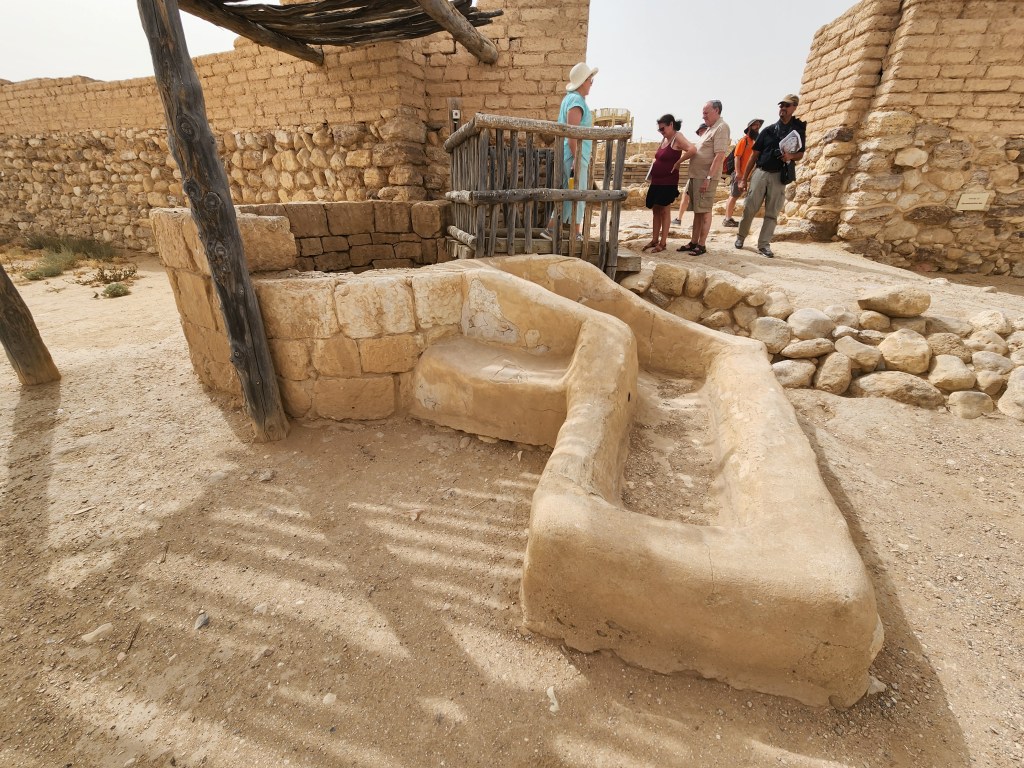
Photo by Comstock on Freeimages.com

Beersheba Unexpected

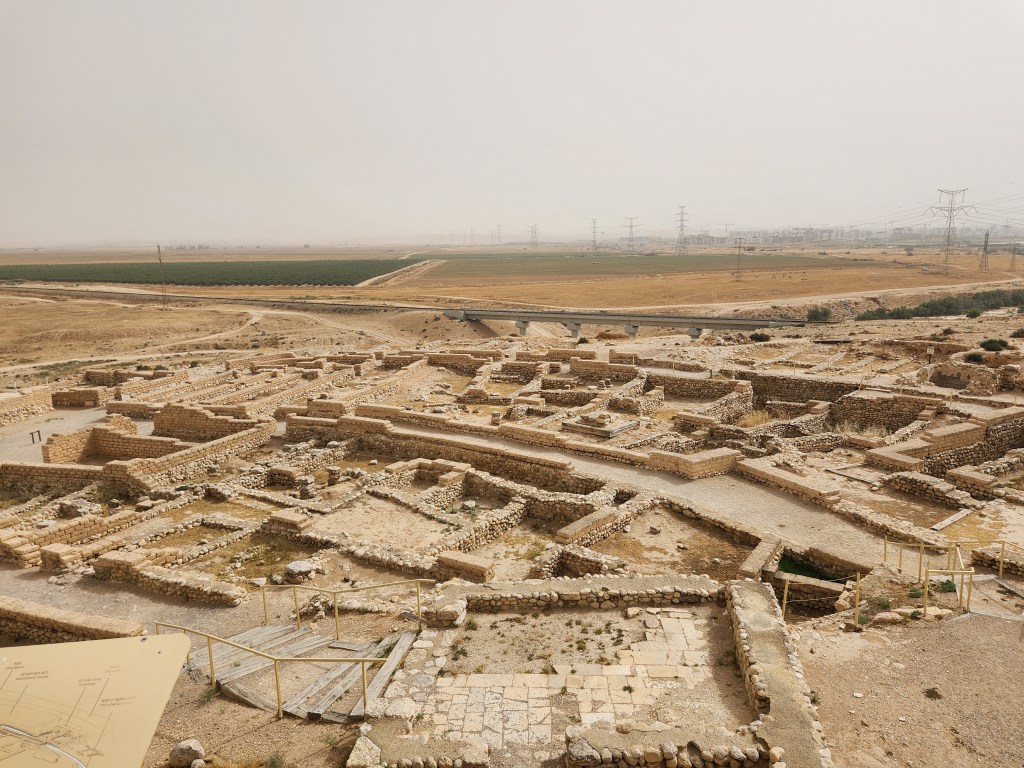
An overview of most of the remains of ancient Beersheba

Beersheba Unexpected

Each day, as we rode on our tour bus toward a new destination, our class took turns preparing a short biblical history lesson of what had happened in that place. Sometimes these were recorded in the Old or New Testaments but sometimes the events of interest to us were to be found in the writings of Josephus, or in rediscovered texts from Egypt, Mesopotamia, or other archeological explorations. And so, on our way to Be’er Sheva (biblical Beersheba) we were reminded of the many biblical references, which are entirely in the Old Testament for reasons that I will explain shortly.

The first reference to Beersheba comes as early Genesis 21 when Abraham sends Hagar and Ishmael away and they “wandered in the Desert of Beersheba.” Just a few verses later, Abraham makes an oath (which amounts to a modern treaty) with Abimelech and exchange seven lambs as a part of the agreement. The name “Beersheba” therefore is said to stem from that event either because the word Beersheba is similar to the Hebrew root of “made an oath,” or because it is similar to the root word of “seven” (or possibly both).

The well at Beersheba

Later, in Genesis 46, Jacob stops in Beersheba to offer sacrifices to God on his way to Egypt, Elijah stops there while running for his life in 1 Kings 19, and almost all of the other occurrences simply use Beersheba as an expression to say all of Israel from north to south as we see in Judges 20:1 when it says, “Then all Israel from Dan to Beersheba and from the land of Gilead came together as one and assembled before the Lord in Mizpah.” This expression is used simply because Dan was, for the most part, the farthest north that Israel grew, and Beersheba was its farthest southern extent.  To the north of Dan was the nation of Aram (which is modern day Syria) and to the south was… well, sand.  Beersheba was, and is, at the northern edge of the Negev desert, which scripture often describes as “wilderness” and the Sinai Peninsula. Continuing south brings you to the borders of Egypt. When the Jews returned to Israel after the Babylonian captivity, Nehemiah records that some returned to Beersheba, but, perhaps because there were so few, and because that territory is no longer controlled by Israel, there is no other mention of that place in scripture.

Looking down into the (deep) well

And so, while Beersheba is well attested in the Bible, compared to many of the other places that we visited, not a lot happened there. And yet, I was struck by the presence of the place in a way that I wasn’t in many of the others. Beersheba may not have had a central role in the stories of scripture, but it was present. The reason that Beersheba was important to Abraham and Isaac was because of the well that was there. Here, at the northern edge of the desert, there isn’t much water other that what flows down the wadi (dry riverbed) during the infrequent rains. And so, this well is very likely the same well that Abraham knew. Moreover, even though it may not often be mentioned by name, anyone who traveled through this region was almost certain to have stopped here.

A model of the Horned Altar found at Beersheba

It is also believed that Beersheba was one of the places of worship that had been built so that people wouldn’t have to travel the many miles north to Jerusalem. If so, this is one of the temples that King Hezekiah ordered torn down in 1 Kings 18. During archaeological digs here, a four-horned altar, often described in scripture, and typically used for sacrifice, was discovered here in secondary use. “Secondary use” means that after the temple here had been torn down, someone reused the stones as a part of wall. The stones from that wall have been moved to the Israel Museum in Jerusalem and reassembled into an altar.

Finally, during those times that Israel controlled Beersheba, it was a military outpost. This was the border between Israel and the wilderness, and between Israel and any enemies, such as Egypt, that might come from the south. Duty here was probably far from home, and certainly hot, unforgiving, and generally miserable.

A city street

Still, what is it about Be’er Sheva that unexpectedly struck me? Why does it have a presence that I could feel? For me, it’s because, like just a few other places, this is where it happened. In other places, over the last two thousand years, the places described in scripture have moved, walls have been torn down and rebuilt, whole cities have been destroyed, rebuilt, destroyed again, over and over until the places that we read about are tens of meters below the surface. But wells don’t move. While the stones surrounding this well at the surface may have been replaced many times, this is the place where Abraham, Isaac, Jacob, Elijah, invading Pharaohs, Mesopotamian generals, Roman armies, Israelite kings, and so many others have stood, draw water, and had a moment of rest.

It was unexpected.  I was surprised.

Beersheba city gate

But here, on a smallish hill on the edge of the desert, I felt as if I was in the presence of history.

And, having done so, it is so much easier to imagine what those people were feeling. The panic of Hagar as she is cast out to almost certain death in the desert, the relief of Israeli merchants returning home from Egypt, the apprehension of outpost soldiers knowing that Egypt’s army was on its way towards them, the anticipation of Pharoah as he moved north towards larger, more well-defended outposts and cities, and the courage of those settlers who dared to make this remote place their home.

It is that insight, out ability to imagine what it must have been like, that allows us to better understand, explain, teach, and preach the stories of scripture. Because understanding those people, and their feelings transforms dry words into real people.


Please LIKE and SHARE!

Click here to subscribe to Pastor John’s blog.

Click here if you would like to subscribe to Pastor John’s weekly messages.

Click here to visit Pastor John’s YouTube channel.


Trading Gold for Beans

Click here to listen to the podcast

Click here to watch the livestream: https://youtu.be/gcjdfIeBugc


Trading Gold for Beans

August 28, 2022*

By Pastor John Partridge

Jeremiah 2:4-13                     Luke 14:1, 7-14                      Hebrews 13:1-8, 15-16

In the story of Jack and the Beanstalk, the hero, a young boy named Jack is sent to the market, by his mother, to sell their cow that has stopped giving milk.  On the way to town, Jack is convinced to sell the family cow, not for gold, but for three magical beans.  On the surface, at least in the story, Jack has made a terrible bargain and has been fleeced and bamboozled by the bean dealer.  But again, in the story, it turns out that the beans really are magical and offer Jack a pathway to his adventure in the kingdom of the Giant and his golden goose.

But what happens in reality?  How often do hucksters and scoundrels convince our elderly to buy the modern equivalent of magic beans and rob them of their retirement funds?  How often do unscrupulous investment advisors line their pockets at the expense of unwise or overly trusting investors?  Or how often do we see internet pop-up ads selling products that just seem too good to be true?  It seems that too often, trusting people are hoodwinked into selling their gold in exchange for piles of worthless beans that aren’t even magical.

And curiously, that is what is at the root of God’s accusation against his people that we find in Jeremiah 2:4-13.  God says that his people have walked away from him and abandoned the gold that he had in exchange for worthless piles of beans.  Jeremiah said…

Hear the word of the Lord, you descendants of Jacob, all you clans of Israel.

This is what the Lord says:

“What fault did your ancestors find in me, that they strayed so far from me?
They followed worthless idols and became worthless themselves.
They did not ask, ‘Where is the Lord, who brought us up out of Egypt
and led us through the barren wilderness, through a land of deserts and ravines,
a land of drought and utter darkness, a land where no one travels and no one lives?’
I brought you into a fertile land to eat its fruit and rich produce.
But you came and defiled my land and made my inheritance detestable.
The priests did not ask, ‘Where is the Lord?’
Those who deal with the law did not know me; the leaders rebelled against me.
The prophets prophesied by Baal, following worthless idols.

“Therefore I bring charges against you again,” declares the Lord.
    “And I will bring charges against your children’s children.
10 Cross over to the coasts of Cyprus and look, send to Kedar and observe closely;
    see if there has ever been anything like this:
11 Has a nation ever changed its gods? (Yet they are not gods at all.)
But my people have exchanged their glorious God for worthless idols.
12 Be appalled at this, you heavens, and shudder with great horror,” declares the Lord.
13 “My people have committed two sins:
They have forsaken me, the spring of living water,
and have dug their own cisterns, broken cisterns that cannot hold water.

God wonders why his people started to drift.  The ancestors of Israel began to stray from God, followed worthless idols and never thought to ask what happened to the God and to the faith that led them across deserts and through the Red Sea.  God gave them an incredible inheritance that they could enjoy and pass on their children, but the people defiled the land and ruined it.  The priests never stopped to ask what happened to God, the theologians and the church leaders either didn’t know God at all or actively rebelled against him and the prophets of Israel sold out to what was popular and prophesied for Baal instead.

God tells his people that they are free to look anywhere they want and try to find another country that has abandoned their gods and they won’t find any even though the gods of other countries are no more than stone statues.  God is appalled and heaven in horrified.  God’s people have traded rivers of life-giving water for broken, leaking, clay pools of foul, stagnant, green water.

They traded piles of gold for a handful of ordinary beans.

In a similar lesson found in Luke 14:1, 7-14, Jesus shares a story that tells us how we tell the difference between gold and beans as we go about the busyness of our daily lives.  Luke says…

14:1 One Sabbath, when Jesus went to eat in the house of a prominent Pharisee, he was being carefully watched.

When he noticed how the guests picked the places of honor at the table, he told them this parable: “When someone invites you to a wedding feast, do not take the place of honor, for a person more distinguished than you may have been invited. If so, the host who invited both of you will come and say to you, ‘Give this person your seat.’ Then, humiliated, you will have to take the least important place. 10 But when you are invited, take the lowest place, so that when your host comes, he will say to you, ‘Friend, move up to a better place.’ Then you will be honored in the presence of all the other guests. 11 For all those who exalt themselves will be humbled, and those who humble themselves will be exalted.”

12 Then Jesus said to his host, “When you give a luncheon or dinner, do not invite your friends, your brothers or sisters, your relatives, or your rich neighbors; if you do, they may invite you back and so you will be repaid. 13 But when you give a banquet, invite the poor, the crippled, the lame, the blind, 14 and you will be blessed. Although they cannot repay you, you will be repaid at the resurrection of the righteous.”

Our lives are filled with opportunities to collect wealth for ourselves.  Some of those opportunities allow us to store up gold, and others cause us to expend our time and our energy and end the day with little more than a handful of beans.  Jesus says that you do not gain from what you take, you gain from what you are given, and by what you give.  Throwing a party and inviting a house full of influential friends, who will, later, invite you back, gains you nothing.  Money, power, and influence will evaporate before your casket closes.  But offering a banquet to the poor, the crippled, the lame, the blind, and for those who are unable to care for themselves, that deposits gold into your account in God’s heavenly treasury.

Similarly, the writer of Hebrews offers us a list of things that we do in life that earn us gold rather than beans.  In Hebrews 13:1-8, 15-16, he says:

13:1 Keep on loving one another as brothers and sisters. Do not forget to show hospitality to strangers, for by so doing some people have shown hospitality to angels without knowing it. Continue to remember those in prison as if you were together with them in prison, and those who are mistreated as if you yourselves were suffering.

Marriage should be honored by all, and the marriage bed kept pure, for God will judge the adulterer and all the sexually immoral. Keep your lives free from the love of money and be content with what you have, because God has said,

“Never will I leave you;
    never will I forsake you.”

So we say with confidence,

“The Lord is my helper; I will not be afraid.
    What can mere mortals do to me?”

Remember your leaders, who spoke the word of God to you. Consider the outcome of their way of life and imitate their faith. Jesus Christ is the same yesterday and today and forever.

15 Through Jesus, therefore, let us continually offer to God a sacrifice of praise—the fruit of lips that openly profess his name. 16 And do not forget to do good and to share with others, for with such sacrifices God is pleased.

Without specifically calling out bankers, or businesspeople, or farmers, or anyone else who work to earn an income, the writer of Hebrews tell us that some activities are better, in the eyes of God, than others.  Loving the people around you, and not just family members, is a good thing.  Inviting strangers into your home because they need a place to stay, is a good thing.  Caring for people who are in prison and people who are mistreated, as if you were suffering alongside of them, is a good thing.  Honoring your marriage and staying true to that one person to whom you are married, is a good thing and so is insulating yourself from greed and envy simply by being content with what you already have.

And one of the best reasons we have, to be content with what we have, is that what we have… is a God who loves us, cares for us, and will never leave us or abandon us.  What we have is a loving God who is constantly beside us to give us strength, encouragement, patience, and comfort so that we can rest in his care and not worry about what our bosses, our bullies, or anyone else can do to us.

We are also encouraged to remember the pastors and people of our past who taught us the word of God and modeled the Christian life for us.  Think about how their lives influenced others, how their faithfulness was a blessing to others, and how their every day lives made the lives of others easier, better, more fulfilling, and sometimes even made the difference in their survival.  Let us remember those people, imitate their faith, and thereby live a life that is pleasing to God and to Jesus Christ.  Don’t just give the occasional gift of cash, give sacrificially, not of cash, but give sacrificially of your praise to God.  Live your life in such a way that you do good for the people around you and share what you have with others rather than hoarding it all for yourself.  God knows that sometimes your giving is a sacrifice, but it is with these sacrifices that God is pleased.

Our culture constantly bombards us with offers to trade our gold for a handful of completely unremarkable, non-magical, ordinary beans.  Our culture worships money, power, greed, influence, sex, the accumulation of possessions, politics, and all sorts of other idols.  We are tempted to run for the front of the line, to grab the best seats, and inflate our own importance.  But in God’s equation, we gain not by what we take, but by what we give.  We gain when we care for those who have no one to care for them.  We gain when we share what we have with those who have less than we do, or who have none of what we have.  We gain when we do good for people who may never be able to do good to us in return and give to those who cannot afford to repay us.

Our culture urges us to keep what we have and to build bigger barns, and bigger houses, to store even more of our abundance.  But God says that we store up real treasure when we swim against the current of our culture, when we love one another, when we welcome the stranger, care for those in prison, soothe the wounds of the mistreated, remain faithful to our spouses, and insulate ourselves from greed and envy by remaining content with what we have.

Our culture surrounds us with voices that shout louder every day and encourage us to get with the program and trade our gold for worthless beans.

Don’t fall for it.

There are no magic beans.

There is no beanstalk and no giant.

There is no golden goose.

But there is a loving God who is waiting to reward us with the gold that we have stored up for ourselves in the vaults, storehouses, and the treasury of heaven.

Don’t let our culture steal your eternity.


Did you enjoy this?

Please LIKE and SHARE!

Click here to subscribe to Pastor John’s blog.

Click here if you would like to subscribe to Pastor John’s weekly messages.

Click here to visit Pastor John’s YouTube channel.


*You have been reading a message presented at Christ United Methodist Church on the date noted at the top of the first page.  Rev. John Partridge is the pastor at Christ UMC in Alliance, Ohio.  Duplication of this message is a part of our Media ministry, if you have received a blessing in this way, we would love to hear from you.  Letters and donations in support of the Media ministry or any of our other projects may be sent to Christ United Methodist Church, 470 East Broadway Street, Alliance, Ohio 44601.  These messages are available to any interested persons regardless of membership.  You may subscribe to these messages, in print or electronic formats, by writing to the address noted, or by contacting us at secretary@CUMCAlliance.org.  These messages can also be found online at https://pastorpartridge.com .  All Scripture references are from the New International Version unless otherwise noted.