Reproduction or Condemnation?

Reproduction or Condemnation?

July 16, 2023*

By Pastor John Partridge

Genesis 25:19-34       Matthew 13:1-9, 18-23          Romans 8:1-11

It is said that the problem of growth, or more accurately the lack of growth, currently being experienced by the modern church can be attributed, at least in part, to the widespread, successful procreation of those whom we often refer to as the Greatest Generation. Simply put, during the nineteen forties, fifties, and sixties, that generation was so wildly successful, and even prolific, at physical reproduction, that they, and the church, became utterly preoccupied with child rearing and many churches simply forgot how to reproduce spiritually.

Churches everywhere were bursting at the seams with children, churches were expanded, education wings were added, and just managing the growth and education of their existing church membership demanded such full-time attention, that almost no one discussed the need for sharing their faith, nor did they pass along the practical skills of faith-sharing and spiritual reproduction to their members or children. The consequences of these actions, or inaction, were that several generations watched their churches begin to shrink while, at the same time, having no idea what to do about it, and feeling no desire or compulsion to do the things that needed to be done simply because they had never seen it modeled in the lives of their parents or grandparents.

And, unexpectedly, as we continue working our way through the story of Abraham and his family in the book of Genesis, our story turns to focus on this difference between physical and spiritual reproduction. We begin this morning by skipping ahead a little from last week and rejoin Isaac and Rebekah as they have children of their own, and as those children grow up and grapple with both life and faith. We begin reading with Genesis 25:19-34…

19 This is the account of the family line of Abraham’s son Isaac.

Abraham became the father of Isaac, 20 and Isaac was forty years old when he married Rebekah, daughter of Bethuel the Aramean from Paddan Aramand sister of Laban the Aramean.

21 Isaac prayed to the Lord on behalf of his wife, because she was childless. The Lord answered his prayer, and his wife Rebekah became pregnant. 22 The babies jostled each other within her, and she said, “Why is this happening to me?” So, she went to inquire of the Lord.

23 The Lord said to her,

“Two nations are in your womb,
    and two peoples from within you will be separated;
one people will be stronger than the other,
    and the older will serve the younger.”

24 When the time came for her to give birth, there were twin boys in her womb. 25 The first to come out was red, and his whole body was like a hairy garment; so, they named him Esau. 26 After this, his brother came out, with his hand grasping Esau’s heel; so, he was named Jacob. Isaac was sixty years old when Rebekah gave birth to them.

27 The boys grew up, and Esau became a skillful hunter, a man of the open country, while Jacob was content to stay at home among the tents. 28 Isaac, who had a taste for wild game, loved Esau, but Rebekah loved Jacob.

29 Once when Jacob was cooking some stew, Esau came in from the open country, famished. 30 He said to Jacob, “Quick, let me have some of that red stew! I’m famished!” (That is why he was also called Edom.)

31 Jacob replied, “First sell me your birthright.”

32 “Look, I am about to die,” Esau said. “What good is the birthright to me?”

33 But Jacob said, “Swear to me first.” So, he swore an oath to him, selling his birthright to Jacob.

34 Then Jacob gave Esau some bread and some lentil stew. He ate and drank, and then got up and left.

So, Esau despised his birthright.

In a twist on Abraham’s story, in which he had two sons and had to decide which would remain in his family and which he would love, we find in this story that Isaac and Rebekah have two sons, and each one loves one child more than the other. But just as the story of Israel is not told from the perspective and lineage of Ishmael, neither is it reckoned from the lineage of Esau. God declares that the descendants of both men will become great nations, but only one will become God’s favorite.

This is not only an unusual focus on parental favoritism, but casts the hero of the story, Jacob, in an odd light in a patriarchal society. In that culture, recorded on clay tablets in the archives of their neighbors, a common insult of male warriors was to say that they were “like women” or that they should have stayed home with the women. And so, in that culture, when scripture records that Esau was an outdoorsman and a skillful hunter, and Jacob was “content to stay at home among the tents,” is casting Esau as the manly hero and the favorite of the reader and painting Jacob as insultingly effeminate. Thus, as I remember what little I know about literature, both men are cast “against type” where the hero would be seen by the reader as the villain and the villain would be seen having the characteristics of a typical hero.

But at the end of our reading, we arrive at the sentence “So, Esau despised his birthright.”  That puzzled me and I wondered what it meant. From our perspective, it’s not hard to understand that since Esau was an outdoorsman and avid hunter, that the administration of his family’s lands, crops, livestock, hired hands, servants, and extended family members just wasn’t something that he cared to do. In our understanding, we can accept that maybe he would have simply preferred that Jacob, who was “content to stay home among the tents” and who was perhaps temperamentally better suited to administration, would take over for their father as the head of the household and let Esau inherit a smaller portion without inheriting all of the responsibilities that came with inheriting the larger portion that came with his birthright.

But that wasn’t the understanding of the rabbis and the teachers of Israel. Because of Esau’s choice, the writer of Hebrews 12:16 goes as far as to describe Esau as “godless.” For these ancient interpreters, Esau’s rejection of his birthright was more than a rejection of his responsibilities to the administration of his family fortune, it was an outright rejection of Abraham’s covenant with God. And so, the biblical condemnation of Esau isn’t because of his place in his family’s lineage of physical reproduction, it was because of he rejected his place in his family’s lineage of spiritual reproduction.

Jesus doesn’t mention Esau by name, but when he preaches using the parable of the sower in Matthew 13:1-9, 18-23, we gain insight into this way of thinking about spiritual reproduction.

13:1 That same day Jesus went out of the house and sat by the lake. Such large crowds gathered around him that he got into a boat and sat in it, while all the people stood on the shore. Then he told them many things in parables, saying: “A farmer went out to sow his seed. As he was scattering the seed, some fell along the path, and the birds came and ate it up. Some fell on rocky places, where it did not have much soil. It sprang up quickly because the soil was shallow. But when the sun came up, the plants were scorched, and they withered because they had no root. Other seed fell among thorns, which grew up and choked the plants. Still other seed fell on good soil, where it produced a crop—a hundred, sixty or thirty times what was sown. Whoever has ears, let them hear.”

18 “Listen then to what the parable of the sower means: 19 When anyone hears the message about the kingdom and does not understand it, the evil one comes and snatches away what was sown in their heart. This is the seed sown along the path. 20 The seed falling on rocky ground refers to someone who hears the word and at once receives it with joy. 21 But since they have no root, they last only a short time. When trouble or persecution comes because of the word, they quickly fall away. 22 The seed falling among the thorns refers to someone who hears the word, but the worries of this life and the deceitfulness of wealth choke the word, making it unfruitful. 23 But the seed falling on good soil refers to someone who hears the word and understands it. This is the one who produces a crop, yielding a hundred, sixty or thirty times what was sown.”

Jesus is just sitting, as many of us have done, enjoying the calm of the seashore and the sound of the wind and the waves, when he gets mobbed by people wanting to hear him teach. And so, he told them many things, but among them was this parable about planting. Jesus explains its meaning, but in the end, it is about spiritual reproduction. The followers of Jesus are expected to plant spiritual seeds and be doing the work of spiritual reproduction and the reason that we are expected to reproduce is explained in the words of Romans 8:1-11 where Paul says:

8:1 Therefore, there is now no condemnation for those who are in Christ Jesus, because through Christ Jesus the law of the Spirit who gives life has set youfree from the law of sin and death. For what the law was powerless to do because it was weakened by the flesh, God did by sending his own Son in the likeness of sinful flesh to be a sin offering. And so, he condemned sin in the flesh, in order that the righteous requirement of the law might be fully met in us, who do not live according to the flesh but according to the Spirit.

Those who live according to the flesh have their minds set on what the flesh desires; but those who live in accordance with the Spirit have their minds set on what the Spirit desires. The mind governed by the flesh is death, but the mind governed by the Spirit is life and peace. The mind governed by the flesh is hostile to God; it does not submit to God’s law, nor can it do so. Those who are in the realm of the flesh cannot please God.

You, however, are not in the realm of the flesh but are in the realm of the Spirit, if indeed the Spirit of God lives in you. And if anyone does not have the Spirit of Christ, they do not belong to Christ. 10 But if Christ is in you, then even though your body is subject to death because of sin, the Spirit gives lifebecause of righteousness. 11 And if the Spirit of him who raised Jesus from the dead is living in you, he who raised Christ from the dead will also give life to your mortal bodies because ofhis Spirit who lives in you.

The important phrases that I want to pull out of this are these: First, “Therefore, there is now no condemnation for those who are in Christ Jesus…” and second, “Those who are in the realm of the flesh cannot please God.”

That means that God does not, and will not, condemn those who are committed to following Christ and in whom Christ dwells. But it also means that no amount of good works will ever be enough to please God if the Spirit of God does not live within you.

So, let’s summarize.

Esau was the grandson of Abraham but is completely left out of the genealogy of Israel, and is considered by Israel’s teaches to be godless, because he rejected his spiritual inheritance. Esau was, in the minds of Israel’s teachers and interpreters, “bad seed.” Jesus teaches that everyone who follows him is called to plant seeds so that they can reproduce spiritually. And Paul explains that while God will not condemn those who follow Jesus, anyone who does not surely will be condemned.

If the Spirit of God does not live inside of a person, there is nothing that they can do, in heaven or on earth, to save themselves. And that means that we stand at this dividing line between life and death. The seeds that we plant, the seeds that bring about spiritual reproduction, are all that stands between eternity and the condemnation of God.

Each of us, through our lives and through our words, may well be, literally, the difference between life and death for our friends and neighbors.

And that is why spiritual reproduction is still vitally important.


Please LIKE and SHARE!

Click here to subscribe to Pastor John’s blog.

Click here if you would like to subscribe to Pastor John’s weekly messages.

Click here to visit Pastor John’s YouTube channel.


*You have been reading a message presented at Christ United Methodist Church on the date noted at the top of the first page.  Rev. John Partridge is the pastor at Christ UMC in Alliance, Ohio.  Duplication of this message is a part of our Media ministry, if you have received a blessing in this way, we would love to hear from you.  Letters and donations in support of the Media ministry or any of our other projects may be sent to Christ United Methodist Church, 470 East Broadway Street, Alliance, Ohio 44601.  These messages are available to any interested persons regardless of membership.  You may subscribe to these messages, in print or electronic formats, by writing to the address noted, or by contacting us at secretary@CUMCAlliance.org.  These messages can also be found online at https://pastorpartridge.com .  All Scripture quotations, unless otherwise indicated, are taken from the Holy Bible, New International Version®, NIV®. Copyright ©1973, 1978, 1984, 2011 by Biblica, Inc.™ Used by permission of Zondervan. All rights reserved worldwide. www.zondervan.comThe “NIV” and “New International Version” are trademarks registered in the United States Patent and Trademark Office by Biblica, Inc.™

I Will Go… Or Will I?

I Will Go… Or Will I?

July 09, 2023*

By Pastor John Partridge

Genesis 24:34-38, 42-49, 58-67         Matthew 11:16-19, 25-30      Romans 7:15-25a

Throughout our lives we must decide in whom we will put our trust. When we are children, we trust our parents.  In school, we often trusted our teachers. In college we trusted that the curriculum and all the agony that it put us through, would be useful and valuable to us upon completion. When we accepted employment, we put a lot of trust in the company that hired us, as well as the supervisors and managers that trained us and oversaw our work. And any of us who served in the military entrusted our lives to those persons who made our duty assignments and sent us to places down the street and around the world.

In recent weeks we have studied how Abraham was repeated tested by God. First God called Abraham to “go to a place that I will show you,” and then we read about Abraham’s conflicted emotions, and his trust in God, as he sent Hagar and Ishmael out into the wilderness, and then again when God tested his willingness to sacrifice his son Isaac. And those are just a few of the many examples from Abraham’s life. But, as we continue reading the story of Genesis, the family of Abraham continues to be tested by God. As Isaac matures to a marriageable age, his father worries that Isaac’s faith might suffer if he were to marry a Canaanite woman. And so, Abraham sends one of his trusted servants to go back to his home country, to find the descendants of the family that he left behind, and among them find a wife for Isaac.

It is almost certain that Abraham’s servant has never been to the place that he has been sent but he trusts that his master would not send him into great danger. At the same time, Abraham and Isaac trusted that this servant would be a good judge of character as his mission was, literally, to select the person with whom Isaac would spend the rest of his life. And so, in Genesis 24:34-38, 42-49, 58-67, the servant finds Abraham’s extended family, meets a girl, and this happens…

34 So he said, “I am Abraham’s servant. 35 The Lord has blessed my master abundantly, and he has become wealthy. He has given him sheep and cattle, silver and gold, male and female servants, and camels and donkeys. 36 My master’s wife Sarah has borne him a son in her old age, and he has given him everything he owns. 37 And my master made me swear an oath, and said, ‘You must not get a wife for my son from the daughters of the Canaanites, in whose land I live, 38 but go to my father’s family and to my own clan, and get a wife for my son.’

42 “When I came to the spring today, I said, ‘Lord, God of my master Abraham, if you will, please grant success to the journey on which I have come. 43 See, I am standing beside this spring. If a young woman comes out to draw water and I say to her, “Please let me drink a little water from your jar,” 44 and if she says to me, “Drink, and I’ll draw water for your camels too,” let her be the one the Lord has chosen for my master’s son.’

45 “Before I finished praying in my heart, Rebekah came out, with her jar on her shoulder. She went down to the spring and drew water, and I said to her, ‘Please give me a drink.’

46 “She quickly lowered her jar from her shoulder and said, ‘Drink, and I’ll water your camels too.’ So, I drank, and she watered the camels also.

47 “I asked her, ‘Whose daughter are you?’

“She said, ‘The daughter of Bethuel son of Nahor, whom Milkah bore to him.’

“Then I put the ring in her nose and the bracelets on her arms, 48 and I bowed down and worshiped the Lord. I praised the Lord, the God of my master Abraham, who had led me on the right road to get the granddaughter of my master’s brother for his son. 49 Now if you will show kindness and faithfulness to my master, tell me; and if not, tell me, so I may know which way to turn.”

58 So they called Rebekah and asked her, “Will you go with this man?”

“I will go,” she said.

59 So they sent their sister Rebekah on her way, along with her nurse and Abraham’s servant and his men. 60 And they blessed Rebekah and said to her,

“Our sister, may you increase
    to thousands upon thousands;
may your offspring possess
    the cities of their enemies.”

61 Then Rebekah and her attendants got ready and mounted the camels and went back with the man. So, the servant took Rebekah and left.

62 Now Isaac had come from Beer Lahai Roi, for he was living in the Negev. 63 He went out to the field one evening to meditate, and as he looked up, he saw camels approaching. 64 Rebekah also looked up and saw Isaac. She got down from her camel 65 and asked the servant, “Who is that man in the field coming to meet us?”

“He is my master,” the servant answered. So, she took her veil and covered herself.

66 Then the servant told Isaac all he had done. 67 Isaac brought her into the tent of his mother Sarah, and he married Rebekah. So, she became his wife, and he loved her; and Isaac was comforted after his mother’s death.

And so, not only did Abraham’s servant trust his master, and not only did Abraham and Isaac trust the servant, but Rebekah was asked to trust a man that she had just met, to leave her home, journey to meet a total stranger, whose family she had never met, so that she could get married and spend the rest of her life with them and almost certainly never see her parents, family, or friends, ever again.

That’s a lot of trust.

But trusting is hard.

And sometimes the people in whom you are asked to place your trust are not trustworthy. And that was, in large part, the situation that Jesus finds in the story of Matthew 11:16-19, 25-30. Although Jesus and the disciples were faithful Jews who attended services in the synagogues and observed the prescribed feasts and festivals at the temple in Jerusalem, Jesus also knew that following God was hard and not everyone had the faith of Abraham. And worse, Jesus knew that many times, the people who ran the Temple, and who led God’s people, were not the most trustworthy people.  And in that story, Jesus speaks into the situation this way…

16 “To what can I compare this generation? They are like children sitting in the marketplaces and calling out to others:

17 “‘We played the pipe for you,
    and you did not dance;
we sang a dirge,
    and you did not mourn.’

18 For John came neither eating nor drinking, and they say, ‘He has a demon.’ 19 The Son of Man came eating and drinking, and they say, ‘Here is a glutton and a drunkard, a friend of tax collectors and sinners.’ But wisdom is proved right by her deeds.”

25 At that time Jesus said, “I praise you, Father, Lord of heaven and earth, because you have hidden these things from the wise and learned, and revealed them to little children. 26 Yes, Father, for this is what you were pleased to do.

27 “All things have been committed to me by my Father. No one knows the Son except the Father, and no one knows the Father except the Son and those to whom the Son chooses to reveal him.

28 “Come to me, all you who are weary and burdened, and I will give you rest. 29 Take my yoke upon you and learn from me, for I am gentle and humble in heart, and you will find rest for your souls. 30 For my yoke is easy and my burden is light.”

Jesus says that many of the people in that generation were like the children that demand that strangers play a game with them. Only they know the rules, they won’t explain the rules, and then they are angry that you didn’t play their game according to their rules. Jesus continues by explaining that the religious leaders of Israel have behaved exactly that way. They saw John refraining from food and drink, and they criticized him for doing so, but then Jesus came and did not refrain from eating and drinking, and they criticized him for that. Just like children in the marketplaces, the religious leaders of Israel were angry because John and Jesus had refused to play their games.

But Jesus also knew that many people really wanted to follow God and to have a good relationship with God, but the leaders of Israel had made the rules so confusing that it kept people up at night. The leaders had created a system of worship that was overly burdensome, time consuming, and still left people unsure of their standing before God. And into this confusion, Jesus says, ““Come to me, all you who are weary and burdened, and I will give you rest. 29 Take my yoke upon you and learn from me, for I am gentle and humble in heart, and you will find rest for your souls. 30 For my yoke is easy and my burden is light.”

Jesus says, “Following God, and having a good relationship with God is not as hard as you’ve been told. All that you need to do, is… trust me.”  Trust me, and I will take away the burdensome rules and the sleepless nights. Trust me… and find… rest.

But Paul finds that even following Jesus can still be difficult. As we read just last week, Paul knows that even though we have grace and forgiveness because of Jesus’ sacrifice, we are not free to sin, but must still strive live a life of righteousness. But doing what is right can be hard. In Romans 7:15-25a Paul says…

15 I do not understand what I do. For what I want to do I do not do, but what I hate I do. 16 And if I do what I do not want to do, I agree that the law is good. 17 As it is, it is no longer I myself who do it, but it is sin living in me. 18 For I know that good itself does not dwell in me, that is, in my sinful nature. For I have the desire to do what is good, but I cannot carry it out. 19 For I do not do the good I want to do, but the evil I do not want to do—this I keep on doing. 20 Now if I do what I do not want to do, it is no longer I who do it, but it is sin living in me that does it.

21 So I find this law at work: Although I want to do good, evil is right there with me. 22 For in my inner being I delight in God’s law; 23 but I see another law at work in me, waging war against the law of my mind and making me a prisoner of the law of sin at work within me. 24 What a wretched man I am! Who will rescue me from this body that is subject to death? 25 Thanks be to God, who delivers me through Jesus Christ our Lord!

When we read these words quickly, we find that these might almost be unintelligible gibberish. But, if we slow way down, read slowly, think about what we’re reading, and consider the meaning, we can dig down into it and get a better sense of what Paul was trying to communicate. And, if we’re honest, this is how Paul intended it to be. This isn’t a comic book, or even a newspaper, that has all the imagery and ideas distilled down into their simplest form that we can skim over, past, and through with little effort and no intellectual engagement. These are transformational ideas that require the focus of our minds and spirits.

And, when we do that, we discover that Paul is saying several things that create a logical progression of thought. First, Paul says that he keeps doing the things that he doesn’t want to do, and so he agrees that the law is good because the law helps to keep him righteous.  For example, we know, intellectually, that driving too fast is dangerous, but without speed limits, we will almost certainly do so. We might not always obey the speed limits, but that boundary helps us to be conscious of our speed and keep everyone on the road safer. In the same way, the boundaries given to us in the law help us to be righteous.

Second, after a lot of confusing language about what he wants to do in comparison to what he actually does, Paul concludes that because of the sin that lives inside of him, he is incapable of consistently doing good.

Simply put, we just can’t do it by ourselves.

But Jesus stands ready to walk with us, and to help us to do better and to overcome the natural evil that lives within us.

Like we saw with Moses, his servant, Isaac, and Rebekah, scripture repeatedly tells us stories about trust. Our relationship is built on our ability to trust in God.

Paul admits that trusting is hard, and that the sin and evil that is inside of us makes it impossible to be consistently good. We, like Paul, must admit that we simply cannot do it alone. We must surrender control, offer our lives as a living sacrifice to God, and trust Jesus to transform us into something better.

It is Jesus who says, trust me, and I will take away the burdensome rules and the sleepless nights.

Trust me… and find… rest.


Please LIKE and SHARE!

Click here to subscribe to Pastor John’s blog.

Click here if you would like to subscribe to Pastor John’s weekly messages.

Click here to visit Pastor John’s YouTube channel.


*You have been reading a message presented at Christ United Methodist Church on the date noted at the top of the first page.  Rev. John Partridge is the pastor at Christ UMC in Alliance, Ohio.  Duplication of this message is a part of our Media ministry, if you have received a blessing in this way, we would love to hear from you.  Letters and donations in support of the Media ministry or any of our other projects may be sent to Christ United Methodist Church, 470 East Broadway Street, Alliance, Ohio 44601.  These messages are available to any interested persons regardless of membership.  You may subscribe to these messages, in print or electronic formats, by writing to the address noted, or by contacting us at secretary@CUMCAlliance.org.  These messages can also be found online at https://pastorpartridge.com .  All Scripture quotations, unless otherwise indicated, are taken from the Holy Bible, New International Version®, NIV®. Copyright ©1973, 1978, 1984, 2011 by Biblica, Inc.™ Used by permission of Zondervan. All rights reserved worldwide. www.zondervan.comThe “NIV” and “New International Version” are trademarks registered in the United States Patent and Trademark Office by Biblica, Inc.™

Beersheba Unexpected

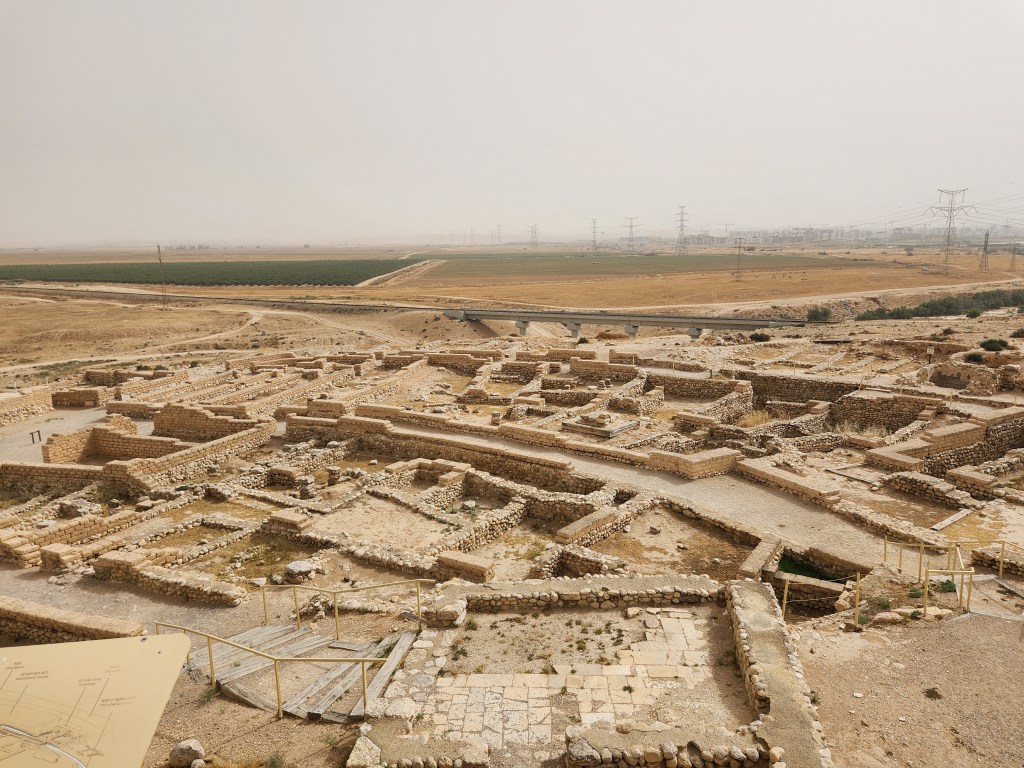
An overview of most of the remains of ancient Beersheba

Beersheba Unexpected

Each day, as we rode on our tour bus toward a new destination, our class took turns preparing a short biblical history lesson of what had happened in that place. Sometimes these were recorded in the Old or New Testaments but sometimes the events of interest to us were to be found in the writings of Josephus, or in rediscovered texts from Egypt, Mesopotamia, or other archeological explorations. And so, on our way to Be’er Sheva (biblical Beersheba) we were reminded of the many biblical references, which are entirely in the Old Testament for reasons that I will explain shortly.

The first reference to Beersheba comes as early Genesis 21 when Abraham sends Hagar and Ishmael away and they “wandered in the Desert of Beersheba.” Just a few verses later, Abraham makes an oath (which amounts to a modern treaty) with Abimelech and exchange seven lambs as a part of the agreement. The name “Beersheba” therefore is said to stem from that event either because the word Beersheba is similar to the Hebrew root of “made an oath,” or because it is similar to the root word of “seven” (or possibly both).

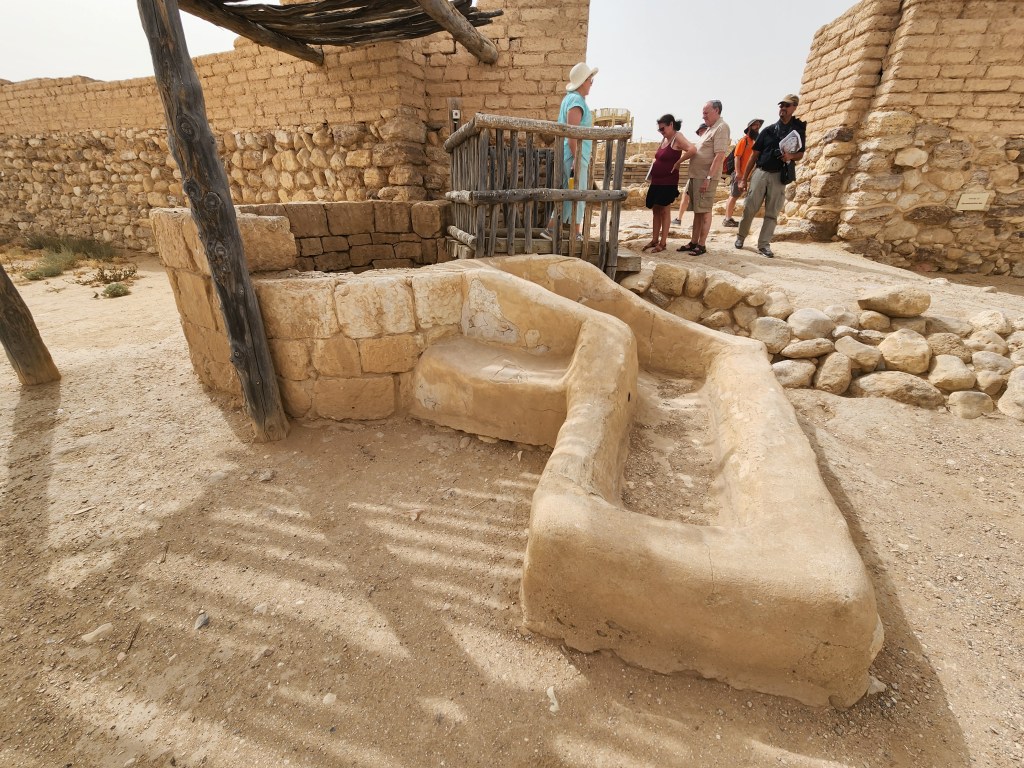
The well at Beersheba

Later, in Genesis 46, Jacob stops in Beersheba to offer sacrifices to God on his way to Egypt, Elijah stops there while running for his life in 1 Kings 19, and almost all of the other occurrences simply use Beersheba as an expression to say all of Israel from north to south as we see in Judges 20:1 when it says, “Then all Israel from Dan to Beersheba and from the land of Gilead came together as one and assembled before the Lord in Mizpah.” This expression is used simply because Dan was, for the most part, the farthest north that Israel grew, and Beersheba was its farthest southern extent.  To the north of Dan was the nation of Aram (which is modern day Syria) and to the south was… well, sand.  Beersheba was, and is, at the northern edge of the Negev desert, which scripture often describes as “wilderness” and the Sinai Peninsula. Continuing south brings you to the borders of Egypt. When the Jews returned to Israel after the Babylonian captivity, Nehemiah records that some returned to Beersheba, but, perhaps because there were so few, and because that territory is no longer controlled by Israel, there is no other mention of that place in scripture.

Looking down into the (deep) well

And so, while Beersheba is well attested in the Bible, compared to many of the other places that we visited, not a lot happened there. And yet, I was struck by the presence of the place in a way that I wasn’t in many of the others. Beersheba may not have had a central role in the stories of scripture, but it was present. The reason that Beersheba was important to Abraham and Isaac was because of the well that was there. Here, at the northern edge of the desert, there isn’t much water other that what flows down the wadi (dry riverbed) during the infrequent rains. And so, this well is very likely the same well that Abraham knew. Moreover, even though it may not often be mentioned by name, anyone who traveled through this region was almost certain to have stopped here.

A model of the Horned Altar found at Beersheba

It is also believed that Beersheba was one of the places of worship that had been built so that people wouldn’t have to travel the many miles north to Jerusalem. If so, this is one of the temples that King Hezekiah ordered torn down in 1 Kings 18. During archaeological digs here, a four-horned altar, often described in scripture, and typically used for sacrifice, was discovered here in secondary use. “Secondary use” means that after the temple here had been torn down, someone reused the stones as a part of wall. The stones from that wall have been moved to the Israel Museum in Jerusalem and reassembled into an altar.

Finally, during those times that Israel controlled Beersheba, it was a military outpost. This was the border between Israel and the wilderness, and between Israel and any enemies, such as Egypt, that might come from the south. Duty here was probably far from home, and certainly hot, unforgiving, and generally miserable.

A city street

Still, what is it about Be’er Sheva that unexpectedly struck me? Why does it have a presence that I could feel? For me, it’s because, like just a few other places, this is where it happened. In other places, over the last two thousand years, the places described in scripture have moved, walls have been torn down and rebuilt, whole cities have been destroyed, rebuilt, destroyed again, over and over until the places that we read about are tens of meters below the surface. But wells don’t move. While the stones surrounding this well at the surface may have been replaced many times, this is the place where Abraham, Isaac, Jacob, Elijah, invading Pharaohs, Mesopotamian generals, Roman armies, Israelite kings, and so many others have stood, draw water, and had a moment of rest.

It was unexpected.  I was surprised.

Beersheba city gate

But here, on a smallish hill on the edge of the desert, I felt as if I was in the presence of history.

And, having done so, it is so much easier to imagine what those people were feeling. The panic of Hagar as she is cast out to almost certain death in the desert, the relief of Israeli merchants returning home from Egypt, the apprehension of outpost soldiers knowing that Egypt’s army was on its way towards them, the anticipation of Pharoah as he moved north towards larger, more well-defended outposts and cities, and the courage of those settlers who dared to make this remote place their home.

It is that insight, out ability to imagine what it must have been like, that allows us to better understand, explain, teach, and preach the stories of scripture. Because understanding those people, and their feelings transforms dry words into real people.


Please LIKE and SHARE!

Click here to subscribe to Pastor John’s blog.

Click here if you would like to subscribe to Pastor John’s weekly messages.

Click here to visit Pastor John’s YouTube channel.


Unreasonable Demands

Click here to listen to the podcast

Click here to watch the video.


Unreasonable Demands

July 02, 2023*

By Pastor John Partridge

Genesis 22:1-14                     Matthew 10:40-42                 Romans 6:12-23

Have you ever had a bad boss?

At my last secular job, the company president, and one or two others, were known to publicly chastise, criticize, and even berate employees, and even supervisors and shop foremen, for mistakes they believed those employees had made. The first time I saw such a thing, I remembered that one of the very first, foundational, and fundamental rules that we had been taught in Non-commissioned officer school, was to always praise your subordinates in public, but criticize and correct them in private. The results were what you would expect, such encounters lowered morale for entire departments and even for the entire shop floor. Worse, some of those employees, especially shop foremen, soon found other employment for fewer hours and more money. Would they have started looking for a job if they had been criticized in private? Maybe, but I’m sure that such encounters helped them to make up their minds to leave.

But stories about bad bosses can be found all over the internet. The Reddit website has entire forums dedicated to the stories of employees, and their bad bosses. Of course, many of those stories end with the employees quitting and telling those bosses to “get stuffed.” But those stories resonate with us, especially if we had a bad boss, and especially if we felt that we had to put up with it because of the economic or other conditions in which we found ourselves.

But what if God is the one who is being unreasonable?

That’s what we appear to be seeing in the story of Genesis 22:1-14. This is the story about God’s command that Abraham sacrifice Isaac as a burnt offering. But the story is all kinds of wrong, in all kinds of ways.  We’ll get to that, but first, let’s read the story…

22:1 Some time later God tested Abraham. He said to him, “Abraham!”

“Here I am,” he replied.

Then God said, “Take your son, your only son, whom you love—Isaac—and go to the region of Moriah. Sacrifice him there as a burnt offering on a mountain I will show you.”

Early the next morning Abraham got up and loaded his donkey. He took with him two of his servants and his son Isaac. When he had cut enough wood for the burnt offering, he set out for the place God had told him about. On the third day Abraham looked up and saw the place in the distance. He said to his servants, “Stay here with the donkey while I and the boy go over there. We will worship and then we will come back to you.”

Abraham took the wood for the burnt offering and placed it on his son Isaac, and he himself carried the fire and the knife. As the two of them went on together, Isaac spoke up and said to his father Abraham, “Father?”

“Yes, my son?” Abraham replied.

“The fire and wood are here,” Isaac said, “but where is the lamb for the burnt offering?”

Abraham answered, “God himself will provide the lamb for the burnt offering, my son.” And the two of them went on together.

When they reached the place God had told him about, Abraham built an altar there and arranged the wood on it. He bound his son Isaac and laid him on the altar, on top of the wood. 10 Then he reached out his hand and took the knife to slay his son. 11 But the angel of the Lord called out to him from heaven, “Abraham! Abraham!”

“Here I am,” he replied.

12 “Do not lay a hand on the boy,” he said. “Do not do anything to him. Now I know that you fear God, because you have not withheld from me your son, your only son.”

13 Abraham looked up and there in a thicket he saw a ramcaught by its horns. He went over and took the ram and sacrificed it as a burnt offering instead of his son. 14 So Abraham called that place The Lord Will Provide. And to this day it is said, “On the mountain of the Lord it will be provided.”

Those of us who are familiar with this story, through regular repetition, have likely made our peace with it, but there’s still something about it that bothers us. In this case, it is our familiarity with the story that blinds us to some of the problems that present themselves in it and, as such, it’s likely that anyone who is unfamiliar with this story will take issue with several things while they read it. First among these is that God asks Abraham to sacrifice Isaac, but this is the same God that throughout the Old Testament, strongly, and repeatedly prohibits any kind of human sacrifice. Second, God promised Abraham children, and now asks that Abraham sacrifice the only child that he has left. Third, as we heard last week, God promised that Abraham would have heirs through Isaac and that Isaac’s descendants would become a great nation. Fourth, again as we heard last week, Abraham had already sent Ishmael away, so Isaac is all that he has left. And fifth, at this point, Isaac must be nearly in his teens, so Sarah, who was already over one hundred years old when Isaac was conceived, must now be somewhere between 110 to 120 years old. Although all things are possible with God, if it was unlikely for a 100-year-old woman to have a baby, having a second one at 120 would seem to be even more unlikely.

For all these reasons, it seems like God’s command to sacrifice Isaac is not only unreasonable but violates God’s agreement with Abraham in a several different ways.

And yet…

Abraham does not complain. Abraham knows all about all these issues and I am certain that all of them had to be swirling through his mind. But Abraham does not object or rebel against God. Abraham knows that the death of Isaac would break God’s promise, destroy his marriage, cancel his future, and erase his legacy.

But Abraham obeys and is faithful. Even though obeying God violates everything that Abraham knows to be true, destroys everything that he holds dear, and erases everything that he has spent his entire life building, Abraham obeys anyway. Even though Abraham can’t see a way that God can possibly make this insanity work, Abraham trusts that God is faithful, will honor his promises, and will find a way through.

But if we look at Matthew 10:40-42, we find something that is the same, sort of a test. Jesus says…

40 “Anyone who welcomes you welcomes me, and anyone who welcomes me welcomes the one who sent me. 41 Whoever welcomes a prophet as a prophet will receive a prophet’s reward, and whoever welcomes a righteous person as a righteous person will receive a righteous person’s reward. 42 And if anyone gives even a cup of cold water to one of these little ones who is my disciple, truly I tell you, that person will certainly not lose their reward.”

Jesus says that if you offer hospitality to those who are doing the work of God, potentially in your home, but also in small acts of kindness like sharing your food and water, that you will share in the rewards that God will give them for their faithfulness.  Welcoming the servants of God, is a gift to God and hospitality given in the name of God is rewarded by God. But doing so comes at a risk, and at a cost to you. The people to whom you offer hospitality may well be strangers, and you might not understand their mission. But your understanding and your comfort are not prerequisites to your obedience.

And finally, we return to Paul’s letter to the church in Rome exactly where we left off last week in Romans 6:12-23, as Paul connects our behavior and our actions to our faithfulness, and to our indebtedness, to God. Paul says…

11 In the same way, count yourselves dead to sin but alive to God in Christ Jesus. 12 Therefore do not let sin reign in your mortal body so that you obey its evil desires. 13 Do not offer any part of yourself to sin as an instrument of wickedness, but rather offer yourselves to God as those who have been brought from death to life; and offer every part of yourself to him as an instrument of righteousness. 14 For sin shall no longer be your master, because you are not under the law, but under grace.

15 What then? Shall we sin because we are not under the law but under grace? By no means! 16 Don’t you know that when you offer yourselves to someone as obedient slaves, you are slaves of the one you obey—whether you are slaves to sin, which leads to death, or to obedience, which leads to righteousness? 17 But thanks be to God that, though you used to be slaves to sin, you have come to obey from your heart the pattern of teaching that has now claimed your allegiance. 18 You have been set free from sin and have become slaves to righteousness.

19 I am using an example from everyday life because of your human limitations. Just as you used to offer yourselves as slaves to impurity and to ever-increasing wickedness, so now offer yourselves as slaves to righteousness leading to holiness. 20 When you were slaves to sin, you were free from the control of righteousness. 21 What benefit did you reap at that time from the things you are now ashamed of? Those things result in death! 22 But now that you have been set free from sin and have become slaves of God, the benefit you reap leads to holiness, and the result is eternal life. 23 For the wages of sin is death, but the gift of God is eternal life inChrist Jesus our Lord.

Paul’s point is that we are called to offer our lives as a sacrifice to God. How we live, how we act, and how we behave are all sacrifices and gifts that we give to God as acts of faithfulness and obedience. Further, Paul emphasizes that while we were once slaves to sin, we are now slaves to righteousness. This isn’t just a useful turn of phrase for the purposes of illustration. In the Roman world, Paul, and everyone else, lived in a culture of honor and patronage. In that culture, when a patron, or other wealthy person, aided you in a business transaction that you could never have put together for yourself, or paid a debt on your behalf that you could never have paid without their help, you became, as a matter of honor, indebted to them.

While, legally and technically, your debt had been paid, you now owed your life and your honor to your new patron. While you could ignore their requests, doing so would be dishonorable and would mark you as an ungracious scoundrel. This is the language that Paul uses in several of his books because it was language that is seen in many Greek and Roman texts and so we know that it was common language that everyone in the ancient world would have readily understood and accepted.

I could explain at some length, but the summary is that because Jesus paid a debt for us, because he substituted his life in place of ours, we now owe him a debt of honor. We owe God our gratitude, our faith, and our obedience. And so, we are expected to behave like Abraham, to obey even when doing so seems impossible and to have the faith that God can, and often does, accomplish the impossible.

Set aside sin.

Obey God.

Trust that God is faithful, will honor his promises, and will find a way through.

And offer your entire life as a living sacrifice to the glory of Jesus Christ and to the building of his kingdom.


Please LIKE and SHARE!

Click here to subscribe to Pastor John’s blog.

Click here if you would like to subscribe to Pastor John’s weekly messages.

Click here to visit Pastor John’s YouTube channel.


*You have been reading a message presented at Christ United Methodist Church on the date noted at the top of the first page.  Rev. John Partridge is the pastor at Christ UMC in Alliance, Ohio.  Duplication of this message is a part of our Media ministry, if you have received a blessing in this way, we would love to hear from you.  Letters and donations in support of the Media ministry or any of our other projects may be sent to Christ United Methodist Church, 470 East Broadway Street, Alliance, Ohio 44601.  These messages are available to any interested persons regardless of membership.  You may subscribe to these messages, in print or electronic formats, by writing to the address noted, or by contacting us at secretary@CUMCAlliance.org.  These messages can also be found online at https://pastorpartridge.com .  All Scripture quotations, unless otherwise indicated, are taken from the Holy Bible, New International Version®, NIV®. Copyright ©1973, 1978, 1984, 2011 by Biblica, Inc.™ Used by permission of Zondervan. All rights reserved worldwide. www.zondervan.comThe “NIV” and “New International Version” are trademarks registered in the United States Patent and Trademark Office by Biblica, Inc.™

Abandoning Good

Click here to listen to the podcast

Click here to watch the video of this message


Abandoning Good

June 25, 2023*

By Pastor John Partridge

Genesis 21:8-21                     Matthew 10:24-39                 Romans 6:1-11

Author Jim Collins, in his 2001 bestselling book, Good to Great,” famously said that “Good is the enemy of Great.” The argument behind this evocative statement is that too many organizations, and people, are willing to settle for less than what they could attain and accept “good enough” because they don’t want to do the hard work that it takes to become really great. But, while that might be a popular way to think about moving from good to great as a business, or even as a church, the message of scripture uses even stronger language to warn us of settling for “good enough” in our spiritual lives personally.

Some of that is how we can understand the difficult story of Genesis 21:8-21. It is hard for us to be sympathetic to the cause of Abraham in this story because, to us, and to our sensibilities, it seems that Abraham and Sarah are being harsh, cruel, and unfeeling. In that story, we see a dark and jealous side of Sarah that is difficult for us to grapple with in a person that we regard as a biblical hero.

The child grew and was weaned, and on the day that Isaac was weaned, Abraham held a great feast. But Sarah saw that the son whom Hagar the Egyptian had borne to Abraham was mocking, 10 and she said to Abraham, “Get rid of that slave woman and her son, for that woman’s son will never share in the inheritance with my son Isaac.”

11 The matter distressed Abraham greatly because it concerned his son. 12 But God said to him, “Do not be so distressed about the boy and your slave woman. Listen to whatever Sarah tells you, because it is through Isaac that your offspringwill be reckoned. 13 I will make the son of the slave into a nation also, because he is your offspring.”

14 Early the next morning Abraham took some food and a skin of water and gave them to Hagar. He set them on her shoulders and then sent her off with the boy. She went on her way and wandered in the Desert of Beersheba.

15 When the water in the skin was gone, she put the boy under one of the bushes. 16 Then she went off and sat down about a bowshot away, for she thought, “I cannot watch the boy die.” And as she sat there, she began to sob.

17 God heard the boy crying, and the angel of God called to Hagar from heaven and said to her, “What is the matter, Hagar? Do not be afraid; God has heard the boy crying as he lies there. 18 Lift the boy up and take him by the hand, for I will make him into a great nation.”

19 Then God opened her eyes and she saw a well of water. So, she went and filled the skin with water and gave the boy a drink.

20 God was with the boy as he grew up. He lived in the desert and became an archer. 21 While he was living in the Desert of Paran, his mother got a wife for him from Egypt.

There are only two things that make this story even a little bit easier for us to come to grips with the actions of Abraham and Sarah. The first is that Abraham genuinely struggles with the idea of sending his own flesh and blood, his seed, his son, out into the wilderness. And it is wilderness. Having only recent visited what is known as Abraham’s well in Beersheba (Be’er Sheva) it is in the middle of miles and miles of… nothing. Yes, people live there, but there is nothing there except desert, dirt, and rocks. To help you imagine what it’s like, it’s a cross between the desert and the foothills of the Rocky Mountains. It is hot, rugged, and altogether inhospitable. The second thing that helps our understanding is that before they were sent away into the desert, God reassured Abraham that he would take care of Ishmael, bless him, and raise up a nation through him.

But why did it happen at all?

Abraham by this time was wealthy. He had so many herds of sheep and camels that he needed hired men and servants to care for them all. Surely, he could have afforded to feed and clothe one more child. That would have been good. But Sarah didn’t want good.  Sarah wanted what was best for her son, Isaac. You see, even though Hagar was a slave, because she had borne Abraham a son, she was, legally, equivalent to his wife Sarah. Legally, Ishmael, as the first-born son, might even have been entitled to receive the inheritance of the first-born which, with two sons, would have typically been two-thirds of Abraham’s estate. The only legal way to prevent that from happening was for Abraham to divorce Hagar, disown her and her son, and send them away. As hard as it was for Abraham, and as hard as it is for us to understand, Sarah was ruthlessly in pursuit of what was best for Isaac.

And, for what it’s worth, modern-day Arabs, who believe themselves to be the descendants of Ishmael, reverse this story and believe that it was Isaac that was sent away, and that Abraham raised Ishmael as his legal heir.

Even today, it is hard for us to set aside good enough in our pursuit of what is great, or to set aside what is good so that we can reach for what is best. In Matthew 10:24-39, Jesus teaches a lesson that is, in no uncertain terms, hard. It isn’t really that difficult to understand, but it is unquestionably hard for us to be obedient in living it out. Jesus says,

24 “The student is not above the teacher, nor a servant above his master. 25 It is enough for students to be like their teachers, and servants like their masters. If the head of the house has been called Beelzebul, how much more the members of his household!

26 “So do not be afraid of them, for there is nothing concealed that will not be disclosed or hidden that will not be made known. 27 What I tell you in the dark, speak in the daylight; what is whispered in your ear, proclaim from the roofs. 28 Do not be afraid of those who kill the body but cannot kill the soul. Rather, be afraid of the One who can destroy both soul and body in hell. 29 Are not two sparrows sold for a penny? Yet not one of them will fall to the ground outside your Father’s care. 30 And even the very hairs of your head are all numbered. 31 So don’t be afraid; you are worth more than many sparrows.

32 “Whoever acknowledges me before others, I will also acknowledge before my Father in heaven. 33 But whoever disowns me before others, I will disown before my Father in heaven.

34 “Do not suppose that I have come to bring peace to the earth. I did not come to bring peace, but a sword. 35 For I have come to turn…

“‘a man against his father,
    a daughter against her mother,
a daughter-in-law against her mother-in-law—
36     a man’s enemies will be the members of his own household.’

37 “Anyone who loves their father or mother more than me is not worthy of me; anyone who loves their son or daughter more than me is not worthy of me. 38 Whoever does not take up their cross and follow me is not worthy of me. 39 Whoever finds their life will lose it, and whoever loses their life for my sake will find it.

Jesus begins by reminding us that if Jesus is our master, and he himself has been called the devil by his opponents, then we, as his followers, should expect the same treatment. Children follow the pattern of their parents, and the bad habits or bad behaviors that they learn may well be worse in them than they were in their parents. But what Jesus demands of us, is that we follow him to the best of our ability… and that’s where this gets hard. Jesus doesn’t demand that we pursue him until we arrive at “good enough,” but until we get to what’s best. And, to get to what’s best, we may have to leave behind things that we care about and things that we love. As important as family is, we must put God, and the truth of God, in the place of first importance in our lives. Making anything more important than God, making anything more important that our relationship with, and our obedience to, Jesus Christ will cause us to lose God entirely. But surrendering what we want, surrendering “good enough,” even if that means losing valuable and treasured relationships with family and friends. But, when we surrender what is “good enough,” we will discover the life that God intends to give us.

In Romans 6:1b-11, Paul equates settling for “good enough” with sin. Paul says that we just can’t keep on doing things that we know are wrong just because we know that Jesus will forgive us. He says…

6:1 What shall we say, then? Shall we go on sinning so that grace may increase? By no means! We are those who have died to sin; how can we live in it any longer? Or don’t you know that all of us who were baptized into Christ Jesus were baptized into his death? We were therefore buried with him through baptism into death in order that, just as Christ was raised from the dead through the glory of the Father, we too may live a new life.

For if we have been united with him in a death like his, we will certainly also be united with him in a resurrection like his. For we know that our old self was crucified with him so that the body ruled by sin might be done away with, that we should no longer be slaves to sin— because anyone who has died has been set free from sin.

Now if we died with Christ, we believe that we will also live with him. For we know that since Christ was raised from the dead, he cannot die again; death no longer has mastery over him. 10 The death he died, he died to sin once for all; but the life he lives, he lives to God.

11 In the same way, count yourselves dead to sin but alive to God in Christ Jesus.

Paul says that when we choose to follow Jesus, we begin an entirely new life. He says that our old life died on the cross with Jesus, and our sins died with it. And so, for us to move from good to great, for us to live our best life, we can never settle for “good enough.” We must be changed and transformed from the person that once were and relentlessly pursue the greatness that God has in store for us but to do that, we must abandon anything that prevents us from reaching God’s best.

Jim Collins said that “Good is the enemy of Great” and the message of scripture is that we must not settle for “good enough.”

We must, at all costs, abandon good, so that we can pursue something better, because settling for “good enough” will prevent us from reaching God’s best.


Please LIKE and SHARE!

Click here to subscribe to Pastor John’s blog.

Click here if you would like to subscribe to Pastor John’s weekly messages.

Click here to visit Pastor John’s YouTube channel.


*You have been reading a message presented at Christ United Methodist Church on the date noted at the top of the first page.  Rev. John Partridge is the pastor at Christ UMC in Alliance, Ohio.  Duplication of this message is a part of our Media ministry, if you have received a blessing in this way, we would love to hear from you.  Letters and donations in support of the Media ministry or any of our other projects may be sent to Christ United Methodist Church, 470 East Broadway Street, Alliance, Ohio 44601.  These messages are available to any interested persons regardless of membership.  You may subscribe to these messages, in print or electronic formats, by writing to the address noted, or by contacting us at secretary@CUMCAlliance.org.  These messages can also be found online at https://pastorpartridge.com .  All Scripture quotations, unless otherwise indicated, are taken from the Holy Bible, New International Version®, NIV®. Copyright ©1973, 1978, 1984, 2011 by Biblica, Inc.™ Used by permission of Zondervan. All rights reserved worldwide. www.zondervan.comThe “NIV” and “New International Version” are trademarks registered in the United States Patent and Trademark Office by Biblica, Inc.™

Finding Home

Finding Home

June 18, 2023*

By Pastor John Partridge

Genesis 18:1-15                     Matthew 9:35 – 10:8-23            Romans 5:1-8

As early as 3000 BCE Phoenician explorers were navigating the high seas and Pacific islanders were doing the same using star charts made of sticks and songs to remember important details. Much later, Arab navigators would use a “kamal,” a marked piece of wood or metal with a beaded string for measuring their location and by the 13th century European mariners used the astrolabe to determine their location. The astrolabe evolved into the marine quadrant, and then the Davis quadrant with backstaff, and that technology progressed and became the Octant, and finally, in 1731, John Hadley developed the Sextant. The precision of the sextant allowed a competent navigator to determine their location within about one-half a nautical mile, day or night, even in the rain and pitching seas. A sextant and compass remained the best way to determine your location at sea for over 250 years and remains a useful method for mariners if GPS or radio navigation becomes unavailable.

Why is that important? Simply because it’s always good to be able to navigate around sea mounts, shoals, and shallow rocks, to find your way to islands where you can replenish stores of fresh water, and most importantly, so that, at the end of your voyage, you can find your way home.

Isn’t that always the most important thing? No matter where we go, finding our way home is always a part of the plan. But sometimes the home that we find isn’t the home that we left. After World War I, my grandfather left his family home in Germany and made a new home here in the United States outside of Pittsburgh, Pennsylvania. The same has been true throughout the history of our nation for millions of other immigrants from around the world. But that story of immigration is also an important part of the story of scripture and an important part of our story as well. As we mentioned last week, when God commanded Abram to “go,” Abram went. But as he went, Abram took with him the values of hospitality that were held by his culture, and we see that in the story of Genesis 18:1-15.

18:1 The Lord appeared to Abraham near the great trees of Mamre while he was sitting at the entrance to his tent in the heat of the day. Abraham looked up and saw three men standing nearby. When he saw them, he hurried from the entrance of his tent to meet them and bowed low to the ground.

He said, “If I have found favor in your eyes, my lord, do not pass your servant by. Let a little water be brought, and then you may all wash your feet and rest under this tree. Let me get you something to eat, so you can be refreshed and then go on your way—now that you have come to your servant.”

“Very well,” they answered, “do as you say.”

The culture in which Abraham lived placed great value on hospitality. Not just in speaking words of welcome to a stranger, but in offering them food, inviting them into your home, giving them a place to stay, sleep, rest, and providing them with necessities that they might need to continue their journey. Essentially, offering hospitality, and not just welcome, to strangers was almost the same as treating them like family.

Why is that important?

It’s important because that culture of hospitality never went out of style. It was passed on by Abraham to the people who would become the Jews and the people of Israel, and it would continue to be found in cultures around the Near East, and it has been, in many ways, passed down to us. If we pay attention, we will see that same culture of hospitality at work in Matthew 9:35 – 10:8, (9-23), when Jesus sends his disciples out into the world to share the message of Good News.

35 Jesus went through all the towns and villages, teaching in their synagogues, proclaiming the good news of the kingdom and healing every disease and sickness. 36 When he saw the crowds, he had compassion on them, because they were harassed and helpless, like sheep without a shepherd. 37 Then he said to his disciples, “The harvest is plentiful, but the workers are few. 38 Ask the Lord of the harvest, therefore, to send out workers into his harvest field.”

10:1 Jesus called his twelve disciples to him and gave them authority to drive out impure spirits and to heal every disease and sickness.

These are the names of the twelve apostles: first, Simon (who is called Peter) and his brother Andrew; James son of Zebedee, and his brother John; Philip and Bartholomew; Thomas and Matthew the tax collector; James son of Alphaeus, and Thaddaeus; Simon the Zealot and Judas Iscariot, who betrayed him.

These twelve Jesus sent out with the following instructions: “Do not go among the Gentiles or enter any town of the Samaritans. Go rather to the lost sheep of Israel. As you go, proclaim this message: ‘The kingdom of heaven has come near.’ Heal the sick, raise the dead, cleanse those who have leprosy, drive out demons. Freely you have received; freely give.

“Do not get any gold or silver or copper to take with you in your belts— 10 no bag for the journey or extra shirt or sandals or a staff, for the worker is worth his keep. 11 Whatever town or village you enter, search there for some worthy person and stay at their house until you leave. 12 As you enter the home, give it your greeting. 13 If the home is deserving, let your peace rest on it; if it is not, let your peace return to you. 14 If anyone will not welcome you or listen to your words, leave that home or town, and shake the dust off your feet. 15 Truly I tell you, it will be more bearable for Sodom and Gomorrah on the day of judgment than for that town.

16 “I am sending you out like sheep among wolves. Therefore, be as shrewd as snakes and as innocent as doves. 17 Be on your guard; you will be handed over to the local councils and be flogged in the synagogues. 18 On my account you will be brought before governors and kings as witnesses to them and to the Gentiles. 19 But when they arrest you, do not worry about what to say or how to say it. At that time, you will be given what to say, 20 for it will not be you speaking, but the Spirit of your Father speaking through you.

21 “Brother will betray brother to death, and a father his child; children will rebel against their parents and have them put to death. 22 You will be hated by everyone because of me, but the one who stands firm to the end will be saved. 23 When you are persecuted in one place, flee to another. Truly I tell you, you will not finish going through the towns of Israel before the Son of Man comes.

As Jesus sends his disciples out into the surrounding towns and villages to share the good news of the kingdom of God, a pivotal part of the plan depends upon the historic and continuing culture of hospitality. In every town where they were to preach, it was expected that they would be able to find at least one person, or one family, that was willing to take them in, house them, and feed them for however long that they remained to preach in that town. They had no money, they paid no rent, and could offer no compensation other than to offer greetings and give the gift of peace to those who invited them in. Although the disciples were away from their birthplaces and away from what was familiar, in the places where they went to share the good news of the kingdom, through the gift of hospitality, they found a place, even for a short while, that they could call “home.”

But scripture tells us of an even more important act of hospitality that has mattered to every follower of Jesus Christ in all of history and that still matters to us today. In Romans 5:1-8, Paul talks about our justification before God, and before we begin, I want to define that. “Justified” is the opposite of “guilty.” It doesn’t necessarily mean that we are innocent, but the implication of being justified is that we have been acquitted and declared, by God’s power and authority, to be righteous. We aren’t righteous because we’re flawless, perfect, and sinless, we are righteous because God says that we are.  Paul explains it this way:

5:1 Therefore, since we have been justified through faith, wehave peace with God through our Lord Jesus Christ, through whom we have gained access by faith into this grace in which we now stand. And weboast in the hope of the glory of God. Not only so, but wealso glory in our sufferings, because we know that suffering produces perseverance; perseverance, character; and character, hope. And hope does not put us to shame, because God’s love has been poured out into our hearts through the Holy Spirit, who has been given to us.

You see, at just the right time, when we were still powerless, Christ died for the ungodly. Very rarely will anyone die for a righteous person, though for a good person someone might possibly dare to die. But God demonstrates his own love for us in this: While we were still sinners, Christ died for us.

While at first it may not seem like it, the story of our redemption and justification is a story about God’s hospitality. God wanted us to live with him. In fact, God wanted us to live with him so much, that he acquitted us of our sin (the theological word is justification) through our faith in Jesus Christ. And Paul expands on that by pointing out that not only did God acquit us, but doing so was expensive. God loved us so much, that he offers us hospitality, and invites us to live with him in his home, but that hospitality came at the expense of the life of God’s own son. Moreover, Paul explains, Jesus didn’t die for us because we were good, but because of God’s great love for us. Through Jesus’ death and resurrection, God opened a path for hospitality. When we put our faith in Jesus Christ, we open the door to peace, hope, grace, and… home.

Our search for a place to belong ends. Because of the hospitality of God, because of Jesus’ obedience and sacrifice, and because of our faith, we have found, for all eternity, a place to call home.

But the message of Jesus, as we saw in Matthew, is that because we have found our home, it is now our calling is to show hospitality to others. We can’t just be welcoming, say “hello” and show them where to sit. Real hospitality can be expensive. It means more than inviting people into our churches, it means inviting them into our lives, caring for them as if they were family, making sure that they have food to eat, clothes to wear, and then telling them about Jesus, so that they can find… home.


Please LIKE and SHARE!

Click here to subscribe to Pastor John’s blog.

Click here if you would like to subscribe to Pastor John’s weekly messages.

Click here to visit Pastor John’s YouTube channel.


*You have been reading a message presented at Christ United Methodist Church on the date noted at the top of the first page.  Rev. John Partridge is the pastor at Christ UMC in Alliance, Ohio.  Duplication of this message is a part of our Media ministry, if you have received a blessing in this way, we would love to hear from you.  Letters and donations in support of the Media ministry or any of our other projects may be sent to Christ United Methodist Church, 470 East Broadway Street, Alliance, Ohio 44601.  These messages are available to any interested persons regardless of membership.  You may subscribe to these messages, in print or electronic formats, by writing to the address noted, or by contacting us at secretary@CUMCAlliance.org.  These messages can also be found online at https://pastorpartridge.com .  All Scripture quotations, unless otherwise indicated, are taken from the Holy Bible, New International Version®, NIV®. Copyright ©1973, 1978, 1984, 2011 by Biblica, Inc.™ Used by permission of Zondervan. All rights reserved worldwide. www.zondervan.comThe “NIV” and “New International Version” are trademarks registered in the United States Patent and Trademark Office by Biblica, Inc.™

Unlikely, Improbable, and Impossible

Unlikely, Improbable, and Impossible

June 11, 2023*

By Pastor John Partridge

Genesis 12:1-9                       Matthew 9:9-13, 18-26                      Romans 4:13-25

Arthur Conan Doyle, through the voice of his detective Sherlock Holmes, often said when describing his method of observation and deduction, that, “when you have eliminated the impossible, whatever is left, however improbable, must be the truth.” Let me say that again, “When you have eliminated the impossible, whatever is left, however improbable, must be the truth.” This is good advice and often worth remembering as a part of the scientific process of testing, evaluation, and exploration. But in the church, despite our recognition of the importance of science, we also recognize the limitations of science. Many of the things that we hold to be true, are unlikely and improbable, and some of them are, outside of the work of an all-powerful God, would normally be assumed to be impossible.

For example, it is unlikely that the youngest son of family of sheep herders, from a small, little known, and often disrespected clan, would not only become the king of his clan, but would unite twelve clans into a unified nation that rivaled the strength and power of the largest superpowers of the world.

But David did.

It is improbable, that a man who was born into the right family, with all the right breeding, and all the right education, who had dedicated his life to persecuting the representatives of the schismatic movement whom he felt were polluting, desecrating, poisoning and destroying his church, would himself be converted to that sect and become the most prolific and well-known preacher, writer, and evangelist that the world has ever known.

But Paul did.

It is impossible for women of advanced age, well past the age of menopause, and especially past the age of 80, 90, or even 100 to become pregnant and bear children.

But Sarah did. And so did Rebekah and Rachael.

It is impossible for the dead to return to life, especially after the dead have been dead for many hours, or even days,

But Lazarus did. The widow’s son did. And, of course, Jesus did.

But sometimes the only difference between possible, unlikely, improbable, and impossible is trust.

We’ll explore that a little further in a few moments, but for now let’s begin with the story of God’s call to Abram in Genesis 12:1-9.

12:1 The Lord had said to Abram, “Go from your country, your people and your father’s household to the land I will show you.

“I will make you into a great nation, and I will bless you;
I will make your name great, and you will be a blessing.
I will bless those who bless you, and whoever curses you I will curse;
and all peoples on earth will be blessed through you.”

So Abram went, as the Lord had told him; and Lot went with him. Abram was seventy-five years old when he set out from Harran. He took his wife Sarai, his nephew Lot, all the possessions they had accumulated and the people they had acquired in Harran, and they set out for the land of Canaan, and they arrived there.

Abram traveled through the land as far as the site of the great tree of Moreh at Shechem. At that time the Canaanites were in the land. The Lord appeared to Abram and said, “To your offspring I will give this land.” So, he built an altar there to the Lord, who had appeared to him.

From there he went on toward the hills east of Bethel and pitched his tent, with Bethel on the west and Ai on the east. There he built an altar to the Lord and called on the name of the Lord.

Then Abram set out and continued toward the Negev.

You will notice that, at no time, was there a negotiation. God did not bribe Abram. Abram did not demand terms, nor did he place limits on his obedience.  Abram did not say that he was willing to follow God for 100 miles, or for two months, nor did he insist on periodic employee reviews or reassurances that he was going in the right direction, doing the right things, or just to make sure that the lines of communication between them remained open.

Abram’s obedience was so unlikely and improbable that it bordered on the impossible.

God said “go” and Abram went.

God said go to the place that I will show you, and Abram went… straight into the desert.

And then, in just a few verses of the ninth chapter of Matthew, we find the unlikely, the improbable, and the impossible, all jumbled together. (Matthew 9:9-13, 18-26)

As Jesus went on from there, he saw a man named Matthew sitting at the tax collector’s booth. “Follow me,” he told him, and Matthew got up and followed him.

10 While Jesus was having dinner at Matthew’s house, many tax collectors and sinners came and ate with him and his disciples. 11 When the Pharisees saw this, they asked his disciples, “Why does your teacher eat with tax collectors and sinners?”

12 On hearing this, Jesus said, “It is not the healthy who need a doctor, but the sick. 13 But go and learn what this means: ‘I desire mercy, not sacrifice.’ For I have not come to call the righteous, but sinners.”

18 While he was saying this, a synagogue leader came and knelt before him and said, “My daughter has just died. But come and put your hand on her, and she will live.” 19 Jesus got up and went with him, and so did his disciples.

20 Just then a woman who had been subject to bleeding for twelve years came up behind him and touched the edge of his cloak. 21 She said to herself, “If I only touch his cloak, I will be healed.”

22 Jesus turned and saw her. “Take heart, daughter,” he said, “your faith has healed you.” And the woman was healed at that moment.

23 When Jesus entered the synagogue leader’s house and saw the noisy crowd and people playing pipes, 24 he said, “Go away. The girl is not dead but asleep.” But they laughed at him. 25 After the crowd had been put outside, he went in and took the girl by the hand, and she got up. 26 News of this spread through all that region.

For a well-paid tax collector, on the Roman payroll, who is often accused by his countrymen as a thief, or as a traitor, to stand up, quit his job, and become the disciple of a poor, itinerant, homeless rabbi is both unlikely and improbable.

For a woman with an incurable disease, who had already been seen by every expert that could affordably be seen, to be completely healed simply by touching the hanging fringe of a rabbi’s jacket is utterly improbable.

For a synagogue leader to seek help from an itinerant rabbi that has been widely criticized by the leaders of the Pharisees, Sadducees, and a range of national church leaders is unlikely.

But a dead girl returning to life is completely impossible.

But, how do these things happen? Sure, a part of the answer is that Jesus was there, and that Jesus could do the impossible.

But is there more to it than that?

In Romans 4:13-25 Paul explains some of the things that happened to Abraham, why those things happened, how they happened, and why they matter to us.

13 It was not through the law that Abraham and his offspring received the promise that he would be heir of the world, but through the righteousness that comes by faith. 14 For if those who depend on the law are heirs, faith means nothing and the promise is worthless, 15 because the law brings wrath. And where there is no law there is no transgression.

16 Therefore, the promise comes by faith, so that it may be by grace and may be guaranteed to all Abraham’s offspring—not only to those who are of the law but also to those who have the faith of Abraham. He is the father of us all. 17 As it is written: “I have made you a father of many nations.” He is our father in the sight of God, in whom he believed—the God who gives life to the dead and calls into being things that were not.

18 Against all hope, Abraham in hope believed and so became the father of many nations, just as it had been said to him, “So shall your offspring be.” 19 Without weakening in his faith, he faced the fact that his body was as good as dead—since he was about a hundred years old—and that Sarah’s womb was also dead. 20 Yet he did not waver through unbelief regarding the promise of God, but was strengthened in his faith and gave glory to God, 21 being fully persuaded that God had power to do what he had promised. 22 This is why “it was credited to him as righteousness.” 23 The words “it was credited to him” were written not for him alone, 24 but also for us, to whom God will credit righteousness—for us who believe in him who raised Jesus our Lord from the dead. 25 He was delivered over to death for our sins and was raised to life for our justification.

Paul says that God did unlikely, improbable, and even impossible things in the life of Abraham, through the lives of his descendants, and through our lives in the twenty first century, because of the faith that Abraham had, and because of the faith of those who follow in his footsteps.

God blessed Abraham because he had the faith to do the unlikely, to walk away from his family, his friends, and his nation, and follow God into the desert, just because God said… “Go.”

An unlikely and improbable tax collector becomes an honored and revered member of the eleven disciples of Jesus because he had the faith to walk away from the comfortable life that he had.

A woman with an incurable disease was healed because she had the faith to seek out Jesus, fight through the crowd that surrounded him, crawl on the ground, reach out, and touch the fringe of his jacket.

The daughter of a respected synagogue leader was raised from the dead because that leader had the courage, and the faith, to rebel against the conventional wisdom of his peers, ignore the prevailing opinion of the movers and shakers and VIPs of his church, and ask Jesus for help.

Throughout scripture, we witness events that are unlikely, improbable, and utterly impossible.

And yet, with faith, through faith, and by the power of God, these things happened.

For God to do unlikely, improbable, and impossible things in our lives, and in the life of our church, we must be willing to demonstrate our faith by doing unlikely and improbable things.

Are we willing to walk away from our comfortable lives and follow him into the desert or into the unknown as Abraham and Matthew did?

Are we willing to fight the crowd to seek him the way that the bleeding woman did?

Are we willing to defy our peers, resist the status quo, and risk our occupation and our reputation so that we can seek Jesus as the synagogue leader did?

We often pray for Jesus to do the unlikely, the improbable, and the impossible in our lives and in the life of our church.

But are we willing to do what God asks of us, are we willing to risk what we have, in order to receive the gift that God has for us?

Do we have… and improbable faith?


Please LIKE and SHARE!

Click here to subscribe to Pastor John’s blog.

Click here if you would like to subscribe to Pastor John’s weekly messages.

Click here to visit Pastor John’s YouTube channel.


*You have been reading a message presented at Christ United Methodist Church on the date noted at the top of the first page.  Rev. John Partridge is the pastor at Christ UMC in Alliance, Ohio.  Duplication of this message is a part of our Media ministry, if you have received a blessing in this way, we would love to hear from you.  Letters and donations in support of the Media ministry or any of our other projects may be sent to Christ United Methodist Church, 470 East Broadway Street, Alliance, Ohio 44601.  These messages are available to any interested persons regardless of membership.  You may subscribe to these messages, in print or electronic formats, by writing to the address noted, or by contacting us at secretary@CUMCAlliance.org.  These messages can also be found online at https://pastorpartridge.com .  All Scripture quotations, unless otherwise indicated, are taken from the Holy Bible, New International Version®, NIV®. Copyright ©1973, 1978, 1984, 2011 by Biblica, Inc.™ Used by permission of Zondervan. All rights reserved worldwide. www.zondervan.comThe “NIV” and “New International Version” are trademarks registered in the United States Patent and Trademark Office by Biblica, Inc.™

What Faith Isn’t

What Faith Isn’t

March 05, 2023*

(2nd Sunday of Lent)

By Pastor John Partridge

Genesis 12:1-4a                     John 3:1-17                Romans 4:1-5, 13-17

Often when we are explaining what things are, and how they work, we pause from our explanations of what they are to spend some time explaining what they aren’t.  This was important when the Covid-19 vaccines began to come out because many people heard the word “vaccine” and their thoughts connected to the polio vaccines that we received as children.  Those vaccines essentially made us “immune” to polio… or so we thought.  But the fact is that those vaccines made us immune because all of us had them, and because each vaccine, and each disease, performs differently in the human body. And so, we had to take the time to explain what vaccines are, and what they are not so that our understanding could align with the reality that the Covid vaccine is a lot more like our annual flu shot than it is to our once or twice in a lifetime polio vaccination.

With that in mind, when I read our lectionary selections for today, it occurred to me that, for as often as we spend time in church explaining what faith is, sometimes it is useful for us to talk about what faith isn’t, and that’s exactly what we find in some of today’s scriptures.  We begin this morning in Genesis 12:1-4a, where we hear God call Abram to leave his home, his family, his people, and his nation, and go to a place that God won’t even name.

12:1 The Lord had said to Abram, “Go from your country, your people and your father’s household to the land I will show you.

“I will make you into a great nation, and I will bless you;
I will make your name great, and you will be a blessing.
I will bless those who bless you, and whoever curses you I will curse;
and all peoples on earth will be blessed through you.”

So Abram went, as the Lord had told him; and Lot went with him.

God calls Abram from his home in the nation of Ur, to leave everything that he knows and just… go.  It’s a bit like the call from American history to just “Go West.”  God does not name a destination but promises to bless Abram and his descendants.  That’s it.  Just a promise.  And with that promise, Abram believes, Abram trusts, and Abram goes.

And as we will shortly see, as gentiles, that story is at the root of our eventual adoption into God’s family.

But first, we move on to John 3:1-17, where we find Jesus meeting with Nicodemus, a Pharisee, and a powerful member of the Sanhedrin.

3:1 Now there was a Pharisee, a man named Nicodemus who was a member of the Jewish ruling council. He came to Jesus at night and said, “Rabbi, we know that you are a teacher who has come from God. For no one could perform the signs you are doing if God were not with him.”

Jesus replied, “Very truly I tell you, no one can see the kingdom of God unless they are born again.”

“How can someone be born when they are old?” Nicodemus asked. “Surely they cannot enter a second time into their mother’s womb to be born!”

Jesus answered, “Very truly I tell you, no one can enter the kingdom of God unless they are born of water and the Spirit. Flesh gives birth to flesh, but the Spirit gives birth to spirit. You should not be surprised at my saying, ‘You[plural, as in “y’all”] must be born again.’ The wind blows wherever it pleases. You hear its sound, but you cannot tell where it comes from or where it is going. So, it is with everyone born of the Spirit.”

“How can this be?” Nicodemus asked.

10 “You are Israel’s teacher,” said Jesus, “and do you not understand these things? 11 Very truly I tell you, we speak of what we know, and we testify to what we have seen, but still, you people do not accept our testimony. 12 I have spoken to you of earthly things and you do not believe; how then will you believe if I speak of heavenly things? 13 No one has ever gone into heaven except the one who came from heaven—the Son of Man. 14 Just as Moses lifted up the snake in the wilderness, so the Son of Man must be lifted up, 15 that everyone who believes may have eternal life in him.”

16 For God so loved the world that he gave his one and only Son, that whoever believes in him shall not perish but have eternal life. 17 For God did not send his Son into the world to condemn the world, but to save the world through him.

As a Pharisee, we know that Nicodemus was a devout man of faith who dedicated his life to doing what was right in the eyes of God.  But because he was a member of the Jewish ruling council, the Sanhedrin, we also know that he was politically connected, respected, and well-known in the community.  Nicodemus says that he and the other leaders knew that Jesus must have been sent by God, because without God he would be unable to do the things that he had been doing.

Jesus explains to Nicodemus that the reason that he can do the things that he does, is because the he has received the Spirit of God and, more importantly, everyone who believes will receive the Spirit of God and will have eternal life.

And, once again, Jesus’ statement that “everyone” who believes may have eternal life, is of vital  importance to us as gentiles.

When Paul was called by God to minister to the Gentiles across the Roman world, there was debate as to whether this was even possible.  For Jews who had been raised on the teaching that they were loved by God because of the covenant that God had made with Abraham, it was difficult to understand how gentiles could be a part of God’s plan.  And so, Paul spent much of his time explaining how that could happen, and a part of that explanation included a definition of what faith in God is, as well as what faith in God isn’t.  We find one of those explanations in Paul’s letter to the church in Rome, in Romans 4:1-5, 13-17 where he connects the dots from today’s scriptures saying…

4:1 What then shall we say that Abraham, our forefather according to the flesh, discovered in this matter? If, in fact, Abraham was justified by works, he had something to boast about—but not before God. What does Scripture say? “Abraham believed God, and it was credited to him as righteousness.”

Now to the one who works, wages are not credited as a gift but as an obligation. However, to the one who does not work but trusts God who justifies the ungodly, their faith is credited as righteousness.

13 It was not through the law that Abraham and his offspring received the promise that he would be heir of the world, but through the righteousness that comes by faith. 14 For if those who depend on the law are heirs, faith means nothing and the promise is worthless, 15 because the law brings wrath. And where there is no law there is no transgression.

16 Therefore, the promise comes by faith, so that it may be by grace and may be guaranteed to all Abraham’s offspring—not only to those who are of the law but also to those who have the faith of Abraham. He is the father of us all. 17 As it is written: “I have made you a father of many nations.” He is our father in the sight of God, in whom he believed—the God who gives life to the dead and calls into being things that were not.

Paul starts, as we did, with the story of Abraham.  When God called Abram, only one thing connected him to the promise of God.  There was, at that time, no covenant with God and Abraham had not yet done anything worth rewarding.  Remember that we said that with God’s promise, Abram believes, Abram trusts, and Abram goes.  The only thing that Abram had was faith.  But nonetheless, scripture records that God credited Abram with righteousness.  

That tells us something about what faith is not.  Faith is not connected to the works that we do for God or in God’s name.  Abraham was credited with righteousness before he could do anything.  And, if Abram received the promise of God through faith, and not through the Law of Moses, which obviously came much later, then God’s grace is not hereditary and is not inherited, such that it cannot be passed from one generation to another.  Paul argues that there is no such thing as inheriting the faith of your parents or your grandparents and that applied to Jews in the first century just as it does for Christians in the twenty-first century.  We do not, and cannot, claim that we are saved because we were born into a Christian family.

Abram received the promise of God because he had… faith.  He was, to borrow a more modern expression, saved by faith.  Jesus said that everyone who believes may have eternal life.  We are not saved by the things that we do, we are not saved by works.  We are not saved by anything that was done by our ancestors, by our grandparents, or by our parents.  Our salvation and rescue are not hereditary and cannot be inherited or passed down from one generation to another.

We are saved by our faith.  We are saved by faith… alone… by grace… alone.

Just as it was for Abraham, by faith, and because of our faith, we are adopted by God into his family and into his church.

And it is for that reason that Paul can say that by grace we are, even as gentiles, the children of Abraham.

And that is why Jesus said that everyone who believes may have eternal life.

May.  Not will.  May.  May have eternal life.  What about you?  Do you believe?


Please LIKE and SHARE!

Click here to subscribe to Pastor John’s blog.

Click here if you would like to subscribe to Pastor John’s weekly messages.

Click here to visit Pastor John’s YouTube channel.


*You have been reading a message presented at Christ United Methodist Church on the date noted at the top of the first page.  Rev. John Partridge is the pastor at Christ UMC in Alliance, Ohio.  Duplication of this message is a part of our Media ministry, if you have received a blessing in this way, we would love to hear from you.  Letters and donations in support of the Media ministry or any of our other projects may be sent to Christ United Methodist Church, 470 East Broadway Street, Alliance, Ohio 44601.  These messages are available to any interested persons regardless of membership.  You may subscribe to these messages, in print or electronic formats, by writing to the address noted, or by contacting us at secretary@CUMCAlliance.org.  These messages can also be found online at https://pastorpartridge.com .  All Scripture quotations, unless otherwise indicated, are taken from the Holy Bible, New International Version®, NIV®. Copyright ©1973, 1978, 1984, 2011 by Biblica, Inc.™ Used by permission of Zondervan. All rights reserved worldwide. www.zondervan.comThe “NIV” and “New International Version” are trademarks registered in the United States Patent and Trademark Office by Biblica, Inc.™

Family vs. Citizenship

Click here to listen to the podcast

Click here to watch the livestream of this service: https://youtu.be/mJdiVrKVMvY

Family vs. Citizenship

March 13, 2022*

By Pastor John Partridge

Genesis 15:1-12, 17-18                     Luke 13:31-35             Philippians 3:17 – 4:1

What would you do if you won a prize that you couldn’t use?

A graduating high school senior would not be impressed with winning a burial plot or custom casket from the funeral home.  Someone who can’t swim and is afraid of the water probably wouldn’t be too impressed if you told them that they won a new bass boat.  And someone who can no longer drive, doesn’t stray far from home, and whom most of us would think of as being a shut-in, would not be terribly excited about winning a cruise or an adventure vacation package to go hiking in Grand Teton National Park.  It is just that sort of… lack of enthusiasm that God receives when he tells an elderly Abram, who was already ninety-nine years old, that he would be given a “great reward.”  We begin our scripture lesson this morning with that story from Genesis 15:1-12, 17-18 where we hear this:

15:1 After this, the word of the Lord came to Abram in a vision:

“Do not be afraid, Abram.
    I am your shield,
    your very great reward”

But Abram said, “Sovereign Lord, what can you give me since I remain childless and the one who will inheritmy estate is Eliezer of Damascus?” And Abram said, “You have given me no children; so, a servant in my household will be my heir.”

Then the word of the Lord came to him: “This man will not be your heir, but a son who is your own flesh and blood will be your heir.” He took him outside and said, “Look up at the sky and count the stars—if indeed you can count them.” Then he said to him, “So shall your offspringbe.”

Abram believed the Lord, and he credited it to him as righteousness.

He also said to him, “I am the Lord, who brought you out of Ur of the Chaldeans to give you this land to take possession of it.”

But Abram said, “Sovereign Lord, how can I know that I will gain possession of it?”

So the Lord said to him, “Bring me a heifer, a goat and a ram, each three years old, along with a dove and a young pigeon.”

10 Abram brought all these to him, cut them in two and arranged the halves opposite each other; the birds, however, he did not cut in half. 11 Then birds of prey came down on the carcasses, but Abram drove them away.

12 As the sun was setting, Abram fell into a deep sleep, and a thick and dreadful darkness came over him.

17 When the sun had set and darkness had fallen, a smoking firepot with a blazing torch appeared and passed between the pieces. 18 On that day the Lord made a covenant with Abram and said, “To your descendants I give this land, from the Wadiof Egypt to the great river, the Euphrates— 19 the land of the Kenites, Kenizzites, Kadmonites, 20 Hittites, Perizzites, Rephaites, 21 Amorites, Canaanites, Girgashites and Jebusites.”

God offers Abram the grand prize to beat all grand prizes and Abram’s response is, “meh”, or “so what?” because he’s already written his will and knows that his entire estate will be inherited by one of his favorite, and most trusted, servants.  Abram has no children and no family other than his faithful wife.  And, since he left his ancestral home decades before, he doesn’t even have any nieces or nephews or extended family that he cared to name in his will.  To Abram, at the age of 99, it’s too late.  He doesn’t need any more money, or power, or fame, or anything else than he already has and he has no heirs to whom to leave it.  But God knows that and includes a bonus in the grand prize that Abram didn’t expect.  God includes an heir, a son, born in his old age, as a part of the prize package.  And, just to reassure Abram that this is the real deal, God signs a covenant contract with animals slaughtered in a particular way, that was a well-known system of signing treaties between lords and vassals in Abram’s time, and one that Abram would certainly have known and understood.  In in his contract with Abram, God not only promises gifts to Abram’s yet unborn son, but also to his heirs many generations into the future.  God’s promise extended beyond Abram, to all of Abram’s family and the nation that would one day descend from them.  But was God’s promise limited to people who were genetically connected to Abram?

Well, many of those people certainly thought so.  And it may well be that attitude that we see in Jesus’ encounter with the Pharisees in Luke 13:31-35.  Here the Pharisees warn Jesus that Herod may want to kill Jesus because he thinks that he is the resurrected John the Baptist, but also because the Pharisees just want Jesus to go away.

31 At that time some Pharisees came to Jesus and said to him, “Leave this place and go somewhere else. Herod wants to kill you.”

32 He replied, “Go tell that fox, ‘I will keep on driving out demons and healing people today and tomorrow, and on the third day I will reach my goal.’ 33 In any case, I must press on today and tomorrow and the next day—for surely no prophet can die outside Jerusalem!

34 “Jerusalem, Jerusalem, you who kill the prophets and stone those sent to you, how often I have longed to gather your children together, as a hen gathers her chicks under her wings, and you were not willing. 35 Look, your house is left to you desolate. I tell you, you will not see me again until you say, ‘Blessed is he who comes in the name of the Lord.’”

So, yes, the Pharisees wanted Jesus to go away, but they had also heard that Herod was afraid that Jesus was able to do miracles because he was John the Baptist, whom Herod had beheaded, who had been raised from the dead.  And in this, although it is certainly self-serving on the part of the Pharisees, there may also an element of “Us vs. Them.”  Jesus and the Pharisees, even though they often were at odds with one another, were on the same “side.”  Since they were all Jews, they were all descendants of Abraham, they were all from the people of Israel, they were from the same family, and at some level, for many of them, Herod was the outsider and the enemy. 

Over the hundreds of years between Abraham and Jesus, the people of Israel often came to see their nationality and their citizenship as being inextricably connected to, and intermingled with, their ideas of family.  This was a thing that started early, and God often gave Israel instructions to push back against that idea by commanding them to treat foreigners the same as everyone else under the law and to treat them decently as human beings and as people of faith.  It was necessary for God to do that because people so intermixed the ideas of family and citizenship that they discriminated against anyone who wasn’t born into the right family tree.

God never said that his Abram’s blessing meant that God would not bless people outside of Abram’s family and God often had to remind his people of that but, with the coming of Jesus, and after Jesus’ resurrection, that familial, genetic understanding was explicitly, and openly confronted by the followers of Jesus.  And that’s what we see in Paul’s letter to the church in Philippi in Philippians 3:17 – 4:1 where he writes these words:

17 Join together in following my example, brothers and sisters, and just as you have us as a model, keep your eyes on those who live as we do. 18 For, as I have often told you before and now tell you again even with tears, many live as enemies of the cross of Christ. 19 Their destiny is destruction, their god is their stomach, and their glory is in their shame. Their mind is set on earthly things. 20 But our citizenship is in heaven. And we eagerly await a Savior from there, the Lord Jesus Christ, 21 who, by the power that enables him to bring everything under his control, will transform our lowly bodies so that they will be like his glorious body.

4:1 Therefore, my brothers and sisters, you whom I love and long for, my joy and crown, stand firm in the Lord in this way, dear friends!

Much like the world we live in, Paul’s world was a confusing and frightening place.  People who claimed to represent Jesus did things, and taught things, that were not in line with the teachings of scripture or those of Jesus.  And there were also people inside and outside of the church whose primary motivation was to enrich themselves rather than to advance the cause of the kingdom of God.  And so, Paul encourages everyone to follow his example and to choose good role models that live and teach in the same selfless way that the disciples, Paul, and his other ministry partners did.  He admits that there are people who “live as enemies of the cross of Christ” but he reminds the church that our true citizenship is not to be found in our families, not in the nation in which we live (although that is not to be ignored), but in heaven.  We look forward to the return of Jesus Christ and our final transformation into the bodies of our eternal form.

Abram knew that God’s grand prize didn’t have much value if he didn’t have anyone with whom to share it and God knew that too, so he made a covenant with Abram to pass that blessing on to the future generations of his offspring.  The mistake that many of his descendants made was to assume that God’s promise was inherited to Abram’s genetic offspring and not the descendants that inherited his faith.  God regularly reminded his people that they needed to welcome the stranger, to welcome the foreigner, to treat foreigners the same under the law as they treated the citizens of their own nation and members of their own family.  And the coming of Jesus, and then the ministry of Paul, broadened that understanding even further.  Everyone who puts their faith in Jesus becomes a member of Abraham’s family and we all inherit the blessings of God and an eternity in God’s house as co-heirs, brothers, and sisters of Jesus Christ. 

But Abram saw that his inheritance lost its value if he didn’t have anyone with whom to share it and the same is true for us.  We have been given a great inheritance that includes the blessings of God, a transformed eternal body, citizenship in the kingdom of God, and an eternal home in God’s house.  But as good as that is, its value fades if we have no one with whom to share it.  Our calling is to stand firm in our faith, to pattern our lives after Jesus, the disciples, Paul, and the best role models that we can find, so that we can live our lives as ambassadors of Jesus Christ and the kingdom of God, and so that we can share what we have with our family, our friends, our nation, and the world.

Because Abram knew that the greatest value of God’s gift wasn’t in having it, but in sharing it.


Did you enjoy this?

Please LIKE and SHARE!

Click here to subscribe to Pastor John’s blog.

Click here if you would like to subscribe to Pastor John’s weekly messages.

Click here to visit Pastor John’s YouTube channel.


*You have been reading a message presented at Christ United Methodist Church on the date noted at the top of the first page.  Rev. John Partridge is the pastor at Christ UMC in Alliance, Ohio.  Duplication of this message is a part of our Media ministry, if you have received a blessing in this way, we would love to hear from you.  Letters and donations in support of the Media ministry or any of our other projects may be sent to Christ United Methodist Church, 470 East Broadway Street, Alliance, Ohio 44601.  These messages are available to any interested persons regardless of membership.  You may subscribe to these messages, in print or electronic formats, by writing to the address noted, or by contacting us at secretary@CUMCAlliance.org.  If you have questions, you can ask them in our discussion forum on Facebook (search for Pastor John Online).  These messages can also be found online at https://pastorpartridge.com .  All Scripture references are from the New International Version unless otherwise noted.