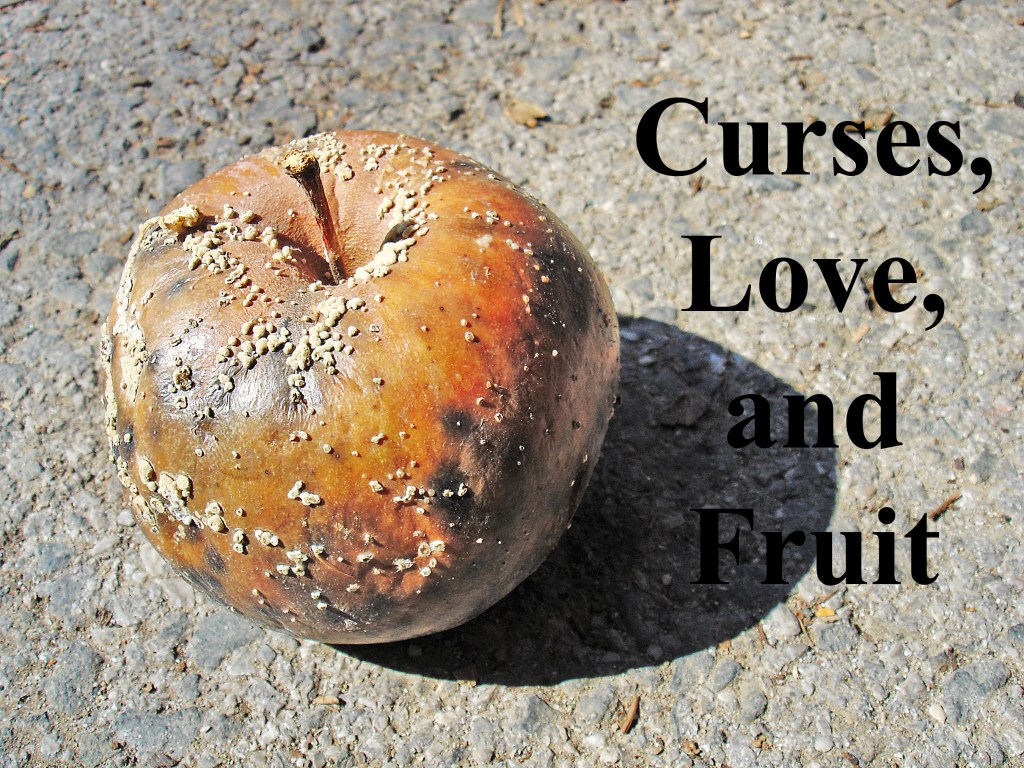
Curses, Love, and Fruit

Curses, Love, and Fruit

July 13, 2025*

By Pastor John Partridge

Amos 7:7-17               Luke 10:25-37                        Colossians 1:1-14

In the Gorge Metropark in Summit County, there is a hiking trail on which, midway through your hike, the trail diverges in two directions and, at the point where the two trails split, there is a sign that, at one time, simply pointed in each direction with the labels, Easy” and “Hard.” Such a sign was brutal in its honesty and efficiency. But while both paths eventually returned you to the trailhead and the parking lot, the harder of the two paths will take you past some incredible scenery and through house-sized (and larger) boulders that were scooped up in Canada during the last glacial period and deposited here as the glaciers melted.

Life is often like that. We often have choices to make that will cause our path in life to diverge and while some of those paths are easy, others are extraordinarily hard. At the same time the scenery, and often the destination of the two paths, can be vastly different. For example, choosing to quit your job so that you can go back to school or learn a trade so that you can get a job that pays better can be a lifechanging decision. Likewise, choosing to join the military so that you can escape from a neighborhood that is likely to pull you into a gang and trap you in poverty is a choice that can take you in a direction that is almost unimaginable to the friends that you leave behind. In contrast, Patti and I have met people in prison who, if you met them on the street, would seem no different that many of the people you know from church and around town, except for one bad choice that resulted in their incarceration. Some choices, good and bad, forever change the scenery and the destination of our lives.

And that is exactly what we find in our first scripture today. God’s prophets, specifically the prophet Amos, had warned Israel to follow the commands of God but, despite those warnings, Israel and her leaders had chosen another path. And so, as we join the story, we hear God explaining to Amos that Israel was about to be measured and tested according to God’s standards. We begin reading from Amos 7:7-17 where we hear this:

This is what he showed me: The Lord was standing by a wall that had been built true to plumb, with a plumb line in his hand. And the Lord asked me, “What do you see, Amos?”

“A plumb line,” I replied.

Then the Lord said, “Look, I am setting a plumb line among my people Israel; I will spare them no longer.

“The high places of Isaac will be destroyed
    and the sanctuaries of Israel will be ruined;
    with my sword I will rise against the house of Jeroboam.”

10 Then Amaziah the priest of Bethel sent a message to Jeroboam king of Israel: “Amos is raising a conspiracy against you in the very heart of Israel. The land cannot bear all his words. 11 For this is what Amos is saying:

“‘Jeroboam will die by the sword,
    and Israel will surely go into exile,
    away from their native land.’”

12 Then Amaziah said to Amos, “Get out, you seer! Go back to the land of Judah. Earn your bread there and do your prophesying there. 13 Don’t prophesy anymore at Bethel, because this is the king’s sanctuary and the temple of the kingdom.”

14 Amos answered Amaziah, “I was neither a prophet nor the son of a prophet, but I was a shepherd, and I also took care of sycamore-fig trees. 15 But the Lord took me from tending the flock and said to me, ‘Go, prophesy to my people Israel.’ 16 Now then, hear the word of the Lord. You say,

“‘Do not prophesy against Israel,
    and stop preaching against the descendants of Isaac.’

17 “Therefore, this is what the Lord says:

“‘Your wife will become a prostitute in the city,
    and your sons and daughters will fall by the sword.
Your land will be measured and divided up,
    and you yourself will die in a pagan country.
And Israel will surely go into exile,
    away from their native land.’”

As God speaks to the prophet Amos, he explains that after all the instructions and commands of God, after all the teaching and preaching, it is time for Israel to be measured the way that a builder measures his work during the construction of a building. God intends to measure his people and his nation and assess the results of all the teaching just as a builder uses a plumb line to measure the straightness of a wall. Worse, God already knows the results and, just as a builder will tear down a wall that isn’t straight, God intends to tear down his own nation and start over.

It is too late for warnings.

Bishop Hopkins once asked the East Ohio Conference, “Are we an institution? Or are we a movement?” As a church, our history, and our calling, is to be a movement, but it is all too easy to drift into institutionalism where all we want to do is to preserve the bureaucracies that we have built and forget that the entire purpose of the church’s existence is to reach the lost. In the story of Amos, we discover that this exact thing has happened to Israel. There has been lots of worship, there has been lots of teaching, and many priests have expended themselves in preserving the institution of the church, but the end result has been a people that follow the king and the church but do not follow God, act in the way that God has called his people to act, or love in the way that God has called his people to love.

It isn’t a surprise that the priests shout and tell Amos to shut up and go home because no one wants to hear the prophecies that he has brought. But that rejection of Amos and the message that he has brought, just results in God bringing a curse against Amaziah the priest and all of Israel that will take many of them into captivity in Babylon, or worse.

But if it is so easy, and common, for the church and its leadership to fall into the trap of preserving the institution, then what does it look like to understand and implement God’s message correctly? And for that, we only have to turn to Luke 10:25-37 where we hear one of Israel’s resident theologians ask Jesus that exact question.

25 On one occasion an expert in the law stood up to test Jesus. “Teacher,” he asked, “what must I do to inherit eternal life?”

26 “What is written in the Law?” he replied. “How do you read it?”

27 He answered, “‘Love the Lord your God with all your heart and with all your soul and with all your strength and with all your mind’; and, ‘Love your neighbor as yourself.’”

28 “You have answered correctly,” Jesus replied. “Do this and you will live.”

29 But he wanted to justify himself, so he asked Jesus, “And who is my neighbor?”

30 In reply Jesus said: “A man was going down from Jerusalem to Jericho, when he was attacked by robbers. They stripped him of his clothes, beat him, and went away, leaving him half dead. 31 A priest happened to be going down the same road, and when he saw the man, he passed by on the other side. 32 So too, a Levite, when he came to the place and saw him, passed by on the other side. 33 But a Samaritan, as he traveled, came where the man was; and when he saw him, he took pity on him. 34 He went to him and bandaged his wounds, pouring on oil and wine. Then he put the man on his own donkey, brought him to an inn, and took care of him. 35 The next day he took out two denarii and gave them to the innkeeper. ‘Look after him,’ he said, ‘and when I return, I will reimburse you for any extra expense you may have.’

36 “Which of these three do you think was a neighbor to the man who fell into the hands of robbers?”

37 The expert in the law replied, “The one who had mercy on him.”

Jesus told him, “Go and do likewise.”

When Jesus tells the religious scholar to love his neighbor, his immediate question is to wonder who it is that he should treat as a neighbor. What he is really asking is, what does real love look like? And the story that Jesus tells in reply is that our calling is to love, even the people who are foreign enemies of our people, or even more simply… everyone you can imagine is your neighbor. And that even includes the people that you were absolutely certain were not your neighbor.

But if that is what love really looks like, then what does it look like when the church gets it right? And for that, we find a fitting example in the church in Colossae, when Paul writes to compliment them in Colossians 1:1-14, where he says:

1:1 Paul, an apostle of Christ Jesus by the will of God, and Timothy our brother,

To God’s holy people in Colossae, the faithful brothers and sistersin Christ:

Grace and peace to you from God our Father.

We always thank God, the Father of our Lord Jesus Christ, when we pray for you, because we have heard of your faith in Christ Jesus and of the love you have for all God’s people— the faith and love that spring from the hope stored up for you in heaven and about which you have already heard in the true message of the gospel that has come to you. In the same way, the gospel is bearing fruit and growing throughout the whole world—just as it has been doing among you since the day you heard it and truly understood God’s grace. You learned it from Epaphras, our dear fellow servant, who is a faithful minister of Christ on ourbehalf, and who also told us of your love in the Spirit.

For this reason, since the day we heard about you, we have not stopped praying for you. We continually ask God to fill you with the knowledge of his will through all the wisdom and understanding that the Spirit gives, 10 so that you may live a life worthy of the Lord and please him in every way: bearing fruit in every good work, growing in the knowledge of God, 11 being strengthened with all power according to his glorious might so that you may have great endurance and patience, 12 and giving joyful thanks to the Father, who has qualified youto share in the inheritance of his holy people in the kingdom of light. 13 For he has rescued us from the dominion of darkness and brought us into the kingdom of the Son he loves, 14 in whom we have redemption, the forgiveness of sins.

Paul tells the people in the church of Colossae that others are talking about them and about their ministry, and that some of those kind words have even reached him where he is imprisoned in Rome. But what is it that people are talking about, and that Paul has heard, that allows him to know that the church has a strong faith? Quite simply, what Paul has heard, is that the church has love for all of God’s people. Moreover, because of what he has heard, he and his companions never stop praying for the church in Colossae and its people, and they encourage them to continue doing more of the things that they have already been doing.

It is notable at this point to highlight one more thing. Paul says that the people of the church can avoid the trap of preserving the institution and forgetting their kingdom mission. But, to do that, we must instead live a life that is worthy of God and bear fruit by doing good work. No, that’s wrong. Paul doesn’t say that we should just do good work.  He says that we should bear fruit by doing every good work.

As individuals and as the church, we have choices to make, and the best choices do not always take us down easy paths.

Bear fruit by doing every good work. That means, don’t just love some people, love all people. Don’t just love a little, love in abundance. Don’t just love ordinarily, love extravagantly.

Because the difference between preserving the institution and advancing the missional movement is found in who we love, and how much we love them. As Paul knew, in the end, the way that we bear fruit for the kingdom of God is to love all the people around us, and by doing every good work.


Please LIKE and SHARE!

Click here to subscribe to Pastor John’s blog.

Click here if you would like to subscribe to Pastor John’s weekly messages.

Click here to visit Pastor John’s YouTube channel.


*You have been reading a message presented at Christ United Methodist Church on the date noted at the top of the first page.  Rev. John Partridge is the pastor at Christ UMC in Alliance, Ohio.  Duplication of this message is a part of our Media ministry, if you have received a blessing in this way, we would love to hear from you.  Letters and donations in support of the Media ministry or any of our other projects may be sent to Christ United Methodist Church, 470 East Broadway Street, Alliance, Ohio 44601.  These messages are available to any interested persons regardless of membership.  You may subscribe to these messages, in print or electronic formats, by writing to the address noted, or by contacting us at secretary@CUMCAlliance.org.  These messages can also be found online at https://pastorpartridge.com .  All Scripture quotations, unless otherwise indicated, are taken from the Holy Bible, New International Version®, NIV®. Copyright ©1973, 1978, 1984, 2011 by Biblica, Inc.™ Used by permission of Zondervan. All rights reserved worldwide. www.zondervan.comThe “NIV” and “New International Version” are trademarks registered in the United States Patent and Trademark Office by Biblica, Inc.™

Photo by grceva on Freeimages.com

God’s Choice

God’s Choice

July 14, 2024*

By Pastor John Partridge

2 Samuel 6:1-5, 12b-19                     Mark 6:14-29                         Ephesians 1:3-14

What choices have you made so far today? It seems obvious to say that everyone here chose to wake up, get out of bed, get dressed, and come to church. Most of us also chose to take a shower, brush our teeth, and otherwise make ourselves presentable. But those are the easy choices.  We like to eat and have the money to pay for things, so we choose to go to work. But occasionally, at work, at home, and elsewhere, we must make harder choices. Do we go along with the crowd, do we follow our friends, even when what they are doing is not honoring to God? Do we stand up against our own political party, or our own church denomination, or our alumni association, or the club to which we’ve belonged for many years, when those groups choose a path that runs against the instructions of scripture? Or do we sometimes elevate our need to belong, or our allegiance to some organization, above our obedience to God and, in doing so, make it into an idol?

Our scriptures for today are dramatically different from one another and have little in common except that, in each one, the people in the story had to make choices, and the choices that they made defined them and revealed who they were at heart. We begin by returning once again to the story of David contained in 2 Samuel 6:1-5, 12b-19 in which, with Israel now unified and at peace, David and his army retrieve the Ark of the Covenant and bring it to Jerusalem.

6:1 David again brought together all the able young men of Israel—thirty thousand. He and all his men went to Baalahin Judah to bring up from there the ark of God, which is called by the Name, the name of the Lord Almighty, who is enthroned between the cherubim on the ark. They set the ark of God on a new cart and brought it from the house of Abinadab, which was on the hill. Uzzah and Ahio, sons of Abinadab, were guiding the new cart with the ark of God on it, and Ahio was walking in front of it. David and all Israel were celebrating with all their might before the Lord, with castanets, harps, lyres, timbrels, sistrums [an Egyptian shaker/rattle instrument] and cymbals.

So, David went to bring up the ark of God from the house of Obed-Edom to the City of David with rejoicing. 13 When those who were carrying the ark of the Lord had taken six steps, he sacrificed a bull and a fattened calf. 14 Wearing a linen ephod, David was dancing before the Lord with all his might, 15 while he and all Israel were bringing up the ark of the Lord with shouts and the sound of trumpets.

16 As the ark of the Lord was entering the City of David, Michal, the daughter of Saul, watched from a window. And when she saw King David leaping and dancing before the Lord, she despised him in her heart.

17 They brought the ark of the Lord and set it in its place inside the tent that David had pitched for it, and David sacrificed burnt offerings and fellowship offerings before the Lord. 18 After he had finished sacrificing the burnt offerings and fellowship offerings, he blessed the people in the name of the Lord Almighty. 19 Then he gave a loaf of bread, a cake of dates and a cake of raisins to each person in the whole crowd of Israelites, both men and women. And all the people went to their homes.

David had been anointed as king and had unified all twelve tribes of Israel. Together they had conquered the Jebusites and declared Jerusalem as the capitol of their unified nation. David had choices. He could do anything that he wanted to do, but among the first things that he does is to take his entire army, travel to Baalah in Judah, take possession of the Ark of the Covenant, and bring it, with much celebration, to their new home. But watching from a window was David’s wife, Michal, who was the daughter of King Saul. As she watched David singing, and dancing before God in celebration, she did not approve. To her, it was undignified for the king to sing and dance and act with joyful abandon in public. But David had made a choice. David could have built a palace, or set out to conquer his neighbors, or undertake projects that would make Israel, and him, richer. But David wanted to honor God first and chose obedience and faithfulness instead of wealth, power, prestige, or even dignity. David chose joy and thankfulness over appearances, respectability, and decorum. And it was those choices, among many others, that defined who David was, and revealed his heart to God and to the world.

In an entirely different story, of an entirely different sort of king, we read the story of king Herod Antipas and the death of John the Baptist in Mark 6:14-29. And in this story, like David, Herod makes some choices that defined him, and revealed his heart.

14 King Herod [Antipas who ruled over Galilee and Perea, the areas east of the Jordan River] heard about this, for Jesus’ name had become well known. Some were saying, “John the Baptist has been raised from the dead, and that is why miraculous powers are at work in him.”

15 Others said, “He is Elijah.”

And still others claimed, “He is a prophet, like one of the prophets of long ago.”

16 But when Herod heard this, he said, “John, whom I beheaded, has been raised from the dead!”

17 For Herod himself had given orders to have John arrested, and he had him bound and put in prison. He did this because of Herodias, his brother Philip’s wife, whom he had married. 18 For John had been saying to Herod, “It is not lawful for you to have your brother’s wife.” [Herod Philip who ruled over Ceasarea Phillip and the area north and west of Galilee] 19 So Herodias nursed a grudge against John and wanted to kill him. But she was not able to, 20 because Herod feared John and protected him, knowing him to be a righteous and holy man. When Herod heard John, he was greatly puzzled; yet he liked to listen to him.

21 Finally the opportune time came. On his birthday Herod gave a banquet for his high officials and military commanders and the leading men of Galilee. 22 When the daughter ofHerodias came in and danced, she pleased Herod and his dinner guests.

The king said to the girl, “Ask me for anything you want, and I’ll give it to you.” 23 And he promised her with an oath, “Whatever you ask I will give you, up to half my kingdom.”

24 She went out and said to her mother, “What shall I ask for?”

“The head of John the Baptist,” she answered.

25 At once the girl hurried in to the king with the request: “I want you to give me right now the head of John the Baptist on a platter.”

26 The king was greatly distressed, but because of his oaths and his dinner guests, he did not want to refuse her. 27 So he immediately sent an executioner with orders to bring John’s head. The man went, beheaded John in the prison, 28 and brought back his head on a platter. He presented it to the girl, and she gave it to her mother. 29 On hearing of this, John’s disciples came and took his body and laid it in a tomb.

Although Herod was distressed by the choice that he was forced to make because of the unwise oath that he had taken in front of his guests, rather than choosing what was right, he chose violence. Rather than choosing repentance and righteousness, Herod chose his reputation. For Herod, it was more important to look good than to be good.

And now we come to Paul’s letter to the church in Ephesus and the words of Ephesians 1:3-14, where Paul reminds us of what God chose. God’s choices were, and are, limitless. God is the creator of at least one universe and all that we know. God could do anything, but Paul reminds us that the choice God makes is utterly astounding and, as it did in the case of David and Herod, God’s choice reveals his heart. Paul says:

Praise be to the God and Father of our Lord Jesus Christ, who has blessed us in the heavenly realms with every spiritual blessing in Christ. For he chose us in him before the creation of the world to be holy and blameless in his sight. In love hepredestined us for adoption to sonshipthrough Jesus Christ, in accordance with his pleasure and will— to the praise of his glorious grace, which he has freely given us in the One he loves. In him we have redemption through his blood, the forgiveness of sins, in accordance with the riches of God’s grace that he lavished on us. With all wisdom and understanding, hemade known to us the mystery of his will according to his good pleasure, which he purposed in Christ, 10 to be put into effect when the times reach their fulfillment—to bring unity to all things in heaven and on earth under Christ.

11 In him we were also chosen, having been predestined according to the plan of him who works out everything in conformity with the purpose of his will, 12 in order that we, who were the first to put our hope in Christ, might be for the praise of his glory. 13 And you also were included in Christ when you heard the message of truth, the gospel of your salvation. When you believed, you were marked in him with a seal, the promised Holy Spirit, 14 who is a deposit guaranteeing our inheritance until the redemption of those who are God’s possession—to the praise of his glory.

As I said a moment ago, God’s choices were, and are, limitless, and Paul’s point is that with infinite power at his fingertips, God chose… us. Paul says that before the creation of the world, God intended for us to be holy and blameless and planned to adopt us into sonship. And it is worth a moment of explanation that the phrase that Paul uses, “adoption to sonship” isn’t just flowery or emotional language, it is a Greek legal term that describes a legal and binding adoption. God, through Jesus Christ, legally adopts us as his children, with all the rights of inheritance that implies, forgives our sins, and pours out his grace on us. Paul says that we were chosen to be a part of God’s plan to bring about the will of God. And, when we chose to believe, we were marked with the Holy Spirit as a deposit and downpayment of our future inheritance as God’s children.

When David became king, his choices revealed his heart and his character and, instead of choosing to pursue wealth, power, notoriety, or ego stroking building projects, David chose to make his first act an act of faithfulness, obedience, and joy.

In contrast, when asked for the head of John the Baptist, Herod Antipas chose violence and reputation over repentance and righteousness.

But God, the king of the universe, with infinite power to do whatever comes to his mind…

… chooses us. And not only does God choose us, but he also plans, in advance, even before creation, to make us holy and blameless through the sacrifice of his son Jesus Christ, and to legally adopt us as his heirs, as sons and daughters of the king. And just to be sure that that we know that he loves us, and see his intentions for us, God marks us with a seal, and leaves us with a deposit guaranteeing our inheritance, by sending the Holy Spirit to live with us, and in us.

David chose obedience.

Herod chose his reputation.

God… (pause) …chose us.

Like David, and like Herod, God’s choice reveals his heart and his character and leaves us with a choice.

Will we choose God, and follow him?

________________________________________________

Please LIKE and SHARE!

Click here to subscribe to Pastor John’s blog.

Click here if you would like to subscribe to Pastor John’s weekly messages.

Click here to visit Pastor John’s YouTube channel.


*You have been reading a message presented at Christ United Methodist Church on the date noted at the top of the first page.  Rev. John Partridge is the pastor at Christ UMC in Alliance, Ohio.  Duplication of this message is a part of our Media ministry, if you have received a blessing in this way, we would love to hear from you.  Letters and donations in support of the Media ministry or any of our other projects may be sent to Christ United Methodist Church, 470 East Broadway Street, Alliance, Ohio 44601.  These messages are available to any interested persons regardless of membership.  You may subscribe to these messages, in print or electronic formats, by writing to the address noted, or by contacting us at secretary@CUMCAlliance.org.  These messages can also be found online at https://pastorpartridge.com .  All Scripture quotations, unless otherwise indicated, are taken from the Holy Bible, New International Version®, NIV®. Copyright ©1973, 1978, 1984, 2011 by Biblica, Inc.™ Used by permission of Zondervan. All rights reserved worldwide. www.zondervan.comThe “NIV” and “New International Version” are trademarks registered in the United States Patent and Trademark Office by Biblica, Inc.™

Photo by Comstock on Freeimages.com

Life and Death Reversed

Click here to listen to the podcast

Click here to watch the livestream of this service: https://youtu.be/plQTN7ZhsS8


Life and Death Reversed

March 27, 2022*

By Pastor John Partridge

Joshua 5:9-12                         Luke 15:1-3, 11b-32              2 Corinthians 5:16-21

Some of you know may that we used to own a 1948 Farmall Cub tractor. I did not grow up in a home that worked on cars, motors, or machinery of any kind, and although my maternal grandfather was known to do be pretty handy, I didn’t learn any of those things from him. But with the arrival of that antique tractor, and a 1970’s era Cub Cadet, with not a lot of money, and a need to maintain our seven-acre mini-farm, I learned. I had all the manuals, I joined an online antique tractor forum, I asked lots of questions, and I learned. I got to the point where I split that tractor completely in half, replaced the clutch, and put it all back together.

There was still a lot that I didn’t, and don’t know, but I learned. And along the way, I gained an appreciation of the guys that could pull an abandoned piece of rusty iron out of a barn or a field, free a seized engine, sandblast the rust, replace, repair, renew, and eventually restore something that most people would see as a lost cause and transform it into a piece of art that looked like it just came off the showroom floor.

Now, on YouTube, I occasionally watch videos of people who rescue old tractors, bulldozers, and other things that have been left to rot away at the side of a road, out in the forest, field, desert, or other places. I love to watch shows like This Old House, and I’ve watched videos of a guy that bought an old missile silo and is transforming it into a home for his family. The transformation that happens as hopeless, discarded relics are restored so that they look and run as if they were new is nothing short of amazing.

And those are just machines and houses.

But what if we could do that for people?

What if lives could be rescued instead of tractors and houses?

And that’s the point of our message today as we begin in Joshua 5:9-12

Then the Lord said to Joshua, “Today I have rolled away the reproach of Egypt from you.” So, the place has been called Gilgal to this day. [Note: in Hebrew, Gilgal sounds like “roll”]

10 On the evening of the fourteenth day of the month, while camped at Gilgal on the plains of Jericho, the Israelites celebrated the Passover. 11 The day after the Passover, that very day, they ate some of the produce of the land: unleavened bread and roasted grain. 12 The manna stopped the day afterthey ate this food from the land; there was no longer any manna for the Israelites, but that year they ate the produce of Canaan.

For many of us, God’s word to Joshua hinges on the word “reproach.”  God says that he will roll away the reproach of Egypt for the people of Israel and, since “reproach” isn’t a word that we often use, many of us will read that and miss a good portion of the point. Reproach means criticism or disapproval. Egypt’s opinion of the Israelites was that they were “just slaves” and incapable of caring for themselves, that they needed overseers to guide them, direct them, and care for them even if their care was cruel, harsh, and unwanted. The Egyptians believed that the slaves who fled to freedom would surely wither away and die. But that wasn’t God’s plan. God brought the people to a place where they could plant and harvest crops and care for themselves. And on the day after Passover, the day after they started eating the food that they had harvested for themselves, God stopped providing food for them. God had finished his work of transforming them from slaves into a free people, and now he set them loose to care for themselves.

But in Luke 15:1-3, 11b-32, we read about an entirely different sort of transformation. In this story the transformation isn’t from slavery to freedom, but from ignorance to understanding.

15:1 Now the tax collectors and sinners were all gathering around to hear Jesus. But the Pharisees and the teachers of the law muttered, “This man welcomes sinners and eats with them.”

11 Jesus continued: “There was a man who had two sons. 12 The younger one said to his father, ‘Father, give me my share of the estate.’ So, he divided his property between them.

13 “Not long after that, the younger son got together all he had, set off for a distant country and there squandered his wealth in wild living. 14 After he had spent everything, there was a severe famine in that whole country, and he began to be in need. 15 So he went and hired himself out to a citizen of that country, who sent him to his fields to feed pigs. 16 He longed to fill his stomach with the pods that the pigs were eating, but no one gave him anything.

17 “When he came to his senses, he said, ‘How many of my father’s hired servants have food to spare, and here I am starving to death! 18 I will set out and go back to my father and say to him: Father, I have sinned against heaven and against you. 19 I am no longer worthy to be called your son; make me like one of your hired servants.’ 20 So he got up and went to his father.

“But while he was still a long way off, his father saw him and was filled with compassion for him; he ran to his son, threw his arms around him, and kissed him.

21 “The son said to him, ‘Father, I have sinned against heaven and against you. I am no longer worthy to be called your son.’

22 “But the father said to his servants, ‘Quick! Bring the best robe and put it on him. Put a ring on his finger and sandals on his feet. 23 Bring the fattened calf and kill it. Let’s have a feast and celebrate. 24 For this son of mine was dead and is alive again; he was lost and is found.’ So, they began to celebrate.

25 “Meanwhile, the older son was in the field. When he came near the house, he heard music and dancing. 26 So he called one of the servants and asked him what was going on. 27 ‘Your brother has come,’ he replied, ‘and your father has killed the fattened calf because he has him back safe and sound.’

28 “The older brother became angry and refused to go in. So, his father went out and pleaded with him. 29 But he answered his father, ‘Look! All these years I’ve been slaving for you and never disobeyed your orders. Yet you never gave me even a young goat so I could celebrate with my friends. 30 But when this son of yours who has squandered your property with prostitutes comes home, you kill the fattened calf for him!’

31 “‘My son,’ the father said, ‘you are always with me, and everything I have is yours. 32 But we had to celebrate and be glad, because this brother of yours was dead and is alive again; he was lost and is found.’”

The accusation against Jesus was that he was hanging out with, offering hospitality to, and even fraternizing with disreputable people who were enemy collaborators and outcasts. Sharing meals with people was seen as an act of intimacy that should only be enjoyed by your closest friends and it was shocking that Jesus would offer this level of inclusion and intimacy to people who were social pariahs.

And in reply to that sort of accusation, Jesus tells a story about a son who disrespected and dishonored his father, his family, and his community in every possible way. The son is so selfish and self-focused, that he says that he wished that his father was dead and wants to receive his inheritance now. This means that his father’s entire estate would be divided into thirds so that his older brother, as the firstborn, would receive two-thirds, and the younger one third.

But what he was demanding wasn’t just the money that he would, eventually, inherit, it represented his father’s security, his family honor, his retirement, and his assets that allowed him to care for his family, dependents, and employees. But not only did the son demand, and take, the money, he treated that money carelessly. He was shortsighted, thought of his present pleasure and comfort without any concern for the future. He did not plan and had no vision, and the price of his short-sightedness is that he ended up with nothing. No money, no home, no pride, and no purity. He ends up homeless, doing a job that no one else wanted, a Jew feeding religiously unclean pigs.

And in his misery, he realizes what he had given up and what he could have had if he had not been so selfish. He decides to beg for his father’s forgiveness and ask to hire him as a servant because he knew that what he had done was unforgivable. He understood that there was no hope of ever again finding acceptance as a family member, but even as a servant he would have food, clothing, and a place to live.

“And while he was still a long way off…” the father saw him. His father had been watching, waiting, and hoping that his son would one day return to him. There had been no word, no letters, no phone calls, no emails and for all that he knew, his son was dead. But, despite his hurt, disappointment, dishonor, and humiliation he still he watched the road and hoped that one day his son might return. And when he does, he casts aside propriety and does what no self-respecting eastern man would do, and he pulls up the hem of his robe like a little boy and he runs to put his arms around his son, he interrupts the prepared speech about being a servant, puts a ring on his finger, and welcomes him back into the family.  And, when the older son remains bitter, and complains, the father explains that relationships aren’t about money, but that there is joy in restoration and reconciliation.

And that is the same lesson that Paul teaches in 2 Corinthians 5:16-21 when he says:

16 So from now on we regard no one from a worldly point of view. Though we once regarded Christ in this way, we do so no longer. 17 Therefore, if anyone is in Christ, the new creation has come: The old has gone, the new is here! 18 All this is from God, who reconciled us to himself through Christ and gave us the ministry of reconciliation: 19 that God was reconciling the world to himself in Christ, not counting people’s sins against them. And he has committed to us the message of reconciliation. 20 We are therefore Christ’s ambassadors, as though God were making his appeal through us. We implore you on Christ’s behalf: Be reconciled to God. 21 God made him who had no sin to be sinfor us, so that in him we might become the righteousness of God.

Although he doesn’t mention it by name, Paul uses the imagery of Jesus’ parable of the lost son to explain how that story matters to the people of his church, and to us. Before we became his followers, we saw Jesus as someone who was a philosopher, preacher, and teacher. But as we chose to follow him, we are transformed. We are transformed in our opinions, attitudes, mind, body, and soul just as the lost son, in realizing what he had lost, suddenly gained more than he ever expected or imagined. When we became the followers of Jesus we became a new creation, death had been reversed, we were once dead, but are now alive. We are reconciled, renewed, restored, welcomed, included, and embraced into our new family as brothers and sister of Jesus Christ.

And that’s just the beginning because just as the lost son had to build a new life after his return to his family, our work begins when we come faith. Paul says that because we have been reconciled, we have all been given the message, mission, and ministry of reconciliation. We are sent into the world, as ambassadors of God’s kingdom, as if God were sharing his message through us. We cry out to the world to be reconciled to God, to realize what we lost because of our selfishness, to return to God, to his family, and be restored to life as a new creation.

You have to admit that restoring old pieces of unwanted, abandoned, and hopelessly rusted machines is an amazing process to watch. But rescuing and restoring unwanted, outcast, abandoned, and hopelessly lost people is way better.

God doesn’t send us to rescue the people around us because we’re good, or because we’re loyal.

God sends us to rescue the people around us because he once rescued us.


Did you enjoy this?

Please LIKE and SHARE!

Click here to subscribe to Pastor John’s blog.

Click here if you would like to subscribe to Pastor John’s weekly messages.

Click here to visit Pastor John’s YouTube channel.


*You have been reading a message presented at Christ United Methodist Church on the date noted at the top of the first page. Rev. John Partridge is the pastor at Christ UMC in Alliance, Ohio. Duplication of this message is a part of our Media ministry, if you have received a blessing in this way, we would love to hear from you. Letters and donations in support of the Media ministry or any of our other projects may be sent to Christ United Methodist Church, 470 East Broadway Street, Alliance, Ohio 44601. These messages are available to any interested persons regardless of membership. You may subscribe to these messages, in print or electronic formats, by writing to the address noted, or by contacting us at secretary@CUMCAlliance.org. If you have questions, you can ask them in our discussion forum on Facebook (search for Pastor John Online). These messages can also be found online at https://pastorpartridge.com . All Scripture references are from the New International Version unless otherwise noted.

God Was Not Pleased

Click here to listen to the podcast.

Click here to watch the livestream of this service: https://youtu.be/C5kj95Pq1Ho


God Was Not Pleased

March 20, 2022*

By Pastor John Partridge

Isaiah 55:1-9                           Luke 13:1-9                 1 Corinthians 10:1-13

Have you ever had a bad boss? 

Wherever we go, wherever we work, play, or volunteer, we learn things.  Sometimes we learn how to do things with excellence from good mentors, bosses, trainers, drill sergeants, coaches, pastors, and others.  But sometimes the lessons that we learned were lessons in how not to do things from some of those same kinds of people who did things badly.  In one of my military non-commissioned officer training courses, I had learned that a supervisor should never, ever, reprimand a subordinate in public and humiliate them.  Correction and reprimand should always be done as privately as possible.  But in my last engineering job, I witnessed several supervisors contribute to a semi-toxic work relationship by doing exactly that. 

While I learned that this was the wrong thing to do in the military, if I had any doubts about it, watching that negative example unfold in front of me, and seeing the fallout from it in employee retention and morale resolved those doubts forever.  If we’re smart, we learn from both good and bad examples.  We can learn how to do things, and how not to do things.

And, as we read the stories preserved for us in scripture, we see those same kinds of lessons, both good and bad.  There are examples for us to follow, and examples of how not to follow, things we should do and things we shouldn’t do.  In Isaiah 55:1-9, we hear God’s invitation to follow and a calling to become a part of the covenant that God made with King David, but also a reminder of our limitations.

55:1 “Come, all you who are thirsty,
    come to the waters;
and you who have no money,
    come, buy and eat!
Come, buy wine and milk
    without money and without cost.
Why spend money on what is not bread,
    and your labor on what does not satisfy?
Listen, listen to me, and eat what is good,
    and you will delight in the richest of fare.
Give ear and come to me;
    listen, that you may live.
I will make an everlasting covenant with you,
    my faithful love promised to David.
See, I have made him a witness to the peoples,
    a ruler and commander of the peoples.
Surely you will summon nations you know not,
    and nations you do not know will come running to you,
because of the Lord your God,
    the Holy One of Israel,
    for he has endowed you with splendor.”

Seek the Lord while he may be found;
    call on him while he is near.
Let the wicked forsake their ways
    and the unrighteous their thoughts.
Let them turn to the Lord, and he will have mercy on them,
    and to our God, for he will freely pardon.

“For my thoughts are not your thoughts,
    neither are your ways my ways,”
declares the Lord.
“As the heavens are higher than the earth,
    so are my ways higher than your ways
    and my thoughts than your thoughts.

God invites the world to come, drink from the water of life, to drink wine and milk, and to eat bread at no cost.  God asks why we spend our money and our time on things that do not, and cannot, satisfy us and invites us to listen to his teachings so that we might live.  God promises to make and eternal contract with his Messiah, Jesus, just as he did with David so that we can, like David, be an example, witness, and role model that will draw others to God.  Our calling is to seek God while we have the chance and to do what we can to encourage others to turn back to God. 

But is everything in life a sign from God?  Is everything that happens to us something that is sent to us, or caused by God?  Generally, no.  While God is involved in leading and guiding our actions and those of the people around us, God isn’t the cause of everything.  Random events happen, accidents happen, people make choices, both good and bad, God isn’t always the cause of those things, and that’s what Jesus tries to explain to the people in the story found in Luke 13:1-9.

13:1 Now there were some present at that time who told Jesus about the Galileans whose blood Pilate had mixed with their sacrifices. Jesus answered, “Do you think that these Galileans were worse sinners than all the other Galileans because they suffered this way? I tell you, no! But unless you repent, you too will all perish. Or those eighteen who died when the tower in Siloam fell on them—do you think they were more guilty than all the others living in Jerusalem? I tell you, no! But unless you repent, you too will all perish.”

Then he told this parable: “A man had a fig tree growing in his vineyard, and he went to look for fruit on it but did not find any. So he said to the man who took care of the vineyard, ‘For three years now I’ve been coming to look for fruit on this fig tree and haven’t found any. Cut it down! Why should it use up the soil?’

“‘Sir,’ the man replied, ‘leave it alone for one more year, and I’ll dig around it and fertilize it. If it bears fruit next year, fine! If not, then cut it down.’”

Pontius Pilate was a paranoid madman who, historians theorize may have been driven mad by the degenerative effects of brain damage from an advanced syphilis infection.  Pilate had murdered a group of Galilean worshippers as they brought sacrifices to God and people were speculating that God must have been punishing them for being terrible sinners.  But Jesus says no.  Everyone, Jesus says, is a sinner and everyone must repent of their sins before God, or we will all die.  The people who were murdered by Pilate, were not being punished for their sins by God, and nor were the people who were crushed when a tower collapsed.  Random things happen.  Accidents happen.  Jesus knew, as we’ve all seen in recent weeks, that crazy despotic leaders do crazy despotic things.  Death is coming for us all sooner or later.  But if we want to find ourselves on the right side of God’s judgement, we must repent of our sin, turn from our wicked ways, and do the best that we can to reproduce our faith and bear fruit for God.

In his first letter to the church in Corinth, Paul emphasizes the need for us to make good choices.  Some people can be given every opportunity to know the truth about God and still make poor choices.  He notes these examples in 1 Corinthians 10:1-13:

10:1 For I do not want you to be ignorant of the fact, brothers and sisters, that our ancestors were all under the cloud and that they all passed through the sea. They were all baptized into Moses in the cloud and in the sea. They all ate the same spiritual food and drank the same spiritual drink; for they drank from the spiritual rock that accompanied them, and that rock was Christ. Nevertheless, God was not pleased with most of them; their bodies were scattered in the wilderness.

Now these things occurred as examples to keep us from setting our hearts on evil things as they did. Do not be idolaters, as some of them were; as it is written: “The people sat down to eat and drink and got up to indulge in revelry.” We should not commit sexual immorality, as some of them did—and in one day twenty-three thousand of them died. We should not test Christ, as some of them did—and were killed by snakes. 10 And do not grumble, as some of them did—and were killed by the destroying angel.

11 These things happened to them as examples and were written down as warnings for us, on whom the culmination of the ages has come. 12 So, if you think you are standing firm, be careful that you don’t fall! 13 No temptationhas overtaken you except what is common to mankind. And God is faithful; he will not let you be temptedbeyond what you can bear. But when you are tempted, he will also provide a way out so that you can endure it.

Paul reminds his congregation that there were people who knew Moses, who were rescued by God from slavery in Egypt, who saw God’s presence in the cloud during the day and a pillar of light at night, who saw the Red Sea part and walked across its bottom, who ate the manna that God provided, who saw all the miracles, and who had every opportunity to follow God, but still God was not pleased with most of them.  Despite repeatedly seeing God and his miracles in person and despite having their entire lives transformed by the acts of God, they still did not have faith and chose to do evil, act immorally, to worship an idol in the form of a golden calf, and to complain about God and the food that he provided them.  And Paul says that these things happened as examples and warnings for us.  How often have we heard someone say that they would believe if only God would somehow reveal himself to them, and yet here were thousands of people who saw God, who saw God’s miracles, and experienced God in ways that most people can only dream about and still they fell away, made bad choices, and put their faith in other things.

But that doesn’t mean that we are without hope.  Paul says that while we must be careful not to fall away, and while temptation is common to every human being who has ever lived, God is faithful.  God will not allow you to be tempted beyond your ability to stand up against it, God will provide a path out of your temptation and, if you only take the time to ask, God will help you to endure.

Role models come is all shapes and sizes.  There are good role models, bad role models, good bosses, bad bosses, good examples, bad examples, models that we should follow, models that teach us what not to do, and examples that warn us of the consequences of making bad choices.  Years from now, when others look back on our lives, I pray that what they remember is not, “God was not pleased” but rather, that we are remembered for our faith and that God found joy in what we did.

But these things don’t happen in a vacuum.  Good bosses don’t happen by accident.  Good bosses made good choices and had good training and good mentors.  And like them, making good choices and strengthening our faith requires good role models and constant, thoughtful, preparation.

What will you do this week to strengthen and deepen your faith?

What will you do to draw closer to God?

What will you do to stand up against temptation?


Did you enjoy this?

Please LIKE and SHARE!

Click here to subscribe to Pastor John’s blog.

Click here if you would like to subscribe to Pastor John’s weekly messages.

Click here to visit Pastor John’s YouTube channel.


*You have been reading a message presented at Christ United Methodist Church on the date noted at the top of the first page.  Rev. John Partridge is the pastor at Christ UMC in Alliance, Ohio.  Duplication of this message is a part of our Media ministry, if you have received a blessing in this way, we would love to hear from you.  Letters and donations in support of the Media ministry or any of our other projects may be sent to Christ United Methodist Church, 470 East Broadway Street, Alliance, Ohio 44601.  These messages are available to any interested persons regardless of membership.  You may subscribe to these messages, in print or electronic formats, by writing to the address noted, or by contacting us at secretary@CUMCAlliance.org.  If you have questions, you can ask them in our discussion forum on Facebook (search for Pastor John Online).  These messages can also be found online at https://pastorpartridge.com .  All Scripture references are from the New International Version unless otherwise noted.

You Can’t Fix Stupid

Click here to listen

Click here to watch on YouTube: https://youtu.be/lKM-13q6Dg4

You Can’t Fix Stupid

September 12, 2021*

By Pastor John Partridge

Proverbs 1:20-33                   Mark 8:27-38             James 3:1-12

On August 4th, 1991, comic strip writer Jeff MacNelly, coined a phrase in his “Shoe” comic strip that has since passed into common usage across the nation and has been widely used in magazines, newspapers, movies, and at least one book title.  In that comic, newspaper editor “Shoe” calls downstairs to the press his press operator Eugene and says, “Yo, Eugene, how goes it down in the pressroom?”  and Eugene answers, “Horrid!  It’s your editorial page.  I can fix almost anything that runs on those presses… bit I can’t fix stupid.”

Some years later, in the movie “Forrest Gump,” the title character similarly says, “Stupid is as stupid does.”

Given the frequency with which most of us do stupid things, it isn’t surprising that someone would say these kinds of things.  The surprising thing is that it took this long for someone to say it, particularly since a similar sentiment is expressed by God in Proverbs 1:20-33.  You’re probably surprised, but I’m serious.  In this passage we hear wisdom speak as if it were a real person, and it begins this way:

20 Wisdom cries out in the street;
    in the squares she raises her voice.
21 At the busiest corner she cries out;
    at the entrance of the city gates she speaks:
22 “How long, O simple ones, will you love being simple?
How long will scoffers delight in their scoffing
    and fools hate knowledge?
23 Give heed to my reproof;
I will pour out my thoughts to you;
    I will make my words known to you.
24 Because I have called and you refused,
    have stretched out my hand and no one heeded,
25 and because you have ignored all my counsel
    and would have none of my reproof,
26 I also will laugh at your calamity;
    I will mock when panic strikes you,
27 when panic strikes you like a storm,
    and your calamity comes like a whirlwind,
    when distress and anguish come upon you.
28 Then they will call upon me, but I will not answer;
    they will seek me diligently, but will not find me.
29 Because they hated knowledge
    and did not choose the fear of the Lord,
30 would have none of my counsel,
    and despised all my reproof,
31 therefore they shall eat the fruit of their way
    and be sated with their own devices.
32 For waywardness kills the simple,
    and the complacency of fools destroys them;
33 but those who listen to me will be secure
    and will live at ease, without dread of disaster.”

Today we may say, “You can’t fix stupid” or “Stupid is as stupid does” but three thousand years ago God simply said, “How long will you love being stupid?”  God says that the skeptics delight too much in their skepticism and fools just hate knowledge but in doing so, all of them have ignored God’s advice and refused to hear God’s reprimands.  The result, God says, is that when the inevitable, but completely avoidable, disaster comes, and when they are up to their necks in alligators, in a full-fledged panic, and then call upon God to help them, God will not answer, and they will be utterly unable to find him.  God says that because they hated knowledge, and refused to listen to God’s advice, he will allow them to suffer the consequences of their stupidity. 

Apparently, even God can’t fix stupid.  Or, more correctly, God simply won’t fix stupid.

In Proverbs, a personified Wisdom declares that the people who ignore God’s instruction, advice, counsel, and reproof are simple, stubborn, and stupid and God warns that if we ignore him in this way, he will leave us to suffer the consequences of our actions because the calamities and disasters that we experience will have been completely avoidable.  But even though we think we’re doing better than that at listening to God’s instructions, Jesus reprimands Peter for something that is a lot easier for us to fail at doing.  In Mark 8:27-38, we hear this:

27 Jesus went on with his disciples to the villages of Caesarea Philippi; and on the way he asked his disciples, “Who do people say that I am?” 28 And they answered him, “John the Baptist; and others, Elijah; and still others, one of the prophets.” 29 He asked them, “But who do you say that I am?” Peter answered him, “You are the Messiah.” 30 And he sternly ordered them not to tell anyone about him.

31 Then he began to teach them that the Son of Man must undergo great suffering, and be rejected by the elders, the chief priests, and the scribes, and be killed, and after three days rise again. 32 He said all this quite openly. And Peter took him aside and began to rebuke him. 33 But turning and looking at his disciples, he rebuked Peter and said, “Get behind me, Satan! For you are setting your mind not on divine things but on human things.”

34 He called the crowd with his disciples, and said to them, “If any want to become my followers, let them deny themselves and take up their cross and follow me. 35 For those who want to save their life will lose it, and those who lose their life for my sake, and for the sake of the gospel, will save it. 36 For what will it profit them to gain the whole world and forfeit their life? 37 Indeed, what can they give in return for their life? 38 Those who are ashamed of me and of my words in this adulterous and sinful generation, of them the Son of Man will also be ashamed when he comes in the glory of his Father with the holy angels.”

While Jesus is traveling to the villages around Caesarea Philippi, or the area we now know as the Golan Heights, he has a discussion with his disciples about who the people say that he is, and who the disciples think that he is.  But as Jesus describes his upcoming trial, death, and resurrection, Peter tries to rebuke Jesus for being such a fatalist and for thinking such negative thoughts.  But Jesus not only rebukes Peter in return, but he flat-out calls him “Satan” for losing his focus on the things of God and thinking too much about earthly politics and power.

Twenty-one centuries later, losing our focus on the divine, and thinking too much about politics, power, and other earthly problems remains an astoundingly easy thing to do.   And in that case, Jesus’ advice to us is to commit everything that we have, our time, our money, and even our lives to the cause and the mission of God, his kingdom, and the Gospel of Jesus Christ. 

At the end of this passage, Jesus’ words echo those of Wisdom in Proverbs 1.  In Proverbs, Wisdom declares that God will leave those who ignored his teaching and correction to struggle without him through the disasters they could have avoided, and in Mark, Jesus declares that the people who abandon Jesus in this generation will be abandoned by God on the day of judgement.

But if the consistent message of God is that he will leave us in our time of trouble and abandon us on the day of judgement, then the message of scripture is hopeless and terrifying. 

But thank God, that’s not even a little bit true.

The message of scripture is quite the opposite.

In James 3:1-12, Jesus’ brother writes to the church and explains how we can make sure that these things never happen to us.  He says:

3:1 Not many of you should become teachers, my brothers and sisters, for you know that we who teach will be judged with greater strictness. For all of us make many mistakes. Anyone who makes no mistakes in speaking is perfect, able to keep the whole body in check with a bridle. If we put bits into the mouths of horses to make them obey us, we guide their whole bodies. Or look at ships: though they are so large that it takes strong winds to drive them, yet they are guided by a very small rudder wherever the will of the pilot directs. So also the tongue is a small member, yet it boasts of great exploits.

How great a forest is set ablaze by a small fire! And the tongue is a fire. The tongue is placed among our members as a world of iniquity; it stains the whole body, sets on fire the cycle of nature, and is itself set on fire by hell. For every species of beast and bird, of reptile and sea creature, can be tamed and has been tamed by the human species, but no one can tame the tongue—a restless evil, full of deadly poison. With it we bless the Lord and Father, and with it we curse those who are made in the likeness of God. 10 From the same mouth come blessing and cursing. My brothers and sisters, this ought not to be so. 11 Does a spring pour forth from the same opening both fresh and brackish water? 12 Can a fig tree, my brothers and sisters, yield olives, or a grapevine, figs? No more can saltwater yield fresh.

If I were to summarize James’ words as they apply to our message today, I would simply say that they mean…

Start small.

You don’t need to have a seminary degree.  You don’t need to read deep and difficult to understand treatises on theology, sociology, and morality.  You just need to start small.

Horses are huge, but they can be guided with a bridle and a bit that’s about the size of a pencil.  Ships are gigantic but they are guided by a rudder that is a tiny fraction of their size.  Fires can be incredibly destructive, but they get started by a tiny spark.  And if we want to get started doing the right thing, we need to start small and get control of our tongue.  And to do that, we need to take control of the choices that we make.

And that’s what all of this is about.  We all make choices.  We make hundreds, even thousands of choices every day.  We choose whether to brush our teeth, whether we will brush up and down, or from side to side.  We choose what clothes to wear, what shoes will be comfortable, what to eat for breakfast, how we want to make our coffee or tea, or other breakfast beverage, we make choices every waking moment of every day we walk the earth.  And among those choices are the words that come out of our mouths, and the things with which we will fill our hearts, our minds, and the very substance of our lives.  We get to choose whether we want to read the words of God.  We get to choose whether we listen to God’s instruction and advice.  And by making those choices, we will choose whether our spring is filled with salt water or fresh water, and whether the words that come out of our mouths are life giving.

In Proverbs, God says that he will pour out his thoughts, make his words known, call out to us, and stretch his hand out to catch us and to hold us.  But we still get to choose whether we will listen, hear, and obey.  We get to choose whether we will ignore God’s instruction and advice, but scripture is clear that making that choice… well…, is just stupid.

The message of scripture is clear about God’s incredible love and care for all his people, but we are free to ignore God.  We are free to ignore God’s instruction and advice, and we are free to live our lives without him.

But God’s reply is that if we stubbornly make those choices, God will allow us to be consumed by the consequences of those choices.

All that is required, is that we begin to make good choices.

Feel free to start small.

But be smart… and choose wisely.

Because there is a point after which…

…you can’t fix stupid.


*You have been reading a message presented at Christ United Methodist Church on the date noted at the top of the first page.  Rev. John Partridge is the pastor at Christ UMC in Alliance, Ohio.  Duplication of this message is a part of our Media ministry, if you have received a blessing in this way, we would love to hear from you.  Letters and donations in support of the Media ministry or any of our other projects may be sent to Christ United Methodist Church, 470 East Broadway Street, Alliance, Ohio 44601. These messages are available to any interested persons regardless of membership.  You may subscribe to these messages, in print or electronic formats, by writing to the address noted, or by contacting us at secretary@CUMCAlliance.org.  If you have questions, you can ask them in our discussion forum on Facebook (search for Pastor John Online).  These messages can also be found online at https://pastorpartridge.wordpress.com/. All Scripture references are from the New International Version unless otherwise noted.


Juggling Morality

Juggling Morality

(or, Schwarzenegger’s Choice)

January 17, 2021*

By Pastor John Partridge

1 Samuel 3:1-20                     John 1:43-51              1 Corinthians 6:12-20

In the Terminator movies with Arnold Schwarzenegger, there is a line of dialog, “Come with me if you want to live,” that has been repeated in nearly every movie in the series.  It became so well known and so repeated among fans that it was picked up and used, unaltered as well as adapted, in other movies, television shows, and video games from Supernatural, to the Teenage Mutant Ninja Turtles, to the Lego Movie, Finding Nemo, and even Casper (the friendly ghost).  In each scene, as well as the parodies, that line of dialog marks a moment of decision between two paths and is often a choice between life and death.  But even though there are no killer cybernetic robots from the future to be found anywhere in scripture, we do find those exact kinds of pivotal, life-changing, moments of decision when the people in the stories are faced with decisions that will change their lives forever.   The first of these that we find today is found in 1 Samuel 3:1-20, where both Eli the priest, and his young assistant Samuel, are each faced with choices that will change them, and all of Israel, forever.

3:1 The boy Samuel ministered before the Lord under Eli. In those days, the word of the Lord was rare; there were not many visions.

One night, Eli, whose eyes were becoming so weak that he could barely see, was lying down in his usual place. The lamp of God had not yet gone out, and Samuel was lying down in the house of the Lord, where the ark of God was. Then the Lord called Samuel.

Samuel answered, “Here I am.” And he ran to Eli and said, “Here I am. You called me.”

But Eli said, “I did not call; go back and lie down.” So, he went and lay down.

Again the Lord called, “Samuel!” And Samuel got up and went to Eli and said, “Here I am. You called me.”

“My son,” Eli said, “I did not call; go back and lie down.”

Now Samuel did not yet know the Lord: The word of the Lord had not yet been revealed to him.

A third time the Lord called, “Samuel!” And Samuel got up and went to Eli and said, “Here I am. You called me.”

Then Eli realized that the Lord was calling the boy. So Eli told Samuel, “Go and lie down, and if he calls you, say, ‘Speak, Lord, for your servant is listening.’” So, Samuel went and lay down in his place.

10 The Lord came and stood there, calling as at the other times, “Samuel! Samuel!”

Then Samuel said, “Speak, for your servant is listening.”

11 And the Lord said to Samuel: “See, I am about to do something in Israel that will make the ears of everyone who hears about it tingle. 12 At that time I will carry out against Eli everything I spoke against his family—from beginning to end. 13 For I told him that I would judge his family forever because of the sin he knew about; his sons blasphemed God, and he failed to restrain them. 14 Therefore I swore to the house of Eli, ‘The guilt of Eli’s house will never be atoned for by sacrifice or offering.’”

15 Samuel lay down until morning and then opened the doors of the house of the Lord. He was afraid to tell Eli the vision, 16 but Eli called him and said, “Samuel, my son.”

Samuel answered, “Here I am.”

17 “What was it he said to you?” Eli asked. “Do not hide it from me. May God deal with you, be it ever so severely, if you hide from me anything he told you.” 18 So Samuel told him everything, hiding nothing from him. Then Eli said, “He is the Lord; let him do what is good in his eyes.”

19 The Lord was with Samuel as he grew up, and he let none of Samuel’s words fall to the ground. 20 And all Israel from Dan to Beersheba recognized that Samuel was attested as a prophet of the Lord. 21 The Lord continued to appear at Shiloh, and there he revealed himself to Samuel through his word.

We understand this story better if we read the previous chapter of Samuel because, there we find that Eli’s sons are terrible priests who abuse those who come to worship under them, they steal from God, and they profane the sacrifices of God.  Eli knew what they were doing, and other than mildly admonishing them, did nothing.  Worse, God had already sent a message to Eli that his entire family would be judged, and his family line would come to an end, because of the behavior of his sons, and still, he did nothing.  In this story, God calls someone new.  God had earlier told Eli that if nothing changed, another priest would be raised up who would have the courage to speak the truth and here, God does exactly that as he calls to Samuel in the night.

I suspect that Eli knows exactly what God is doing when the boy Samuel comes to him, and he encourages Samuel to answer, to listen, and to be obedient.  And Samuel does exactly that.  Samuel chooses to listen to God and to obey him.  But Eli, despite God’s warnings, despite knowing that God was preparing judgement against him, still chooses to do nothing.  Eli chooses to ignore the sin of his sons and the injustices for which they were responsible.  Both Samuel and Eli chose between life and death.  Samuel chose to listen.  Eli chose not to listen.  Samuel chose obedience and life, while Eli chose disobedience and death.

And then, as Jesus begins to call his disciples to follow him, we hear this story in John 1:43-51:

43 The next day Jesus decided to leave for Galilee. Finding Philip, he said to him, “Follow me.”

44 Philip, like Andrew and Peter, was from the town of Bethsaida. 45 Philip found Nathanael and told him, “We have found the one Moses wrote about in the Law, and about whom the prophets also wrote—Jesus of Nazareth, the son of Joseph.”

46 “Nazareth! Can anything good come from there?” Nathanael asked.

“Come and see,” said Philip.

47 When Jesus saw Nathanael approaching, he said of him, “Here truly is an Israelite in whom there is no deceit.”

48 “How do you know me?” Nathanael asked.

Jesus answered, “I saw you while you were still under the fig tree before Philip called you.”

49 Then Nathanael declared, “Rabbi, you are the Son of God; you are the king of Israel.”

50 Jesus said, “You believebecause I told you I saw you under the fig tree. You will see greater things than that.” 51 He then added, “Very truly I tell you, youwill see ‘heaven open, and the angels of God ascending and descending on the Son of Man.”

Much like the call of Samuel by God, and through Philip’s introduction, Jesus calls Nathaniel to follow him. Nathaniel is, at first, skeptical that anything good could come from a hick town like Nazareth, but even before he has a chance to speak, Jesus knows everything about him, his honestly, his integrity, and even where he was sitting when Philip invited him to come with him to meet Jesus.  At this moment, Nathaniel had two choices, he could pretend that this was not incredible and impossible and go home and tell his friends that he had met Jesus.  Or he could choose to upend his entire life, leave his job and his family.  Nathaniel immediately recognizes that only the Messiah could do what Jesus had just done and makes the choice to follow Jesus regardless of the cost.

But what does that have to do with us?

If we have already chosen to follow Jesus, then why am I wasting my breath repeating these stories?

And the reason is simply that the choice of following Jesus is one that is in front of us every day and one that we must make many times over the course of each day and untold thousands of times each year.  In Paul’s letter to the church in Corinth (1 Corinthians 6:12-20), he explains it this way:

12 “I have the right to do anything,” you say—but not everything is beneficial. “I have the right to do anything”—but I will not be mastered by anything. 13 You say, “Food for the stomach and the stomach for food, and God will destroy them both.” The body, however, is not meant for sexual immorality but for the Lord, and the Lord for the body. 14 By his power God raised the Lord from the dead, and he will raise us also. 15 Do you not know that your bodies are members of Christ himself? Shall I then take the members of Christ and unite them with a prostitute? Never! 16 Do you not know that he who unites himself with a prostitute is one with her in body? For it is said, “The two will become one flesh.” 17 But whoever is united with the Lord is one with him in spirit.

18 Flee from sexual immorality. All other sins a person commits are outside the body, but whoever sins sexually, sins against their own body. 19 Do you not know that your bodies are temples of the Holy Spirit, who is in you, whom you have received from God? You are not your own; 20 you were bought at a price. Therefore, honor God with your bodies.

The argument that Paul was, apparently, hearing, was that since we are already forgiven by Jesus’ death and resurrection, then we can do whatever we want.  But, while Paul agrees that we are forgiven, he explains that we simply cannot do whatever we want, because not everything that can be done, should be done.  Or in other words, just because you can do something, doesn’t mean that doing so is a good thing. 

The argument that was used two thousand years ago, sounds almost identical to some of the arguments that we hear today.  In Corinth, the people said, “Food for the stomach and the stomach for food, and God will destroy them both.”  Or, in other words, I am hungry, so I eat.  But, in the end, both the food and my stomach will be buried and return to the dust from which they were created.  We hear almost the same things today when people rationalize their behaviors.  We hear “I was hungry, so I ate it.”  We hear, “I wanted it, so I bought it.” And we hear things like, “if it feels good do it,” and “the heart wants, what the heart wants.”  But not everything that our bodies want, and not everything that feels good, is good for us, and not everything is what God wants for us.

Paul says that we are thinking about it in the wrong way.  We ought not think that we can do whatever we want because we are already forgiven, we should, instead, remember that, as forgiven people, we have become, as the body of Christ, a part of Jesus and our sin, drags Jesus into the mud with us.  We would never dream of buying Jesus a hooker, or asking Jesus to participate in an extramarital affair, but that is exactly what we do when we sin.  Instead of saying, “if it feels good, do it,” we should flee and run far away from any sort of immorality and sin.  We are, Paul says, the temples of the Holy Spirit.  So, if you wouldn’t do something in church, you probably shouldn’t be doing it at all.  Because our lives were purchased on the cross, they belong to Jesus and not to us, so the way that we treat our bodies is a reflection on how we are treating God.

Every day, in a hundred ordinary decisions, we make choices about how to live our lives and how we will honor God.  Eli and Samuel made very different choices, and those choices carried them in vastly different directions.  Nathaniel gave up everything when he chose to follow Jesus, and his life was transformed because of it.

Like them, every day, we choose whether we will honor God.

And whether you hear it in Arnold Schwarzenegger’s voice or not, you can imagine Jesus saying…

… “Come with me, and live.”

It really is a choice between life and death.

What will you choose?


You can find the video of this worship service here: https://youtu.be/8kwXPODOLpc

Did you enjoy reading this?

Click here if you would like to subscribe to Pastor John’s weekly messages.

Click here to subscribe to Pastor John’s blog.

Click here to visit Pastor John’s YouTube channel.


*You have been reading a message presented at Christ United Methodist Church on the date noted at the top of the first page.  Rev. John Partridge is the pastor at Christ UMC in Alliance, Ohio.  Duplication of this message is a part of our Media ministry, if you have received a blessing in this way, we would love to hear from you.  Letters and donations in support of the Media ministry or any of our other projects may be sent to Christ United Methodist Church, 470 East Broadway Street, Alliance, Ohio 44601. These messages are available to any interested persons regardless of membership.  You may subscribe to these messages, in print or electronic formats, by writing to the address noted, or by contacting us at secretary@CUMCAlliance.org.  If you have questions, you can ask them in our discussion forum on Facebook (search for Pastor John Online).  These messages can also be found online at https://pastorpartridge.wordpress.com/. All Scripture references are from the New International Version unless otherwise noted.