
Religion that Misses the Point

Religion that Misses the Point

(Ash Wednesday)

February 14, 2024*

By Pastor John Partridge

Isaiah 58:1-12            Matthew 6:1-6, 16-21            2 Corinthians 5:20b-6:10

Scripture Readings

Isaiah 58:1-12

58:1 “Shout it aloud, do not hold back.
    Raise your voice like a trumpet.
Declare to my people their rebellion
    and to the descendants of Jacob their sins.
For day after day they seek me out;
    they seem eager to know my ways,
as if they were a nation that does what is right
    and has not forsaken the commands of its God.
They ask me for just decisions
    and seem eager for God to come near them.
‘Why have we fasted,’ they say,
    ‘and you have not seen it?
Why have we humbled ourselves,
    and you have not noticed?’

“Yet on the day of your fasting, you do as you please
    and exploit all your workers.
Your fasting ends in quarreling and strife,
    and in striking each other with wicked fists.
You cannot fast as you do today
    and expect your voice to be heard on high.
Is this the kind of fast I have chosen,
    only a day for people to humble themselves?
Is it only for bowing one’s head like a reed
    and for lying in sackcloth and ashes?
Is that what you call a fast,
    a day acceptable to the Lord?

“Is not this the kind of fasting I have chosen:
to loose the chains of injustice
    and untie the cords of the yoke,
to set the oppressed free
    and break every yoke?
Is it not to share your food with the hungry
    and to provide the poor wanderer with shelter—
when you see the naked, to clothe them,
    and not to turn away from your own flesh and blood?
Then your light will break forth like the dawn,
    and your healing will quickly appear;
then your righteousness will go before you,
    and the glory of the Lord will be your rear guard.
Then you will call, and the Lord will answer;
    you will cry for help, and he will say: Here am I.

“If you do away with the yoke of oppression,
    with the pointing finger and malicious talk,
10 and if you spend yourselves in behalf of the hungry
    and satisfy the needs of the oppressed,
then your light will rise in the darkness,
    and your night will become like the noonday.
11 The Lord will guide you always;
    he will satisfy your needs in a sun-scorched land
    and will strengthen your frame.
You will be like a well-watered garden,
    like a spring whose waters never fail.
12 Your people will rebuild the ancient ruins
    and will raise up the age-old foundations;
you will be called Repairer of Broken Walls,
    Restorer of Streets with Dwellings.

Matthew 6:1-6, 16-21

6:1 “Be careful not to practice your righteousness in front of others to be seen by them. If you do, you will have no reward from your Father in heaven.

“So when you give to the needy, do not announce it with trumpets, as the hypocrites do in the synagogues and on the streets, to be honored by others. Truly I tell you, they have received their reward in full. But when you give to the needy, do not let your left hand know what your right hand is doing, so that your giving may be in secret. Then your Father, who sees what is done in secret, will reward you.

“And when you pray, do not be like the hypocrites, for they love to pray standing in the synagogues and on the street corners to be seen by others. Truly I tell you, they have received their reward in full. But when you pray, go into your room, close the door, and pray to your Father, who is unseen. Then your Father, who sees what is done in secret, will reward you.

16 “When you fast, do not look somber as the hypocrites do, for they disfigure their faces to show others they are fasting. Truly I tell you, they have received their reward in full. 17 But when you fast, put oil on your head and wash your face, 18 so that it will not be obvious to others that you are fasting, but only to your Father, who is unseen; and your Father, who sees what is done in secret, will reward you.

19 “Do not store up for yourselves treasures on earth, where moths and vermin destroy, and where thieves break in and steal. 20 But store up for yourselves treasures in heaven, where moths and vermin do not destroy, and where thieves do not break in and steal. 21 For where your treasure is, there your heart will be also.

Religion: Missing the Point

In the scriptures that we heard a few moments ago, we heard God, through the prophet Isaiah, declare that his people were in rebellion against him because, while they came to church and seemed eager to know about God, they didn’t do the things that God had called them, and taught them, to do. The asked God for wisdom, fasted, and prayed, but refused his instructions by exploiting their workers, and fighting among themselves.

God declares that his people are in rebellion against him because their religion completely misses the point. Instead of fasting and giving up food, or other comforts, God wants his people to free the oppressed and overturn injustice. Rather than just giving up food and going hungry for a day, God wants his people to feed the hungry, provide shelter for the homeless, and clothe the naked. Instead of oppressing others, blaming others for your problems, and running people down with your words, spend your time feeding the hungry and helping to ease the burden of oppression. When God’s people do these things, then we begin to understand the point of our religion, only then will people begin to see the light of God in us, and it is then that God will begin to bless his people and grow his church.

We find a good example of how things should be done in the words of the Apostle Paul to the church in Corinth in 2 Corinthians 5:20b-6:10, when he says:

We implore you on Christ’s behalf: Be reconciled to God. 21 God made him who had no sin to be sinfor us, so that in him we might become the righteousness of God.

6:1 As God’s co-workers we urge you not to receive God’s grace in vain. For he says,

“In the time of my favor I heard you,
    and in the day of salvation I helped you.”

I tell you, now is the time of God’s favor, now is the day of salvation.

We put no stumbling block in anyone’s path, so that our ministry will not be discredited. Rather, as servants of God we commend ourselves in every way: in great endurance; in troubles, hardships and distresses; in beatings, imprisonments and riots; in hard work, sleepless nights and hunger; in purity, understanding, patience and kindness; in the Holy Spirit and in sincere love; in truthful speech and in the power of God; with weapons of righteousness in the right hand and in the left; through glory and dishonor, bad report and good report; genuine, yet regarded as impostors; known, yet regarded as unknown; dying, and yet we live on; beaten, and yet not killed; 10 sorrowful, yet always rejoicing; poor, yet making many rich; having nothing, and yet possessing everything.

Paul declares that he, his missionary team, and those supporting them in ministry in Corinth, did everything that they could to bring people to faith without stumbling over any hypocrisy in the way that they lived their lives. They endured trouble, hardship and distress, beatings, imprisonment, riots, hard work, lack of sleep, and hunger, while living a life of purity and having an attitude that expressed understanding, patience, kindness, and love toward the people around them. Even when they were falsely accused, when they suffered for their beliefs and for their ministry, they rejoiced in sharing the good news of Jesus Christ with others.

In short, they lived, and they loved, as if the teachings of scripture, and the words of Jesus Christ mattered. Unlike the people that Isaiah was rebuking, they did not just show up on Sunday morning and abuse their employees on Sunday afternoon. They didn’t tell people how great their church was, and then argue and fight with one another.

Although today is the day that we wear ashes on our forehead, and enter the season when people choose to fast from one thing or another, remember that these things are only a reminder. They are a reminder that we should never practice a religion that misses the point. They are a reminder that what God really wants, isn’t ashes and fasting from food, what God really wants for his people to feed the hungry, provide shelter for the homeless, clothe the naked, and fight against oppression and injustice.

What God really wants is obedience…. and love.


Please LIKE and SHARE!

Click here to subscribe to Pastor John’s blog.

Click here if you would like to subscribe to Pastor John’s weekly messages.

Click here to visit Pastor John’s YouTube channel.


*You have been reading a message presented at Christ United Methodist Church on the date noted at the top of the first page.  Rev. John Partridge is the pastor at Christ UMC in Alliance, Ohio.  Duplication of this message is a part of our Media ministry, if you have received a blessing in this way, we would love to hear from you.  Letters and donations in support of the Media ministry or any of our other projects may be sent to Christ United Methodist Church, 470 East Broadway Street, Alliance, Ohio 44601.  These messages are available to any interested persons regardless of membership.  You may subscribe to these messages, in print or electronic formats, by writing to the address noted, or by contacting us at secretary@CUMCAlliance.org.  These messages can also be found online at https://pastorpartridge.com .  All Scripture quotations, unless otherwise indicated, are taken from the Holy Bible, New International Version®, NIV®. Copyright ©1973, 1978, 1984, 2011 by Biblica, Inc.™ Used by permission of Zondervan. All rights reserved worldwide. www.zondervan.comThe “NIV” and “New International Version” are trademarks registered in the United States Patent and Trademark Office by Biblica, Inc.™

Unexpected People in Heaven

Mystery Explained!

(or Unexpected People in Heaven)

January 07, 2024*

By Pastor John Partridge

Isaiah 60:1-6              Matthew 2:1-12                     Ephesians 3:1-12

Whether it’s reading Sherlock Holmes and Agatha Christie, or watching NCIS and FBI dramas on television, many of us enjoy a good mystery. Since Patti spends much more time in her car than I do, she regularly listens to audio books, and whenever I go with her, she is always listening to a mystery of some kind. Good authors keep us guessing. What will happen next? What plot twist lies in store for us? Among the many characters that we’ve met, who is the perpetrator of the crime in question?

It’s just our human nature to be curious, and for our curiosity to be inspired by a good mystery story. But whatever it is, we look forward to the end of the book, movie, or television drama where all is revealed, and the mystery is solved. And that’s the part of the biblical story that we will dig into today, it is the moment that Paul proclaims the mystery “has now been revealed by the Spirit to God’s holy apostles and prophets,” and of course, to us. But before we get to the big reveal, let’s dig into the back story and understand some of the history of the mystery. Let’s begin with the prophecy and promise contained in Isaiah 60:1-6 where we hear this message:

60:1 “Arise, shine, for your light has come,
    and the glory of the Lord rises upon you.
See, darkness covers the earth
    and thick darkness is over the peoples,
but the Lord rises upon you
    and his glory appears over you.
Nations will come to your light,
    and kings to the brightness of your dawn.

“Lift up your eyes and look about you:
    All assemble and come to you;
your sons come from afar,
    and your daughters are carried on the hip.
Then you will look and be radiant,
    your heart will throb and swell with joy;
the wealth on the seas will be brought to you,
    to you the riches of the nations will come.
Herds of camels will cover your land,
    young camels of Midian and Ephah.
And all from Sheba will come,
    bearing gold and incense
    and proclaiming the praise of the Lord.

Through Isaiah, God tells of a coming day when the Lord’s rising will overcome the darkness of the human soul in the same way that the sun overcomes the darkness of night. And on that day the people of Israel will return from the four corners of the earth to which they had migrated, Israel will be filled with wealth, symbolized here by camels, and all who come will bring gold, incense, and other gifts that would be fit for a king.

And then, as we anticipate the celebration Epiphany, we hear of the coming of the Wise Men and we hear how their coming echoes the prophecies of Isaiah. They come to Israel from afar bearing gifts of gold and incense and, as we hear that echo, we understand how much else of Isaiah’s prophecy is being fulfilled. A light has come into the darkness of the world and into the darkness of the souls of humanity.

Reading from Matthew 2:1-12, we hear these words:

2:1 After Jesus was born in Bethlehem in Judea, during the time of King Herod, Magifrom the east came to Jerusalem and asked, “Where is the one who has been born king of the Jews? We saw his star when it rose and have come to worship him.”

When King Herod heard this he was disturbed, and all Jerusalem with him. When he had called together all the people’s chief priests and teachers of the law, he asked them where the Messiah was to be born. “In Bethlehem in Judea,” they replied, “for this is what the prophet has written:

“‘But you, Bethlehem, in the land of Judah,
    are by no means least among the rulers of Judah;
for out of you will come a ruler
    who will shepherd my people Israel.’”

Then Herod called the Magi secretly and found out from them the exact time the star had appeared. He sent them to Bethlehem and said, “Go and search carefully for the child. As soon as you find him, report to me, so that I too may go and worship him.”

After they had heard the king, they went on their way, and the star they had seen when it rose went ahead of them until it stopped over the place where the child was. 10 When they saw the star, they were overjoyed. 11 On coming to the house, they saw the child with his mother Mary, and they bowed down and worshiped him. Then they opened their treasures and presented him with gifts of gold, frankincense, and myrrh. 12 And having been warned in a dream not to go back to Herod, they returned to their country by another route.

We’ve lost count of the times, and the Christmases, that we have read, and heard this story. We know the story of the magi. But where is the mystery in that? The mystery is found in the “why.” These men were not Jews and so, why did they come? They were not Jewish, they did not share the faith of Mary and Joseph or the nation of Israel, and yet they worshipped the baby in a manger.  Moreover, they were not the first to present this puzzle. In 2 Kings 5, Naaman, the great military commander of the nation of Aram came to Israel to be healed of his leprosy and, after God healed him, he asked the prophet Elisha,, “please let me, your servant, be given as much earth as a pair of mules can carry, for your servant will never again make burnt offerings and sacrifices to any other god but the Lord.

Before that, the prophet Elijah fed the widow of Zarephath with a miraculously never-ending supply of oil and flour during a famine. And of course, there was the prostitute who hid the spies in Jericho, and Ruth who followed her mother-in-law Naomi, married Boaz, and became the great-grandmother of King David. And long before that, we know that not everyone who fled slavery in Egypt were from Abraham’s family, but all of them, of every race and nationality, became known as the children of Israel. All of these were Gentiles. They were not the children of Abraham; they were not born into the covenant of Abraham, they were not a part of God’s contract with Abraham, and they did not inherit the promise that God had made to Abraham’s descendants. And so how is it that they could have faith in Israel’s God? How is it that God would accept them?

And, like the end of our modern-day detective stories, that is exactly the mystery that Paul reveals as he writes to the church in Ephesus in Ephesians 3:1-12, saying:

3:1 For this reason I, Paul, the prisoner of Christ Jesus for the sake of you Gentiles—

Surely you have heard about the administration of God’s grace that was given to me for you, 3that is, the mystery made known to me by revelation, as I have already written briefly. In reading this, then, you will be able to understand my insight into the mystery of Christ, 5which was not made known to people in other generations as it has now been revealed by the Spirit to God’s holy apostles and prophets. This mystery is that through the gospel the Gentiles are heirs together with Israel, members together of one body, and sharers together in the promise in Christ Jesus.

I became a servant of this gospel by the gift of God’s grace given me through the working of his power. Although I am less than the least of all the Lord’s people, this grace was given me: to preach to the Gentiles the boundless riches of Christ, and to make plain to everyone the administration of this mystery, which for ages past was kept hidden in God, who created all things. 10 His intent was that now, through the church, the manifold wisdom of God should be made known to the rulers and authorities in the heavenly realms, 11according to his eternal purpose that he accomplished in Christ Jesus our Lord. 12 In him and through faith in him we may approach God with freedom and confidence.

The mystery, as Paul explains it, and as we have already discussed, is how God could love Gentiles and invite them into his family. Even in the Old Testament there were occasional examples that, despite having made an eternal covenant with Abraham and his descendants, and those who later became the people of Israel, there were hints that God loved Gentiles and would accept them into his family. But now, through the story of the gospel, through the life, death, and resurrection of Jesus Christ, the Gentiles are invited into God’s family, adopted by the creator and king of all that exists, and are now heirs, together with Israel, members of one body, and together with the people of Israel and Abraham’s family, share in the promises of Jesus Christ.

That’s the big reveal. That God has always loved the Gentiles, that the Gentiles were always welcome to join his people, and that God always had a plan to invite the entire world into his family. But now that the mystery has been revealed, God’s plan to rescue the world includes us, the church. Paul says that God’s intent, God’s plan, is for the church to spread his word, to act as God’s agents in the world and to tell the rulers, the authorities, our neighbors, our friends, and the entire world the story of the gospel, the message and the Good News of Jesus Christ, and to invite them all to join God’s family. Because, as Paul said, “in him, and through faith in him, we may approach God with freedom and confidence.

God commands us to share the story, and to spread the Good News. But it is a story that’s worth sharing because it’s our story.


Please LIKE and SHARE!

Click here to subscribe to Pastor John’s blog.

Click here if you would like to subscribe to Pastor John’s weekly messages.

Click here to visit Pastor John’s YouTube channel.


*You have been reading a message presented at Christ United Methodist Church on the date noted at the top of the first page.  Rev. John Partridge is the pastor at Christ UMC in Alliance, Ohio.  Duplication of this message is a part of our Media ministry, if you have received a blessing in this way, we would love to hear from you.  Letters and donations in support of the Media ministry or any of our other projects may be sent to Christ United Methodist Church, 470 East Broadway Street, Alliance, Ohio 44601.  These messages are available to any interested persons regardless of membership.  You may subscribe to these messages, in print or electronic formats, by writing to the address noted, or by contacting us at secretary@CUMCAlliance.org.  These messages can also be found online at https://pastorpartridge.com .  All Scripture quotations, unless otherwise indicated, are taken from the Holy Bible, New International Version®, NIV®. Copyright ©1973, 1978, 1984, 2011 by Biblica, Inc.™ Used by permission of Zondervan. All rights reserved worldwide. www.zondervan.comThe “NIV” and “New International Version” are trademarks registered in the United States Patent and Trademark Office by Biblica, Inc.™ Photo by user carlohh on Freeimages dot com.

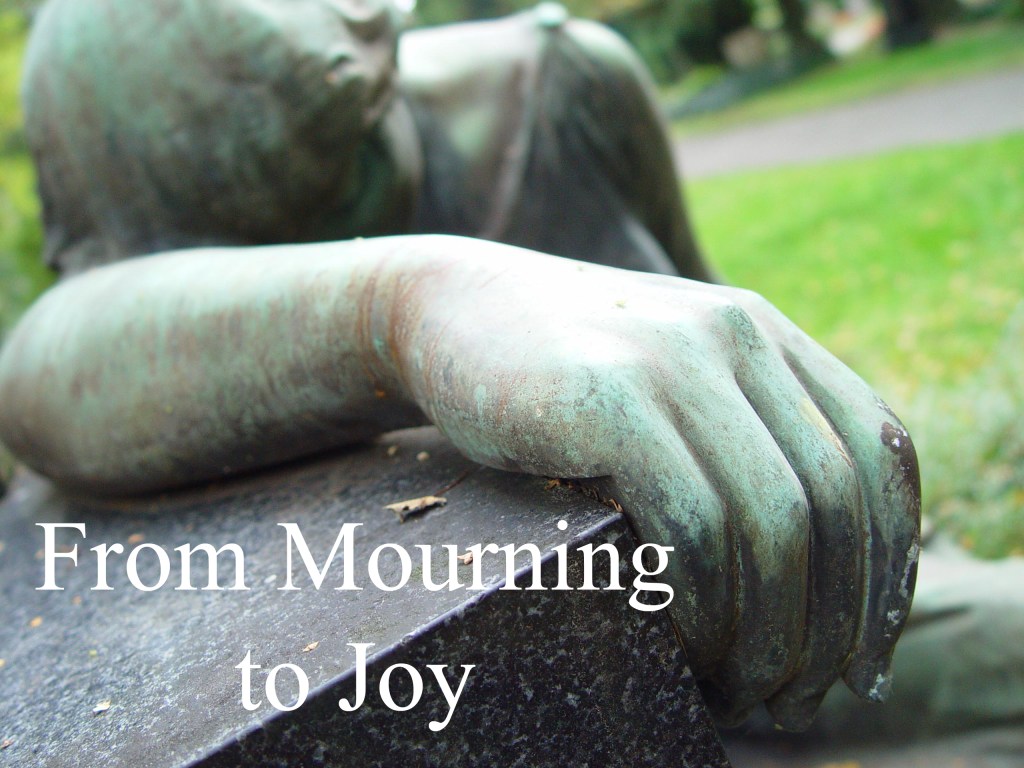
From Mourning to Joy

From Mourning to Joy

December 17, 2023*

By Pastor John Partridge

Isaiah 61:1-4, 8-11                 John 1:6-8, 19-28                          1 Thessalonians 5:16-24

On June second of 2022, seventeen-year-old Ethan Liming, the son of United Methodist Pastor Bill Liming, was beaten to death during an altercation at a basketball court in downtown Akron. This week we were notified that another of our East Ohio Conference colleagues, Beth Wilterdink, with whom Mike Greiner and I have served on the conference committee on camps and retreats, is mourning, with her husband and family, the loss of their barely two-year-old daughter Cora. I can read about these things, but I can’t begin to understand the pain and the grief that these families must feel.

But many of us have experienced our own kinds of loss. Some of you have lost children, many of us have lost parents or siblings. We each understand grief in our own way. And so, we have some insight into the lives of the people who heard God’s message through his prophet Isaiah. These were the people who had lost everything. They had lost sons, daughters, husbands, wives, brothers, sisters, parents, and grandparents, they had lost their nation and their freedom and had been carried off into captivity in Babylon. They were filled with grief. But God speaks to them through the writings of Isaiah and tells them that in the midst of their grief, there is good news. We hear these words in Isaiah 61:1-4, 8-11…

61:1 The Spirit of the Sovereign Lord is on me, because the Lord has anointed me
    to proclaim good news to the poor.
He has sent me to bind up the brokenhearted, to proclaim freedom for the captives
    and release from darkness for the prisoners,
to proclaim the year of the Lord’s favor and the day of vengeance of our God,
to comfort all who mourn,
    and provide for those who grieve in Zion— to bestow on them a crown of beauty
    instead of ashes, the oil of joy instead of mourning, and a garment of praise
    instead of a spirit of despair.
They will be called oaks of righteousness, a planting of the Lord for the display of his splendor.

They will rebuild the ancient ruins and restore the places long devastated;
they will renew the ruined cities that have been devastated for generations.

“For I, the Lord, love justice;I hate robbery and wrongdoing.
In my faithfulness I will reward my people and make an everlasting covenant with them.
Their descendants will be known among the nations and their offspring among the peoples.
All who see them will acknowledge that they are a people the Lord has blessed.”

10 I delight greatly in the Lord;my soul rejoices in my God.
For he has clothed me with garments of salvation and arrayed me in a robe of his righteousness,
as a bridegroom adorns his head like a priest, and as a bride adorns herself with her jewels.
11 For as the soil makes the sprout come up and a garden causes seeds to grow,
so the Sovereign Lord will make righteousness and praise spring up before all nations.

God says that there will be healing for the brokenhearted, release for prisoners, comfort for those who mourn, and God promises to transform the ashes of their grief into a crown of beauty. God promises to rebuild, restore, and renew, and to bring justice and faithfulness to replace their despair and loss. And in the end, God will use the nations of the world to raise up gardens of righteousness and praise.

In no way does God, or Isaiah, diminish the pain, loss, and grief that we experience today, God does not tell us to “get over it,” but God does promise that he will, one day, transform our grief into joy.

But, because John the Baptist had been quoting from the words of Isaiah, the priests and the leaders of Israel came out to the wilderness in John 1:6-8, 19-28 to ask if he was a resurrected Isaiah that God had sent to fulfill the promises that had been written so long ago.

There was a man sent from God whose name was John. He came as a witness to testify concerning that light, so that through him all might believe. He himself was not the light; he came only as a witness to the light.

19 Now this was John’s testimony when the Jewish leaders in Jerusalem sent priests and Levites to ask him who he was. 20 He did not fail to confess, but confessed freely, “I am not the Messiah.”

21 They asked him, “Then who are you? Are you Elijah?”

He said, “I am not.”

“Are you the Prophet?”

He answered, “No.”

22 Finally they said, “Who are you? Give us an answer to take back to those who sent us. What do you say about yourself?”

23 John replied in the words of Isaiah the prophet, “I am the voice of one calling in the wilderness, ‘Make straight the way for the Lord.’”

24 Now the Pharisees who had been sent 25 questioned him, “Why then do you baptize if you are not the Messiah, nor Elijah, nor the Prophet?”

26 “I baptize with water,” John replied, “but among you stands one you do not know. 27 He is the one who comes after me, the straps of whose sandals I am not worthy to untie.”

28 This all happened at Bethany on the other side of the Jordan, where John was baptizing.

But John says that he is not Isaiah, nor is he Elijah, nor is he the promised messiah. Instead, he has come to point to the Messiah, to announce his arrival, and to proclaim the fulfillment of God’s promises in Isaiah in the person of Jesus Christ.

But, knowing that Jesus is the Messiah, as we do, what does that mean for us today? What does that tell us about our grief, and our pain, and how we are to live our lives in the twenty-first century? In his letter to the church in Thessalonica, contained in 1 Thessalonians 5:16-24, Paul says this:

16 Rejoice always, 17 pray continually, 18 give thanks in all circumstances; for this is God’s will for you in Christ Jesus.

19 Do not quench the Spirit. 20 Do not treat prophecies with contempt 21 but test them all; hold on to what is good, 22 reject every kind of evil.

23 May God himself, the God of peace, sanctify you through and through. May your whole spirit, soul and body be kept blameless at the coming of our Lord Jesus Christ. 24 The one who calls you is faithful, and he will do it.

Paul says that God’s will for us is to live in anticipation of God’s final and ultimate victory. We are to live as if Christ has already returned, and God has already fulfilled his promises of rescue, rebuilding, restoration, renewal, and transformation. Rejoice always, pray continually, give thanks in all circumstances, test the prophecies of God to prove their truthfulness, reject every kind of evil, but hold on to all that is good.

In this world, we know that we will experience suffering, pain, grief, and death.

But one day God will transform our mourning into joy.

Until then…

…reject every kind of evil and…

                                    …hold on to what is good.


Please LIKE and SHARE!

Click here to subscribe to Pastor John’s blog.

Click here if you would like to subscribe to Pastor John’s weekly messages.

Click here to visit Pastor John’s YouTube channel.


*You have been reading a message presented at Christ United Methodist Church on the date noted at the top of the first page.  Rev. John Partridge is the pastor at Christ UMC in Alliance, Ohio.  Duplication of this message is a part of our Media ministry, if you have received a blessing in this way, we would love to hear from you.  Letters and donations in support of the Media ministry or any of our other projects may be sent to Christ United Methodist Church, 470 East Broadway Street, Alliance, Ohio 44601.  These messages are available to any interested persons regardless of membership.  You may subscribe to these messages, in print or electronic formats, by writing to the address noted, or by contacting us at secretary@CUMCAlliance.org.  These messages can also be found online at https://pastorpartridge.com .  All Scripture quotations, unless otherwise indicated, are taken from the Holy Bible, New International Version®, NIV®. Copyright ©1973, 1978, 1984, 2011 by Biblica, Inc.™ Used by permission of Zondervan. All rights reserved worldwide. www.zondervan.comThe “NIV” and “New International Version” are trademarks registered in the United States Patent and Trademark Office by Biblica, Inc.™

Neighbors Know?

Neighbors Know?

January 22, 2023*

By Pastor John Partridge

Isaiah 9:1-4                Matthew 4:12-23                   1 Corinthians 1:10-18

Patti and I have a friend who was once talking to his next-door neighbor on his phone while searching for a particular kitchen gadget.  His neighbor, looking out her kitchen window, which window was opposite his kitchen window, and only six or eight feet away, told him, on the phone, in which drawer he would find the thing for which he was looking.  Yikes.  Our friend and his wife bought a curtain for their kitchen window the very next day and they moved to a suburban neighborhood with much larger lots as soon as they were financially able to do so.

Obviously, that’s an unusual occurrence, but few of us could argue that our neighbors probably know things about us that few other people know.  They see us come and go, they know our schedules, they know when lights in certain rooms typically are turned on and off, they notice when we aren’t home and when our schedules change from our normal habits.  I am almost certain that many of your neighbors know that you are here this morning and that you typically go to church on Sunday mornings because they’ve seen you leave and return, and probably noticed that you were dressed for the occasion.  But what else have your neighbors noticed?  That’s a loaded question that I want you to think about while we consider our scriptures for this morning.  We begin in Isaiah 9:1-4, where we hear God’s prophet share yet another prophecy about the future messiah.

9:1 Nevertheless, there will be no more gloom for those who were in distress. In the past he humbled the land of Zebulun and the land of Naphtali, but in the future, he will honor Galilee of the nations, by the Way of the Sea, beyond the Jordan—

The people walking in darkness have seen a great light;
on those living in the land of deep darkness
    a light has dawned.
You have enlarged the nation and increased their joy;
they rejoice before you as people rejoice at the harvest,
as warriors rejoice when dividing the plunder.
For as in the day of Midian’s defeat, you have shattered
the yoke that burdens them, the bar across their shoulders,
    the rod of their oppressor.

In a moment, we will hear many of these same words reflected in the gospel of Matthew, but before we do, notice that God says that the messiah’s arrival will be as if the sun had dawned on a dark and dreary world. Light would come to darkness, joy would come to sadness, enemies would be shattered, oppression would be thrown off, and burdens would be lifted.  And by quoting extensively from that passage in Isaiah, Matthew proclaims that Jesus was that messiah, that the new day Isaiah spoke of had finally dawned, that the light had come, and that the future was already looking brighter.  Matthew 4:12-23 says,

12 When Jesus heard that John had been put in prison, he withdrew to Galilee. 13 Leaving Nazareth, he went and lived in Capernaum, which was by the lake in the area of Zebulun and Naphtali— 14 to fulfill what was said through the prophet Isaiah:

15 “Land of Zebulun and land of Naphtali,
    the Way of the Sea, beyond the Jordan,
    Galilee of the Gentiles—
16 the people living in darkness
    have seen a great light;
on those living in the land of the shadow of death
    a light has dawned.”

17 From that time on Jesus began to preach, “Repent, for the kingdom of heaven has come near.”

18 As Jesus was walking beside the Sea of Galilee, he saw two brothers, Simon called Peter and his brother Andrew. They were casting a net into the lake, for they were fishermen. 19 “Come, follow me,” Jesus said, “and I will send you out to fish for people.” 20 At once they left their nets and followed him.

21 Going on from there, he saw two other brothers, James, son of Zebedee and his brother John. They were in a boat with their father Zebedee, preparing their nets. Jesus called them, 22 and immediately they left the boat and their father and followed him.

23 Jesus went throughout Galilee, teaching in their synagogues, proclaiming the good news of the kingdom, and healing every disease and sickness among the people.

Matthew begins by quoting enough of the passage that we read from Isaiah, that every Jew who read, or heard his words would immediately recognize it as a messianic prophecy, but in doing so, Matthew connects Isaiah’s description with Jesus, and therefore identifies Jesus as the promised messiah.  But next, Matthew says, “From that time on Jesus began to preach, “Repent, for the kingdom of heaven has come near.””

A light had dawned.  Hope was reborn.  The Spirit of God, working from within the body of Jesus Christ, was at work in the world… and people noticed.  When Jesus said, “Follow me,” Simon and Andrew, and James, and John, dropped what they were doing, walked away from their jobs, away from their family businesses and away from their families that depended on them and followed Jesus.  And Jesus travelled across the region of Galilee teaching, healing, and proclaiming the news that the rescue of God’s people had come.

When the Spirit of God came, people noticed. 

And, as odd as it may seem, I think that is at the core of what Paul is trying to say in his first letter to the church in Corinth.  The people in the church weren’t getting along, and Paul’s criticism is that their division is getting in the way of what God was trying to do among them. (1 Corinthians 1:10-18) Paul said:

10 I appeal to you, brothers and sisters, in the name of our Lord Jesus Christ, that all of you agree with one another in what you say and that there be no divisions among you, but that you be perfectly united in mind and thought. 11 My brothers and sisters, some from Chloe’s household have informed me that there are quarrels among you. 12 What I mean is this: One of you says, “I follow Paul”; another, “I follow Apollos”; another, “I follow Cephas”; still another, “I follow Christ.”

13 Is Christ divided? Was Paul crucified for you? Were you baptized in the name of Paul? 14 I thank God that I did not baptize any of you except Crispus and Gaius, 15 so no one can say that you were baptized in my name. 16 (Yes, I also baptized the household of Stephanas; beyond that, I don’t remember if I baptized anyone else.) 17 For Christ did not send me to baptize, but to preach the gospel—not with wisdom and eloquence, lest the cross of Christ be emptied of its power.

18 For the message of the cross is foolishness to those who are perishing, but to us who are being saved it is the power of God.

Paul’s point is that we should be united in purpose and not be divided in ways that distract us, and distract our neighbors, from our primary mission of spreading the good news of the gospel of Jesus Christ.  To those of us who have heard, and have accepted him, that message carries the power of God.  This is the power that was seen, and felt without words, by the disciples that Jesus called and by the people who came from all over the region of Galilee to hear Jesus teach, preach, and heal.

But, as we have been discussing for the last several weeks, this is also the same Spirit of God that came upon you on the day of your baptism, that lives within you, and that goes with you everywhere you go.  And, just as people noticed, and felt, the presence of the Spirit of God in Jesus, and in the disciples, they are going to notice that same spirit in each one of us.  Your neighbors may not know where you keep your gravy boat, but they do know things about you.  You can bet that they know whether you go to church on Sunday, they know if church attendance is an occasional or a regular thing, and they know if the way that you live your life reflects the teachings of scripture even if they’ve never opened a Bible.

The problem that Paul was addressing in the church at Corinth was that internal division and arguing was distracting the followers of Jesus Christ from their mission, and at the same time was disguising the Spirit of God from the people around them.  Like us, Paul knew that the people in the church weren’t perfect, but his encouragement then, and now, is for the people of the church, for us, to do better.  Your neighbors, your friends, and the people around you know things, and notice things about you.  They notice when you mow the lawn two days later than usual, they notice when you forget to take the trash to the curb, they notice when you’re caring for your grand-dogs, and they’re going to notice the Spirit of God that lives within you.

The kingdom of heaven has come near… because it lives in each of you.

Our mission is to do the best we can not to disguise his Spirit and screw up what God is doing.

And so, the question we need to ask ourselves is this:

Do your neighbors know?

And if not, why not?


Did you enjoy this?

Please LIKE and SHARE!

Click here to subscribe to Pastor John’s blog.

Click here if you would like to subscribe to Pastor John’s weekly messages.

Click here to visit Pastor John’s YouTube channel.


*You have been reading a message presented at Christ United Methodist Church on the date noted at the top of the first page.  Rev. John Partridge is the pastor at Christ UMC in Alliance, Ohio.  Duplication of this message is a part of our Media ministry, if you have received a blessing in this way, we would love to hear from you.  Letters and donations in support of the Media ministry or any of our other projects may be sent to Christ United Methodist Church, 470 East Broadway Street, Alliance, Ohio 44601.  These messages are available to any interested persons regardless of membership.  You may subscribe to these messages, in print or electronic formats, by writing to the address noted, or by contacting us at secretary@CUMCAlliance.org.  These messages can also be found online at https://pastorpartridge.com .  All Scripture quotations, unless otherwise indicated, are taken from the Holy Bible, New International Version®, NIV®. Copyright ©1973, 1978, 1984, 2011 by Biblica, Inc.™ Used by permission of Zondervan. All rights reserved worldwide. www.zondervan.comThe “NIV” and “New International Version” are trademarks registered in the United States Patent and Trademark Office by Biblica, Inc.™

The Ghost of Baptism Past

The Ghost of Baptism Past

January 15, 2023*

(Baptism of the Lord)

By Pastor John Partridge

Isaiah 42:1-9              Matthew 3:13-17                   Acts 10:34-43

In Charles Dickens’ 1843 novella A Christmas Carol, Ebeneezer Scrooge is visited by three spirits over the course of an evening.  These visits, by the ghosts of Christmas past, present, and future, serve to remind Mr. Scrooge about the real meaning of Christmas, and of life, rather than his miserly devotion to the accumulation of wealth at all costs.  In a way, today’s message borrows from that format as we visit scriptures from before, during, and after the life of Jesus Christ, that tell us something about the deeper meanings of baptism in our past, our present, and in our future.  We begin with God’s promise of his spirit, eight centuries before Jesus’ birth, found in Isaiah 42:1-9.

42:1 “Here is my servant, whom I uphold,
    my chosen one in whom I delight;
I will put my Spirit on him,
    and he will bring justice to the nations.
He will not shout or cry out,
    or raise his voice in the streets.
A bruised reed he will not break,
    and a smoldering wick he will not snuff out.
In faithfulness he will bring forth justice;
    he will not falter or be discouraged
till he establishes justice on earth.
    In his teaching the islands will put their hope.”

This is what God the Lord says—
the Creator of the heavens, who stretches them out,
    who spreads out the earth with all that springs from it,
    who gives breath to its people,
    and life to those who walk on it:
“I, the Lord, have called you in righteousness;
    I will take hold of your hand.
I will keep you and will make you
    to be a covenant for the people
    and a light for the Gentiles,
to open eyes that are blind,
    to free captives from prison
    and to release from the dungeon those who sit in darkness.

“I am the Lord; that is my name!
    I will not yield my glory to another
    or my praise to idols.
See, the former things have taken place,
    and new things I declare;
before they spring into being
    I announce them to you.”

Isaiah says that the coming messiah will be filled with God’s spirit and bring justice to the world but will be so gentle that he will not do any further damage the most fragile among us.  Moreover, God will not only call his people to right living, but will hold their hands, call the Gentiles to become a part of his family, and will rescue those who are imprisoned by jailers or by their infirmities.

Last week we talked about how God would use the Messiah to open the doors of his kingdom to the Gentiles, but for our purposes this morning, take a moment to notice how Isaiah declares the promise to put God’s spirit in and upon the Messiah that he would send.  And with that in mind, we move forward to the moment of Jesus’ baptism, and the moment when God fulfills that promise in Matthew 3:13-17.

13 Then Jesus came from Galilee to the Jordan to be baptized by John. 14 But John tried to deter him, saying, “I need to be baptized by you, and do you come to me?”

15 Jesus replied, “Let it be so now; it is proper for us to do this to fulfill all righteousness.” Then John consented.

16 As soon as Jesus was baptized, he went up out of the water. At that moment heaven was opened, and he saw the Spirit of God descending like a dove and alighting on him. 17 And a voice from heaven said, “This is my Son, whom I love; with him I am well pleased.”

Jesus tells John that he has chosen to be baptized even though he, as the perfect messiah, had no actual need of baptism.  Rather, Jesus chooses to be baptized because it is necessary to fulfill God’s promises that the Messiah would be called to righteousness and to model obedience to God for all who would follow him.  And the moment that he rises out of the waters of the Jordan River, the heavens open, the Spirit of God descends, lands upon Jesus, and God audibly proclaims this love for, and his satisfaction with, Jesus and the work that he is doing.

But if the words of Isaiah speak about the spirit of baptism past, and the Spirit of God at the Jordan River appears as the spirit of baptism in Jesus’ present, then what does that leave us for the spirit of baptism future?  For that, let us jump ahead another few years to a month or two after Jesus’ resurrection and ascension, and we find Peter as he speaks to a gathering international crowd, Jews, and Gentiles from across the known world, on the day of Pentecost in Acts 10:34-43.

34 Then Peter began to speak: “I now realize how true it is that God does not show favoritism 35 but accepts from every nation the one who fears him and does what is right. 36 You know the message God sent to the people of Israel, announcing the good news of peace through Jesus Christ, who is Lord of all. 37 You know what has happened throughout the province of Judea, beginning in Galilee after the baptism that John preached— 38 how God anointed Jesus of Nazareth with the Holy Spirit and power, and how he went around doing good and healing all who were under the power of the devil, because God was with him.

39 “We are witnesses of everything he did in the country of the Jews and in Jerusalem. They killed him by hanging him on a cross, 40 but God raised him from the dead on the third day and caused him to be seen. 41 He was not seen by all the people, but by witnesses whom God had already chosen—by us who ate and drank with him after he rose from the dead. 42 He commanded us to preach to the people and to testify that he is the one whom God appointed as judge of the living and the dead. 43 All the prophets testify about him that everyone who believes in him receives forgiveness of sins through his name.”

Paul’s point is that God anointed Jesus with the Holy Spirit and then appointed us to follow in his footsteps.  When we choose to follow Jesus, are baptized, and join God’s family as the brothers and sisters of Jesus, we, like Jesus, are baptized and filled with the Spirit of God.  We are therefore empowered by God, to go out into the world and do the work of Jesus Christ and the work of God’s kingdom.  Jesus commands us to preach to the people his future, and of our present, to tell them that Jesus is the one whom they will face on the day of judgement, that it is Jesus about whom the prophets were writing, and that forgiveness comes to everyone who believes in him and puts their faith in him.

In the story, A Christmas Carol, the overnight experience with the three spirits of Christmas past, present, and future, transformed Ebeneezer Scrooge and changed the direction of his entire life.  As the followers of Jesus Christ, our experience with the Spirit of God through baptism, past, present, and future, is similarly transformational.  Just as the spirits did in A Christmas Carol, God does not intend to leave us in the same sorry state in which he found us.  Baptism is a transformational moment when we receive the anointing and the presence of the Spirit of God, and we are commanded by Jesus Christ to be his witnesses, to share the good news with the people around us so that they too can be rescued and adopted into God’s family.

Ebeneezer Scrooge wasn’t visited by the spirits of Christmas so that he could stay the same miserable creature that he always was.  Likewise, we were not baptized to that we could stay the same as we were and do the things we had always done.  Our baptism is transformational. 

God does not intend for us to stay the same.

God intends for us to change the world.


Did you enjoy this?

Please LIKE and SHARE!

Click here to subscribe to Pastor John’s blog.

Click here if you would like to subscribe to Pastor John’s weekly messages.

Click here to visit Pastor John’s YouTube channel.


*You have been reading a message presented at Christ United Methodist Church on the date noted at the top of the first page.  Rev. John Partridge is the pastor at Christ UMC in Alliance, Ohio.  Duplication of this message is a part of our Media ministry, if you have received a blessing in this way, we would love to hear from you.  Letters and donations in support of the Media ministry or any of our other projects may be sent to Christ United Methodist Church, 470 East Broadway Street, Alliance, Ohio 44601.  These messages are available to any interested persons regardless of membership.  You may subscribe to these messages, in print or electronic formats, by writing to the address noted, or by contacting us at secretary@CUMCAlliance.org.  These messages can also be found online at https://pastorpartridge.com .  All Scripture quotations, unless otherwise indicated, are taken from the Holy Bible, New International Version®, NIV®. Copyright ©1973, 1978, 1984, 2011 by Biblica, Inc.™ Used by permission of Zondervan. All rights reserved worldwide. www.zondervan.comThe “NIV” and “New International Version” are trademarks registered in the United States Patent and Trademark Office by Biblica, Inc.™
Hidden Knowledge

Worship service live stream: https://youtu.be/KLDg65hiMqU

Sermon only: https://youtu.be/vcZ29fLNsxM

Two Minute Benediction – “The Explosion of Epiphany” https://youtu.be/QHE4D8cyeNA

Hidden Knowledge Podcast
The Explosion of Epiphany

Hidden Knowledge

January 08, 2023*

(Epiphany)

By Pastor John Partridge

Isaiah 60:1-6              Matthew 2:1-12                     Ephesians 3:1-12

If you watch the headlines, or start surfing the internet, you will occasionally see fantastic headlines or posts in the comment sections of your friend’s posts, claiming that the church is repressing the truth, that there are banned books, deliberate conspiracies of secrecy, and all sorts of hidden knowledge.  Over the centuries and millennia, many groups have launched new heresies, cults, and religions claiming that they had access to hidden knowledge that no one else could obtain.  In every case, their claims are heaping piles of hogwash. 

While I was in seminary there were several times when the tabloid style headlines claimed that there was some new revelation from a “newly discovered” or “hidden” gospel that had recently come to light, and our professors would just tiredly point out that the artifact in question had been known to theologians for centuries and that dozens of books had already been written about it.  The early church fathers, in the first centuries after Jesus, repeatedly fought against sects that preached that they alone held secret knowledge and every time, what they really held was some misinterpretation of scripture that everyone already knew about.

But in today’s scripture, Paul seems to claim that there is indeed secret knowledge about Jesus.  Or that there was, past tense, secret knowledge.  Or maybe he just seems to be saying that, and we need to slow down and read it again more carefully.  In any case, before we get to Paul, let’s back up eight hundred years, and listen to the prophet Isaiah in this passage from Isaiah 60:1-6, where he says:

60:1 “Arise, shine, for your light has come,
    and the glory of the Lord rises upon you.
See, darkness covers the earth
    and thick darkness is over the peoples,
but the Lord rises upon you
    and his glory appears over you.
Nations will come to your light,
    and kings to the brightness of your dawn.

“Lift up your eyes and look about you:
    All assemble and come to you;
your sons come from afar,
    and your daughters are carried on the hip.
Then you will look and be radiant,
    your heart will throb and swell with joy;
the wealth on the seas will be brought to you,
    to you the riches of the nations will come.
Herds of camels will cover your land,
    young camels of Midian and Ephah.
And all from Sheba will come,
    bearing gold and incense
    and proclaiming the praise of the Lord.

Isaiah tells of a day when God will send a light into a world that is filled with darkness, a king so filled with the glory of God that nations and kings will flock to worship him and to listen to him.  But think about what he said for just a moment.  Yahweh was the God of Israel, the God of Abraham, Isaac, and Jacob.  He was the God of one family who made up the twelve tribes of Israel, but Isaiah says that a king is coming who will be so great, that other kings, and other nations will bow down and worship him.  These would, by necessity, represent people who were not family, who were not sons and daughters of Abraham, and who were not, therefore, Jewish at all.  That represents a significant change from the status quo of a people who traditionally looked down on, and avoided, Gentiles as much as possible.  But then comes the Christmas story, the birth story of Jesus, and in Matthew 2:1-12, we hear the first fulfillment of Isaiah’s words:

2:1 After Jesus was born in Bethlehem in Judea, during the time of King Herod, Magifrom the east came to Jerusalem and asked, “Where is the one who has been born king of the Jews? We saw his star when it rose and have come to worship him.”

When King Herod heard this he was disturbed, and all Jerusalem with him. When he had called together all the people’s chief priests and teachers of the law, he asked them where the Messiah was to be born. “In Bethlehem in Judea,” they replied, “for this is what the prophet has written:

“‘But you, Bethlehem, in the land of Judah,
    are by no means least among the rulers of Judah;
for out of you will come a ruler
    who will shepherd my people, Israel.’”

Then Herod called the Magi secretly and found out from them the exact time the star had appeared. He sent them to Bethlehem and said, “Go and search carefully for the child. As soon as you find him, report to me, so that I too may go and worship him.”

After they had heard the king, they went on their way, and the star they had seen when it rose went ahead of them until it stopped over the place where the child was. 10 When they saw the star, they were overjoyed. 11 On coming to the house, they saw the child with his mother Mary, and they bowed down and worshiped him. Then they opened their treasures and presented him with gifts of gold, frankincense, and myrrh. 12 And having been warned in a dream not to go back to Herod, they returned to their country by another route.

Magi, high ranking government officials representing at least one foreign government, travel to Bethlehem to deliver gifts and worship the new king that they saw foretold in the stars.  We retell this story every Christmas, and it seems so familiar that it has become ordinary.  But the familiarity of the story causes us to forget how big a deal this really was.  These men were not Jews, or members of the twelve tribes of Israel, in any way the children of Abraham.  They were foreigners, strangers, outsiders, and Gentiles.  Jesus was barely old enough to walk when, through him, God had already begun to use him to fulfill the promises of scripture and to invite the outsiders and foreigners into his family.  And after Jesus’ life, death, and resurrection, that fulfillment explodes into the world as we can see in the words of the Apostle Paul in Ephesians 3:1-12:

3:1 For this reason I, Paul, the prisoner of Christ Jesus for the sake of you Gentiles—

Surely you have heard about the administration of God’s grace that was given to me for you, that is, the mystery made known to me by revelation, as I have already written briefly. In reading this, then, you will be able to understand my insight into the mystery of Christ, which was not made known to people in other generations as it has now been revealed by the Spirit to God’s holy apostles and prophets. This mystery is that through the gospel the Gentiles are heirs together with Israel, members together of one body, and sharers together in the promise in Christ Jesus.

I became a servant of this gospel by the gift of God’s grace given me through the working of his power. Although I am less than the least of all the Lord’s people, this grace was given me: to preach to the Gentiles the boundless riches of Christ, and to make plain to everyone the administration of this mystery, which for ages past was kept hidden in God, who created all things. 10 His intent was that now, through the church, the manifold wisdom of God should be made known to the rulers and authorities in the heavenly realms, 11 according to his eternal purpose that he accomplished in Christ Jesus our Lord. 12 In him and through faith in him we may approach God with freedom and confidence.

And here is where Paul discusses the mystery of faith that was revealed to him.  It wasn’t some sort of “secret knowledge” or any information that had been hidden in code in the Hebrew alphabet, or the writings of scripture.  The mystery was that Jesus did exactly what God had told everyone that the Messiah would do.  Jesus was the agent, rescuer and king of his people that invited the outsiders, the outcasts, and the foreigners into Abraham’s family just as Isaiah had written.  The mystery really wasn’t what God did, or that he did it, because through Isaiah and his other prophets, God had made it abundantly clear that these were his intentions all along.  The mystery of history was how God would bring fulfillment to these scriptures.  The revelation was that God chose to do these things through Jesus Christ. 

Paul’s great calling was to share the good news of Jesus Christ with the Gentiles, but also to connect the dots that had been written by the prophets and show the Jews that this was what God had intended all along.  The big deal that we miss in the Christmas story is that, for us, the climax isn’t the birth of Jesus, the Messiah of the children of Abraham.  The big deal is the arrival of the magi who announce to the world that the doors have been opened to the Gentiles.  The arrival of the magi is the moment in scripture where God fulfills his promise to invite the outcasts, outsiders, and foreigners to be adopted into the family of Abraham and be grafted into his family tree.

The big deal in the story of magi, is that this is the moment when the story really matters to us because the moment that those outsiders, outcasts, foreigners, and Gentiles are invited in, is the moment when you and I become a part of the Christmas story, and the moment when we were invited to become a part of God’s family.


Did you enjoy this?

Please LIKE and SHARE!

Click here to subscribe to Pastor John’s blog.

Click here if you would like to subscribe to Pastor John’s weekly messages.

Click here to visit Pastor John’s YouTube channel.


*You have been reading a message presented at Christ United Methodist Church on the date noted at the top of the first page.  Rev. John Partridge is the pastor at Christ UMC in Alliance, Ohio.  Duplication of this message is a part of our Media ministry, if you have received a blessing in this way, we would love to hear from you.  Letters and donations in support of the Media ministry or any of our other projects may be sent to Christ United Methodist Church, 470 East Broadway Street, Alliance, Ohio 44601.  These messages are available to any interested persons regardless of membership.  You may subscribe to these messages, in print or electronic formats, by writing to the address noted, or by contacting us at secretary@CUMCAlliance.org.  These messages can also be found online at https://pastorpartridge.com .  All Scripture quotations, unless otherwise indicated, are taken from the Holy Bible, New International Version®, NIV®. Copyright ©1973, 1978, 1984, 2011 by Biblica, Inc.™ Used by permission of Zondervan. All rights reserved worldwide. www.zondervan.comThe “NIV” and “New International Version” are trademarks registered in the United States Patent and Trademark Office by Biblica, Inc.™

Are You “The One?”

Click here to watch the livestream of this worship service: https://youtu.be/mklwIC-s9qc

Click here to watch the sermon only: https://youtu.be/6c_55_VpJMw

Click here to listen to the podcast

Are You the One?

December 11, 2022*

(3rd Sunday of Advent)

By Pastor John Partridge

Isaiah 35:1-10                         Matthew 11:2-11                    James 5:7-10

In the blockbuster 1999 movie, The Matrix, Keanu Reeves, as the character Neo, is awakened from a pod and discovers that his entire life had been lived inside of a computer simulation. Over the course of the movie, Neo, and the audience, discover that he is the person known in their modern legend as “The One.” Although computers have taken over the universe, the computer program that makes the simulated world possible requires, as part of its vast program, an anomaly, a glitch, that is both necessary to making the whole thing work, and problematic to the machines that want to subjugate humanity.  That glitch, that anomaly, is that one randomly selected person, known as the Prime Program, or The One, carries a special piece of program code that gives them superhuman abilities in the matrix.  These abilities give that person the power to bend the rules of the matrix simulation, allowing them to ignore physics, gravity, and any other laws of nature.

In scripture, we also find a world that is waiting for the arrival of “the One.” In this case, we are dealing with the real world and with a spiritual world, and not a fictional computer simulation.  But the movies have borrowed from this scriptural tradition and have created parallels that we see in both the theater and in the stories of the Old and New Testaments.  What we find is that God, through his prophets, promised that one day he would send a messiah, a rescuer, and a redeemer, who would come to save Israel from their enemies and save the entire world from destruction, sin, and death. 

But as the centuries passed, Israel asked the same question that the characters in the Matrix movie were asking.  Is the story real?  When will we see the One?  And whenever they met someone who impressed them, they might even ask themselves if he might be “The One.”  We begin this morning with Isaiah 35:1-10, as we hear God’s prophet tell of the things that the Messiah would do:

35:1 The desert and the parched land will be glad;the wilderness will rejoice and blossom.
Like the crocus, it will burst into bloom; it will rejoice greatly and shout for joy.
The glory of Lebanon will be given to it, the splendor of Carmel and Sharon;
they will see the glory of the Lord, the splendor of our God.

Strengthen the feeble hands,steady the knees that give way;
say to those with fearful hearts, “Be strong, do not fear;
your God will come, he will come with vengeance;
with divine retribution he will come to save you.”

Then will the eyes of the blind be opened and the ears of the deaf unstopped.
Then will the lame leap like a deer, and the mute tongue shout for joy.
Water will gush forth in the wilderness and streams in the desert.
The burning sand will become a pool, the thirsty ground bubbling springs.
In the haunts where jackals once lay, grass and reeds and papyrus will grow.

And a highway will be there;it will be called the Way of Holiness;
    it will be for those who walk on that Way.
The unclean will not journey on it; wicked fools will not go about on it.
No lion will be there, nor any ravenous beast;
    they will not be found there.
But only the redeemed will walk there, and those the Lord has rescued will return.
They will enter Zion with singing; everlasting joy will crown their heads.
Gladness and joy will overtake them, and sorrow and sighing will flee away.

It was these words that were repeated, taught, and remembered, when people thought and dreamed about the coming of the messiah. And so, when John the Baptist sees that Jesus isn’t doing the things that he thought that he would do, he begins to wonder if Jesus is really “The One.”  And so, John sends his disciples to ask Jesus that very question, “Are you the One.”   Matthew 11:2-11 records Jesus’ reply.

When John, who was in prison, heard about the deeds of the Messiah, he sent his disciples to ask him, “Are you the one who is to come, or should we expect someone else?”

Jesus replied, “Go back and report to John what you hear and see: The blind receive sight, the lame walk, those who have leprosy are cleansed, the deaf hear, the dead are raised, and the good news is proclaimed to the poor. Blessed is anyone who does not stumble on account of me.”

As John’s disciples were leaving, Jesus began to speak to the crowd about John: “What did you go out into the wilderness to see? A reed swayed by the wind? If not, what did you go out to see? A man dressed in fine clothes? No, those who wear fine clothes are in kings’ palaces. Then what did you go out to see? A prophet? Yes, I tell you, and more than a prophet. 10 This is the one about whom it is written:

“‘I will send my messenger ahead of you,
    who will prepare your way before you.’

11 Truly I tell you, among those born of women there has not risen anyone greater than John the Baptist; yet whoever is least in the kingdom of heaven is greater than he.

It was a fair question.  It’s always been a fair question. We have been reading the promises of God in the writings of the prophets for thousands of years.  Like many of Jesus’ own disciples, John thought that the Messiah should behave differently, and do things differently than Jesus was doing them. And Jesus’ reply was to echo Isaiah and say that the eyes of the blind were opened, the ears of the deaf unstopped, the lame are healed, the mute speak, the good news is proclaimed to the poor, and even the dead are raised.

But two thousand years later we are still asking the same question.  Was Jesus really “The One”?  If Jesus were really the Messiah, shouldn’t he have returned to do the rest of the things that Isaiah and the other prophets said that the Messiah would do?  It’s a fair question because two thousand years is a long time.  The people who had seen Jesus, even some of his disciples, were convinced that Jesus would return in their lifetimes.  And then they were sure that he would return before the Apostle John died.  And then they thought he would certainly return before the year 100, then the year 1000, then maybe it should be the year 2000.  But the calendar keeps turning and we keep asking the question, “Is he really “The One”?”  And that is exactly the question to which Jesus’ brother James was responding in James 5:7-11 when he said:

Be patient, then, brothers and sisters, until the Lord’s coming. See how the farmer waits for the land to yield its valuable crop, patiently waiting for the autumn and spring rains. You too, be patient and stand firm, because the Lord’s coming is near. Don’t grumble against one another, brothers and sisters, or you will be judged. The Judge is standing at the door!

10 Brothers and sisters, as an example of patience in the face of suffering, take the prophets who spoke in the name of the Lord. 11 As you know, we count as blessed those who have persevered. You have heard of Job’s perseverance and have seen what the Lord finally brought about. The Lord is full of compassion and mercy.

As in many other things, patience is the key.  Students of a foreign language do not learn to speak fluently overnight, nor do students learn to play a musical instrument well during their first lesson, or even during the first year. In Star Wars, Master Yoda repeatedly admonished Luke Skywalker to have patience, and that is something with which we all have struggled. Like all these things that I mentioned that make sense to us, James uses an agricultural illustration that made sense to his audience.  When we plant our gardens, or when a farmer plants an entire field, we cannot harvest until the appropriate time has come.  We wait for sunshine, warm nights, and the rains that water the earth because plants have needs that must be met just as we do, and they need time to grow to maturity. In the same way, James tells us that there will be an appropriate time, that Jesus will come, and that his coming is near. 

Rather than grumble and fight, we must be patient with one another, love, nurture, and support one another, and persevere through whatever this life throws at us. Rather than impatiently questioning whether Jesus is “The One,” we should remember the perseverance of Job and many others that we know from scripture, people who patiently endured and persevered through their trials and through their lives so that we could look back and see what God accomplished through them.

As we wait for the return of “The One” let us be patient in our waiting, patient with one another in our struggling, and remember the examples of scripture of those who struggled like us, but who endured so that God could demonstrate what could be accomplished with his help.


Did you enjoy this?

Please LIKE and SHARE!

Click here to subscribe to Pastor John’s blog.

Click here if you would like to subscribe to Pastor John’s weekly messages.

Click here to visit Pastor John’s YouTube channel.


*You have been reading a message presented at Christ United Methodist Church on the date noted at the top of the first page.  Rev. John Partridge is the pastor at Christ UMC in Alliance, Ohio.  Duplication of this message is a part of our Media ministry, if you have received a blessing in this way, we would love to hear from you.  Letters and donations in support of the Media ministry or any of our other projects may be sent to Christ United Methodist Church, 470 East Broadway Street, Alliance, Ohio 44601.  These messages are available to any interested persons regardless of membership.  You may subscribe to these messages, in print or electronic formats, by writing to the address noted, or by contacting us at secretary@CUMCAlliance.org.  These messages can also be found online at https://pastorpartridge.com .  All Scripture quotations, unless otherwise indicated, are taken from the Holy Bible, New International Version®, NIV®. Copyright ©1973, 1978, 1984, 2011 by Biblica, Inc.™ Used by permission of Zondervan. All rights reserved worldwide. www.zondervan.comThe “NIV” and “New International Version” are trademarks registered in the United States Patent and Trademark Office by Biblica, Inc.™

Remembering the Darkness

Remembering the Darkness

April 15, 2022*

(Good Friday)

By Pastor John Partridge

Isaiah 52:13 – 53:12               John 18:1 – 19:42                   Hebrews 10:16-25

The service of Good Friday is different than most. It isn’t a service that includes preaching in the traditional sense. Instead, it is a time of remembering the ancient promises of God and the stories of the darkness that preceded the joy of Easter. It is in remembering the darkness where we find the real joy of Easter’s dawn and the discovery of Jesus’ resurrection.


Isaiah 52:13 – 53:12

52:13 See, my servant will act wisely; he will be raised and lifted up and highly exalted.
14 Just as there were many who were appalled at him his appearance was so disfigured beyond that of any human being and his form marred beyond human likeness—so he will sprinkle many nations, and kings will shut their mouths because of him.

For what they were not told, they will see, and what they have not heard, they will understand.

53:1 Who has believed our message and to whom has the arm of the Lord been revealed?
He grew up before him like a tender shoot, and like a root out of dry ground.
He had no beauty or majesty to attract us to him, nothing in his appearance that we should desire him.
He was despised and rejected by mankind, a man of suffering, and familiar with pain.
Like one from whom people hide their faces he was despised, and we held him in low esteem.

Surely he took up our pain and bore our suffering,
yet we considered him punished by God, stricken by him, and afflicted.
But he was pierced for our transgressions, he was crushed for our iniquities;
the punishment that brought us peace was on him, and by his wounds we are healed.
We all, like sheep, have gone astray, each of us has turned to our own way;
and the Lord has laid on him the iniquity of us all.

He was oppressed and afflicted, yet he did not open his mouth;
he was led like a lamb to the slaughter, and as a sheep before its shearers is silent,
    so he did not open his mouth.By oppressionand judgment, he was taken away.
    Yet who of his generation protested?
For he was cut off from the land of the living; for the transgression of my people, he was punished.
He was assigned a grave with the wicked, and with the rich in his death,
though he had done no violence, nor was any deceit in his mouth.

10 Yet it was the Lord’s will to crush him and cause him to suffer,
    and though the Lord makeshis life an offering for sin,
he will see his offspring and prolong his days,
    and the will of the Lord will prosper in his hand.
11 After he has suffered,
    he will see the light of lifeand be satisfied
by his knowledgemy righteous servant will justify many,
    and he will bear their iniquities.
12 Therefore I will give him a portion among the great,
    and he will divide the spoils with the strong,
because he poured out his life unto death,
    and was numbered with the transgressors.
For he bore the sin of many,
    and made intercession for the transgressors.

Hebrews 10:16-25

16 “This is the covenant I will make with them
    after that time, says the Lord.
I will put my laws in their hearts,
    and I will write them on their minds.”

17 Then he adds:

“Their sins and lawless acts
    I will remember no more.”

18 And where these have been forgiven, sacrifice for sin is no longer necessary.

19 Therefore, brothers and sisters, since we have confidence to enter the Most Holy Place by the blood of Jesus, 20 by a new and living way opened for us through the curtain, that is, his body, 21 and since we have a great priest over the house of God, 22 let us draw near to God with a sincere heart and with the full assurance that faith brings, having our hearts sprinkled to cleanse us from a guilty conscience and having our bodies washed with pure water. 23 Let us hold unswervingly to the hope we profess, for he who promised is faithful. 24 And let us consider how we may spur one another on toward love and good deeds, 25 not giving up meeting together, as some are in the habit of doing, but encouraging one another—and all the more as you see the Day approaching.

John 18:1 – 19:42

18:1 When he had finished praying, Jesus left with his disciples and crossed the Kidron Valley. On the other side there was a garden, and he and his disciples went into it.

Now Judas, who betrayed him, knew the place, because Jesus had often met there with his disciples. So Judas came to the garden, guiding a detachment of soldiers and some officials from the chief priests and the Pharisees. They were carrying torches, lanterns and weapons.

Jesus, knowing all that was going to happen to him, went out and asked them, “Who is it you want?”

“Jesus of Nazareth,” they replied.

“I am he,” Jesus said. (And Judas the traitor was standing there with them.) When Jesus said, “I am he,” they drew back and fell to the ground.

Again he asked them, “Who is it you want?”

“Jesus of Nazareth,” they said.

Jesus answered, “I told you that I am he. If you are looking for me, then let these men go.” This happened so that the words he had spoken would be fulfilled: “I have not lost one of those you gave me.”

10 Then Simon Peter, who had a sword, drew it and struck the high priest’s servant, cutting off his right ear. (The servant’s name was Malchus.)

11 Jesus commanded Peter, “Put your sword away! Shall I not drink the cup the Father has given me?”

12 Then the detachment of soldiers with its commander and the Jewish officials arrested Jesus. They bound him 13 and brought him first to Annas, who was the father-in-law of Caiaphas, the high priest that year. 14 Caiaphas was the one who had advised the Jewish leaders that it would be good if one man died for the people.

15 Simon Peter and another disciple were following Jesus. Because this disciple was known to the high priest, he went with Jesus into the high priest’s courtyard, 16 but Peter had to wait outside at the door. The other disciple, who was known to the high priest, came back, spoke to the servant girl on duty there and brought Peter in.

17 “You aren’t one of this man’s disciples too, are you?” she asked Peter.

He replied, “I am not.”

18 It was cold, and the servants and officials stood around a fire they had made to keep warm. Peter also was standing with them, warming himself.

19 Meanwhile, the high priest questioned Jesus about his disciples and his teaching.

20 “I have spoken openly to the world,” Jesus replied. “I always taught in synagogues or at the temple, where all the Jews come together. I said nothing in secret. 21 Why question me? Ask those who heard me. Surely they know what I said.”

22 When Jesus said this, one of the officials nearby slapped him in the face. “Is this the way you answer the high priest?” he demanded.

23 “If I said something wrong,” Jesus replied, “testify as to what is wrong. But if I spoke the truth, why did you strike me?” 24 Then Annas sent him bound to Caiaphas the high priest.

25 Meanwhile, Simon Peter was still standing there warming himself. So they asked him, “You aren’t one of his disciples too, are you?”

He denied it, saying, “I am not.”

26 One of the high priest’s servants, a relative of the man whose ear Peter had cut off, challenged him, “Didn’t I see you with him in the garden?” 27 Again Peter denied it, and at that moment a rooster began to crow.

28 Then the Jewish leaders took Jesus from Caiaphas to the palace of the Roman governor. By now it was early morning, and to avoid ceremonial uncleanness they did not enter the palace, because they wanted to be able to eat the Passover. 29 So Pilate came out to them and asked, “What charges are you bringing against this man?”

30 “If he were not a criminal,” they replied, “we would not have handed him over to you.”

31 Pilate said, “Take him yourselves and judge him by your own law.”

“But we have no right to execute anyone,” they objected. 32 This took place to fulfill what Jesus had said about the kind of death he was going to die.

33 Pilate then went back inside the palace, summoned Jesus and asked him, “Are you the king of the Jews?”

34 “Is that your own idea,” Jesus asked, “or did others talk to you about me?”

35 “Am I a Jew?” Pilate replied. “Your own people and chief priests handed you over to me. What is it you have done?”

36 Jesus said, “My kingdom is not of this world. If it were, my servants would fight to prevent my arrest by the Jewish leaders. But now my kingdom is from another place.”

37 “You are a king, then!” said Pilate.

Jesus answered, “You say that I am a king. In fact, the reason I was born and came into the world is to testify to the truth. Everyone on the side of truth listens to me.”

38 “What is truth?” retorted Pilate. With this he went out again to the Jews gathered there and said, “I find no basis for a charge against him. 39 But it is your custom for me to release to you one prisoner at the time of the Passover. Do you want me to release ‘the king of the Jews’?”

40 They shouted back, “No, not him! Give us Barabbas!” Now Barabbas had taken part in an uprising.

19:1 Then Pilate took Jesus and had him flogged. The soldiers twisted together a crown of thorns and put it on his head. They clothed him in a purple robe and went up to him again and again, saying, “Hail, king of the Jews!” And they slapped him in the face.

Once more Pilate came out and said to the Jews gathered there, “Look, I am bringing him out to you to let you know that I find no basis for a charge against him.” When Jesus came out wearing the crown of thorns and the purple robe, Pilate said to them, “Here is the man!”

As soon as the chief priests and their officials saw him, they shouted, “Crucify! Crucify!”

But Pilate answered, “You take him and crucify him. As for me, I find no basis for a charge against him.”

The Jewish leaders insisted, “We have a law, and according to that law he must die, because he claimed to be the Son of God.”

When Pilate heard this, he was even more afraid, and he went back inside the palace. “Where do you come from?” he asked Jesus, but Jesus gave him no answer. 10 “Do you refuse to speak to me?” Pilate said. “Don’t you realize I have power either to free you or to crucify you?”

11 Jesus answered, “You would have no power over me if it were not given to you from above. Therefore the one who handed me over to you is guilty of a greater sin.”

12 From then on, Pilate tried to set Jesus free, but the Jewish leaders kept shouting, “If you let this man go, you are no friend of Caesar. Anyone who claims to be a king opposes Caesar.”

13 When Pilate heard this, he brought Jesus out and sat down on the judge’s seat at a place known as the Stone Pavement (which in Aramaic is Gabbatha). 14 It was the day of Preparation of the Passover; it was about noon.

“Here is your king,” Pilate said to the Jews.

15 But they shouted, “Take him away! Take him away! Crucify him!”

“Shall I crucify your king?” Pilate asked.

“We have no king but Caesar,” the chief priests answered.

16 Finally Pilate handed him over to them to be crucified.

So, the soldiers took charge of Jesus. 17 Carrying his own cross, he went out to the place of the Skull (which in Aramaic is called Golgotha). 18 There they crucified him, and with him two others—one on each side and Jesus in the middle.

19 Pilate had a notice prepared and fastened to the cross. It read: jesus of nazareth, the king of the jews. 20 Many of the Jews read this sign, for the place where Jesus was crucified was near the city, and the sign was written in Aramaic, Latin and Greek. 21 The chief priests of the Jews protested to Pilate, “Do not write ‘The King of the Jews,’ but that this man claimed to be king of the Jews.”

22 Pilate answered, “What I have written, I have written.”

23 When the soldiers crucified Jesus, they took his clothes, dividing them into four shares, one for each of them, with the undergarment remaining. This garment was seamless, woven in one piece from top to bottom.

24 “Let’s not tear it,” they said to one another. “Let’s decide by lot who will get it.”

This happened that the scripture might be fulfilled that said,

“They divided my clothes among them
    and cast lots for my garment.”

So, this is what the soldiers did.

25 Near the cross of Jesus stood his mother, his mother’s sister, Mary the wife of Clopas, and Mary Magdalene. 26 When Jesus saw his mother there, and the disciple whom he loved standing nearby, he said to her, “Woman, here is your son,” 27 and to the disciple, “Here is your mother.” From that time on, this disciple took her into his home.

28 Later, knowing that everything had now been finished, and so that Scripture would be fulfilled, Jesus said, “I am thirsty.” 29 A jar of wine vinegar was there, so they soaked a sponge in it, put the sponge on a stalk of the hyssop plant, and lifted it to Jesus’ lips. 30 When he had received the drink, Jesus said, “It is finished.” With that, he bowed his head and gave up his spirit.

31 Now it was the day of Preparation, and the next day was to be a special Sabbath. Because the Jewish leaders did not want the bodies left on the crosses during the Sabbath, they asked Pilate to have the legs broken and the bodies taken down. 32 The soldiers therefore came and broke the legs of the first man who had been crucified with Jesus, and then those of the other. 33 But when they came to Jesus and found that he was already dead, they did not break his legs. 34 Instead, one of the soldiers pierced Jesus’ side with a spear, bringing a sudden flow of blood and water. 35 The man who saw it has given testimony, and his testimony is true. He knows that he tells the truth, and he testifies so that you also may believe. 36 These things happened so that the scripture would be fulfilled: “Not one of his bones will be broken, 37 and, as another scripture says, “They will look on the one they have pierced.”

38 Later, Joseph of Arimathea asked Pilate for the body of Jesus. Now Joseph was a disciple of Jesus, but secretly because he feared the Jewish leaders. With Pilate’s permission, he came and took the body away. 39 He was accompanied by Nicodemus, the man who earlier had visited Jesus at night. Nicodemus brought a mixture of myrrh and aloes, about seventy-five pounds. 40 Taking Jesus’ body, the two of them wrapped it, with the spices, in strips of linen. This was in accordance with Jewish burial customs. 41 At the place where Jesus was crucified, there was a garden, and in the garden a new tomb, in which no one had ever been laid. 42 Because it was the Jewish day of Preparation and since the tomb was nearby, they laid Jesus there.


Did you enjoy this?

Please LIKE and SHARE!

Click here to subscribe to Pastor John’s blog.

Click here if you would like to subscribe to Pastor John’s weekly messages.

Click here to visit Pastor John’s YouTube channel.


*You have been reading a message presented at Christ United Methodist Church on the date noted at the top of the first page.  Rev. John Partridge is the pastor at Christ UMC in Alliance, Ohio.  Duplication of this message is a part of our Media ministry, if you have received a blessing in this way, we would love to hear from you.  Letters and donations in support of the Media ministry or any of our other projects may be sent to Christ United Methodist Church, 470 East Broadway Street, Alliance, Ohio 44601.  These messages are available to any interested persons regardless of membership.  You may subscribe to these messages, in print or electronic formats, by writing to the address noted, or by contacting us at secretary@CUMCAlliance.org.  These messages can also be found online at https://pastorpartridge.com .  All Scripture references are from the New International Version unless otherwise noted.

From Ruin to Rescue

Click here to listen to the Podcast

Click here to watch on YouTube: https://youtu.be/ti7TpIKkqLQ


From Ruin to Rescue

February 06, 2022*

By Pastor John Partridge

Isaiah 6:1-13

Luke 5:1-11

1 Corinthians 15:1-11

There is a story that is common to special Sundays with the Gideon’s, or to inspirational speakers who are recovered alcoholics, or drug addicts, or former gang members.  It’s the same attraction that we have to the stories of people like Chuck Colson.  Colson was convicted of breaking into the Watergate building and was a key participant in that Nixon-era scandal, but he encountered the message of the risen Jesus in prison and founded Prison Fellowship ministry to reach others who find themselves on the wrong side of iron bars.  We are inspired by stories of people who got lost or reached rock bottom, but ultimately found a way to rebuild their lives.

As we read the stories of scripture, we find many stories like that and, in fact, the whole point of God’s message is a story of redemption, rescue, and restoration.  But before a story of rescue can be told, we often need to hear a story of ruin.  Before we hear how a person rose from the ashes like a phoenix, there is often a story of how they crashed and burned.  And, for that, we begin with the story of Israel contained in Isaiah 6:1-13 where we hear this:

6:1 In the year that King Uzziah died, I saw the Lord, high and exalted, seated on a throne; and the train of his robe filled the temple. Above him were seraphim, each with six wings: With two wings they covered their faces, with two they covered their feet, and with two they were flying. And they were calling to one another:

“Holy, holy, holy is the Lord Almighty; the whole earth is full of his glory.”

At the sound of their voices the doorposts and thresholds shook, and the temple was filled with smoke.

“Woe to me!” I cried. “I am ruined! For I am a man of unclean lips, and I live among a people of unclean lips, and my eyes have seen the King, the Lord Almighty.”

Then one of the seraphim flew to me with a live coal in his hand, which he had taken with tongs from the altar. With it he touched my mouth and said, “See, this has touched your lips; your guilt is taken away and your sin atoned for.”

Then I heard the voice of the Lord saying, “Whom shall I send? And who will go for us?”

And I said, “Here am I. Send me!”

He said, “Go and tell this people:

“‘Be ever hearing, but never understanding;
    be ever seeing, but never perceiving.’
10 Make the heart of this people calloused; make their ears dull and close their eyes.
Otherwise, they might see with their eyes, hear with their ears,
    understand with their hearts, and turn and be healed.”

11 Then I said, “For how long, Lord?”

And he answered:

“Until the cities lie ruined and without inhabitant,
until the houses are left deserted
    and the fields ruined and ravaged,
12 until the Lord has sent everyone far away
    and the land is utterly forsaken.
13 And though a tenth remains in the land,
    it will again be laid waste.
But as the terebinth and oak
    leave stumps when they are cut down,
    so the holy seed will be the stump* in the land.”

Isaiah has a vision of God in all his glory, sitting on the throne of heaven and Isaiah cries out that he is ruined or, we perhaps understand his intentions better by translating that as “I am a dead man walking.”    It was a common belief that any imperfect and sinful mortal who saw a perfect and holy God face to face would immediately die.  But an angel, a seraph, takes a hot coal from the altar, touches it to Isaiah’s lips and says that his guilt has been taken away and atonement has been made for his sin.  And so, when God asks who he might send into the world as his ambassador, Isaiah raises his hand and volunteers. 

.

But the message that God has for the people of Israel is terrifying.  God’s message is that the people just aren’t getting it.  They don’t see, they don’t understand, they’re sick, and they don’t want to get better, and God’s judgement is that for their disobedience, he will allow them to suffer the consequences of their unbelief.  And, when Isaiah asks how long this punishment will endure, God replies that Israel will be left to their own devices until their houses, fields, people, and everything else are utterly ruined and the trees are left as stumps. 

Stumps.

The word “stumps” is worth noting because a few chapters later, Isaiah refers to the messiah as a shoot that comes up from the “stump of Jesse.” (Isaiah 11:1) God’s punishment is to turn Israel over to the natural consequences of their disobedient actions and refuse to rescue them.  But, in the same passage, God hints at the hope of future rescue.

And then, after we have heard about what happens to a disobedient people, and what happens to them when they refuse to hear the words of God, in Luke 5:1-11, we are given a vision of what happens when God’s people do listen and are obedient to his words as Jesus begins his ministry and encounters fishermen by the shores of the Sea of Galilee.

5:1 One day as Jesus was standing by the Lake of Gennesaret, the people were crowding around him and listening to the word of God. He saw at the water’s edge two boats, left there by the fishermen, who were washing their nets. He got into one of the boats, the one belonging to Simon, and asked him to put out a little from shore. Then he sat down and taught the people from the boat.

When he had finished speaking, he said to Simon, “Put out into deep water, and let down the nets for a catch.”

Simon answered, “Master, we’ve worked hard all night and haven’t caught anything. But because you say so, I will let down the nets.”

When they had done so, they caught such a large number of fish that their nets began to break. So they signaled their partners in the other boat to come and help them, and they came and filled both boats so full that they began to sink.

When Simon Peter saw this, he fell at Jesus’ knees and said, “Go away from me, Lord; I am a sinful man!” For he and all his companions were astonished at the catch of fish they had taken, 10 and so were James and John, the sons of Zebedee, Simon’s partners.

Then Jesus said to Simon, “Don’t be afraid; from now on you will fish for people.” 11 So they pulled their boats up on shore, left everything, and followed him.

Jesus had barely started his ministry but even so, Simon, who would later be called Peter, was willing to let Jesus borrow his boat as a place to preach to the people gathered on the shores of Galilee.  After Jesus was done preaching, he asked Simon, a professional fisherman who had been fishing the shores of this lake for his entire life, to go out into deep water and to throw out the nets that he and his partners had just spent hours cleaning.  Worse still, the fisherman had not only just cleaned the nets, they had spent the entire night fishing with them and caught nothing but weeds, grass, sticks, and rocks.  They had been awake all night.  They had been throwing heavy, wet, nets into the sea and hauling them back out, hand over hand, time after time, hour after hour, all night.  And then, after they had spent their morning cleaning and repairing those same nets, they were ready to go home, see their families, eat, get some sleep, and get ready to do it again.  They were tired, sore, hungry, and probably more than a little grouchy.

But despite their hunger, irritation, fatigue, professional experience, and every other reason that they had to say no, and tell Jesus to get stuffed, Simon tells Jesus, “…because you say so, I will let down the nets.”

“Because you say so, I will let down the nets.”

And because Simon and his friends are willing to be obedient, even when they don’t even really know Jesus, and even though everything says that they should just go home and get some sleep, their lives are completely transformed.  This is the opposite of what we saw a moment ago in Isaiah 6.  There, the people of God knew the words of God but selfishly chose to go their own way and to do their own thing.  Here, even though they haven’t yet recognized Jesus as the Messiah, these fishermen are willing to be obedient, even in the face of their own hunger, fatigue, and irritation.  And it is that willingness to be obedient that transforms their lives.

And that brings us to 1 Corinthians 15:1-11, where we find Paul warning the church in Corinth that they seem to be drifting toward selfishness and away from obedience.  Paul says:

15:1 Now, brothers and sisters, I want to remind you of the gospel I preached to you, which you received and on which you have taken your stand. By this gospel you are saved, if you hold firmly to the word I preached to you. Otherwise, you have believed in vain.

For what I received I passed on to you as of first importance: that Christ died for our sins according to the Scriptures, that he was buried, that he was raised on the third day according to the Scriptures, and that he appeared to Cephas, and then to the Twelve. After that, he appeared to more than five hundred of the brothers and sisters at the same time, most of whom are still living, though some have fallen asleep. Then he appeared to James, then to all the apostles, and last of all he appeared to me also, as to one abnormally born.

For I am the least of the apostles and do not even deserve to be called an apostle, because I persecuted the church of God. 10 But by the grace of God I am what I am, and his grace to me was not without effect. No, I worked harder than all of them—yet not I, but the grace of God that was with me. 11 Whether then, it is I or they, this is what we preach, and this is what you believed.

Paul says that the people of the church need to remember where they started, to remember the gospel message that they had originally found so compelling that they had left behind their former gods, and former religions, and chosen to follow Jesus instead.  It was that message, Paul says, that saved them and abandoning that message would make everything that they had done, and everything that they had endured, completely pointless.  He then recites four points that are still contained on many of our creeds today, that Christ died, was buried, raised on the third day, and appeared to Peter and the twelve. 

But Paul also says that although he had once persecuted the church, he was shown grace by God, had been transformed, and was now a missionary to the Gentiles for the cause of Jesus Christ.  Like Peter, Paul’s entire life was transformed by his obedience to God, and he urges the people of the church in Corinth to remember that this was the power of the gospel in which they had put their faith.

We face a choice between ruin and redemption, between ruin and rescue, and the thing that transforms one to the other is our obedience to God and our willingness to do the things that Jesus asks us to do.  Clinging to selfishness will inevitably lead to our destruction, but like Peter, the fishermen, and like Paul, our obedience to Jesus Christ can completely transform our lives into something new, powerful, unexpected, and completely amazing.

But, having been rescued, God asks us to rescue others.  God is still asking, “Whom shall I send? And who will go for us?”

Are you ready to be obedient?  Are you ready to fish for people?

What will be your answer? 


Did you enjoy reading this?

Please LIKE and SHARE!

Click here to subscribe to Pastor John’s blog.

Click here if you would like to subscribe to Pastor John’s weekly messages.

Click here to visit Pastor John’s YouTube channel.


*You have been reading a message presented at Christ United Methodist Church on the date noted at the top of the first page.  Rev. John Partridge is the pastor at Christ UMC in Alliance, Ohio.  Duplication of this message is a part of our Media ministry, if you have received a blessing in this way, we would love to hear from you.  Letters and donations in support of the Media ministry or any of our other projects may be sent to Christ United Methodist Church, 470 East Broadway Street, Alliance, Ohio 44601.  These messages are available to any interested persons regardless of membership.  You may subscribe to these messages, in print or electronic formats, by writing to the address noted, or by contacting us at secretary@CUMCAlliance.org.    These messages can also be found online at https://pastorpartridge.com/.  All Scripture references are from the New International Version unless otherwise noted.

Wedding Gifts

What would God give you for your wedding?
Click here to listen to the Podcast

Click here to watch the video: https://youtu.be/bjVI86lTxmM

Wedding Gifts

January 16, 2022*

by Pastor John Partridge

Isaiah 62:1-5

John 2:1-11

1 Corinthians 12:1-11

What is an appropriate gift that you would give at a wedding?  What we give, and how much we can afford to spend, changes with our own marital status, income level, relationship with the people being married, how well we like them, and probably what kind of mood we were in when we went shopping.  We hear about the typical gifts of toasters, blenders, electric blankets, and other small appliances, sometimes we shop from the list that the couple provided on their gift registry, the crafty among us give thoughtful, handmade gifts time and self, but there is variety in our gift giving and it changes with the passage of time and changes in culture. 

When my parents were married, not long after World War Two, most people were “getting by” but didn’t have a lot of money and so, among other things, my parents received enough towel sets that they were still unboxing them fifteen or twenty years into their marriage.  One of my college roommates gave Patti and I a plunger with rolls of toilet paper slid onto the handle.  His logic was that, when he and his wife lived in their first apartment, the toilet overflowed and… they didn’t own a plunger.  Panic ensued.  But, in any case, the lesson that he learned was that sooner or later, whether you realize it or not on your wedding day, everyone will eventually need a plunger.  But when you need it is a terrible time to go shopping for one.  Honestly, despite this being a relatively inexpensive gift, we needed it, we appreciated it, we used it, and I still think that his logic is a bit brilliant in its own way.

But with all those gift-giving ideas floating around in our minds, what sorts of wedding gifts do you think that we might find in the pages of scripture?  As you might expect, they can be quite different depending on who is giving them, who is receiving them, and the time, place, and culture in which the gifts were given.  But there’s a twist here.  Before we’re finished, we will discover that some of the wedding gifts that we find in scripture are gifts that are being given… to us.  But before we get to that, let’s begin with the words of the prophet Isaiah found in Isaiah 62:1-5 where he says:

62:1 For Zion’s sake I will not keep silent,
    for Jerusalem’s sake I will not remain quiet,
till her vindication shines out like the dawn,
    her salvation like a blazing torch.
The nations will see your vindication,
    and all kings your glory;
you will be called by a new name
    that the mouth of the Lord will bestow.
You will be a crown of splendor in the Lord’s hand,
    a royal diadem in the hand of your God.
No longer will they call you Deserted,
    or name your land Desolate.
But you will be called Hephzibah, [ Hephzibah means my delight is in her.]
    and your land Beulah[Beulah means married.];
for the Lord will take delight in you,
    and your land will be married.
As a young man marries a young woman,
    so will your Builder marry you;
as a bridegroom rejoices over his bride,
    so will your God rejoice over you.

Isaiah says that he will not shut up until Israel is vindicated by God and the world sees God’s glory and Israel’s splendor as a jewel in God’s hand.  At that time, Isaiah says, Israel’s name will be changed from Deserted to Delighted, and from Desolate to Married, or perhaps, from Desolate to “Beloved Bride.”  Isaiah says that at that time it will be as if Israel’s builder will marry her, and rejoice over her, like a bridegroom marries and finds joy in his bride. 

And then in John 2:1-11, we see Jesus give an entirely different sort of gift to an unknown couple from the village of Cana in Galilee.  We don’t know who they were, but Jesus’ mother was invited and so was Jesus, and so were all his disciples.  As we will see in a moment, it was a seriously big wedding and an enormous party afterward.

2:1 On the third day a wedding took place at Cana in Galilee.  Jesus’ mother was there, and Jesus and his disciples had also been invited to the wedding.  When the wine was gone, Jesus’ mother said to him, “They have no more wine.”

“Woman, why do you involve me?” Jesus replied.  “My hour has not yet come.”

His mother said to the servants, “Do whatever he tells you.”

Nearby stood six stone water jars, the kind used by the Jews for ceremonial washing, each holding from twenty to thirty gallons.

Jesus said to the servants, “Fill the jars with water”; so, they filled them to the brim.

Then he told them, “Now draw some out and take it to the master of the banquet.”

They did so, and the master of the banquet tasted the water that had been turned into wine.  He did not realize where it had come from, though the servants who had drawn the water knew.  Then he called the bridegroom aside 10 and said, “Everyone brings out the choice wine first and then the cheaper wine after the guests have had too much to drink; but you have saved the best till now.”

11 What Jesus did here in Cana of Galilee was the first of the signs through which he revealed his glory; and his disciples believed in him.

We don’t know the people who are being married.  We don’t know their parents.  And no one in the entire story is named other than Mary and Jesus.  We aren’t even sure how Mary or Jesus knows them because the wedding is in Cana and they were from Nazareth, but most likely Mary, Jesus, or both, knew the bride, the groom, their parents, or had some connection.  My guess is that the disciples were invited out of politeness because they were known to be “with” Jesus.  It was common, at that time, for weddings to included entire villages, last for a week or more and, as we look at the story about the wine, we can see just how big this party is going to be.

At some point, and we really don’t know how long it took, the wine ran out.  This is not trivial.  This is a big deal.  Jesus lived in a culture that was based on a system of honor.  The loss of honor could cost a family, or an entire village, the ability to do business, lose customers, make it difficult to find spouses for their children, or even buy and sell at a disadvantage in the marketplace.  Honor was everything.  And running out of wine, halfway through the wedding party could cost this family, and possibly the entire village, their honor.  Our story says that before the master of the feast even finds out what is going on, Jesus has the servants fill six stone jars with what adds up to be as much as 180 gallons of water. 

I think that it’s interesting that, before Jesus performs this miracle, he is essentially drafted by his mother.  Jesus protests that it is not yet time for his ministry to begin, or since he has already gathered his disciples, that it is not yet time for him to reveal himself by performing miracles, but just as mothers have done for, well, pretty much forever, when Jesus disagrees with her, Mary just ignores him entirely and tells the servants to do whatever Jesus tells them to do.  And even though Jesus is 33 years old, runs his father’s business, is the head of the household, and the Son of God, he does what dutiful sons do, and obeys his mother. 

Jesus obeys his mother and, in addition to whatever gifts they might have brought with them, Jesus gives the bride, the groom, their families, and even their village, the gift of what we would calculate to be 75 cases or more than 900 bottles of wine.  And, if we assume that the original supply got them at least halfway through the party, 900 bottles of wine, for the two or three days that remained of the wedding reception tells us that there were a lot of guests, that this was a really big party, and a really big deal.  Jesus’ gift wasn’t just a gift of wine, it was a gift of honor and a rescue from an enormous embarrassment.  Much like Isaiah had described 800 years earlier, Jesus brought a wedding gift of vindication before it was even needed, and transformed embarrassment, ruin, and dishonor into delight before the disaster even happened.

But the promise that we read in Isaiah wasn’t just that the builder and creator of the universe would show up at a wedding, but that he would be the bridegroom and would marry the church and its people.  And, as you might expect, Jesus brings gifts to his bride as a part of that relationship, and we see some of those gifts listed in Paul’s letter to the church in Corinth as we read his words in 1 Corinthians 12:1-11.

12:1 Now about the gifts of the Spirit, brothers and sisters, I do not want you to be uninformed.  You know that when you were pagans, somehow or other you were influenced and led astray to mute idols.  Therefore I want you to know that no one who is speaking by the Spirit of God says, “Jesus be cursed,” and no one can say, “Jesus is Lord,” except by the Holy Spirit.

There are different kinds of gifts, but the same Spirit distributes them.  There are different kinds of service, but the same Lord.  There are different kinds of working, but in all of them and in everyone it is the same God at work.

Now to each one the manifestation of the Spirit is given for the common good.  To one there is given through the Spirit a message of wisdom, to another a message of knowledge by means of the same Spirit, to another faith by the same Spirit, to another gifts of healing by that one Spirit, 10 to another miraculous powers, to another prophecy, to another distinguishing between spirits, to another speaking in different kinds of tongues, and to still another the interpretation of tongues.  11 All these are the work of one and the same Spirit, and he distributes them to each one, just as he determines.

Paul says that the gifts that God gives to his people are varied and are unique to the needs, personality, goals, purpose, and mission of each person that chooses to follow Jesus.  We are given different gifts, called to different kinds of service, and given different kinds of work to do, but all those varied, unique, and individual pieces of the puzzle are a part of larger whole, a part of a greater purpose than our own lives or the lives of our immediate family.  The gifts given to us by God’s spirit are not only given for our benefit but are intended for use toward the common good of our community, our church, and the kingdom of God.

Whether we have been given wisdom, knowledge, faith, gifts of healing, miraculous powers, prophecy, discernment, a facility in speaking or understanding languages, or any other gift, our wedding gifts are not intended to sit on a shelf and gather dust.  Neither are those gifts intended to enrich our selfish desires.  God’s purpose in giving wedding gifts to his bride, to us, is now, and has always been, is for us to share those gifts with others; to use them for the common good, to help the people around us, to benefit the churches to which we belong, to rescue to the lost, bring comfort to the suffering, feed the hungry, clothe the naked, heal the sick, share the message of the Gospel of Jesus Christ, and to grow the kingdom of God.  God’s gifts to us weren’t intended to be hoarded.  They were intended to be shared with entire world.

And so, unlike the gifts that we give to a bride a groom at a wedding, God isn’t waiting for us to send a thank you card, and God isn’t wondering how well we liked his gifts.  The question that God is asking is…

            …how are you healing, how are you helping, how are you growing, how are you helping, and what are you doing with the gifts that I gave you?


Did you enjoy reading this?

Please LIKE and SHARE!

Click here to subscribe to Pastor John’s blog.

Click here if you would like to subscribe to Pastor John’s weekly messages.

Click here to visit Pastor John’s YouTube channel.


*You have been reading a message presented at Christ United Methodist Church on the date noted at the top of the first page.  Rev. John Partridge is the pastor at Christ UMC in Alliance, Ohio.  Duplication of this message is a part of our Media ministry, if you have received a blessing in this way, we would love to hear from you.  Letters and donations in support of the Media ministry or any of our other projects may be sent to Christ United Methodist Church, 470 East Broadway Street, Alliance, Ohio 44601.  These messages are available to any interested persons regardless of membership.  You may subscribe to these messages, in print or electronic formats, by writing to the address noted, or by contacting us at secretary@CUMCAlliance.org.  If you have questions, you can ask them in our discussion forum on Facebook (search for Pastor John Online).  These messages can also be found online at https://pastorpartridge.com/.  All Scripture references are from the New International Version unless otherwise noted.