It’s That Time Again

It’s That Time Again

Pastor’s Letter – October Newsletter

It’s Fall, school has started, and most of our church folk have concluded our summer activities though it’s hard to grasp that June, July, and August passed by so quickly. As always, I thought that I would manage to get more done than I did. In any case, this is the time of year that our church begins to make plans for next year. Our fantastic finance team, led by Julie, our treasurer, has already completed a draft of our budget for next year and only needs to finalize budget numbers that are given to us by our Annual Conference. But that means that our Committee on Nominations and Leadership Development (aka the Nominating Committee) has also begun to meet and to consider who will lead our church in 2024.

I admit that this is sometimes tedious. Much like summer, our entire year passes so quickly that it seems as if our committee just finished the last list before we begin on the next one. But, at the same time, our work is sometimes a little exciting. We talk to many of you, imagine how things might change, and preview the new list of leaders before anyone else. Of course, since our church is not bursting at the seams with new members, many members of our committees are “recycled” from last year, and that’s not a bad thing either. As long as many of our experienced and highly capable leaders are willing to continue their work, we’re glad to have them do so. But, at the same time, we understand when they get tired and need to do something different.

But all that introduction leads me to two things that I probably say every year. First, I want to thank everyone who has served in leadership, not just in 2023, but over the 130 plus years of Christ Church (and First Church) in this place. All the time, effort, skill, and experience of all those leaders, as well as the power of the Spirit of God, are the reason that we’re still here and still in ministry to the people of Alliance. Over the past few years, our church has navigated a pandemic and other changes that the church members of the past could hardly have imagined, and we did it with the help of our amazing leadership team. So, again, thank you.

Second, I want to encourage everyone who isn’t currently serving, or who hasn’t ever served on a committee, whether you are a member of Christ Church or not, to consider how you can be a part of leading our church in 2024. While there are some restrictions on what leadership positions that nonmembers can hold, there are a great many that are open to anyone who attends worship and who wants to contribute. Please be in prayer and consider what God might be leading you to do. Your opinion, and your contribution, matter.

Finally, even though our Nominating Committee has only had one meeting (at the time I’m writing this), there are already some exciting developments because of the people who have already said ‘yes.’ I remain convinced that God has big plans for Christ Church, and I hope that you will be a part of it. Please let me, or any member of our Nominating Committee know what it is that you are interested in doing.

Blessings,

Pastor John

Do the Stuff

Do the Stuff

August 28, 2023

by John Partridge

This isn’t a particularly religious idea, but it’s one that has grown on me over the years and one that I frequently repeated this summer. In the early 1990’s Patti and I were in the Upper Peninsula of Michigan at a camp Patti had worked at during college, and which we often visited. What was unusual was that on this visit, my parents stopped to visit us and see the camp because they were also in the area. As it happened, had made a stop in Frankenmuth at Bronner’s the year-round Christmas store and were (I think) heading across the Canadian border to ride the train through the Agawa Canyon which Dad had read about for years in Model Railroader magazine.

That part makes sense. The part that never made sense to me was that later, when I asked them what they thought of the train ride… they didn’t go. They drove all the way to the Upper Peninsula, crossed the border into Canada, and… decided that the train ride was too expensive. They had a good time, I guess, but they didn’t do the thing. They didn’t do the thing that Dad had read about, and probably dreamed about, for years, all because the train tickets cost as much as a night in a hotel (they still cost around $100 CDN per person). I couldn’t get over it. It bugged me then, and it still bugs me now. There is a time to save money, but there are times when you just… do the stuff.

When Patti and I first went into ministry, we didn’t have much money and we did our best to squeeze what we could out of every penny. When we went to Annual Conference at Lakeside, we slept in a tent at the campground because that’s what we could afford. But we still would buy ice cream with the kids at least once during the week and play putt-putt golf and do other things with the kids just because we were there. There are times when you can make memories and there are other times when you can save money. Sometimes, you just… do the stuff.

This summer in Israel, our group made a choice of whether we wanted to stop for lunch each day, or just carry snacks in our backpacks and keep going so that we could see more archeological sites and spend more time at others. The choice for all of us was easy. We paid a lot of money to take this class, and to travel to Israel, to see and to learn… not to eat nice, sit-down lunches. In other words, we just wanted to… do the stuff.  On at least one evening, after we had been touring and hiking all day, and were already tired, we had the option of walking into downtown Bethlehem to do a little shopping and to get some falafel from a local vendor. I was already tired, but… my choice was to do the stuff.

At the National Scout Jamboree in July, there were also several times when I had the chance to walk less, to stay out of the heat and out of the sun instead of hiking an extra three or five miles… but sitting in the shade wasn’t why I was there. I made the extra effort because I wanted to do the stuff. I gave this same advice to several people during the Jamboree as they struggled with decisions about what they wanted to do with their day. I gave this advice because I knew, from watching my dad thirty years ago, that sometimes you only get one chance to do the stuff. Years from now no one will remember the time that you sat in the shade, but you will almost certainly remember climbing the rock wall, riding mountain bikes, or whatever else that you were daydreaming about.

This is also a part of the reason why I went back to school at a time when Patti and I are thinking seriously about our retirement. I always wondered if I had what it takes to earn an advanced degree. It was the stuff of daydreams, but could I do it? And a part of me said… do the stuff. I do not want to spend my retirement wondering if I could have done it. Yes, it’s hard. Yes, it’s time-consuming. Yes, at times it’s a giant pain in the keister. But I decided to try, and so every day I just… do the stuff.

One step at a time.

But, in the end, this does have an application to our spiritual life. As we move through our church year, especially as Christ Church sets goals for next year and considers a strategic plan and a new vision for our future, we will almost certainly arrive at moments when we must decide whether to continue doing what we’ve always done, or to do something different.

Sometimes rather than wondering how we might draw closer to God, or how we might find God’s purpose for our lives, or whether it might help to join a Bible study, have a daily devotion time, get back into the habit of reading scripture, attend church more regularly, join a Sunday school class, or do something entirely new and unexpected, what we ought to be thinking is whether we will regret NOT doing them later. Sometimes the best way out of our indecision, is simply to decide to just…

…do the stuff.


Please LIKE and SHARE!

Click here to subscribe to Pastor John’s blog.

Click here if you would like to subscribe to Pastor John’s weekly messages.

Click here to visit Pastor John’s YouTube channel.

Beersheba Unexpected

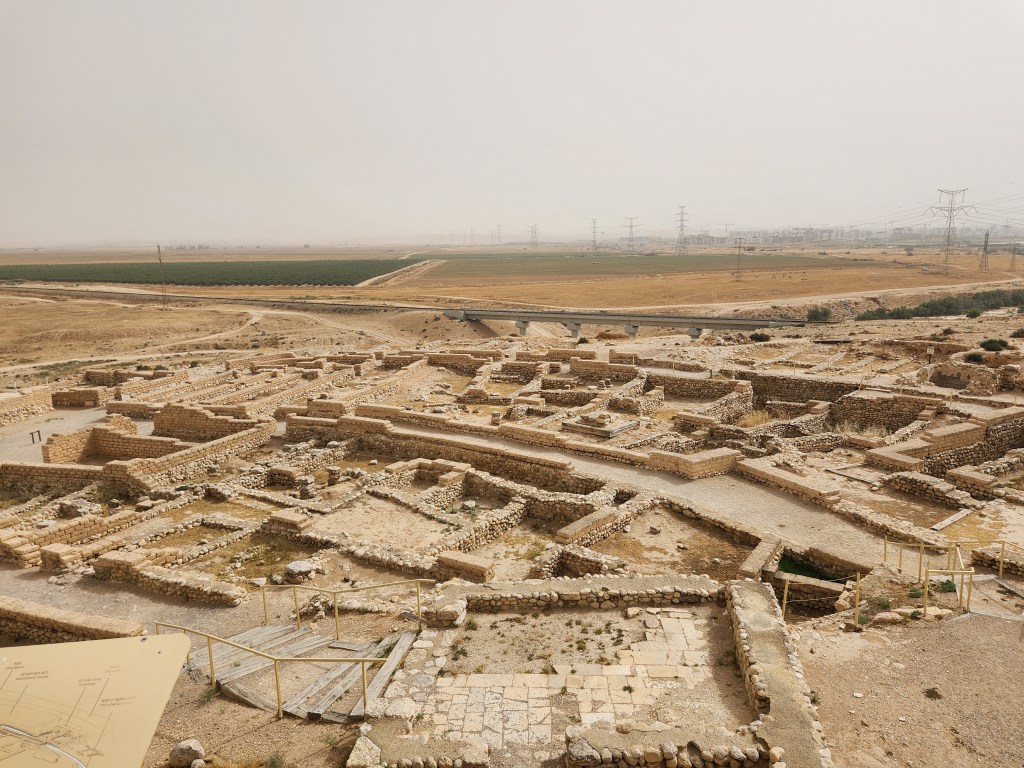
An overview of most of the remains of ancient Beersheba

Beersheba Unexpected

Each day, as we rode on our tour bus toward a new destination, our class took turns preparing a short biblical history lesson of what had happened in that place. Sometimes these were recorded in the Old or New Testaments but sometimes the events of interest to us were to be found in the writings of Josephus, or in rediscovered texts from Egypt, Mesopotamia, or other archeological explorations. And so, on our way to Be’er Sheva (biblical Beersheba) we were reminded of the many biblical references, which are entirely in the Old Testament for reasons that I will explain shortly.

The first reference to Beersheba comes as early Genesis 21 when Abraham sends Hagar and Ishmael away and they “wandered in the Desert of Beersheba.” Just a few verses later, Abraham makes an oath (which amounts to a modern treaty) with Abimelech and exchange seven lambs as a part of the agreement. The name “Beersheba” therefore is said to stem from that event either because the word Beersheba is similar to the Hebrew root of “made an oath,” or because it is similar to the root word of “seven” (or possibly both).

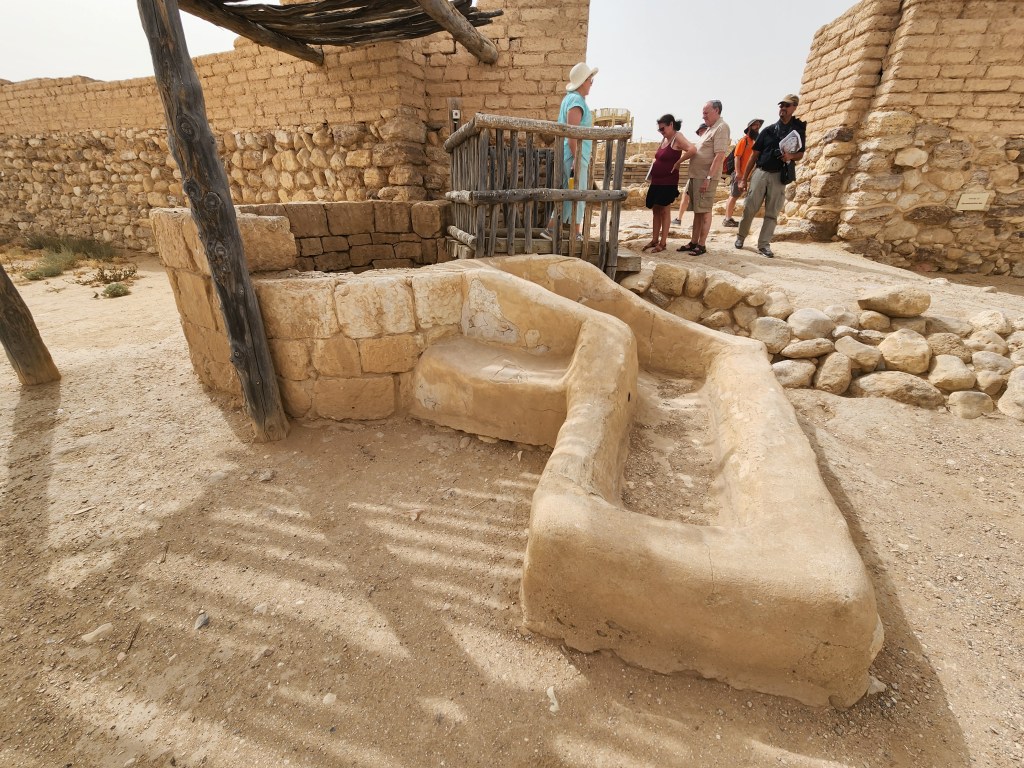
The well at Beersheba

Later, in Genesis 46, Jacob stops in Beersheba to offer sacrifices to God on his way to Egypt, Elijah stops there while running for his life in 1 Kings 19, and almost all of the other occurrences simply use Beersheba as an expression to say all of Israel from north to south as we see in Judges 20:1 when it says, “Then all Israel from Dan to Beersheba and from the land of Gilead came together as one and assembled before the Lord in Mizpah.” This expression is used simply because Dan was, for the most part, the farthest north that Israel grew, and Beersheba was its farthest southern extent.  To the north of Dan was the nation of Aram (which is modern day Syria) and to the south was… well, sand.  Beersheba was, and is, at the northern edge of the Negev desert, which scripture often describes as “wilderness” and the Sinai Peninsula. Continuing south brings you to the borders of Egypt. When the Jews returned to Israel after the Babylonian captivity, Nehemiah records that some returned to Beersheba, but, perhaps because there were so few, and because that territory is no longer controlled by Israel, there is no other mention of that place in scripture.

Looking down into the (deep) well

And so, while Beersheba is well attested in the Bible, compared to many of the other places that we visited, not a lot happened there. And yet, I was struck by the presence of the place in a way that I wasn’t in many of the others. Beersheba may not have had a central role in the stories of scripture, but it was present. The reason that Beersheba was important to Abraham and Isaac was because of the well that was there. Here, at the northern edge of the desert, there isn’t much water other that what flows down the wadi (dry riverbed) during the infrequent rains. And so, this well is very likely the same well that Abraham knew. Moreover, even though it may not often be mentioned by name, anyone who traveled through this region was almost certain to have stopped here.

A model of the Horned Altar found at Beersheba

It is also believed that Beersheba was one of the places of worship that had been built so that people wouldn’t have to travel the many miles north to Jerusalem. If so, this is one of the temples that King Hezekiah ordered torn down in 1 Kings 18. During archaeological digs here, a four-horned altar, often described in scripture, and typically used for sacrifice, was discovered here in secondary use. “Secondary use” means that after the temple here had been torn down, someone reused the stones as a part of wall. The stones from that wall have been moved to the Israel Museum in Jerusalem and reassembled into an altar.

Finally, during those times that Israel controlled Beersheba, it was a military outpost. This was the border between Israel and the wilderness, and between Israel and any enemies, such as Egypt, that might come from the south. Duty here was probably far from home, and certainly hot, unforgiving, and generally miserable.

A city street

Still, what is it about Be’er Sheva that unexpectedly struck me? Why does it have a presence that I could feel? For me, it’s because, like just a few other places, this is where it happened. In other places, over the last two thousand years, the places described in scripture have moved, walls have been torn down and rebuilt, whole cities have been destroyed, rebuilt, destroyed again, over and over until the places that we read about are tens of meters below the surface. But wells don’t move. While the stones surrounding this well at the surface may have been replaced many times, this is the place where Abraham, Isaac, Jacob, Elijah, invading Pharaohs, Mesopotamian generals, Roman armies, Israelite kings, and so many others have stood, draw water, and had a moment of rest.

It was unexpected.  I was surprised.

Beersheba city gate

But here, on a smallish hill on the edge of the desert, I felt as if I was in the presence of history.

And, having done so, it is so much easier to imagine what those people were feeling. The panic of Hagar as she is cast out to almost certain death in the desert, the relief of Israeli merchants returning home from Egypt, the apprehension of outpost soldiers knowing that Egypt’s army was on its way towards them, the anticipation of Pharoah as he moved north towards larger, more well-defended outposts and cities, and the courage of those settlers who dared to make this remote place their home.

It is that insight, out ability to imagine what it must have been like, that allows us to better understand, explain, teach, and preach the stories of scripture. Because understanding those people, and their feelings transforms dry words into real people.


Please LIKE and SHARE!

Click here to subscribe to Pastor John’s blog.

Click here if you would like to subscribe to Pastor John’s weekly messages.

Click here to visit Pastor John’s YouTube channel.


Moving on Up… to Caesarea

View of the Mediterranean Sea from Caesarea

Moving on Up… to Caesarea

I remember watching situation comedy, “The Jeffersons” on television in the late 1970’s. The show was a spin-off of All in the Family and centered around the lives George and Louise Jefferson after George builds a chain of dry cleaners and his newfound upper-middle class income allows him to move into a luxury high-rise apartment instead of the old neighborhood in which he had grown up. The show was reliably funny but, for me and many others, one of the memorable things that stuck with us was the theme song, “Moving on Up.” (I hope you’ll forgive me if you get that song stuck in your head for the rest of the day.)

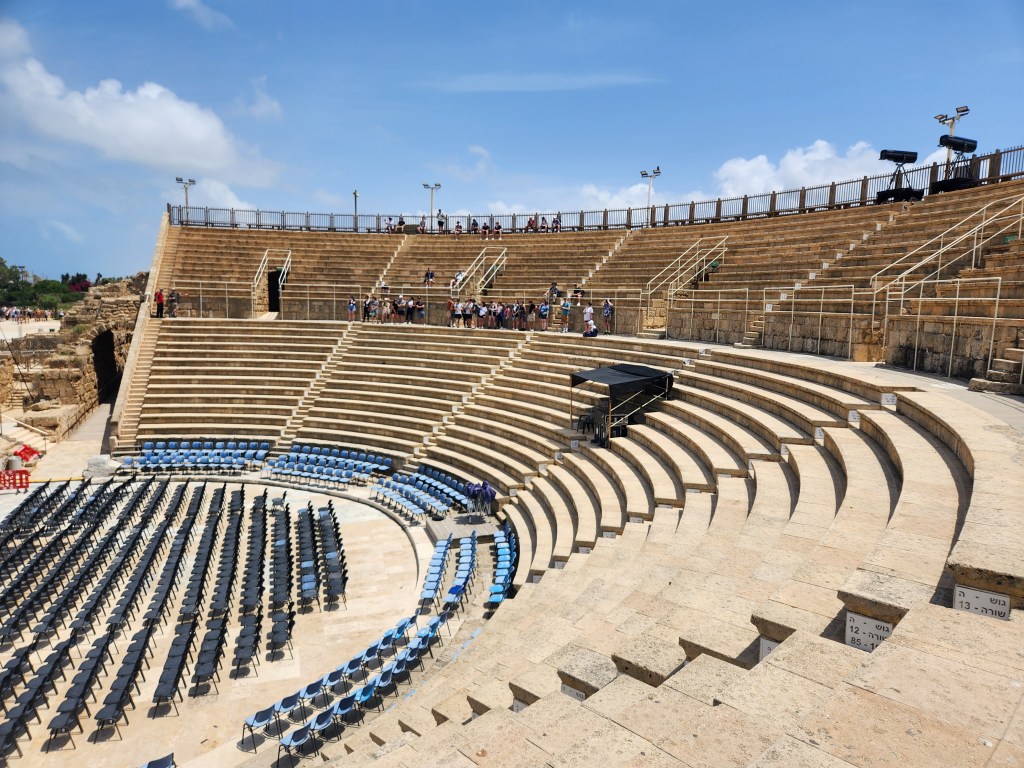
Theater at Caesarea

It was that song that has been stuck in my head as I think about the things that I saw in Caesarea by the Sea, or Caesarea Maritima, on the shores of the Mediterranean Sea in Israel. I had been there before but having spent a significant amount of time over the last couple semesters reading and studying, seeing it all again from this new perspective, and touring those ruins with other students, led by our professor,Dr. David deSilva, I saw many things differently. But while travel always changes us, we can’t always anticipate how we will be changed.

During this visit, the thing that struck me at many of the sites we visited, but particularly at Caesarea, was the incredible gulf that existed between the rich and the poor before, and during, the New Testament period. I’d read about it, and I thought that I understood it, and prior to this trip I certainly could have explained and even preached about it. But this time something was different.

The inner harbor at Caesarea by the Sea

Certainly, Caesarea has a lot going for it and King Herod had every reason to want to build a city, and a palace, here. Being on the sea it has a beautiful view, and an agreeable climate, and with the construction of one of the ancient world’s largest seaports, Caesarea became a center of trade and travel, a center of government, and along with those things became quite wealthy. Caesarea had a beautiful theater, concert hall (an Odeon), an almost impossibly enormous temple of Augustus that dominated the city, an oval track for horse (or human) racing (known as a circus), and even a 10 mile (15 km) long aqueduct to fill the ornate public fountains, flush the toilets, and make sure that no one would ever run out of drinking water. Many buildings were architecturally, over the top gorgeous, and some were known to be covered in imported marble. Fish, wine, and delicacies imported from around the known world were available.

Caesarea Aqueducts

Herod built his palace on a spit of land protruding into the sea just around the corner from the theater and had every luxury available including a cold pool, sauna, and an almost Olympic sized, freshwater swimming pool that was carved out of solid bedrock. After Herod’s death, his palace was used by the governors, procurators of the Judaea Province. Among these were the prefect Pontius Pilate, and Governor Antoninus Felix, that we read about during Paul’s trial in Acts 23, and Governor Porcius Festus who heard Paul’s defense there in Acts 25.

Ruins of Herod’s Palace with mosaic floors and pool.

It was the goal for local and provincial elites to move up to places like Caesarea. There was an enormous disparity between the “haves” and the “have nots” and even between the “wealthy” and “average.” Most of the population were rural peasants that eked out a subsistence level of survival, farming, and fishing in rural areas like Nazareth. There, it wasn’t uncommon for a house to only have one room for an entire family, while larger families might have two, or even four. In Jerusalem, the home of an important, and somewhat wealthy person, might have four rooms and possibly a little larger. Wealthy rulers and government officials made up only 2 percent of the population. Perhaps another 5 percent were “retainers,” career military, lower government functionaries, and household servants for the 2 percent. Merchants and most of the priestly class were basically just “less poor” than peasants, but not anything close to wealthy, and artisans may have had even less income than the peasants.[1]

While we might consider the accommodation in Caesarea to be primitive, and they certainly would not meet our standards of sanitation, many of us would still find it to be nicer than many twenty-first century cities. Caesarea was the place that important and wealthy people dreamed of living. But the lifestyle of the wealthy was so far removed from the experience and expectation of the average person, that it wasn’t even a dream. There was no “middle” class. Two percent were fabulously wealthy and lived a life of luxury, five percent lived well in service to those wealthy people, and everyone else barely made enough money to eat. There was no upward mobility. There was no “moving on up.”

There was only grinding poverty.

Seeing that, understanding that, and grappling with what that means, changes the way that we read the gospels, the stories of the New Testament, and all of scripture.


Please LIKE and SHARE!

Click here to subscribe to Pastor John’s blog.

Click here if you would like to subscribe to Pastor John’s weekly messages.

Click here to visit Pastor John’s YouTube channel.


[1] Sakari Häkkinen, Poverty in the first-century Galilee, Department of New Testament Studies, Faculty of Theology, University of Pretoria, South Africa

Five Thousand Years of Megiddo

Five Thousand Years of Megiddo

(and counting)

by John Partridge

A panoramic view from the top of Mount Megiddo

Whether you have read the New or the Old Testaments, you are likely to have encountered a story about the fortress of Megiddo. Its strategic location has already made it a place of importance in 3000 BCE, and long before the arrival of Joshua and the Israelites in 1400 BCE. As most ancient fortresses were, even into the Medieval period, Megiddo lies at the top of a rise that might be a big hill or a small mountain. That alone might not have made Megiddo a good location for a fortress, but its geographic location certainly did.

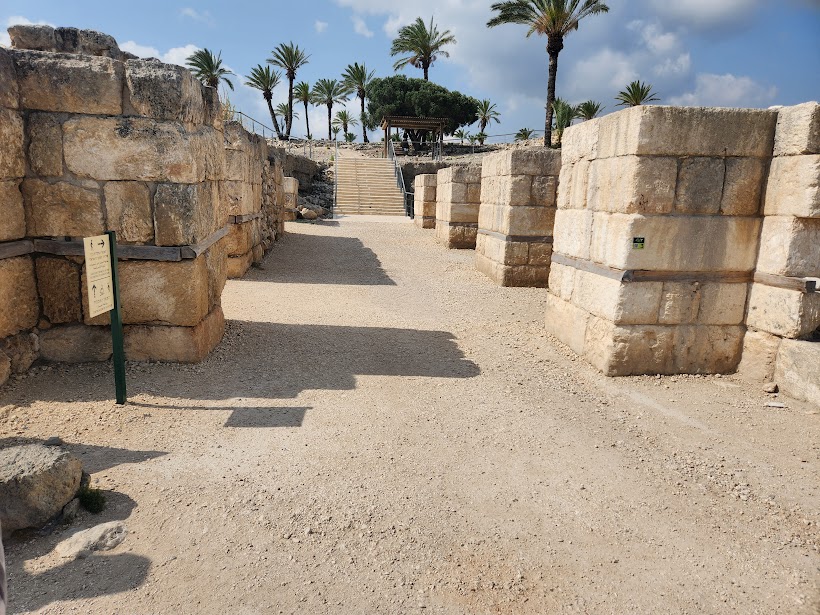
Iron Age City Gate (built under Solomon or Ahab)

The fortress, or more properly the historic succession of fortresses, overlooks the Jezreel valley, which is not only one of the most fertile plains in the Ancient Near East, but has within it, the Via Maris, the road that connected Egypt, Syria, Anatolia, and Mesopotamia which was important to many ancient empires including the Egyptians, Babylonians, Hittites, Assyrians, Israelites, Canaanites, and many others. And not only did Megiddo overlook this important highway, but it did also so in the place where the Via Maris narrowed through the pass at Mount Carmel on its way to the coastal plain along the Mediterranean Sea.

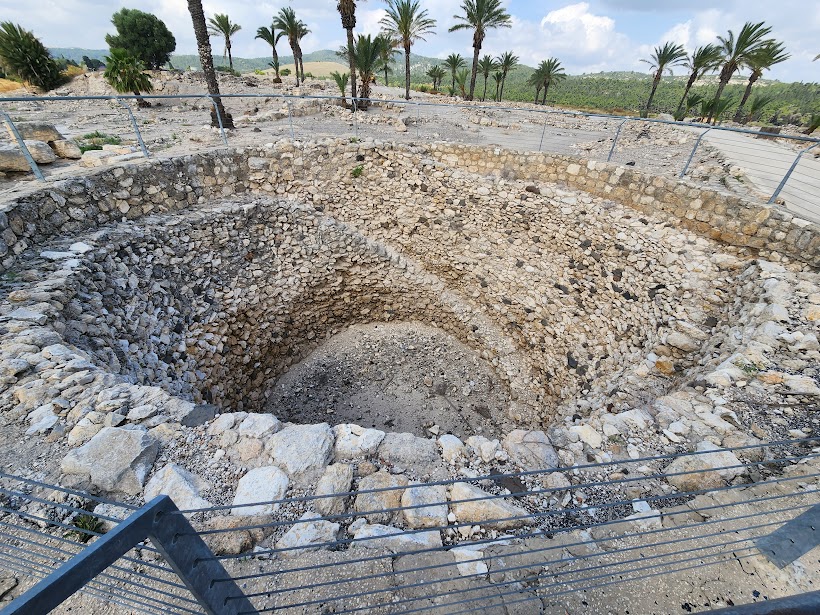
Granary

The archeological digs at Megiddo have unearthed a temple that was built by the early Canaanites, one of the largest structures in the entire Ancient Near East, as early as 3000 BCE. This was the place where Egyptian soldiers of Thutmose III fought between 1450 and 1400 BCE, and then Joshua and the Israelites between 1400 and 1375 BCE as seen in Joshua 12:21. Here, Solomon established one of his great chariot cities to stable his horses (1 Kings 4:12), and it was here that both King Ahaziah (2 Kings 9:27) and King Josiah (2 Kings 23:29) met their deaths. Much more recently, this was the place where British troops fought the Ottoman army during World War I and where the apostle John envisioned the great battle of Armageddon in Revelation 16:16 (Armageddon is a mistranslation of what John almost certainly wrote as “Har Megiddo,” meaning mountain, of Megiddo).

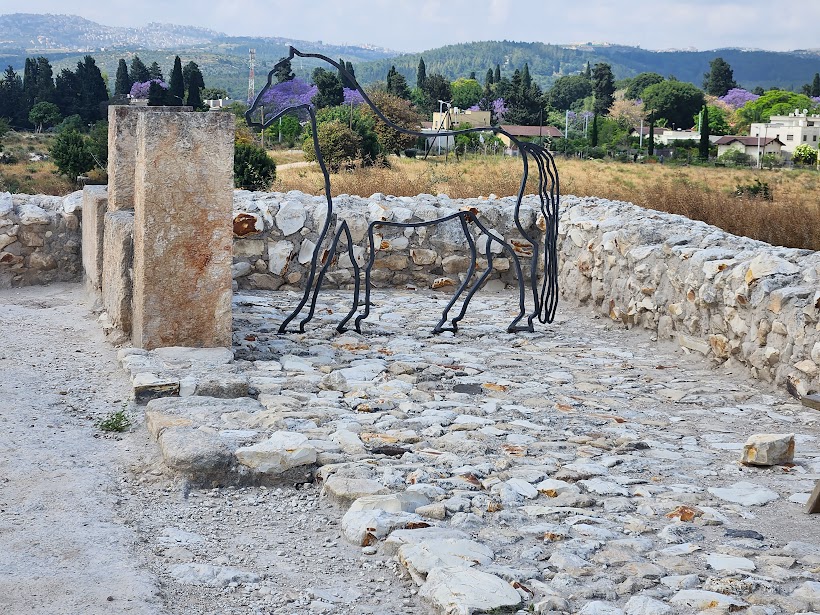
“Solomon’s stables”

In my recent trip to Israel, we walked through the ruins of Megiddo and saw the layers of the cities that had been built there over the course of thousands of years.  We saw the monumental city gates built in the Bronze Age by the Egyptians and in the Iron Age by either King Solomon or by King Ahab, the ancient temples, the buildings where Solomon’s horses were stabled (or which might have been warehouses), a granary silo that once stored the city’s supply of wheat, barley, or other grains, a monumental southern palace (once again dating to either Solomon or Ahab), and an amazing tunnel that connected the city to it’s spring outside the gates of city which protected it from invading armies.

Stairs to the spring tunnel
Tunnel to the spring outside the walls

The impressive views of the Jezreel Valley from the walls of Megiddo are amazing. Looking out over the valley, it is easy to imagine the battles that were fought here. One can easily picture invading armies marching along the valley toward this fortress and feel the quiet anticipation, or outright dread, of the soldiers watching from those walls. It is in these places that we not only learn history, but that history comes alive as you touch it and feel it with your hands as well as with your imagination and with your soul. And, having been in this place, having walked the paths of so many biblical figures, seen the walls and buildings where they lived and worked, and easily imagined what they might have looked like so many years ago, my understanding and appreciation of scripture has changed. No longer is Megiddo just a set piece in a story of long ago, but a real and tangible place that will forever change the way that I read history, and how I understand, interpret, and preach the stories of the Bible.


Please LIKE and SHARE!

Click here to subscribe to Pastor John’s blog.

Click here if you would like to subscribe to Pastor John’s weekly messages.

Click here to visit Pastor John’s YouTube channel.

Where in the World is Pastor John?

If you haven’t already, some of you will certainly be wondering what’s going on by the end of May. I didn’t preach for two Sundays in April and missed (or will miss) three more in May.  

I’m fine… Really.

In April, I was in church for United Women in Faith Sunday, as well as the following week when I asked Pastor Christ to preach so that I could finish my research paper and other work that was due at the end of spring semester. Then, in May, I participated in the Great Day of Music Sunday (but didn’t preach) followed by two more Sundays in which Pastor Chris preached again. On the first of these, I was on a summer semester study trip as our entire class was in Israel to see all the places that we’ve been studying and writing about for the last 30 plus weeks. I returned on a Friday (if I was on schedule) but, again, Pastor Chris was kind enough to preach so that I didn’t have to worry about writing a sermon while I was traveling.

Of course, I’m writing this before I leave for Israel so that Dolores can put it in the newsletter, but by the time you read this, I should be back. I plan to be here through June, but I’ll miss a week or two in July when I will once again be serving as chaplain for the 2023 National Scout Jamboree. After that, I think I will be around for a while. There is a chance that I’ll be out again later in the year to perform a church wedding for our son Jonah and his wife Kylie after their private back yard service this past January.

Other than that, I don’t have any definite plans, but at some point, Patti and I might like to go somewhere… together.

I want to say thank you to all of you for allowing me the flexibility to go to school and serve in ministry in other capacities such as scouting and missions.  I also want to say thank you to Pastor Chris and Susan Haddox who almost always say ‘yes” when I need to be somewhere else. And of course, I want to say thank you to my wife, Patti, for putting up with all my travel (and other shenanigans).

Blessings,

Pastor John


Please LIKE and SHARE!

Click here to subscribe to Pastor John’s blog.

Click here if you would like to subscribe to Pastor John’s weekly messages.

Click here to visit Pastor John’s YouTube channel.

Purity, Lobsters, and Poly-Cotton Blends

Purity, Lobsters, and Poly-Cotton Blends

by John Partridge

One our recent class reading assignments has covered a range of issues surrounding the idea of purity and holiness in the nation of Israel (and the diaspora) as described in the Old Testament. As you likely know, many of the rules and regulations surrounding these two ideas of purity and holiness are found in the book of Leviticus where we also find God describing to Moses the fundamentals of worship, the design of God’s worship space, the sacrificial system and, perhaps most importantly, who and what God desires for his followers to be. 

As Protestant Christians in the twenty-first century, many, if not most of us, just kind of skip over Leviticus (and most everywhere else that rules about purity and holiness crop up) for several reasons. Let’s face it, it’s a little boring because it’s full of lists and genealogies, we’ve been convinced that all those purity codes don’t apply to us, and… if we’re honest, some of them are just downright weird. So weird in fact, that non-Christians point them out in an effort to describe our faith as something illogical or nonsensical.

But after diving a little deeper and learning more about it, some of those purity rules aren’t as strange as they might at first appear.  But before I get to that, I want to back up to my first paragraph and look at the last sentence.  It’s that last part that I think is most important.  God lays out his system of worship, the sacrificial system, the rules about purity and holiness because all of those things point to who and what God desires for his followers to be.  And so, even though our Christianity (thankfully) doesn’t sacrifice animals, or follow ancient Jewish rules about purity and holiness, those parts we skip over can still tell us something about who God want us to be as his people.

It’s worth noting that Israel wasn’t the only nation with holiness or purity codes.  Other nations, and other gods, had rules that had to be followed, and purifying rituals that had to be performed, before coming into the presence of their god or entering their temples. So, holiness or purification wasn’t unusual in and of itself. What made Israel’s God different was that he didn’t just call his people to follow these rules to enter the Tabernacle or to worship him, although there was a set of rules for that. What stands out was that Israel’s God intended for his people to follow these rules all the time so that they could be purer and holier than the people and the cultures that surrounded them.  God’s intention was for them to be different and to stand out because of it.  Three times in Leviticus (in chapters 19, 21, and 22) God instructs his people saying, “Be holy because I, the Lord your God, am holy,” (NIV) or some similar variation.

So how do rules about food, clothing, work, and a pile of other things accomplish that?  Honestly, there are things that we find in those lists that never made any sense to me.  Sure, taking a ritual bath before entering the Temple made some sense. Much like our concept of baptism, it isn’t hard to envision a ritual bath as both a physical and ritual cleansing and leaving our impurities behind us before coming into God’s presence.  But there are a bunch of other things on those lists that just seem weird. I mean, what’s wrong with lobsters?  I like lobster and crab, but they were both absolutely forbidden to a Jew.  And what about pork, or clothing made of two kinds of fabric? And what was the deal about skin diseases, sex, menstrual cycles, nocturnal emissions, anything to do with blood, or dead animals?

Admittedly, that’s a lot of stuff. But it all goes back to, “Be holy because I, the Lord your God, am holy.”

The logic behind it all began simply with the belief that God was perfect and holy.  We still believe that. And so, if God has called his people to be holy, then they must, as much as possible, do things that make them fit to be in God’s presence and to physically be the kind of holy people God called them to be. We still believe that too. But all those rules about purity and holiness flowed out of this belief. We can understand the logic as if these ancient people imagined what a perfect world would be like so that they could be perfect enough, and holy enough, for a perfect and holy God.  Genesis is clear that the world we live in is broken, so what would the earth have looked like before it was broken? The Israelites’ answer that to that question was that in a perfect world, everything would fit into sensible categories and classifications.  That isn’t an outrageous assumption. Modern science is based on entire systems of classifications to make sense of our world. We have the periodic table to classify elements and the taxonomic system that categorizes every plant and animal on earth into seven classifications of kingdom, phylum class, order, family, genus, and species.

Obviously, five thousand years ago (give or take a couple thousand), the categories weren’t so complex. But for them, “clean” things were those things that seemed to fit into a sensible order and didn’t cross boundaries. First, blood was life-giving.  And so, any animal that took life, or ate blood, like predators or scavengers, was not clean. Fish were clean, but fish with skin or legs like a land animal, were not clean. People could be clean, but bodily fluids, which were supposed to be on the inside, made people unclean if they were on the outside. That’s how lepers with skin diseases, menstruating women, men who had a nocturnal emission, or anyone with an open wound were defined as unclean. And in that system of classification and boundaries, while linen (which is made from stems of the flax plant) and wool (which comes from sheep or goats) were each fine for use as clothing, mixing them (possibly because one was from a plant and the other from an animal) was seen as crossing boundaries, and was therefore prohibited.

When we understand this system of classification, the Old Testament rules of purity and holiness make a lot more sense. But why does it matter? We aren’t Jewish and the rules about food and purity don’t apply to us.  Right?

Well, no. And yes.

We aren’t bound by Jewish dietary rules or many of the others. But, as the followers of God, we are still connected to their intent. We still believe that God speaks to us when he says, “Be holy because I, the Lord your God, am holy.” We are still called to be different from our culture, and to be a holy people who are set apart by God. That’s why we still talk about sin and living a life that looks like the one Jesus modeled for us. We may not follow the Old Testament codes of purity and holiness, but our calling is the same. In our own, Protestant Christian, twenty-first century way, we are still called to live lives that are pure, holy, and different from the people around us.

God still calls us to stand out from the crowd… and be a little weird.


Please LIKE and SHARE!

Click here to subscribe to Pastor John’s blog.

Click here if you would like to subscribe to Pastor John’s weekly messages.

Click here to visit Pastor John’s YouTube channel.
How Will God Change You?

Ancient Meaning – Modern Application

Easter 2023

For the last several years, I have mentioned in this letter, that “this is an unusual time.”  But, for the most part, we are putting the unusual-ness of the pandemic behind us and accepting what’s left as a new normal.  We are going out to eat, holding church dinners, attending plays and concerts, and doing almost all of the things that we were doing before we first heard the acronym COVID-19.

But why does it matter that we are returning to normal?

It matters because a return to normal means that we can be done focusing only on surviving for the next few months or even for the next year.  Returning to normal means that our focus once again shifts to look farther into the future.  How do we envision Christ Church five years from now, a decade from now, or fifty years from now?  Shifting our focus requires that we imagine how Christ Church might be different and how it might change.  And imagining how Christ Church might change means that we must consider how we might change.  And considering how we might change must include both the plural and the singular, both we collectively, and each of us individually.

But those things are also a part of the message of Lent and Easter.  As we hear the familiar stories from scripture, as we read and listen to the story of Lazarus’ resurrection and his unprecedented second chance, as we hear the wonder in the voices of the crowd of witnesses, of the women who find an empty tomb, of the men walking to Emmaus with Jesus, of Thomas as he puts his hand in the Jesus’s wounds, and of the disciples who witness Jesus appear in a locked room, we must imagine with them, how our lives will be changed.

The resurrection of Jesus changed everything.  It changed the direction of the lives of everyone who knew him.  Peter and the others would never go back to their fishing boats because God had a different future planned for them.  And twenty-one centuries later, the resurrection of Jesus is still transforming lives.  As we celebrate Easter and move into the season of Eastertide, let us once again consider where God is leading us, how God intends to change us and transform us so that we are fit to do the work and the mission of the future that he has planned for us.

We are the disciples of Jesus Christ.

And God is still calling us to do his work.

Let us listen to his voice, consider what we must do, and how we might need to change in order to receive his blessings and arrive at the future that he has planned for us… for our children… for our grandchildren… and beyond.

Blessings,

Pastor John


Please LIKE and SHARE!

Click here to subscribe to Pastor John’s blog.

Click here if you would like to subscribe to Pastor John’s weekly messages.

Click here to visit Pastor John’s YouTube channel.
A Cup Full of Jesus, Please

A Cup Full of Jesus

by John Partridge

In my New Testament Culture class discussion this week, we noted that today’s church, and its people, often bears a striking resemblance to the ancient Jerusalem temple and its Jewish congregants.  Like us, they had priests and Levites who were the professionals that led worship, nearby were the faithful “serious lay scholars” that were the Pharisees.  These folks were lay people, but nearly all of their free time was dedicated to the church and to the study of scripture.  Neither of these groups were large and, together, only represented a small percentage of Jerusalem’s population.  The people in the temple courts were, like today, divided among the regular attenders, the occasional visitors, and those, both local and from far away, that only showed up for the big holy days and festivals. 

Two thousand years of history hasn’t changed human behavior much.  Then, like now, many of the people in the temple and in the church, were folks who were just trying to get by, survive, and get through life.  But all of that reminded me of a Sunday school lesson that my friend Brian Baer used in our class something like thirty years ago.  In that lesson, much like I mentioned during our Sunday morning prayer time recently, Brian reminded us that we worship a God of miracles.  Our God is the god who spoke the universe into existence, set the stars in place, created the earth and all that is in it, and knit us together each with our own skills, talents, and abilities.  We follow Jesus who raised Lazarus from the dead, healed incurable diseases, rose from the dead, and changed the course of human history forever.

And yet, how many of us come to church expecting little or nothing?  How many of us are so focused on getting by, or so focused on stability, repeatability, and maintaining the status quo of our lives, that we ask nothing more from God than absolutely necessary.  We come to the foot of a raging waterfall of miraculous power and blessing that dwarfs Niagara Falls, and in our hand is nothing more than a teacup.

I’d like a cup full of Jesus, please.

The only thing we ask is enough of Jesus to get by, to get us through the next week, and for only enough of Jesus to survive.

Why is that?  What are we afraid of?

Are we worried that too much of Jesus would overwhelm us?  That asking, and expecting, more from Jesus would be transformative and force us to change?  Are we worried that if God’s Spirit and blessing really poured out upon us that we would have to deal with changes in our church, our families, or our personal lives?  Are we worried that God might change how we think about the people around us and how we act around them?  Or are we worried that God might ask something of us in return?  Would God pour out his blessing on us and ask us to go on a mission trip, or teach, volunteer, go into ministry, or do something, anything, outside of our comfort zone?

God is waiting to pour out a Niagara Falls of his Spirit and blessing into your lives.

Don’t be afraid to ask for big things.  Don’t be afraid of what a loving God might want to give you, how he might want to transform you, or how he may intend to change us both personally, and as a church.

At the very least, let us come to Jesus with expectation and hope and not, teacup in hand, asking only for another cup of Jesus.


Please LIKE and SHARE!

Click here to subscribe to Pastor John’s blog.

Click here if you would like to subscribe to Pastor John’s weekly messages.

Click here to visit Pastor John’s YouTube channel.
Lent, John the Baptist, and the Asbury Revival

Lent, John the Baptist, and the Asbury Revival

February 22, 2023

by John Partridge

Regardless of whether you watched the unfolding events at the chapel on the campus of Asbury University, particularly during this season of Lent, I have been struck by the similarities between the events unfolding at Asbury and the ministry of John the Baptist. As the weekly chapel worship service at Asbury continued well beyond its scheduled ending, the students stayed because, whether they could put a name to it or not, they didn’t want to leave the presence that they felt in that place.  In Christian circles, we would say that they felt the presence of God.  Reports say that they were called to a closeness with God, they felt the call of God upon their lives, and they felt a call and a need for repentance. 

That chapel service continued for the rest of that day, on into the night, and for more than a week beyond its scheduled time.  Students arranged to lead worship in shifts of sorts, not with an official schedule, but by choosing small groups of worship leaders from among those present as the Spirit led them.  The names of the worship leaders weren’t given to the press because they wanted God to get the credit.  If you knew who they were, you could find PhD’s bringing water to thirsty people in line, pushing wheelchairs, and guiding visitors to the nearest restroom.

Students and adults from nearby towns came first, then folks from out of state, and brothers and sisters in Christ from around the world.  They came to see, and to feel, this thing that God was doing and, by the accounts that I have read, they were deeply moved and came away changed, even if their visit was brief.  But of course, they weren’t the only ones that came.  Asbury’s campus was also visited by the media, the curious, by academics who had written about an earlier Asbury revival in the 1970’s, by “ministry professionals” with decades of experience, and some who were openly skeptical.

Within days, the academics, the skeptics, and the “ministry professionals” could be found online, critiquing Asbury, its students, the worship leaders, and everything about that event.  Whether you want to call it a revival or something else, it reminded me a lot of Jesus’ baptism.  John was admittedly more than a little odd.  He dressed in camel hair, ate locusts and wild honey, and wandered the countryside preaching a message of repentance.  But as odd as he was, people felt something in his presence.  People from across the entire region flocked to hear him, to repent of their sin, recommit their lives to following God, and be baptized as an outward sign of their repentance.

But mixed in among those whose lives were changed were the curious, the academics, the skeptics, and the “ministry professionals.”  The Pharisees then, as the modern equivalents are doing even now, insisted that this isn’t how God works, that John was doing it wrong, that the people were being deceived, and that certainly, as professionals, they knew better.  And yet, God didn’t choose to work through them.  God has always chosen unexpected, under-prepared, and often unqualified people, in unexpected places, to do unexpected things, and following paths that surprise us.

So, what was really happening at Asbury University?  I won’t pretend to have all the answers, but it seems safe to say that God was doing something, even if we can’t put a name to it, or explain exactly what it was.  After all, scholars and skeptics are still trying to explain what John the Baptist’s ministry was about, what he accomplished, and what God was doing through him.  I’m certain that books and countless internet articles will debate what happened at Asbury for decades to come.  But from my perspective, I think that we can all find comfort, reassurance, and a timely message for Ash Wednesday and the season of Lent. 

We are both comforted and reassured as we see God engaged in human affairs.  God has not abandoned us.  God still walks the earth and is still calling us to follow him.  But particularly in this season of Lent, just as we heard from the ministry of John the Baptist, we are reminded that God is calling us to repent of our sins and to recommit our lives to following God.  I’m certain that as you read about what happened in Kentucky on the campus of Asbury University, that you will hear the voices of the skeptics, the critics, and the “ministry professionals” proclaiming that they know better.  But I also hope that you will hear the quiet voice of God in these remarkable events as he says, “Follow me, and I will give you rest.”


Did you enjoy this?

Please LIKE and SHARE!

Click here to subscribe to Pastor John’s blog.

Click here if you would like to subscribe to Pastor John’s weekly messages.

Click here to visit Pastor John’s YouTube channel.