
Isaiah 2:1-5 Matthew 24:36-44 Romans 13:11-14
As we begin the season of Advent this week, we celebrate hope. Hope is both key, and central to, this season as we prepare for the arrival of the Messiah at Christmas. The subject, and the message of hope has arisen many times in our studies together throughout the year, but it is especially apparent as we read the stories of scripture to which the lectionary points during the seasons of Advent and Christmas. We begin this morning by reading the promises of God to the people of Judah given through his prophet Isaiah. In these words, Isaiah offers encouragement regarding Israel’s eventual return from their captivity in Babylon, but as we read, we will quickly realize that the promise that God gives them goes far beyond their return from Babylon in 538 BCE. Reading from Isaiah 2:1-5, we hear this:
2:1 This is what Isaiah son of Amoz saw concerning Judah and Jerusalem:
2 In the last days
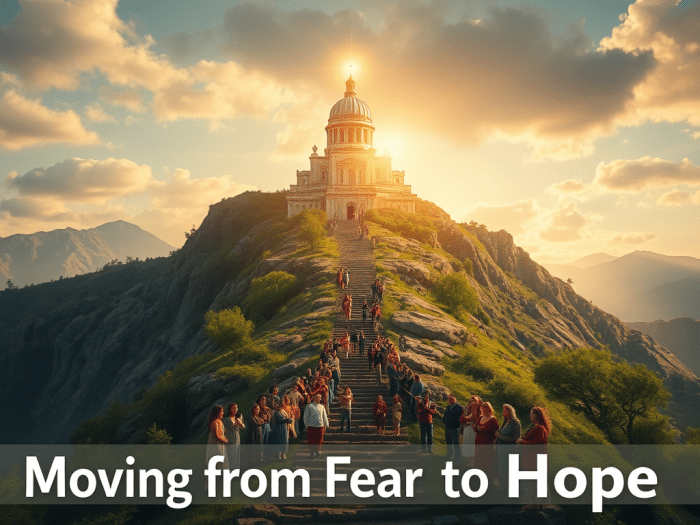
the mountain of the Lord’s temple will be established
as the highest of the mountains;
it will be exalted above the hills,
and all nations will stream to it.
3 Many peoples will come and say,
“Come, let us go up to the mountain of the Lord,
to the temple of the God of Jacob.
He will teach us his ways,
so that we may walk in his paths.”
The law will go out from Zion,
the word of the Lord from Jerusalem.
4 He will judge between the nations
and will settle disputes for many peoples.
They will beat their swords into plowshares
and their spears into pruning hooks.
Nation will not take up sword against nation,
nor will they train for war anymore.
5 Come, descendants of Jacob,
let us walk in the light of the Lord.
This begins simply by saying that God sent a vision to Isaiah and what follows is a description of what he saw regarding the last days of the earth before the judgement of God. And in those last days, Isaiah says that God’s temple would be built on the highest of mountains and Israel’s God will rule over all the nations and all the people of the earth. People will come to God’s city so that they can learn to walk in the ways of his teaching, and not only will they set aside their weapons, but their abandonment of war and their commitment to living in peace will be unending so that peace will prevail upon the earth for all time.
This is a message that is as relevant for us today as it was six centuries before Jesus. Like us, the people of Israel and Judah had watched centuries of wars and violence tear apart their families, villages, and their nation as well as the nations around them. Israel had been conquered by several nations, and would be conquered by several more, as well as the violence of a civil war before the coming of Jesus Christ. While we may be able to list many wars fought in the last century by memory, all the wars on Israel’s list had been fought over the land in which they lived. And so, then, as now, the promise of unending peace was an almost unbelievable message of hope.
And then, nearly six hundred years later, as Jesus speaks with his disciples about the end of the age and the coming of the Son of Man, they all understand that what Jesus is describing is the final fulfillment of the promises of God contained in the message of Isaiah. The disciples want to know when that is going to happen, when will the Romans be overthrown, when will Israel’s God be worshipped by the entire world, when will the violence end, and when would there finally be peace on earth? And in Matthew 24:36-44, Jesus says:
36 “But about that day or hour no one knows, not even the angels in heaven, nor the Son, but only the Father. 37 As it was in the days of Noah, so it will be at the coming of the Son of Man. 38 For in the days before the flood, people were eating and drinking, marrying and giving in marriage, up to the day Noah entered the ark; 39 and they knew nothing about what would happen until the flood came and took them all away. That is how it will be at the coming of the Son of Man. 40 Two men will be in the field; one will be taken and the other left. 41 Two women will be grinding with a hand mill; one will be taken and the other left.
42 “Therefore, keep watch, because you do not know on what day your Lord will come. 43 But understand this: If the owner of the house had known at what time of night the thief was coming, he would have kept watch and would not have let his house be broken into. 44 So you also must be ready, because the Son of Man will come at an hour when you do not expect him.
Jesus is clear in telling his followers that none of us can ever know exactly when the end of this age is going to come, but just because we cannot know, doesn’t mean that we should be unprepared. If you live on the east coast of the United States, you cannot know when a hurricane is going to hit the town in which you live, but you can be certain that it will happen eventually. And because you know, you learn how to watch for the signs. You can read the clouds, you watch the weather on television, you keep an emergency weather radio charged up during hurricane season, and you have a list of preparations made in advance. You may have a supply of food, an escape route planned out of the city, a place to stay with friends inland, precut boards or hurricane shutters to cover your windows, and a host of other preparations. And Jesus says that like the residents of the east coast we, as the followers of God, should keep watch, look for the signs of the coming of the end of the age, and to be prepared so that when it comes, we will be ready.
But how?
As we live neither in the past of the old or new testaments, and not yet at the end of the age, how do we live in the now? This is the same question that the people of the first century were asking. While Jerusalem had not yet been destroyed, at the time that Paul wrote his letter to the church in Rome, there was already growing violence in Israel. Assassins had already murdered the high priest, many communities and people were in open revolt against an increasingly corrupt occupying Roman government, and the Roman army was fighting back with great violence. In less than ten years, there would be all out war between the Jews and Rome. And in this time of uneasiness and alarm, Paul gives this advice on how the followers of Jesus Christ should live their lives in Romans 13:11-14, saying:
11 And do this, understanding the present time: The hour has already come for you to wake up from your slumber, because our salvation is nearer now than when we first believed. 12 The night is nearly over; the day is almost here. So let us put aside the deeds of darkness and put on the armor of light. 13 Let us behave decently, as in the daytime, not in carousing and drunkenness, not in sexual immorality and debauchery, not in dissension and jealousy. 14 Rather, clothe yourselves with the Lord Jesus Christ, and do not think about how to gratify the desires of the flesh.
While Paul admits that we do not know when the end will come, he explains that it is obvious that the end was closer now than it was when Isaiah wrote the promises of God, or when Jesus walked with his disciples. Even though we don’t know when Jesus will return, each day that passes after the resurrection is one day closer to his return and the day of judgement. And so, as we hold tightly to the hope that we have been given through the promises that we have heard in the words of Isaiah and the gospel writers, we must live in the now by setting aside the deeds of darkness and living lives that are filled with light. We must set aside drunkenness, sexual immorality, and internal church conflicts and live in ways that reflect the teaching and the model of Jesus Christ. It is the universal temptation of humanity to live lives in the selfish pursuit of pleasure and greed, to do what feels good, or what is the most profitable. But instead, Paul tells us that our calling is to set aside these desires of the flesh, and instead do our best to wear the clothes of Jesus Christ and to represent him well. Our goal should not be to do what feels good, but to live so much like Jesus that others can see him in us.
God has given us great promises that fill us with hope for the future. But, as we live our lives today, as we live in the “now,” we must watch for the signs of the last days, and live as if Jesus were coming tomorrow so that the world can see him in us, be drawn to him, and be rescued with us.
Please LIKE and SHARE!
Click here to subscribe to Pastor John’s blog.
Click here if you would like to subscribe to Pastor John’s weekly messages.
Click here to visit Pastor John’s YouTube channel.
*You have been reading a message presented at Christ United Methodist Church on the date noted at the top of the first page. Rev. John Partridge is the pastor at Christ UMC in Alliance, Ohio. Duplication of this message is a part of our Media ministry, if you have received a blessing in this way, we would love to hear from you. Letters and donations in support of the Media ministry or any of our other projects may be sent to Christ United Methodist Church, 470 East Broadway Street, Alliance, Ohio 44601. These messages are available to any interested persons regardless of membership. You may subscribe to these messages, in print or electronic formats, by writing to the address noted, or by contacting us at secretary@CUMCAlliance.org. These messages can also be found online at https://pastorpartridge.com . All Scripture quotations, unless otherwise indicated, are taken from the Holy Bible, New International Version®, NIV®. Copyright ©1973, 1978, 1984, 2011 by Biblica, Inc.™ Used by permission of Zondervan. All rights reserved worldwide. www.zondervan.comThe “NIV” and “New International Version” are trademarks registered in the United States Patent and Trademark Office by Biblica, Inc.™







 Pastor Partridge