Ponies, Palms, and Murder Plots

A photograph of palm branches
Click here to listen to the podcast. (Our apologies for a couple dropouts when my wireless microphone died)

Click here to watch the livestream of this service:https://youtu.be/hVAPawqTrwQ


Ponies, Palms, and Murder Plots

(Palm Sunday)

April 10, 2022*

By Pastor John Partridge

Luke 19:28-40

Today we begin the final week of our preparations for Easter.  We remember the time that, as the church, we refer to as “Holy Week.”  This is that time of remembrance that begins with the joy of Jesus’ triumphal entry into Jerusalem that we remember today as Palm Sunday but continues with Jesus’ prayer in the Garden of Gethsemane, his arrest, illegal trial, crucifixion, death, burial, and his resurrection on Easter morning.  I hope that you will join us, not just for the bookends of Palm Sunday and Easter, but for the entire journey through Holy Thursday, Good Friday, the Easter Vigil on Saturday, and then, after we have walked through that season of frustration, anger, despair, and darkness, to arrive together and celebrate the joy of Easter morning.

But this morning, we remember the story of Jesus’ arrival in Jerusalem for the celebration of the Passover as recorded in Luke 19:28-40.

28 After Jesus had said this, he went on ahead, going up to Jerusalem. 29 As he approached Bethphage and Bethany at the hill called the Mount of Olives, he sent two of his disciples, saying to them, 30“Go to the village ahead of you, and as you enter it, you will find a colt tied there, which no one has ever ridden. Untie it and bring it here.  31 If anyone asks you, ‘Why are you untying it?’ say, ‘The Lord needs it.’”

32 Those who were sent ahead, went, and found it just as he had told them.  33 As they were untying the colt, its owners asked them, “Why are you untying the colt?”

34 They replied, “The Lord needs it.”

35 They brought it to Jesus, threw their cloaks on the colt and put Jesus on it.  36 As he went along, people spread their cloaks on the road.

37 When he came near the place where the road goes down the Mount of Olives, the whole crowd of disciples began joyfully to praise God in loud voices for all the miracles they had seen:

38 “Blessed is the king who comes in the name of the Lord!”

“Peace in heaven and glory in the highest!”

39 Some of the Pharisees in the crowd said to Jesus, “Teacher, rebuke your disciples!”

40 “I tell you,” he replied, “if they keep quiet, the stones will cry out.”

For such a short passage, there is a lot going on.  First, Jesus knew what the disciples would find when they went into the village ahead of them.  He knew that they would find a colt that had been tied out, he knew that it was such a green colt that it had never been ridden, and although this last one is hardly surprising, Jesus also knew that the owner of the colt would want to know why they were taking it.  Just as Jesus had seen Nathaniel sitting under a fig tree before Philip called him to follow Jesus in John 1:48, Jesus knew what the disciples would find when they went into the village.  But what is even more surprising, and to my skeptical and sometimes a little cynical mind, even more miraculous, was that the owner of the colt allowed the disciples to borrow it.  Think about that for a minute.  We take it for granted because it was Jesus, because we are reading the Bible, and because we’ve heard the story dozens of times. 

But seriously?  The disciples meet a random stranger, whose horse or donkey has only recently had a baby.  That baby hasn’t been ridden, it wasn’t old enough to take to the trainer, or to start working at its training, two total strangers off the street start untying it, and the only explanation they offer is that their boss needs it.  Seriously?  If you owned a new car, that the dealer just delivered to your house on a flatbed trailer, and you hadn’t even had time to drive it yet, how likely are you to loan it to a total stranger?  Think about that.  If your dog had puppies and they had barely started eating solid food, what the chances that you’d let a stranger “borrow” one?  This wasn’t just a baby, horses and donkeys were valuable and they typically only have one baby every 12 to 18 months.  So, as I think about this story, and think about what we all know about human nature, I think that although there might be more to the story than Luke chose to tell us, I also think that this might just be one of the greatest miracles in the Easter story next to the resurrection itself.

In any case, the owner allows the disciples to borrow the colt, they bring it to Jesus, throw their outer garments over it’s back, and Jesus rides it.  And that, if you know anything about horses, may also be a significant miracle.  Ask your friends who know horses, what’s likely to happen if you just jump on the back of a horse that’s never been ridden.  The odds are good that, outside of that rider being Jesus, that such a story isn’t going to end well.

And as Jesus came near the place where the road goes down the Mount of Olives toward the gates of the city of Jerusalem, the crowd that was with Jesus began to praise God, in loud voices, for all the miracles that they had seen.  They pulled palm branches from the trees and laid them in the road in front of Jesus, and if Palm branches weren’t handy, they laid down their own shirts so that even the animal upon which Jesus rode would, symbolically, not get its feet dirty.  And more than that, they began to shout an historic welcome found in scripture, notably in Psalm 118, that the people of Israel had used as kings entered the city of Jerusalem.  They shouted, “Blessed is the king who comes in the name of the Lord!” and they said, “Peace in heaven and glory in the highest!” 

And the Pharisees who saw what they were doing, and who heard what they were shouting were displeased.  They recognized that the disciples were offering Jesus a king’s welcome.  They understood that these symbols were used, and were reserved for, the recognition of kings.  And they knew that not far away, inside of the city, sharing a wall with the temple itself, was the Fortress Antonia and a detachment of Roman soldiers.  They knew that those soldiers were there to keep the peace, they knew that the only king that could ever be accepted was Caesar, and they knew that blood had been spilled the last time someone claimed to be the king of Israel.  The arrival of Jesus, and his disciples’ cries proclaiming him to be king, was threatening to upset the status quo.  And the people who had the most to lose from a change in the status quo were the Pharisees.

They insist that Jesus tell his disciples to stop before too many people hear, or at least before the wrong people, the powerful people, the people with swords, could hear them.  But Jesus stares them down and declares that if the disciples keep quiet, the stones along the sides of the road would cry out instead.

And so, the actions of the disciples, and Jesus’ refusal to stop them, combined with all the previous interactions that Jesus had with the Pharisees, had reached a climax.  The Pharisees could no longer look the other way, there was no longer any doubt, they absolutely knew that Jesus was going to upset the status quo.  If Jesus lived, more people were going to follow him.  And if those people were going to label Jesus as a king, it was going to stir up the worst kind of trouble.  The deal that the Pharisees and the other leaders of Israel had made with Rome was that they could remain in power if they helped Rome to rule over Israel and if they helped them to keep the peace.  If the disciples proclaimed that Jesus was a king, then this contract would be broken, and the Romans would blame the Pharisees.  It was their necks, their jobs, their careers, their lives, that were on the line.  It was no longer an intellectual argument.  In this moment, the Pharisees had to choose between themselves, and Jesus.  And they knew what had to happen.

Jesus.  Must.   Die.


Did you enjoy this?

Please LIKE and SHARE!

Click here to subscribe to Pastor John’s blog.

Click here if you would like to subscribe to Pastor John’s weekly messages.

Click here to visit Pastor John’s YouTube channel.


*You have been reading a message presented at Christ United Methodist Church on the date noted at the top of the first page.  Rev. John Partridge is the pastor at Christ UMC in Alliance, Ohio.  Duplication of this message is a part of our Media ministry, if you have received a blessing in this way, we would love to hear from you.  Letters and donations in support of the Media ministry or any of our other projects may be sent to Christ United Methodist Church, 470 East Broadway Street, Alliance, Ohio 44601.  These messages are available to any interested persons regardless of membership.  You may subscribe to these messages, in print or electronic formats, by writing to the address noted, or by contacting us at secretary@CUMCAlliance.org.  These messages can also be found online at https://pastorpartridge.com .  All Scripture references are from the New International Version unless otherwise noted.

Religious Extravagance

Click here to listen to the podcast.

Click here to watch the livestream of this service: https://youtu.be/nnvOP5sOeM0


Religious Extravagance

April 03, 2022*

By Pastor John Partridge

Isaiah 43:16-21                      John 12:1-8                Philippians 3:4b-14

What do you think of when I say the word… extravagant?

We buy things that we need, but how nice those things are often depends upon how much money we have available to spend on things that don’t matter.  We might need a watch, but we could buy a cheap one at the dollar store that will keep time, or we can buy a decent Timex that will last longer.  But when we have a little more disposable income, we might consider buying an Apple watch or a Garmin sport watch that not only keeps time but counts our steps, calories, tracks our heartrate, and a bunch of other things.  And there are some people who have enough money that they can wear a year’s salary, or even the value of a house, on their wrist with wildly expensive watches made of gold and platinum.  But do you know what those expensive watches say at three o’clock in the afternoon?  They say that it’s three o’clock.  The difference between a Timex and a Rolex isn’t that the time is different, or that expensive watches somehow give their wearers twenty-five hours in a day instead of the usual twenty-four, the difference is in their level of extravagance.

We could say that a house with four bedrooms is better than a house with one bedroom if you have a larger family.  But at some point, as homes grow larger and pass three thousand square feet, four thousand, five thousand square feet, and even larger, at some point we’ve crossed a line from utilitarian and into extravagance.

And so, if I were to ask you what comes to mind when I say the words “religious extravagance,” I wouldn’t blame you a bit if you began to think about the mansions that we’ve seen on television that belong to a variety televangelists and other religious leaders who have capitalized, in one way or another, on their position, power, or notoriety.  But is religious extravagance about 25,000 square foot mansions, Rolls Royce automobiles, and private jets? 

As we consider that question, let’s begin by remembering what God said through his prophet Isaiah in Isaiah 43:16-21.

16 This is what the Lord says—
    he who made a way through the sea,
    a path through the mighty waters,
17 who drew out the chariots and horses,
    the army and reinforcements together,
and they lay there, never to rise again,
    extinguished, snuffed out like a wick:
18 “Forget the former things;
    do not dwell on the past.
19 See, I am doing a new thing!
    Now it springs up; do you not perceive it?
I am making a way in the wilderness
    and streams in the wasteland.
20 The wild animals honor me,
    the jackals and the owls,
because I provide water in the wilderness
    and streams in the wasteland,
to give drink to my people, my chosen,
21     the people I formed for myself
    that they may proclaim my praise.

As I read that passage, I divided it into four sections that each said something different.  The first, asks God’s people to remember what God is capable of doing and all the amazing, awesome, powerful, and even impossible things that God has done.  The second, simply says that while we should remember what God has done, we should not live in the past or get stuck there.  The third, says that as we keep the first two things in mind, the big news is that God is doing something new.  Now, God is doing the impossible.  He is making a road through the impassable wilderness and bringing free flowing water to the desert.  The fourth thing explains why God does everything that God does.  The reason that God does extravagant miracles, achieves the impossible, blesses his people, feeds them, and cares for them, is not just so that they will give thanks, but so that they will tell the world about his greatness.

But in John 12:1-8 we see an entirely different sort of extravagance as the time of Jesus’s crucifixion draws near.

12:1 Six days before the Passover, Jesus came to Bethany, where Lazarus lived, whom Jesus had raised from the dead.  Here a dinner was given in Jesus’ honor.  Martha served, while Lazarus was among those reclining at the table with him.  Then Mary took about a pintof pure nard, an expensive perfume; she poured it on Jesus’ feet and wiped his feet with her hair.  And the house was filled with the fragrance of the perfume.

But one of his disciples, Judas Iscariot, who was later to betray him, objected, “Why wasn’t this perfume sold and the money given to the poor?  It was worth a year’s wages.” He did not say this because he cared about the poor but because he was a thief; as keeper of the money bag, he used to help himself to what was put into it.

“Leave her alone,” Jesus replied.  “It was intended that she should save this perfume for the day of my burial.  You will always have the poor among you, but you will not always have me.”

For perspective, let’s consider the value of what Mary did for Jesus.  It’s one thing to say that she anointed Jesus with perfume that cost a year’s wages, but it’s another thing entirely to put that into language that is personally meaningful to our wallets.  Thinking about a year’s wages in a vague sort of way sounds like it might be a lot, but we feel a punch in the gut when we put that into numbers that we understand.  And a number that most of us can understand is the median income.  The “median” is the annual income at which half of all wage earners made more, and half made less.  And in the United States, the median income in 2021 was $79,900.  So, when we say that Mary poured $80,000 on the ground, we feel that it a different way than saying that it was worth about a year’s wages.  John uses this as an opportunity to criticize Judas for being a thief, but it’s hard not to think, as Judas suggested, about how much food, clothing, rental assistance, bus passes, or other things that we could buy for the poor with $80,000.  Mary’s gift was not just costly, it was extravagant.  But Jesus understands and explains to everyone present that there was a limited time that anyone could give such a gift, and while God’s intent was that this gift should have been for Jesus’ burial, Mary chose to give her gift to Jesus while he was still alive rather than after he was dead.

And in Philippians 3:4b-14, the Apostle Paul frames the discussion about extravagance differently.  Rather than reminding everyone about the extravagant gifts that God has given to us, or about the extravagant gift that Mary gave to Jesus, Paul explains how his life changed because of his reaction and response to God’s extravagance.  Paul says:

If someone else thinks they have reasons to put confidence in the flesh, I have more: circumcised on the eighth day, of the people of Israel, of the tribe of Benjamin, a Hebrew of Hebrews; in regard to the law, a Pharisee; as for zeal, persecuting the church; as for righteousness based on the law, faultless.

But whatever were gains to me I now consider loss for the sake of Christ.  What is more, I consider everything a loss because of the surpassing worth of knowing Christ Jesus my Lord, for whose sake I have lost all things.  I consider them garbage, that I may gain Christ and be found in him, not having a righteousness of my own that comes from the law, but that which is through faith inChrist—the righteousness that comes from God on the basis of faith.  10 I want to know Christ—yes, to know the power of his resurrection and participation in his sufferings, becoming like him in his death, 11 and so, somehow, attaining to the resurrection from the dead.

12 Not that I have already obtained all this, or have already arrived at my goal, but I press on to take hold of that for which Christ Jesus took hold of me.  13 Brothers and sisters, I do not consider myself yet to have taken hold of it.  But one thing I do: Forgetting what is behind and straining toward what is ahead, 14 I press on toward the goal to win the prize for which God has called me heavenward in Christ Jesus.

Paul begins by reminding his readers that for all the worldly reasons that people can have confidence, trust, and even arrogance, Paul has all of them… in abundance.  Paul had money, possessions, accomplishments, power, authority and more.  He was born into the right kind of prestigious family, he mixed with the right kinds of prestigious people, he followed all of the church’s rules in a very public way in the sect of the Pharisees, and even among the Pharisees, he was outstanding in his passion, zeal, and herculean efforts as a defender of the faith and a warrior for the church as he persecuted those who followed Jesus, and he did all these things so well that no one could find fault with his theology or practice.  Paul was beyond a rising star in the leadership of the church and was on track to be among those in the very highest levels of the Jewish church and the leadership of Israel.

But Paul after he met Jesus, he threw it all away.

Because he chose to follow Jesus, Paul lost his position in Jewish leadership, was cast out of the Pharisees, excommunicated, banned from the Temple, and we suspect that he may have even been disowned by his family.  Paul says that he has now given up anything that he once considered to be valuable because the value of knowing Jesus was worth more than anything that he had before.  In fact, what Paul received when he put his faith in Jesus was so extravagantly valuable that in comparison, everything that he had before was worth no more than garbage to him.

The value of what Paul received from God through faith in Jesus Christ is so valuable, that even after he has given up everything that he had, Paul still looks forward to the future and presses onward so that he can become whatever God called him to be, and to do whatever God called him to do.  Paul freely admits that Gods work in him, and through him, is not yet finished, but he continues to do the work of Jesus Christ, and to press on so that he can earn the reward that God has prepared for him.

Isaiah said that our mission it to show the world how amazing, wonderful, and awesome God is, and not spend our time and money showing people how awesome we are.  The goal is to get the people around us to give thanks to God and give praise to him, not to give thanks and give praise to us.  Mary shows her gratitude to Jesus by giving him the most extravagant gift that she can imagine.  It is a gift that is her life savings and represents her pension and her rainy-day fund all wrapped up in one package.  Paul says that God’s gift to us, the gift of his own son, Jesus Christ, is such an extravagant gift, that nothing that we have, and nothing that we can do, can ever begin to show God how grateful we are.  Instead, Paul’s response was to give up all that he had and spend his entire life giving of himself to do the work of God’s kingdom.

My friends, religious extravagance isn’t about churches that seat tens of thousands, or 25,000 square foot mansions, Rolls Royce automobiles, and private jets.  Those sorts of things point people in exactly the opposite direction that God wants us pointing.  Religious extravagance is demonstrating to the world that what God has given to us in Jesus Christ is so valuable that we will give, or do, anything to show God our gratitude and to do the work of the kingdom of God so that, as God said through Isaiah, the world would proclaim God’s praise.

When the followers of Jesus Christ are extravagant, every part of that extravagance should point to God so that the world sees the wonders of our amazing God… and not us.


Click here to listen to the podcast

Click here to watch the livestream of this service: https://youtu.be/plQTN7ZhsS8


Did you enjoy this?

Please LIKE and SHARE!

Click here to subscribe to Pastor John’s blog.

Click here if you would like to subscribe to Pastor John’s weekly messages.

Click here to visit Pastor John’s YouTube channel.


*You have been reading a message presented at Christ United Methodist Church on the date noted at the top of the first page.  Rev. John Partridge is the pastor at Christ UMC in Alliance, Ohio.  Duplication of this message is a part of our Media ministry, if you have received a blessing in this way, we would love to hear from you.  Letters and donations in support of the Media ministry or any of our other projects may be sent to Christ United Methodist Church, 470 East Broadway Street, Alliance, Ohio 44601.  These messages are available to any interested persons regardless of membership.  You may subscribe to these messages, in print or electronic formats, by writing to the address noted, or by contacting us at secretary@CUMCAlliance.org.  These messages can also be found online at https://pastorpartridge.com .  All Scripture references are from the New International Version unless otherwise noted.

Life and Death Reversed

Click here to listen to the podcast

Click here to watch the livestream of this service: https://youtu.be/plQTN7ZhsS8


Life and Death Reversed

March 27, 2022*

By Pastor John Partridge

Joshua 5:9-12                         Luke 15:1-3, 11b-32              2 Corinthians 5:16-21

Some of you know may that we used to own a 1948 Farmall Cub tractor. I did not grow up in a home that worked on cars, motors, or machinery of any kind, and although my maternal grandfather was known to do be pretty handy, I didn’t learn any of those things from him. But with the arrival of that antique tractor, and a 1970’s era Cub Cadet, with not a lot of money, and a need to maintain our seven-acre mini-farm, I learned. I had all the manuals, I joined an online antique tractor forum, I asked lots of questions, and I learned. I got to the point where I split that tractor completely in half, replaced the clutch, and put it all back together.

There was still a lot that I didn’t, and don’t know, but I learned. And along the way, I gained an appreciation of the guys that could pull an abandoned piece of rusty iron out of a barn or a field, free a seized engine, sandblast the rust, replace, repair, renew, and eventually restore something that most people would see as a lost cause and transform it into a piece of art that looked like it just came off the showroom floor.

Now, on YouTube, I occasionally watch videos of people who rescue old tractors, bulldozers, and other things that have been left to rot away at the side of a road, out in the forest, field, desert, or other places. I love to watch shows like This Old House, and I’ve watched videos of a guy that bought an old missile silo and is transforming it into a home for his family. The transformation that happens as hopeless, discarded relics are restored so that they look and run as if they were new is nothing short of amazing.

And those are just machines and houses.

But what if we could do that for people?

What if lives could be rescued instead of tractors and houses?

And that’s the point of our message today as we begin in Joshua 5:9-12

Then the Lord said to Joshua, “Today I have rolled away the reproach of Egypt from you.” So, the place has been called Gilgal to this day. [Note: in Hebrew, Gilgal sounds like “roll”]

10 On the evening of the fourteenth day of the month, while camped at Gilgal on the plains of Jericho, the Israelites celebrated the Passover. 11 The day after the Passover, that very day, they ate some of the produce of the land: unleavened bread and roasted grain. 12 The manna stopped the day afterthey ate this food from the land; there was no longer any manna for the Israelites, but that year they ate the produce of Canaan.

For many of us, God’s word to Joshua hinges on the word “reproach.”  God says that he will roll away the reproach of Egypt for the people of Israel and, since “reproach” isn’t a word that we often use, many of us will read that and miss a good portion of the point. Reproach means criticism or disapproval. Egypt’s opinion of the Israelites was that they were “just slaves” and incapable of caring for themselves, that they needed overseers to guide them, direct them, and care for them even if their care was cruel, harsh, and unwanted. The Egyptians believed that the slaves who fled to freedom would surely wither away and die. But that wasn’t God’s plan. God brought the people to a place where they could plant and harvest crops and care for themselves. And on the day after Passover, the day after they started eating the food that they had harvested for themselves, God stopped providing food for them. God had finished his work of transforming them from slaves into a free people, and now he set them loose to care for themselves.

But in Luke 15:1-3, 11b-32, we read about an entirely different sort of transformation. In this story the transformation isn’t from slavery to freedom, but from ignorance to understanding.

15:1 Now the tax collectors and sinners were all gathering around to hear Jesus. But the Pharisees and the teachers of the law muttered, “This man welcomes sinners and eats with them.”

11 Jesus continued: “There was a man who had two sons. 12 The younger one said to his father, ‘Father, give me my share of the estate.’ So, he divided his property between them.

13 “Not long after that, the younger son got together all he had, set off for a distant country and there squandered his wealth in wild living. 14 After he had spent everything, there was a severe famine in that whole country, and he began to be in need. 15 So he went and hired himself out to a citizen of that country, who sent him to his fields to feed pigs. 16 He longed to fill his stomach with the pods that the pigs were eating, but no one gave him anything.

17 “When he came to his senses, he said, ‘How many of my father’s hired servants have food to spare, and here I am starving to death! 18 I will set out and go back to my father and say to him: Father, I have sinned against heaven and against you. 19 I am no longer worthy to be called your son; make me like one of your hired servants.’ 20 So he got up and went to his father.

“But while he was still a long way off, his father saw him and was filled with compassion for him; he ran to his son, threw his arms around him, and kissed him.

21 “The son said to him, ‘Father, I have sinned against heaven and against you. I am no longer worthy to be called your son.’

22 “But the father said to his servants, ‘Quick! Bring the best robe and put it on him. Put a ring on his finger and sandals on his feet. 23 Bring the fattened calf and kill it. Let’s have a feast and celebrate. 24 For this son of mine was dead and is alive again; he was lost and is found.’ So, they began to celebrate.

25 “Meanwhile, the older son was in the field. When he came near the house, he heard music and dancing. 26 So he called one of the servants and asked him what was going on. 27 ‘Your brother has come,’ he replied, ‘and your father has killed the fattened calf because he has him back safe and sound.’

28 “The older brother became angry and refused to go in. So, his father went out and pleaded with him. 29 But he answered his father, ‘Look! All these years I’ve been slaving for you and never disobeyed your orders. Yet you never gave me even a young goat so I could celebrate with my friends. 30 But when this son of yours who has squandered your property with prostitutes comes home, you kill the fattened calf for him!’

31 “‘My son,’ the father said, ‘you are always with me, and everything I have is yours. 32 But we had to celebrate and be glad, because this brother of yours was dead and is alive again; he was lost and is found.’”

The accusation against Jesus was that he was hanging out with, offering hospitality to, and even fraternizing with disreputable people who were enemy collaborators and outcasts. Sharing meals with people was seen as an act of intimacy that should only be enjoyed by your closest friends and it was shocking that Jesus would offer this level of inclusion and intimacy to people who were social pariahs.

And in reply to that sort of accusation, Jesus tells a story about a son who disrespected and dishonored his father, his family, and his community in every possible way. The son is so selfish and self-focused, that he says that he wished that his father was dead and wants to receive his inheritance now. This means that his father’s entire estate would be divided into thirds so that his older brother, as the firstborn, would receive two-thirds, and the younger one third.

But what he was demanding wasn’t just the money that he would, eventually, inherit, it represented his father’s security, his family honor, his retirement, and his assets that allowed him to care for his family, dependents, and employees. But not only did the son demand, and take, the money, he treated that money carelessly. He was shortsighted, thought of his present pleasure and comfort without any concern for the future. He did not plan and had no vision, and the price of his short-sightedness is that he ended up with nothing. No money, no home, no pride, and no purity. He ends up homeless, doing a job that no one else wanted, a Jew feeding religiously unclean pigs.

And in his misery, he realizes what he had given up and what he could have had if he had not been so selfish. He decides to beg for his father’s forgiveness and ask to hire him as a servant because he knew that what he had done was unforgivable. He understood that there was no hope of ever again finding acceptance as a family member, but even as a servant he would have food, clothing, and a place to live.

“And while he was still a long way off…” the father saw him. His father had been watching, waiting, and hoping that his son would one day return to him. There had been no word, no letters, no phone calls, no emails and for all that he knew, his son was dead. But, despite his hurt, disappointment, dishonor, and humiliation he still he watched the road and hoped that one day his son might return. And when he does, he casts aside propriety and does what no self-respecting eastern man would do, and he pulls up the hem of his robe like a little boy and he runs to put his arms around his son, he interrupts the prepared speech about being a servant, puts a ring on his finger, and welcomes him back into the family.  And, when the older son remains bitter, and complains, the father explains that relationships aren’t about money, but that there is joy in restoration and reconciliation.

And that is the same lesson that Paul teaches in 2 Corinthians 5:16-21 when he says:

16 So from now on we regard no one from a worldly point of view. Though we once regarded Christ in this way, we do so no longer. 17 Therefore, if anyone is in Christ, the new creation has come: The old has gone, the new is here! 18 All this is from God, who reconciled us to himself through Christ and gave us the ministry of reconciliation: 19 that God was reconciling the world to himself in Christ, not counting people’s sins against them. And he has committed to us the message of reconciliation. 20 We are therefore Christ’s ambassadors, as though God were making his appeal through us. We implore you on Christ’s behalf: Be reconciled to God. 21 God made him who had no sin to be sinfor us, so that in him we might become the righteousness of God.

Although he doesn’t mention it by name, Paul uses the imagery of Jesus’ parable of the lost son to explain how that story matters to the people of his church, and to us. Before we became his followers, we saw Jesus as someone who was a philosopher, preacher, and teacher. But as we chose to follow him, we are transformed. We are transformed in our opinions, attitudes, mind, body, and soul just as the lost son, in realizing what he had lost, suddenly gained more than he ever expected or imagined. When we became the followers of Jesus we became a new creation, death had been reversed, we were once dead, but are now alive. We are reconciled, renewed, restored, welcomed, included, and embraced into our new family as brothers and sister of Jesus Christ.

And that’s just the beginning because just as the lost son had to build a new life after his return to his family, our work begins when we come faith. Paul says that because we have been reconciled, we have all been given the message, mission, and ministry of reconciliation. We are sent into the world, as ambassadors of God’s kingdom, as if God were sharing his message through us. We cry out to the world to be reconciled to God, to realize what we lost because of our selfishness, to return to God, to his family, and be restored to life as a new creation.

You have to admit that restoring old pieces of unwanted, abandoned, and hopelessly rusted machines is an amazing process to watch. But rescuing and restoring unwanted, outcast, abandoned, and hopelessly lost people is way better.

God doesn’t send us to rescue the people around us because we’re good, or because we’re loyal.

God sends us to rescue the people around us because he once rescued us.


Did you enjoy this?

Please LIKE and SHARE!

Click here to subscribe to Pastor John’s blog.

Click here if you would like to subscribe to Pastor John’s weekly messages.

Click here to visit Pastor John’s YouTube channel.


*You have been reading a message presented at Christ United Methodist Church on the date noted at the top of the first page. Rev. John Partridge is the pastor at Christ UMC in Alliance, Ohio. Duplication of this message is a part of our Media ministry, if you have received a blessing in this way, we would love to hear from you. Letters and donations in support of the Media ministry or any of our other projects may be sent to Christ United Methodist Church, 470 East Broadway Street, Alliance, Ohio 44601. These messages are available to any interested persons regardless of membership. You may subscribe to these messages, in print or electronic formats, by writing to the address noted, or by contacting us at secretary@CUMCAlliance.org. If you have questions, you can ask them in our discussion forum on Facebook (search for Pastor John Online). These messages can also be found online at https://pastorpartridge.com . All Scripture references are from the New International Version unless otherwise noted.

God Was Not Pleased

Click here to listen to the podcast.

Click here to watch the livestream of this service: https://youtu.be/C5kj95Pq1Ho


God Was Not Pleased

March 20, 2022*

By Pastor John Partridge

Isaiah 55:1-9                           Luke 13:1-9                 1 Corinthians 10:1-13

Have you ever had a bad boss? 

Wherever we go, wherever we work, play, or volunteer, we learn things.  Sometimes we learn how to do things with excellence from good mentors, bosses, trainers, drill sergeants, coaches, pastors, and others.  But sometimes the lessons that we learned were lessons in how not to do things from some of those same kinds of people who did things badly.  In one of my military non-commissioned officer training courses, I had learned that a supervisor should never, ever, reprimand a subordinate in public and humiliate them.  Correction and reprimand should always be done as privately as possible.  But in my last engineering job, I witnessed several supervisors contribute to a semi-toxic work relationship by doing exactly that. 

While I learned that this was the wrong thing to do in the military, if I had any doubts about it, watching that negative example unfold in front of me, and seeing the fallout from it in employee retention and morale resolved those doubts forever.  If we’re smart, we learn from both good and bad examples.  We can learn how to do things, and how not to do things.

And, as we read the stories preserved for us in scripture, we see those same kinds of lessons, both good and bad.  There are examples for us to follow, and examples of how not to follow, things we should do and things we shouldn’t do.  In Isaiah 55:1-9, we hear God’s invitation to follow and a calling to become a part of the covenant that God made with King David, but also a reminder of our limitations.

55:1 “Come, all you who are thirsty,
    come to the waters;
and you who have no money,
    come, buy and eat!
Come, buy wine and milk
    without money and without cost.
Why spend money on what is not bread,
    and your labor on what does not satisfy?
Listen, listen to me, and eat what is good,
    and you will delight in the richest of fare.
Give ear and come to me;
    listen, that you may live.
I will make an everlasting covenant with you,
    my faithful love promised to David.
See, I have made him a witness to the peoples,
    a ruler and commander of the peoples.
Surely you will summon nations you know not,
    and nations you do not know will come running to you,
because of the Lord your God,
    the Holy One of Israel,
    for he has endowed you with splendor.”

Seek the Lord while he may be found;
    call on him while he is near.
Let the wicked forsake their ways
    and the unrighteous their thoughts.
Let them turn to the Lord, and he will have mercy on them,
    and to our God, for he will freely pardon.

“For my thoughts are not your thoughts,
    neither are your ways my ways,”
declares the Lord.
“As the heavens are higher than the earth,
    so are my ways higher than your ways
    and my thoughts than your thoughts.

God invites the world to come, drink from the water of life, to drink wine and milk, and to eat bread at no cost.  God asks why we spend our money and our time on things that do not, and cannot, satisfy us and invites us to listen to his teachings so that we might live.  God promises to make and eternal contract with his Messiah, Jesus, just as he did with David so that we can, like David, be an example, witness, and role model that will draw others to God.  Our calling is to seek God while we have the chance and to do what we can to encourage others to turn back to God. 

But is everything in life a sign from God?  Is everything that happens to us something that is sent to us, or caused by God?  Generally, no.  While God is involved in leading and guiding our actions and those of the people around us, God isn’t the cause of everything.  Random events happen, accidents happen, people make choices, both good and bad, God isn’t always the cause of those things, and that’s what Jesus tries to explain to the people in the story found in Luke 13:1-9.

13:1 Now there were some present at that time who told Jesus about the Galileans whose blood Pilate had mixed with their sacrifices. Jesus answered, “Do you think that these Galileans were worse sinners than all the other Galileans because they suffered this way? I tell you, no! But unless you repent, you too will all perish. Or those eighteen who died when the tower in Siloam fell on them—do you think they were more guilty than all the others living in Jerusalem? I tell you, no! But unless you repent, you too will all perish.”

Then he told this parable: “A man had a fig tree growing in his vineyard, and he went to look for fruit on it but did not find any. So he said to the man who took care of the vineyard, ‘For three years now I’ve been coming to look for fruit on this fig tree and haven’t found any. Cut it down! Why should it use up the soil?’

“‘Sir,’ the man replied, ‘leave it alone for one more year, and I’ll dig around it and fertilize it. If it bears fruit next year, fine! If not, then cut it down.’”

Pontius Pilate was a paranoid madman who, historians theorize may have been driven mad by the degenerative effects of brain damage from an advanced syphilis infection.  Pilate had murdered a group of Galilean worshippers as they brought sacrifices to God and people were speculating that God must have been punishing them for being terrible sinners.  But Jesus says no.  Everyone, Jesus says, is a sinner and everyone must repent of their sins before God, or we will all die.  The people who were murdered by Pilate, were not being punished for their sins by God, and nor were the people who were crushed when a tower collapsed.  Random things happen.  Accidents happen.  Jesus knew, as we’ve all seen in recent weeks, that crazy despotic leaders do crazy despotic things.  Death is coming for us all sooner or later.  But if we want to find ourselves on the right side of God’s judgement, we must repent of our sin, turn from our wicked ways, and do the best that we can to reproduce our faith and bear fruit for God.

In his first letter to the church in Corinth, Paul emphasizes the need for us to make good choices.  Some people can be given every opportunity to know the truth about God and still make poor choices.  He notes these examples in 1 Corinthians 10:1-13:

10:1 For I do not want you to be ignorant of the fact, brothers and sisters, that our ancestors were all under the cloud and that they all passed through the sea. They were all baptized into Moses in the cloud and in the sea. They all ate the same spiritual food and drank the same spiritual drink; for they drank from the spiritual rock that accompanied them, and that rock was Christ. Nevertheless, God was not pleased with most of them; their bodies were scattered in the wilderness.

Now these things occurred as examples to keep us from setting our hearts on evil things as they did. Do not be idolaters, as some of them were; as it is written: “The people sat down to eat and drink and got up to indulge in revelry.” We should not commit sexual immorality, as some of them did—and in one day twenty-three thousand of them died. We should not test Christ, as some of them did—and were killed by snakes. 10 And do not grumble, as some of them did—and were killed by the destroying angel.

11 These things happened to them as examples and were written down as warnings for us, on whom the culmination of the ages has come. 12 So, if you think you are standing firm, be careful that you don’t fall! 13 No temptationhas overtaken you except what is common to mankind. And God is faithful; he will not let you be temptedbeyond what you can bear. But when you are tempted, he will also provide a way out so that you can endure it.

Paul reminds his congregation that there were people who knew Moses, who were rescued by God from slavery in Egypt, who saw God’s presence in the cloud during the day and a pillar of light at night, who saw the Red Sea part and walked across its bottom, who ate the manna that God provided, who saw all the miracles, and who had every opportunity to follow God, but still God was not pleased with most of them.  Despite repeatedly seeing God and his miracles in person and despite having their entire lives transformed by the acts of God, they still did not have faith and chose to do evil, act immorally, to worship an idol in the form of a golden calf, and to complain about God and the food that he provided them.  And Paul says that these things happened as examples and warnings for us.  How often have we heard someone say that they would believe if only God would somehow reveal himself to them, and yet here were thousands of people who saw God, who saw God’s miracles, and experienced God in ways that most people can only dream about and still they fell away, made bad choices, and put their faith in other things.

But that doesn’t mean that we are without hope.  Paul says that while we must be careful not to fall away, and while temptation is common to every human being who has ever lived, God is faithful.  God will not allow you to be tempted beyond your ability to stand up against it, God will provide a path out of your temptation and, if you only take the time to ask, God will help you to endure.

Role models come is all shapes and sizes.  There are good role models, bad role models, good bosses, bad bosses, good examples, bad examples, models that we should follow, models that teach us what not to do, and examples that warn us of the consequences of making bad choices.  Years from now, when others look back on our lives, I pray that what they remember is not, “God was not pleased” but rather, that we are remembered for our faith and that God found joy in what we did.

But these things don’t happen in a vacuum.  Good bosses don’t happen by accident.  Good bosses made good choices and had good training and good mentors.  And like them, making good choices and strengthening our faith requires good role models and constant, thoughtful, preparation.

What will you do this week to strengthen and deepen your faith?

What will you do to draw closer to God?

What will you do to stand up against temptation?


Did you enjoy this?

Please LIKE and SHARE!

Click here to subscribe to Pastor John’s blog.

Click here if you would like to subscribe to Pastor John’s weekly messages.

Click here to visit Pastor John’s YouTube channel.


*You have been reading a message presented at Christ United Methodist Church on the date noted at the top of the first page.  Rev. John Partridge is the pastor at Christ UMC in Alliance, Ohio.  Duplication of this message is a part of our Media ministry, if you have received a blessing in this way, we would love to hear from you.  Letters and donations in support of the Media ministry or any of our other projects may be sent to Christ United Methodist Church, 470 East Broadway Street, Alliance, Ohio 44601.  These messages are available to any interested persons regardless of membership.  You may subscribe to these messages, in print or electronic formats, by writing to the address noted, or by contacting us at secretary@CUMCAlliance.org.  If you have questions, you can ask them in our discussion forum on Facebook (search for Pastor John Online).  These messages can also be found online at https://pastorpartridge.com .  All Scripture references are from the New International Version unless otherwise noted.

Family vs. Citizenship

Click here to listen to the podcast

Click here to watch the livestream of this service: https://youtu.be/mJdiVrKVMvY

Family vs. Citizenship

March 13, 2022*

By Pastor John Partridge

Genesis 15:1-12, 17-18                     Luke 13:31-35             Philippians 3:17 – 4:1

What would you do if you won a prize that you couldn’t use?

A graduating high school senior would not be impressed with winning a burial plot or custom casket from the funeral home.  Someone who can’t swim and is afraid of the water probably wouldn’t be too impressed if you told them that they won a new bass boat.  And someone who can no longer drive, doesn’t stray far from home, and whom most of us would think of as being a shut-in, would not be terribly excited about winning a cruise or an adventure vacation package to go hiking in Grand Teton National Park.  It is just that sort of… lack of enthusiasm that God receives when he tells an elderly Abram, who was already ninety-nine years old, that he would be given a “great reward.”  We begin our scripture lesson this morning with that story from Genesis 15:1-12, 17-18 where we hear this:

15:1 After this, the word of the Lord came to Abram in a vision:

“Do not be afraid, Abram.
    I am your shield,
    your very great reward”

But Abram said, “Sovereign Lord, what can you give me since I remain childless and the one who will inheritmy estate is Eliezer of Damascus?” And Abram said, “You have given me no children; so, a servant in my household will be my heir.”

Then the word of the Lord came to him: “This man will not be your heir, but a son who is your own flesh and blood will be your heir.” He took him outside and said, “Look up at the sky and count the stars—if indeed you can count them.” Then he said to him, “So shall your offspringbe.”

Abram believed the Lord, and he credited it to him as righteousness.

He also said to him, “I am the Lord, who brought you out of Ur of the Chaldeans to give you this land to take possession of it.”

But Abram said, “Sovereign Lord, how can I know that I will gain possession of it?”

So the Lord said to him, “Bring me a heifer, a goat and a ram, each three years old, along with a dove and a young pigeon.”

10 Abram brought all these to him, cut them in two and arranged the halves opposite each other; the birds, however, he did not cut in half. 11 Then birds of prey came down on the carcasses, but Abram drove them away.

12 As the sun was setting, Abram fell into a deep sleep, and a thick and dreadful darkness came over him.

17 When the sun had set and darkness had fallen, a smoking firepot with a blazing torch appeared and passed between the pieces. 18 On that day the Lord made a covenant with Abram and said, “To your descendants I give this land, from the Wadiof Egypt to the great river, the Euphrates— 19 the land of the Kenites, Kenizzites, Kadmonites, 20 Hittites, Perizzites, Rephaites, 21 Amorites, Canaanites, Girgashites and Jebusites.”

God offers Abram the grand prize to beat all grand prizes and Abram’s response is, “meh”, or “so what?” because he’s already written his will and knows that his entire estate will be inherited by one of his favorite, and most trusted, servants.  Abram has no children and no family other than his faithful wife.  And, since he left his ancestral home decades before, he doesn’t even have any nieces or nephews or extended family that he cared to name in his will.  To Abram, at the age of 99, it’s too late.  He doesn’t need any more money, or power, or fame, or anything else than he already has and he has no heirs to whom to leave it.  But God knows that and includes a bonus in the grand prize that Abram didn’t expect.  God includes an heir, a son, born in his old age, as a part of the prize package.  And, just to reassure Abram that this is the real deal, God signs a covenant contract with animals slaughtered in a particular way, that was a well-known system of signing treaties between lords and vassals in Abram’s time, and one that Abram would certainly have known and understood.  In in his contract with Abram, God not only promises gifts to Abram’s yet unborn son, but also to his heirs many generations into the future.  God’s promise extended beyond Abram, to all of Abram’s family and the nation that would one day descend from them.  But was God’s promise limited to people who were genetically connected to Abram?

Well, many of those people certainly thought so.  And it may well be that attitude that we see in Jesus’ encounter with the Pharisees in Luke 13:31-35.  Here the Pharisees warn Jesus that Herod may want to kill Jesus because he thinks that he is the resurrected John the Baptist, but also because the Pharisees just want Jesus to go away.

31 At that time some Pharisees came to Jesus and said to him, “Leave this place and go somewhere else. Herod wants to kill you.”

32 He replied, “Go tell that fox, ‘I will keep on driving out demons and healing people today and tomorrow, and on the third day I will reach my goal.’ 33 In any case, I must press on today and tomorrow and the next day—for surely no prophet can die outside Jerusalem!

34 “Jerusalem, Jerusalem, you who kill the prophets and stone those sent to you, how often I have longed to gather your children together, as a hen gathers her chicks under her wings, and you were not willing. 35 Look, your house is left to you desolate. I tell you, you will not see me again until you say, ‘Blessed is he who comes in the name of the Lord.’”

So, yes, the Pharisees wanted Jesus to go away, but they had also heard that Herod was afraid that Jesus was able to do miracles because he was John the Baptist, whom Herod had beheaded, who had been raised from the dead.  And in this, although it is certainly self-serving on the part of the Pharisees, there may also an element of “Us vs. Them.”  Jesus and the Pharisees, even though they often were at odds with one another, were on the same “side.”  Since they were all Jews, they were all descendants of Abraham, they were all from the people of Israel, they were from the same family, and at some level, for many of them, Herod was the outsider and the enemy. 

Over the hundreds of years between Abraham and Jesus, the people of Israel often came to see their nationality and their citizenship as being inextricably connected to, and intermingled with, their ideas of family.  This was a thing that started early, and God often gave Israel instructions to push back against that idea by commanding them to treat foreigners the same as everyone else under the law and to treat them decently as human beings and as people of faith.  It was necessary for God to do that because people so intermixed the ideas of family and citizenship that they discriminated against anyone who wasn’t born into the right family tree.

God never said that his Abram’s blessing meant that God would not bless people outside of Abram’s family and God often had to remind his people of that but, with the coming of Jesus, and after Jesus’ resurrection, that familial, genetic understanding was explicitly, and openly confronted by the followers of Jesus.  And that’s what we see in Paul’s letter to the church in Philippi in Philippians 3:17 – 4:1 where he writes these words:

17 Join together in following my example, brothers and sisters, and just as you have us as a model, keep your eyes on those who live as we do. 18 For, as I have often told you before and now tell you again even with tears, many live as enemies of the cross of Christ. 19 Their destiny is destruction, their god is their stomach, and their glory is in their shame. Their mind is set on earthly things. 20 But our citizenship is in heaven. And we eagerly await a Savior from there, the Lord Jesus Christ, 21 who, by the power that enables him to bring everything under his control, will transform our lowly bodies so that they will be like his glorious body.

4:1 Therefore, my brothers and sisters, you whom I love and long for, my joy and crown, stand firm in the Lord in this way, dear friends!

Much like the world we live in, Paul’s world was a confusing and frightening place.  People who claimed to represent Jesus did things, and taught things, that were not in line with the teachings of scripture or those of Jesus.  And there were also people inside and outside of the church whose primary motivation was to enrich themselves rather than to advance the cause of the kingdom of God.  And so, Paul encourages everyone to follow his example and to choose good role models that live and teach in the same selfless way that the disciples, Paul, and his other ministry partners did.  He admits that there are people who “live as enemies of the cross of Christ” but he reminds the church that our true citizenship is not to be found in our families, not in the nation in which we live (although that is not to be ignored), but in heaven.  We look forward to the return of Jesus Christ and our final transformation into the bodies of our eternal form.

Abram knew that God’s grand prize didn’t have much value if he didn’t have anyone with whom to share it and God knew that too, so he made a covenant with Abram to pass that blessing on to the future generations of his offspring.  The mistake that many of his descendants made was to assume that God’s promise was inherited to Abram’s genetic offspring and not the descendants that inherited his faith.  God regularly reminded his people that they needed to welcome the stranger, to welcome the foreigner, to treat foreigners the same under the law as they treated the citizens of their own nation and members of their own family.  And the coming of Jesus, and then the ministry of Paul, broadened that understanding even further.  Everyone who puts their faith in Jesus becomes a member of Abraham’s family and we all inherit the blessings of God and an eternity in God’s house as co-heirs, brothers, and sisters of Jesus Christ. 

But Abram saw that his inheritance lost its value if he didn’t have anyone with whom to share it and the same is true for us.  We have been given a great inheritance that includes the blessings of God, a transformed eternal body, citizenship in the kingdom of God, and an eternal home in God’s house.  But as good as that is, its value fades if we have no one with whom to share it.  Our calling is to stand firm in our faith, to pattern our lives after Jesus, the disciples, Paul, and the best role models that we can find, so that we can live our lives as ambassadors of Jesus Christ and the kingdom of God, and so that we can share what we have with our family, our friends, our nation, and the world.

Because Abram knew that the greatest value of God’s gift wasn’t in having it, but in sharing it.


Did you enjoy this?

Please LIKE and SHARE!

Click here to subscribe to Pastor John’s blog.

Click here if you would like to subscribe to Pastor John’s weekly messages.

Click here to visit Pastor John’s YouTube channel.


*You have been reading a message presented at Christ United Methodist Church on the date noted at the top of the first page.  Rev. John Partridge is the pastor at Christ UMC in Alliance, Ohio.  Duplication of this message is a part of our Media ministry, if you have received a blessing in this way, we would love to hear from you.  Letters and donations in support of the Media ministry or any of our other projects may be sent to Christ United Methodist Church, 470 East Broadway Street, Alliance, Ohio 44601.  These messages are available to any interested persons regardless of membership.  You may subscribe to these messages, in print or electronic formats, by writing to the address noted, or by contacting us at secretary@CUMCAlliance.org.  If you have questions, you can ask them in our discussion forum on Facebook (search for Pastor John Online).  These messages can also be found online at https://pastorpartridge.com .  All Scripture references are from the New International Version unless otherwise noted.

Facing Temptations Today

Facing Temptations Today

March 06, 2022

Rev. Chris Martin

Rev. Chris Martin reminds us of the story of Jesus’ baptism, the beginning of his ministry, his forty days in the desert, his temptation at the hands of Satan, and what it all means to us as we face life’s temptations today. You’ve heard the story before, but not from the likes of this master storyteller. Click here to listen to this podcast.

Facing Temptations Today – Rev. Chris Martin

Click here to watch the livestream of this worship service: https://youtu.be/QoqPorzTaCM


Did you enjoy this?

Please LIKE and SHARE!

Click here to subscribe to Pastor John’s blog.

Click here if you would like to subscribe to Pastor John’s weekly messages.

Click here to visit Pastor John’s YouTube channel.

Doing What Counts

Doing What Counts

March 02, 2022*

Ash Wednesday

By Pastor John Partridge

Joel 2:1-2, 12-17                     Matthew 6:1-6, 16-21             2 Corinthians 5:20 – 6:10

Old Testament Reading: Joel 2:1-2, 12-17 

2:1 Blow the trumpet in Zion sound the alarm on my holy hill.

Let all who live in the land tremble,for the day of the Lord is coming.
It is close at hand— a day of darkness and gloom, a day of clouds and blackness.
Like dawn spreading across the mountains a large and mighty army comes,
such as never was in ancient times nor ever will be in ages to come.

12 “Even now,” declares the Lord,“return to me with all your heart,
    with fasting and weeping and mourning.”

13 Rend your heartand not your garments.
Return to the Lord your God, for he is gracious and compassionate,
slow to anger and abounding in love, and he relents from sending calamity.
14 Who knows? He may turn and relent and leave behind a blessing—
grain offerings and drink offerings for the Lord your God.

15 Blow the trumpet in Zion,declare a holy fast,
    call a sacred assembly.
16 Gather the people, consecrate the assembly;
bring together the elders, gather the children,
    those nursing at the breast.
Let the bridegroom leave his room and the bride her chamber.
17 Let the priests, who minister before the Lord, weep between the portico and the altar.
Let them say, “Spare your people, Lord.
    Do not make your inheritance an object of scorn, a byword among the nations.
Why should they say among the peoples, ‘Where is their God?’”

_____________________

In our scripture reading from Joel, we heard God’s prophet cry out to the people to fast, pray, weep, and “Return to the Lord” because, obviously, the people of Israel had wandered from God and were doing things that they shouldn’t have been doing.  But what is it that they should have been doing?  If God is keeping score, then what should we be doing?  What should we not be doing?  And, how do we make our time, and our actions, count?  To begin, let’s start in Matthew 6:1-6, 16-21, where Jesus gives us some great examples of all of these.  Jesus said…

6:1 “Be careful not to practice your righteousness in front of others to be seen by them. If you do, you will have no reward from your Father in heaven.

“So when you give to the needy, do not announce it with trumpets, as the hypocrites do in the synagogues and on the streets, to be honored by others. Truly I tell you, they have received their reward in full. But when you give to the needy, do not let your left hand know what your right hand is doing, so that your giving may be in secret. Then your Father, who sees what is done in secret, will reward you.

“And when you pray, do not be like the hypocrites, for they love to pray standing in the synagogues and on the street corners to be seen by others. Truly I tell you, they have received their reward in full. But when you pray, go into your room, close the door, and pray to your Father, who is unseen. Then your Father, who sees what is done in secret, will reward you.

16 “When you fast, do not look somber as the hypocrites do, for they disfigure their faces to show others they are fasting. Truly I tell you, they have received their reward in full. 17 But when you fast, put oil on your head and wash your face, 18 so that it will not be obvious to others that you are fasting, but only to your Father, who is unseen; and your Father, who sees what is done in secret, will reward you.

19 “Do not store up for yourselves treasures on earth, where moths and vermin destroy, and where thieves break in and steal. 20 But store up for yourselves treasures in heaven, where moths and vermin do not destroy, and where thieves do not break in and steal. 21 For where your treasure is, there your heart will be also.

Jesus says, ‘Don’t do things for show.’  Actions that count aren’t hypocritical.  The followers of Jesus should never do things just because those things make us look good.  Getting your picture in the paper, and ten seconds of fame on the television news, with one of those oversized checks because you gave a lot of money to the poor is great, but in God’s eyes that doesn’t count because, at least at some level, you did that for yourself and not for God. 

If you’re going to fast, or give up something for Lent, that’s great, but don’t go on social media and tell all your friends that you’re doing it… or it doesn’t count.  If you’re going to do things to benefit others, or do things to build your relationship with God, then do them, but don’t do them, and make a big deal about doing them, just so you can look good to the people around you.  When you do that, then looking good to the people around you is your reward because in God’s eyes, it doesn’t count.

The bank account into which you want to make deposits is a heavenly one and not an earthly one and so the deposits we want to be making are deposits that build up God’s kingdom and not deposits that grow your earthly reputation.  In 2 Corinthians 5:20 – 6:10, the Apostle Paul puts it this way:

20 We are therefore Christ’s ambassadors, as though God were making his appeal through us. We implore you on Christ’s behalf: Be reconciled to God. 21 God made him who had no sin to be a sin offeringfor us, so that in him we might become the righteousness of God.

6:1 As God’s co-workers we urge you not to receive God’s grace in vain. For he says,

“In the time of my favor I heard you,
    and in the day of salvation I helped you.”

I tell you, now is the time of God’s favor, now is the day of salvation.

We put no stumbling block in anyone’s path, so that our ministry will not be discredited. Rather, as servants of God we commend ourselves in every way: in great endurance; in troubles, hardships and distresses; in beatings, imprisonments and riots; in hard work, sleepless nights and hunger; in purity, understanding, patience and kindness; in the Holy Spirit and in sincere love; in truthful speech and in the power of God; with weapons of righteousness in the right hand and in the left; through glory and dishonor, bad report and good report; genuine, yet regarded as impostors; known, yet regarded as unknown; dying, and yet we live on; beaten, and yet not killed; 10 sorrowful, yet always rejoicing; poor, yet making many rich; having nothing, and yet possessing everything.

Paul says that we are called to represent ourselves the way that ambassadors for another country would.  We should be aware that everything that we do reflects our king and his kingdom and so everything that we do should draw us closer to God and strengthen our relationship with him.  Paul says that we should “put no stumbling block in anyone’s path,” so that people won’t turn away from God, or stop listening to the message of Jesus Christ, because of the things that we said and did.

Instead, the things that we should be known for are things like endurance, courage, faithfulness, hard work, suffering, purity, understanding, patience, kindness, and sincere love.  When people think of us, they should remember truthful speech, the power of God, righteousness, persistence, joy

Generosity, and an unusual yet consistent combination of actions and attitudes that point to God, and give credit to God, while avoiding credit for ourselves.

If you join the Army to get rich, you made a mistake.  People join the military for a lot of reasons, but they describe it as “serving” our country for a reason.  For all the things that you might get out of your service, getting rich definitely isn’t one of them.  And as we enter the season of Lent, we are reminded that following Jesus is quite similar.  If you’re following Jesus to get rich, or to get famous, or to be popular, or to grow your business, or most anything that can benefit yourself, then you’re doing it wrong.

Our calling is not to do things that benefit us.

Our calling is to do things for others so that we can be a benefit to God and his kingdom.

That is how we do things that count.


Did you enjoy reading this?

Please LIKE and SHARE!

Click here to subscribe to Pastor John’s blog.

Click here if you would like to subscribe to Pastor John’s weekly messages.

Click here to visit Pastor John’s YouTube channel.


*You have been reading a message presented at Christ United Methodist Church on the date noted at the top of the first page.  Rev. John Partridge is the pastor at Christ UMC in Alliance, Ohio.  Duplication of this message is a part of our Media ministry, if you have received a blessing in this way, we would love to hear from you.  Letters and donations in support of the Media ministry or any of our other projects may be sent to Christ United Methodist Church, 470 East Broadway Street, Alliance, Ohio 44601.  These messages are available to any interested persons regardless of membership.  You may subscribe to these messages, in print or electronic formats, by writing to the address noted, or by contacting us at secretary@CUMCAlliance.org.  If you have questions, you can ask them in our discussion forum on Facebook (search for Pastor John Online).  These messages can also be found online at https://pastorpartridge.com.  All Scripture references are from the New International Version unless otherwise noted.

Applied vs. Theoretical Christianity

General George McClellan

Applied vs. Theoretical Christianity

In 1861 President Lincoln gave General George McClellan the responsibility of building and training the Union Army and he did so with excellence.  McClellan was a master of organization and so while he did an admirable job of building the Army and was popular with the troops, he was still removed from command less than a year later.  Why?  Because despite General McClellan’s skill as an organizer, he was described as “ineffective” when commanding the army on the battlefield.  Just as we see in science, where theoretical physics and applied physics are two entirely different fields of study, the theory of battle and the application of that theory can be, and often are, vastly different and require an entirely different mindset.

There is an old military adage that likely dates to a German Field Marshal in the early 1800’s that says, “No plan survives first contact with the enemy.”  And the reason that is true, is because theory and application are always different.  That means that an effective battlefield command must be able to adapt as conditions change, or as members of our Marine Corps often say, “Adapt and overcome.”

In the church, we encounter that same disconnect between theory and application.  Thinking, learning, and teaching about Christianity, are often quite different from the practical reality of living a Christian life or of putting “boots on the ground” and doing the things that we talk about on Sunday.  We see that difference in the hundreds of church growth books that are on the market.  It seems like every year someone else has a new book, with a new formula, that’s sure to grow your church ten percent in the first two months.  But those formulas are what worked for the author, and although there may be lessons that we can use, what worked in their church, in their city, at that time, has no guarantee of being effective in our church, in our city, at the time we decide to act.

But the second disconnect between theory and application is even bigger and it’s been a problem… well, forever.  Jesus called out the Pharisees for it when they criticized his disciples for not washing their hands.  Nowhere in the Law of Moses is handwashing required, only tradition required it.  But the Pharisees, although they knew the law better than anyone, gave gifts to the church but left their parents hungry.  They learned the law, they knew the law, the taught the law but they kept a tradition that broke the law.  There is, and always has been, a gap between knowing what to do, and doing it.

Our challenge, as the followers of Jesus Christ isn’t just to learn about Jesus, but to put “boots on the ground” and do the things that Jesus taught us to do.  It’s one thing to learn, and know, and even teach, about being generous, merciful, kind, forgiving, and loving, but doing those things is often another thing entirely.  We have not been called to be experts in theoretical Christianity, but to actively practice applied Christianity. Our calling isn’t to know things about Jesus, our calling is to be like Jesus.

Because knowing a lot of stuff about Jesus isn’t going to change hearts or grow our church.

But acting a lot like Jesus will.


Did you enjoy reading this?

Please LIKE and SHARE!

Click here to subscribe to Pastor John’s blog.

Click here if you would like to subscribe to Pastor John’s weekly messages.

Click here to visit Pastor John’s YouTube channel.

Giving up COVID for Lent?

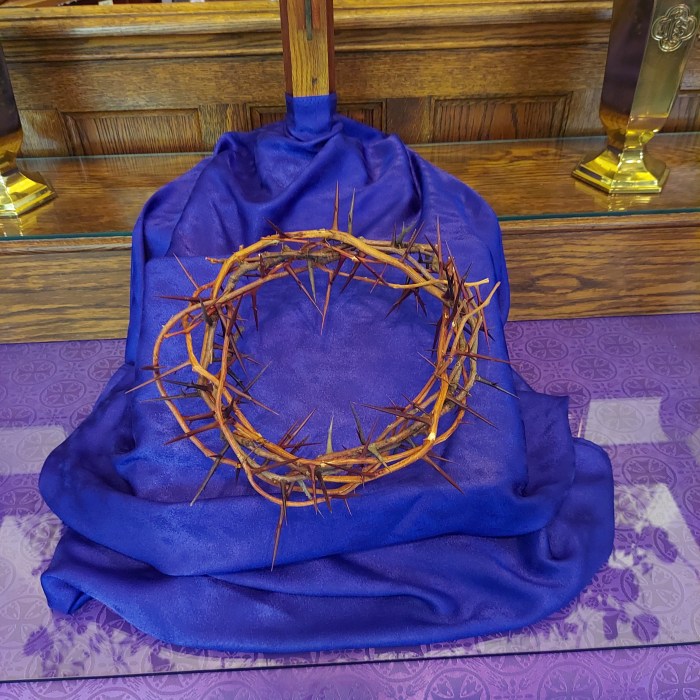
An image of a crown of thorns

Giving up Covid for Lent?

This year, our season of Lent begins with Ash Wednesday, on March 2nd.

But what will that look like?

Lent is a time to remember and to reflect.  Spring is coming.  And with its arrival, we will celebrate Jesus’ resurrection at Easter.  Ordinarily, we see Lent as a time to prepare.  A time to give up a favorite treat, food, or activity to remind ourselves of Jesus’ sacrifice and to reflect on him whenever we think about our abstinence from the thing that we “gave up” for Lent.  But over the past two years we’ve all given up so many things, my heart almost breaks when I think about giving up anything else. 

Our hearts ache for the return of “normal.”

And isn’t that sort of the point? 

And so, let’s think about Lent, and our preparation for Easter with that in mind.  Last year, we couldn’t be together for Lent.  We held Ash Wednesday online, but in dispensing own ashes, and marking our own foreheads, we missed out on pieces that felt crucial to our sense of belonging and normalcy.  This year we are worshipping in person and this year we will hold Ash Wednesday in person (and since we noticed that our attendance at our virtual Ash Wednesday far exceeded our regular in-person service, we will also have a livestream).

As we walk through the scriptures of preparation during Lent, you will notice that then, like now, the disciples were passing through a season of radical change.  Their routines were disrupted.  They were separated from their families, from Jesus, and often from one another.  By Easter morning they were heartbroken, frustrated, grieving, and longing for a return to normal.  And while our circumstances are vastly different, our own experiences over the last two years certainly make us appreciate what they were going through. 

And, assuming the progress of the pandemic continues the downward trend that we’ve been seeing, let’s plan to be together on Easter.  Let us use this time to start breaking the habits of the pandemic.  Rather than “giving up” for Lent, let’s start “adding back.”  Let’s try to attend church on Sunday rather than on Monday or Tuesday (remember YouTube tells me when you’re watching), try to get back in the habit of watching “live” at 10:15 instead of watching in the afternoon and try to attend weekly instead of skipping weeks.

In short, let us use this season of lent hopefully, and prepare ourselves for a return to as “normal” and Easter as we can muster.

Let us commit to a season of preparation so that we will arrive on Easter morning renewed, refreshed, equipped, expectant, and joyful.

My hope is that we can journey together during this season of anticipation and arrive, together, joyfully on Easter morning.

Blessings,

Pastor John

Christ United Methodist Church

Unmasked!

Click here to listen to the podcast

Click here to watch the livestream: https://youtu.be/7_DJBw967X8

Unmasked!

February 27, 2022*

By Pastor John Partridge

Exodus 34:29-35             Luke 9:28-36                       2 Corinthians 3:12 – 4:2

Have you ever felt self-conscious?  Have you worried that you don’t look quite right, or suddenly notice that everyone seems to be looking at you?  Maybe you have food stuck in your teeth, or your fly is unzipped, or your skin broke out and have a big zit or something.  It happens to everyone.  There even a powerful photograph of President Carter, Menachem Begin, and Anwar Sadat moments before they went in front of the cameras to sign the Camp David Accords.  In that moment, all three of these men, presidents of powerful nations, simultaneously and self-consciously stop to straighten their neckties before stepping out into the glare of the public eye.  And, I wonder if what we see in Exodus 34:29-35, was caused, at least in part, by Moses being self-conscious about everyone looking at him.

29 When Moses came down from Mount Sinai with the two tablets of the covenant law in his hands, he was not aware that his face was radiant because he had spoken with the Lord. 30 When Aaron and all the Israelites saw Moses, his face was radiant, and they were afraid to come near him. 31 But Moses called to them; so, Aaron and all the leaders of the community came back to him, and he spoke to them. 32 Afterward all the Israelites came near him, and he gave them all the commands the Lord had given him on Mount Sinai.

33 When Moses finished speaking to them, he put a veil over his face. 34 But whenever he entered the Lord’s presence to speak with him, he removed the veil until he came out. And when he came out and told the Israelites what he had been commanded, 35 they saw that his face was radiant. Then Moses would put the veil back over his face until he went in to speak with the Lord.

After Moses met with God, he was outwardly, and visibly, changed.  Our scripture says that his face was radiant, and from the description, that doesn’t seem to mean that he was happy in the way that we say, “the bride was radiant.”  We are, apparently, to understand that Moses’ face was… glowing… with a light of its own and that light, not surprisingly, was at least disconcerting, if not frightening, to the people around him.  The world didn’t seem any different to Moses, but Moses’ appearance was different, and it was noticeable, even shocking, to everyone who saw him.  And so, either to calm the fears of everyone else, or to calm his own feelings of self-consciousness, Moses began to wear a mask in public after each of his meetings with God.  There was something about being in the presence of God, that changes human beings.  And we see something similar in Luke 9:28-36.

28 About eight days after Jesus said this, he took Peter, John, and James with him and went up onto a mountain to pray. 29 As he was praying, the appearance of his face changed, and his clothes became as bright as a flash of lightning. 30 Two men, Moses, and Elijah, appeared in glorious splendor, talking with Jesus. 31 They spoke about his departure, which he was about to bring to fulfillment at Jerusalem. 32 Peter and his companions were very sleepy, but when they became fully awake, they saw his glory and the two men standing with him. 33 As the men were leaving Jesus, Peter said to him, “Master, it is good for us to be here. Let us put up three shelters—one for you, one for Moses and one for Elijah.” (He did not know what he was saying.)

34 While he was speaking, a cloud appeared and covered them, and they were afraid as they entered the cloud. 35 A voice came from the cloud, saying, “This is my Son, whom I have chosen; listen to him.” 36 When the voice had spoken, they found that Jesus was alone. The disciples kept this to themselves and did not tell anyone at that time what they had seen.

The disciples had become accustomed to traveling with Jesus and it was probably not uncommon for them to wake up early and be walking before the sun had risen.  But whatever the case on this day, whether morning or evening, the disciples that were walking with Jesus were half asleep.  But as Jesus prayed, the appearance of his face changed… and even his clothes changed so that they became as bright as a flash of lightning.  And then Moses and Elijah appeared, and they shone in “glorious splendor” perhaps, in a way, that was similar to the way that Moses’ face had shone when he met God.  And so now, obviously, Peter, James, and John were absolutely, completely, 100 percent awake and were, in a sense, in shock.  As soon as Moses and Elijah began to leave, Peter just begins to babble nonsense about building houses, worship centers, or something.  And then, as if this hadn’t been enough, suddenly a cloud appears, envelops them, and the voice of God announces that the disciples should listen to Jesus because he is his son.  And then, just as suddenly as it began, it was over, and they found themselves standing, on the mountainside, alone.

What I find interesting, is that even though Peter had been babbling about building shelters, and although Peter was often prone to shoot off his mouth, and to say things without thinking, after this incredible experience, none of these three disciples say… anything.  They don’t tell their families, they don’t tell the other disciples, they don’t tell anybody… anything.  And again, I think this has a lot to do with the disciples feeling self-conscious.  What they had just experienced was powerful, incredible, and probably more than a little… unbelievable.  Even for people who had witnessed Jesus heal the sick and raise the dead, who would believe what they had just seen?  Who would believe that they had seen the glory of God radiating from the face of Jesus?  Who would believe that they had been surrounded by the holy cloud of God that they had read about in the scriptures, or that they had met Moses and Elijah?  Who would believe that they had heard God’s own voice proclaiming that Jesus was his son?  Would anyone believe them?  Would they think they were crazy?  Would the Pharisees and other church leaders declare that they were heretics and throw them out of the Temple?

And regardless of their self-consciousness or fear, the disciples could not un-see what they had seen.  Like Moses, they had spent time in the presence of God, and they had been changed.

But what does that mean for us?  What do we take away from these stories of Moses, Jesus, the disciples, and the transfiguration?  In 2 Corinthians 3:12 – 4:2, Paul explained it to his church this way:

12 Therefore, since we have such a hope, we are very bold. 13 We are not like Moses, who would put a veil over his face to prevent the Israelites from seeing the end of what was passing away. 14 But their minds were made dull, for to this day the same veil remains when the old covenant is read. It has not been removed, because only in Christ is it taken away. 15 Even to this day when Moses is read, a veil covers their hearts. 16 But whenever anyone turns to the Lord, the veil is taken away. 17 Now the Lord is the Spirit, and where the Spirit of the Lord is, there is freedom. 18 And we all, who with unveiled faces contemplate the Lord’s glory, are being transformed into his image with ever-increasing glory, which comes from the Lord, who is the Spirit.

4:1 Therefore, since through God’s mercy we have this ministry, we do not lose heart. Rather, we have renounced secret and shameful ways; we do not use deception, nor do we distort the word of God. On the contrary, by setting forth the truth plainly we commend ourselves to everyone’s conscience in the sight of God.

Obviously, Paul’s understanding of why Moses wore a veil is not he same as mine and, I think, not the same as the reason given in Exodus.  Exodus simply says that people were afraid to look at Moses because he glowed or radiated but Paul interprets that to mean that Moses wore a mask so that people couldn’t see that the radiance of God in him faded over time.  Those are not at all the same things and, I think, Paul’s interpretation is unfair, and a little unkind, to Moses.  But I also think that Paul says this to make a point.  Paul makes the point of saying that accepting Christ is like tearing away the veil, or unmasking God so that we can see his glory more clearly.  Christians, Paul says, are the “unveiled faces” that can see God more clearly and something happens to us because of it.

As I said before, human beings that have spent time in the presence of God, are changed by the experience.  Moses glowed.  He was both outwardly and inwardly different because he met God.  Peter and James and John, and all the other disciples, were changed because of the time that they spent in the presence of both God and his son, Jesus.  Paul met Jesus on the road to Damascus, his entire life was turned upside down, and he was never the same afterwards.  Paul says that because we have met Jesus, and because we have been unmasked, and have seen the glory of God, our lives have also been changed.  We don’t give up, we are encouraged, we no longer deceive other people or distort the word of God.  Instead, we tell the truth as plainly as we can, and we tell the truth all the time, so that everyone will know that we can be trusted.

But there’s one more thing worth mentioning, I think.  Paul believed that when Moses met God face to face, the glory of God that radiated from Moses’ face faded over time.  And while I’m not sure that’s how I would interpret it, there is some sense to it.  Human beings are not God.  We do not, and we cannot, contain God’s glory.  Being in the presence of God changes us, but the effect in us fades if we aren’t deliberate in doing things that bring us back into God’s presence.  That’s why setting times of regular Bible study, prayer, and church attendance are so vital.  Nearly every Sunday, we pray that God would be at work changing us into the people that he created us to be.  But for that to happen, we need to do two things.  First, we need to give God permission to change us, and be willing to change.  And second, we must, regularly and deliberately, invite God into our lives, and set aside time for us to spend time in God’s presence.

But we warned: Just as Moses, Peter, James, John, Paul, and the disciples discovered, being in God’s presence changes people. 

And maybe that’s why so many people seem to be afraid to do it.


Did you enjoy reading this?

Please LIKE and SHARE!

Click here to subscribe to Pastor John’s blog.

Click here if you would like to subscribe to Pastor John’s weekly messages.

Click here to visit Pastor John’s YouTube channel.


*You have been reading a message presented at Christ United Methodist Church on the date noted at the top of the first page.  Rev. John Partridge is the pastor at Christ UMC in Alliance, Ohio.  Duplication of this message is a part of our Media ministry, if you have received a blessing in this way, we would love to hear from you.  Letters and donations in support of the Media ministry or any of our other projects may be sent to Christ United Methodist Church, 470 East Broadway Street, Alliance, Ohio 44601.  These messages are available to any interested persons regardless of membership.  You may subscribe to these messages, in print or electronic formats, by writing to the address noted, or by contacting us at secretary@CUMCAlliance.org.  If you have questions, you can ask them in our discussion forum on Facebook (search for Pastor John Online).  These messages can also be found online at https://pastorpartridge.com/.  All Scripture references are from the New International Version unless otherwise noted.