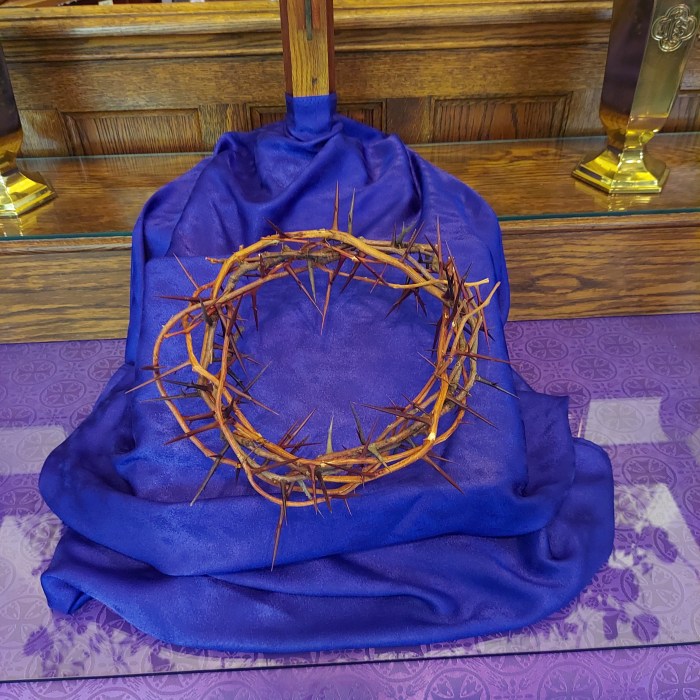
Unmasked!

Click here to listen to the podcast

Click here to watch the livestream: https://youtu.be/7_DJBw967X8

Unmasked!

February 27, 2022*

By Pastor John Partridge

Exodus 34:29-35             Luke 9:28-36                       2 Corinthians 3:12 – 4:2

Have you ever felt self-conscious?  Have you worried that you don’t look quite right, or suddenly notice that everyone seems to be looking at you?  Maybe you have food stuck in your teeth, or your fly is unzipped, or your skin broke out and have a big zit or something.  It happens to everyone.  There even a powerful photograph of President Carter, Menachem Begin, and Anwar Sadat moments before they went in front of the cameras to sign the Camp David Accords.  In that moment, all three of these men, presidents of powerful nations, simultaneously and self-consciously stop to straighten their neckties before stepping out into the glare of the public eye.  And, I wonder if what we see in Exodus 34:29-35, was caused, at least in part, by Moses being self-conscious about everyone looking at him.

29 When Moses came down from Mount Sinai with the two tablets of the covenant law in his hands, he was not aware that his face was radiant because he had spoken with the Lord. 30 When Aaron and all the Israelites saw Moses, his face was radiant, and they were afraid to come near him. 31 But Moses called to them; so, Aaron and all the leaders of the community came back to him, and he spoke to them. 32 Afterward all the Israelites came near him, and he gave them all the commands the Lord had given him on Mount Sinai.

33 When Moses finished speaking to them, he put a veil over his face. 34 But whenever he entered the Lord’s presence to speak with him, he removed the veil until he came out. And when he came out and told the Israelites what he had been commanded, 35 they saw that his face was radiant. Then Moses would put the veil back over his face until he went in to speak with the Lord.

After Moses met with God, he was outwardly, and visibly, changed.  Our scripture says that his face was radiant, and from the description, that doesn’t seem to mean that he was happy in the way that we say, “the bride was radiant.”  We are, apparently, to understand that Moses’ face was… glowing… with a light of its own and that light, not surprisingly, was at least disconcerting, if not frightening, to the people around him.  The world didn’t seem any different to Moses, but Moses’ appearance was different, and it was noticeable, even shocking, to everyone who saw him.  And so, either to calm the fears of everyone else, or to calm his own feelings of self-consciousness, Moses began to wear a mask in public after each of his meetings with God.  There was something about being in the presence of God, that changes human beings.  And we see something similar in Luke 9:28-36.

28 About eight days after Jesus said this, he took Peter, John, and James with him and went up onto a mountain to pray. 29 As he was praying, the appearance of his face changed, and his clothes became as bright as a flash of lightning. 30 Two men, Moses, and Elijah, appeared in glorious splendor, talking with Jesus. 31 They spoke about his departure, which he was about to bring to fulfillment at Jerusalem. 32 Peter and his companions were very sleepy, but when they became fully awake, they saw his glory and the two men standing with him. 33 As the men were leaving Jesus, Peter said to him, “Master, it is good for us to be here. Let us put up three shelters—one for you, one for Moses and one for Elijah.” (He did not know what he was saying.)

34 While he was speaking, a cloud appeared and covered them, and they were afraid as they entered the cloud. 35 A voice came from the cloud, saying, “This is my Son, whom I have chosen; listen to him.” 36 When the voice had spoken, they found that Jesus was alone. The disciples kept this to themselves and did not tell anyone at that time what they had seen.

The disciples had become accustomed to traveling with Jesus and it was probably not uncommon for them to wake up early and be walking before the sun had risen.  But whatever the case on this day, whether morning or evening, the disciples that were walking with Jesus were half asleep.  But as Jesus prayed, the appearance of his face changed… and even his clothes changed so that they became as bright as a flash of lightning.  And then Moses and Elijah appeared, and they shone in “glorious splendor” perhaps, in a way, that was similar to the way that Moses’ face had shone when he met God.  And so now, obviously, Peter, James, and John were absolutely, completely, 100 percent awake and were, in a sense, in shock.  As soon as Moses and Elijah began to leave, Peter just begins to babble nonsense about building houses, worship centers, or something.  And then, as if this hadn’t been enough, suddenly a cloud appears, envelops them, and the voice of God announces that the disciples should listen to Jesus because he is his son.  And then, just as suddenly as it began, it was over, and they found themselves standing, on the mountainside, alone.

What I find interesting, is that even though Peter had been babbling about building shelters, and although Peter was often prone to shoot off his mouth, and to say things without thinking, after this incredible experience, none of these three disciples say… anything.  They don’t tell their families, they don’t tell the other disciples, they don’t tell anybody… anything.  And again, I think this has a lot to do with the disciples feeling self-conscious.  What they had just experienced was powerful, incredible, and probably more than a little… unbelievable.  Even for people who had witnessed Jesus heal the sick and raise the dead, who would believe what they had just seen?  Who would believe that they had seen the glory of God radiating from the face of Jesus?  Who would believe that they had been surrounded by the holy cloud of God that they had read about in the scriptures, or that they had met Moses and Elijah?  Who would believe that they had heard God’s own voice proclaiming that Jesus was his son?  Would anyone believe them?  Would they think they were crazy?  Would the Pharisees and other church leaders declare that they were heretics and throw them out of the Temple?

And regardless of their self-consciousness or fear, the disciples could not un-see what they had seen.  Like Moses, they had spent time in the presence of God, and they had been changed.

But what does that mean for us?  What do we take away from these stories of Moses, Jesus, the disciples, and the transfiguration?  In 2 Corinthians 3:12 – 4:2, Paul explained it to his church this way:

12 Therefore, since we have such a hope, we are very bold. 13 We are not like Moses, who would put a veil over his face to prevent the Israelites from seeing the end of what was passing away. 14 But their minds were made dull, for to this day the same veil remains when the old covenant is read. It has not been removed, because only in Christ is it taken away. 15 Even to this day when Moses is read, a veil covers their hearts. 16 But whenever anyone turns to the Lord, the veil is taken away. 17 Now the Lord is the Spirit, and where the Spirit of the Lord is, there is freedom. 18 And we all, who with unveiled faces contemplate the Lord’s glory, are being transformed into his image with ever-increasing glory, which comes from the Lord, who is the Spirit.

4:1 Therefore, since through God’s mercy we have this ministry, we do not lose heart. Rather, we have renounced secret and shameful ways; we do not use deception, nor do we distort the word of God. On the contrary, by setting forth the truth plainly we commend ourselves to everyone’s conscience in the sight of God.

Obviously, Paul’s understanding of why Moses wore a veil is not he same as mine and, I think, not the same as the reason given in Exodus.  Exodus simply says that people were afraid to look at Moses because he glowed or radiated but Paul interprets that to mean that Moses wore a mask so that people couldn’t see that the radiance of God in him faded over time.  Those are not at all the same things and, I think, Paul’s interpretation is unfair, and a little unkind, to Moses.  But I also think that Paul says this to make a point.  Paul makes the point of saying that accepting Christ is like tearing away the veil, or unmasking God so that we can see his glory more clearly.  Christians, Paul says, are the “unveiled faces” that can see God more clearly and something happens to us because of it.

As I said before, human beings that have spent time in the presence of God, are changed by the experience.  Moses glowed.  He was both outwardly and inwardly different because he met God.  Peter and James and John, and all the other disciples, were changed because of the time that they spent in the presence of both God and his son, Jesus.  Paul met Jesus on the road to Damascus, his entire life was turned upside down, and he was never the same afterwards.  Paul says that because we have met Jesus, and because we have been unmasked, and have seen the glory of God, our lives have also been changed.  We don’t give up, we are encouraged, we no longer deceive other people or distort the word of God.  Instead, we tell the truth as plainly as we can, and we tell the truth all the time, so that everyone will know that we can be trusted.

But there’s one more thing worth mentioning, I think.  Paul believed that when Moses met God face to face, the glory of God that radiated from Moses’ face faded over time.  And while I’m not sure that’s how I would interpret it, there is some sense to it.  Human beings are not God.  We do not, and we cannot, contain God’s glory.  Being in the presence of God changes us, but the effect in us fades if we aren’t deliberate in doing things that bring us back into God’s presence.  That’s why setting times of regular Bible study, prayer, and church attendance are so vital.  Nearly every Sunday, we pray that God would be at work changing us into the people that he created us to be.  But for that to happen, we need to do two things.  First, we need to give God permission to change us, and be willing to change.  And second, we must, regularly and deliberately, invite God into our lives, and set aside time for us to spend time in God’s presence.

But we warned: Just as Moses, Peter, James, John, Paul, and the disciples discovered, being in God’s presence changes people. 

And maybe that’s why so many people seem to be afraid to do it.


Did you enjoy reading this?

Please LIKE and SHARE!

Click here to subscribe to Pastor John’s blog.

Click here if you would like to subscribe to Pastor John’s weekly messages.

Click here to visit Pastor John’s YouTube channel.


*You have been reading a message presented at Christ United Methodist Church on the date noted at the top of the first page.  Rev. John Partridge is the pastor at Christ UMC in Alliance, Ohio.  Duplication of this message is a part of our Media ministry, if you have received a blessing in this way, we would love to hear from you.  Letters and donations in support of the Media ministry or any of our other projects may be sent to Christ United Methodist Church, 470 East Broadway Street, Alliance, Ohio 44601.  These messages are available to any interested persons regardless of membership.  You may subscribe to these messages, in print or electronic formats, by writing to the address noted, or by contacting us at secretary@CUMCAlliance.org.  If you have questions, you can ask them in our discussion forum on Facebook (search for Pastor John Online).  These messages can also be found online at https://pastorpartridge.com/.  All Scripture references are from the New International Version unless otherwise noted.

Christian Extra-Terrestrials?

Click here to listen to the Podcast

Click here to watch the livestream of this service: https://youtu.be/SA72AxXPOR0

Christian Extra-Terrestrials?

February 20, 2022*

By Pastor John Partridge

Genesis 45:3-11, 15

Luke 6:27-38

1 Corinthians 15:35-38, 42-50

Many of you are old enough to have watched the Steven Spielberg movie, E.T. the Extraterrestrial and, even if you haven’t watched it, you probably at least know something about it.  There’s also a good chance that E.T. is what you thought of when you saw today’s sermon title, “Christian Extraterrestrials.”  But despite Elon Musk’s goal of establishing a colony on Mars, interplanetary Christians is not what I have in mind… at least for today.  What I have in mind, however, is just a little bit different linguistically.  I thought about using Superhuman, or Supernatural, but those words bring up mental images of Superman from the planet Krypton, or a couple of brothers on television who fight ghosts, demons, and other non-human creatures, so neither of those words really work either.  But the definition of the prefix “extra” means “beyond” and so while “extra-terrestrial” can mean a person, or a creature, that is from beyond our planet, it might also mean someone from this planet whose abilities lie beyond the those of normal, or expected, people. 

And besides, it made you curious.

In any case, “beyond terrestrial” is a legitimate translation of the language that is used in our scriptures today.  But, before we get to that, let’s begin with the story of Joseph.  Nearing the end of Joseph’s epic in Genesis, we join his story at the point where, having once been sold into slavery by his brothers, Joseph is now, after Pharaoh, the second most powerful man in all of Egypt if not the second most powerful man on the planet.  But at this moment, Joseph reveals his true identity to his brothers, the same men who years earlier had beaten him, thrown him in an empty cistern, and sold him into slavery.  And, understandably, when his brothers realize who he is, they are terrified.  We rejoin that story in Genesis 45:3-11,15:

Joseph said to his brothers, “I am Joseph! Is my father still living?” But his brothers were not able to answer him, because they were terrified at his presence.

Then Joseph said to his brothers, “Come close to me.” When they had done so, he said, “I am your brother Joseph, the one you sold into Egypt! And now, do not be distressed and do not be angry with yourselves for selling me here, because it was to save lives that God sent me ahead of you. For two years now there has been famine in the land, and for the next five years there will be no plowing and reaping. But God sent me ahead of you to preserve for you a remnant on earth and to save your lives by a great deliverance.

“So then, it was not you who sent me here, but God. He made me father to Pharaoh, lord of his entire household and ruler of all Egypt. Now hurry back to my father and say to him, ‘This is what your son Joseph says: God has made me lord of all Egypt. Come down to me; don’t delay. 10 You shall live in the region of Goshen and be near me—you, your children and grandchildren, your flocks, and herds, and all you have. 11 I will provide for you there, because five years of famine are still to come. Otherwise, you and your household and all who belong to you will become destitute.’

15 And he kissed all his brothers and wept over them. Afterward his brothers talked with him.

Joseph’s brothers were terrified that, because he was now the most powerful man in Egypt, and not the pesky younger brother, they expected that he would take his revenge on them for what they had done.  And, honestly, no one would be surprised if that had happened.  Joseph had every right to be angry and it would have been fair for him to sell his brothers into slavery as they had done to him.  But Joseph’s relationship with God gave him a different perspective.  Rather than seeing this as an opportunity for revenge, Joseph sees that God has been intervening in human affairs, influencing events, and moving him into position so that he could rescue the entire nation of Egypt, and his family, the people that would one day become the nation of Israel.  Joseph behaves in a way that is unexpected because his relationship with God has given him a vision of the world that is beyond human.

And we can see that same vision as Jesus teaches his disciples in Luke 6:27-38, as he says:

27 “But to you who are listening I say: Love your enemies, do good to those who hate you, 28 bless those who curse you, pray for those who mistreat you. 29 If someone slaps you on one cheek, turn to them the other also. If someone takes your coat, do not withhold your shirt from them. 30 Give to everyone who asks you, and if anyone takes what belongs to you, do not demand it back. 31 Do to others as you would have them do to you.

32 “If you love those who love you, what credit is that to you? Even sinners love those who love them. 33 And if you do good to those who are good to you, what credit is that to you? Even sinners do that. 34 And if you lend to those from whom you expect repayment, what credit is that to you? Even sinners lend to sinners, expecting to be repaid in full. 35 But love your enemies, do good to them, and lend to them without expecting to get anything back. Then your reward will be great, and you will be children of the Most High, because he is kind to the ungrateful and wicked. 36 Be merciful, just as your Father is merciful.

37 “Do not judge, and you will not be judged. Do not condemn, and you will not be condemned. Forgive, and you will be forgiven. 38 Give, and it will be given to you. A good measure, pressed down, shaken together, and running over, will be poured into your lap. For with the measure you use, it will be measured to you.”

Jesus says that being ‘just as good’ as the evil people around you isn’t good enough.  And being just as good as average and ordinary people isn’t good enough either.  The standard for his followers is to do good even when no other reasonable person would do good, to be unreasonably good, or… beyond humanly good.  Jesus wants his followers to love the people around them more than other reasonable people would love, to love in a way that is beyond humanly loving or, beyond earthly love. 

And the examples that Jesus gives are so far beyond our understanding of normal, that they are understandably difficult.  Jesus says that we should loan money, not just to people that we trust, and not just people that we believe can pay us back, but to loan money to people we don’t even like, people we regard as our enemies, and that includes people that we might be confident have no means, and possibly no intention, of ever paying us back.  Jesus says that we should loan them the money with no expectation that we should get it back.  In other words, just give money away to people that you hate, and who probably hate you back.  Loving in ways that are beyond human, or beyond terrestrial, is exactly the point that Jesus is making.  Our calling isn’t to love the people around us like ordinary, average, or even exceptional people love, our calling is to love the people around us the way that God loves.  God is loving, kind, and merciful to the ungrateful and the wicked who neither like him nor even know him.

It’s worth noting here that “Do not judge” is currently one of the most commonly misquoted and misinterpreted verses of scripture.  It most certainly does not mean that we should… never… judge.  Matthew includes this same quote from Jesus, but records Jesus’ statement as saying, “Do not judge, or you too will be judged. For in the same way you judge others, you will be judged, and with the measure you use, it will be measured to you.” (Matthew 7:1) To make this clear, some translations record this as “Do not judge unfairly” rather than simply do not judge.  There are many times when Jesus asks, even commands us to judge between good and evil, honor and dishonor, to be discerning in all that we do, and other things.  What Jesus clearly means is that we will be judged in the same way that we judge others.  Don’t rush to judgement.  Don’t judge without evidence. Or, as the translators have said, don’t judge unfairly.  Likewise, we can expect to receive the generosity of God with the same, or better, generosity that we show others.  Give and it will be given to you in an even more abundant and generous measure.

But why?  Why is the standard for love, mercy, and compassion so much higher for Christians than it is for everyone else?  Why does God demand that our behavior be beyond human, whether we call that super-human or extra-terrestrial?  We find the answer to “why” in Paul’s letter to the church in Corinth where he says (1 Corinthians 15:35-38, 42-50)

35 But someone will ask, “How are the dead raised? With what kind of body will they come?” 36 How foolish! What you sow does not come to life unless it dies. 37 When you sow, you do not plant the body that will be, but just a seed, perhaps of wheat or of something else. 38 But God gives it a body as he has determined, and to each kind of seed he gives its own body.

42 So will it be with the resurrection of the dead. The body that is sown is perishable, it is raised imperishable; 43 it is sown in dishonor, it is raised in glory; it is sown in weakness, it is raised in power; 44 it is sown a natural body, it is raised a spiritual body.

If there is a natural body, there is also a spiritual body. 45 So it is written: “The first man Adam became a living being”; the last Adam [aka Jesus], a life-giving spirit. 46 The spiritual did not come first, but the natural, and after that the spiritual. 47 The first man was of the dust of the earth; the second man is of heaven. 48 As was the earthly man [Adam], so are those who are of the earth; and as is the heavenly man [Jesus], so also are those who are of heaven. 49 And just as we have borne the image of the earthly man, so shall webear the image of the heavenly man.

And although Paul takes a while to get to his point, the answer really is simple.  The reason that the followers of Jesus Christ are commanded, and empowered, to behave in ways that are beyond human, and the reason that it isn’t okay to just be the same as other people, is because earth and heaven are not the same.  Adam and Jesus are not the same.  When we choose to follow Jesus Christ, we become image bearers of God.  Our calling is no longer to look like everyone else and reflect the image of the world in which we live, but rather to reflect the image of a merciful, just, compassionate, and loving God and to reflect an entirely different reality.

As the image bearers of God, we must love more than humanly possible, be impossibly forgiving, extraordinarily generous, inhumanly merciful, and in every other way that we can, be an accurate reflection the goodness and holiness of God.

God has called us, commanded us, and empowered us to behave in ways that are super-human, and beyond earthly.

In other words, we are called to be nothing less than Extra-Terrestrial Christians.


Did you enjoy reading this?

Please LIKE and SHARE!

Click here to subscribe to Pastor John’s blog.

Click here if you would like to subscribe to Pastor John’s weekly messages.

Click here to visit Pastor John’s YouTube channel.


*You have been reading a message presented at Christ United Methodist Church on the date noted at the top of the first page.  Rev. John Partridge is the pastor at Christ UMC in Alliance, Ohio.  Duplication of this message is a part of our Media ministry, if you have received a blessing in this way, we would love to hear from you.  Letters and donations in support of the Media ministry or any of our other projects may be sent to Christ United Methodist Church, 470 East Broadway Street, Alliance, Ohio 44601.  These messages are available to any interested persons regardless of membership.  You may subscribe to these messages, in print or electronic formats, by writing to the address noted, or by contacting us at secretary@CUMCAlliance.org.  If you have questions, you can ask them in our discussion forum on Facebook (search for Pastor John Online).  These messages can also be found online at https://pastorpartridge.com.  All Scripture references are from the New International Version unless otherwise noted.

Whom Do You Trust?

Click here to listen to the podcast

Video of this worship service can be found here: https://youtu.be/t5u9MdvdDYg

Whom Do You Trust?

February 13, 2022*

By Pastor John Partridge

Jeremiah 17:5-10

Luke6:17-26

1 Corinthians 15:12-20

Do you remember the television game show Who Wants to be a Millionaire?

On that show, you earned money by answering multiple choice questions that increased in difficulty as you advanced.  And, as the questions got harder, players had the opportunity to use three “lifelines.”  They could ask the audience, they could reduce the number of possible answers from four to two, or they could phone a friend.  Today, I want to think about that last one.  Imagine that one question might stand between you and a million dollars.  And that’s what every contestant had to think about when they had the opportunity play the game.  Choose one person, and a million dollars hangs on their ability to answer one random question.  And in that moment of decision, those contestants had to ask themselves, “Whom do I trust?”

In a variety of ways, we answer that question all the time.  Whom do we trust to educate, or to babysit, or provide medical care, for our children?  Whom do we trust with the money that we save for our retirement?  Whom do we trust to run our government, church, or social club?  Whom do we trust with our friendship, or our medical care, or a host of other things?  The stakes of our decisions are high because our lives can, literally, hang in the balance.  That’s exactly what we find in our scriptures for today.  We begin with the words of God found in Jeremiah 17:5-10.  Lives hang in the balance, but whom do you trust? 

This is what the Lord says:

“Cursed is the one who trusts in man,
    who draws strength from mere flesh
    and whose heart turns away from the Lord.
That person will be like a bush in the wastelands;
    they will not see prosperity when it comes.
They will dwell in the parched places of the desert,
    in a salt land where no one lives.

“But blessed is the one who trusts in the Lord,
    whose confidence is in him.
They will be like a tree planted by the water
    that sends out its roots by the stream.
It does not fear when heat comes;
    its leaves are always green.
It has no worries in a year of drought
    and never fails to bear fruit.”

The heart is deceitful above all things
    and beyond cure.
    Who can understand it?

10 “I the Lord search the heart
    and examine the mind,
to reward each person according to their conduct,
    according to what their deeds deserve.”

This is incredibly relevant to us in the twenty-first century.  God doesn’t say that we are cursed for trusting any one person, but we can be cursed by God for putting the fundamental trust of our lives in any human, in any person, other than God.  We must not put our trust in politicians, or in human governments, or in television, radio, or internet personalities.  Humans fail.  Humans disappoint.  Humans can be selfish and turn away from God.  If we want our lives to be blessed by God, then we must trust our lives to God and put our confidence entirely in God.

At the end of the day, God says, our reward is based on merit.  Our reward isn’t based on what we thought, but on our deeds.  In other words, our reward is based upon what we do.  And please note, that this statement about rewards is not written in the past tense.  This is not a judgement by God after our lives are over, but rewards that God gives while we are alive.

In Luke 6:17-26, Jesus delivers a message that is known as the Sermon on the Plain, and in that message, Jesus also has something to say about trust.

17 He went down with them and stood on a level place. A large crowd of his disciples was there and a great number of people from all over Judea, from Jerusalem, and from the coastal region around Tyre and Sidon, 18 who had come to hear him and to be healed of their diseases. Those troubled by impure spirits were cured, 19 and the people all tried to touch him, because power was coming from him and healing them all.

20 Looking at his disciples, he said:

“Blessed are you who are poor,
    for yours is the kingdom of God.
21 Blessed are you who hunger now,
    for you will be satisfied.
Blessed are you who weep now,
    for you will laugh.
22 Blessed are you when people hate you,
    when they exclude you and insult you
    and reject your name as evil,
        because of the Son of Man.

23 “Rejoice in that day and leap for joy, because great is your reward in heaven. For that is how their ancestors treated the prophets.

24 “But woe to you who are rich,
    for you have already received your comfort.
25 Woe to you who are well fed now,
    for you will go hungry.
Woe to you who laugh now,
    for you will mourn and weep.
26 Woe to you when everyone speaks well of you,
    for that is how their ancestors treated the false prophets.

Untold thousands of sermons have, undoubtedly been written about Jesus’ Sermon on the Plain but let’s think about its meaning in light of today’s focus on trust.  Jesus says that the poor, the hungry, and the weeping are all blessed by God and most everyone will admit that this always sounds a bit odd.  But as we think about trust, doesn’t it make sense that the poor are blessed, because they trust God for their daily living.  The hungry trust God for their daily food.  Those who weep lean on God for strength and we all cling to God when the people around us hate us, exclude us, insult us, and reject us.  Likewise, the richer we are, the more comfortable we get, when our bellies are full, and when we are laughing and surrounded by friends, it is easy for us to put our trust somewhere other than God. 

The emphasis of Jesus’ message is that we needn’t worry when things aren’t going well.  None of us want to be poor, or hungry, filled with sorrow, or hated by the people around us, but our primary concern should never be for our comfort or our popularity.  Our primary concern should always be about our relationship with, and our trust in God.

And in 1 Corinthians 15:12-20, Paul shares a message for his church that remains strikingly relevant in a twenty first century world that doubts the resurrection just as much as it did two thousand years ago.  Paul says…

12 But if it is preached that Christ has been raised from the dead, how can some of you say that there is no resurrection of the dead? 13 If there is no resurrection of the dead, then not even Christ has been raised. 14 And if Christ has not been raised, our preaching is useless and so is your faith. 15 More than that, we are then found to be false witnesses about God, for we have testified about God that he raised Christ from the dead. But he did not raise him if in fact the dead are not raised. 16 For if the dead are not raised, then Christ has not been raised either. 17 And if Christ has not been raised, your faith is futile; you are still in your sins. 18 Then those also who have fallen asleep in Christ are lost. 19 If only for this life we have hope in Christ, we are of all people most to be pitied.

20 But Christ has indeed been raised from the dead, the first-fruits of those who have fallen asleep.

Then, like now, there were people, even preachers, that said Jesus had never been raised from the dead.  They may have said that Jesus never really died, or that the resurrection never happened, and Paul could find folks with either of those opinions, just as you can now.  But Paul makes it clear that if there is no resurrection, then all of Christianity falls apart.  Anyone, and certainly any preacher or teacher, that says that the resurrection didn’t happen is a false witness.  If Jesus didn’t rise from the dead, then we have no hope of resurrection, no hope of eternal life, and everything that we have believed, and our life’s work, has been a waste.  Were that true, Paul says, our trust would have been completely misplaced, and we would be the most pitiable people in the world.

But Jesus did rise from the dead.

And that, Paul says, is the foundation of our faith, our church, our mission, who we are, and everything that we do.  It is in Jesus Christ that we have placed our faith, and in whom we have put our whole trust.

Twenty centuries ago, the temptation was for people to put their faith and confidence in the Caesar, or the emperor, national governments, powerful armies, wealthy patrons, money, or false gods.  And, although the names of the politicians, nations, and false gods may have changed, the things that tempt people away from God haven’t really changed that much.  We’re still tempted to trust politicians, parties, national governments, powerful armies, employers, wealth, popularity, and other gods instead of the one true God, the creator of everything.  Poverty, hunger, sorrow, and persecution, are not now, nor have they ever been something that anyone wants for their life, but they all have a way of clarifying our trust.  The lesson isn’t that it’s good to be poor, but that the most important thing is to put our whole trust in God and to keep God in the center of all that we do, and all that we are.

We still wonder whom we can trust, but ultimately the answer is a lot more important than a game show and is worth a lot more than a million dollars.  Times changed and the people of the Old and New Testaments would feel lost in the world of the twenty-first century, but wisdom doesn’t change.  The wisdom of scripture is just a true today as it was two thousand, or even three thousand years ago.

Proverbs 3:5-6 says:

Trust in the Lord with all your heart
    and lean not on your own understanding;
in all your ways submit to him,
    and he will make your paths straight.


Did you enjoy reading this?

Please LIKE and SHARE!

Click here to subscribe to Pastor John’s blog.

Click here if you would like to subscribe to Pastor John’s weekly messages.

Click here to visit Pastor John’s YouTube channel.


*You have been reading a message presented at Christ United Methodist Church on the date noted at the top of the first page.  Rev. John Partridge is the pastor at Christ UMC in Alliance, Ohio.  Duplication of this message is a part of our Media ministry, if you have received a blessing in this way, we would love to hear from you.  Letters and donations in support of the Media ministry or any of our other projects may be sent to Christ United Methodist Church, 470 East Broadway Street, Alliance, Ohio 44601.  These messages are available to any interested persons regardless of membership.  You may subscribe to these messages, in print or electronic formats, by writing to the address noted, or by contacting us at secretary@CUMCAlliance.org.  If you have questions, you can ask them in our discussion forum on Facebook (search for Pastor John Online).  These messages can also be found online at https://pastorpartridge.com/.  All Scripture references are from the New International Version unless otherwise noted.

From Ruin to Rescue

Click here to listen to the Podcast

Click here to watch on YouTube: https://youtu.be/ti7TpIKkqLQ


From Ruin to Rescue

February 06, 2022*

By Pastor John Partridge

Isaiah 6:1-13

Luke 5:1-11

1 Corinthians 15:1-11

There is a story that is common to special Sundays with the Gideon’s, or to inspirational speakers who are recovered alcoholics, or drug addicts, or former gang members.  It’s the same attraction that we have to the stories of people like Chuck Colson.  Colson was convicted of breaking into the Watergate building and was a key participant in that Nixon-era scandal, but he encountered the message of the risen Jesus in prison and founded Prison Fellowship ministry to reach others who find themselves on the wrong side of iron bars.  We are inspired by stories of people who got lost or reached rock bottom, but ultimately found a way to rebuild their lives.

As we read the stories of scripture, we find many stories like that and, in fact, the whole point of God’s message is a story of redemption, rescue, and restoration.  But before a story of rescue can be told, we often need to hear a story of ruin.  Before we hear how a person rose from the ashes like a phoenix, there is often a story of how they crashed and burned.  And, for that, we begin with the story of Israel contained in Isaiah 6:1-13 where we hear this:

6:1 In the year that King Uzziah died, I saw the Lord, high and exalted, seated on a throne; and the train of his robe filled the temple. Above him were seraphim, each with six wings: With two wings they covered their faces, with two they covered their feet, and with two they were flying. And they were calling to one another:

“Holy, holy, holy is the Lord Almighty; the whole earth is full of his glory.”

At the sound of their voices the doorposts and thresholds shook, and the temple was filled with smoke.

“Woe to me!” I cried. “I am ruined! For I am a man of unclean lips, and I live among a people of unclean lips, and my eyes have seen the King, the Lord Almighty.”

Then one of the seraphim flew to me with a live coal in his hand, which he had taken with tongs from the altar. With it he touched my mouth and said, “See, this has touched your lips; your guilt is taken away and your sin atoned for.”

Then I heard the voice of the Lord saying, “Whom shall I send? And who will go for us?”

And I said, “Here am I. Send me!”

He said, “Go and tell this people:

“‘Be ever hearing, but never understanding;
    be ever seeing, but never perceiving.’
10 Make the heart of this people calloused; make their ears dull and close their eyes.
Otherwise, they might see with their eyes, hear with their ears,
    understand with their hearts, and turn and be healed.”

11 Then I said, “For how long, Lord?”

And he answered:

“Until the cities lie ruined and without inhabitant,
until the houses are left deserted
    and the fields ruined and ravaged,
12 until the Lord has sent everyone far away
    and the land is utterly forsaken.
13 And though a tenth remains in the land,
    it will again be laid waste.
But as the terebinth and oak
    leave stumps when they are cut down,
    so the holy seed will be the stump* in the land.”

Isaiah has a vision of God in all his glory, sitting on the throne of heaven and Isaiah cries out that he is ruined or, we perhaps understand his intentions better by translating that as “I am a dead man walking.”    It was a common belief that any imperfect and sinful mortal who saw a perfect and holy God face to face would immediately die.  But an angel, a seraph, takes a hot coal from the altar, touches it to Isaiah’s lips and says that his guilt has been taken away and atonement has been made for his sin.  And so, when God asks who he might send into the world as his ambassador, Isaiah raises his hand and volunteers. 

.

But the message that God has for the people of Israel is terrifying.  God’s message is that the people just aren’t getting it.  They don’t see, they don’t understand, they’re sick, and they don’t want to get better, and God’s judgement is that for their disobedience, he will allow them to suffer the consequences of their unbelief.  And, when Isaiah asks how long this punishment will endure, God replies that Israel will be left to their own devices until their houses, fields, people, and everything else are utterly ruined and the trees are left as stumps. 

Stumps.

The word “stumps” is worth noting because a few chapters later, Isaiah refers to the messiah as a shoot that comes up from the “stump of Jesse.” (Isaiah 11:1) God’s punishment is to turn Israel over to the natural consequences of their disobedient actions and refuse to rescue them.  But, in the same passage, God hints at the hope of future rescue.

And then, after we have heard about what happens to a disobedient people, and what happens to them when they refuse to hear the words of God, in Luke 5:1-11, we are given a vision of what happens when God’s people do listen and are obedient to his words as Jesus begins his ministry and encounters fishermen by the shores of the Sea of Galilee.

5:1 One day as Jesus was standing by the Lake of Gennesaret, the people were crowding around him and listening to the word of God. He saw at the water’s edge two boats, left there by the fishermen, who were washing their nets. He got into one of the boats, the one belonging to Simon, and asked him to put out a little from shore. Then he sat down and taught the people from the boat.

When he had finished speaking, he said to Simon, “Put out into deep water, and let down the nets for a catch.”

Simon answered, “Master, we’ve worked hard all night and haven’t caught anything. But because you say so, I will let down the nets.”

When they had done so, they caught such a large number of fish that their nets began to break. So they signaled their partners in the other boat to come and help them, and they came and filled both boats so full that they began to sink.

When Simon Peter saw this, he fell at Jesus’ knees and said, “Go away from me, Lord; I am a sinful man!” For he and all his companions were astonished at the catch of fish they had taken, 10 and so were James and John, the sons of Zebedee, Simon’s partners.

Then Jesus said to Simon, “Don’t be afraid; from now on you will fish for people.” 11 So they pulled their boats up on shore, left everything, and followed him.

Jesus had barely started his ministry but even so, Simon, who would later be called Peter, was willing to let Jesus borrow his boat as a place to preach to the people gathered on the shores of Galilee.  After Jesus was done preaching, he asked Simon, a professional fisherman who had been fishing the shores of this lake for his entire life, to go out into deep water and to throw out the nets that he and his partners had just spent hours cleaning.  Worse still, the fisherman had not only just cleaned the nets, they had spent the entire night fishing with them and caught nothing but weeds, grass, sticks, and rocks.  They had been awake all night.  They had been throwing heavy, wet, nets into the sea and hauling them back out, hand over hand, time after time, hour after hour, all night.  And then, after they had spent their morning cleaning and repairing those same nets, they were ready to go home, see their families, eat, get some sleep, and get ready to do it again.  They were tired, sore, hungry, and probably more than a little grouchy.

But despite their hunger, irritation, fatigue, professional experience, and every other reason that they had to say no, and tell Jesus to get stuffed, Simon tells Jesus, “…because you say so, I will let down the nets.”

“Because you say so, I will let down the nets.”

And because Simon and his friends are willing to be obedient, even when they don’t even really know Jesus, and even though everything says that they should just go home and get some sleep, their lives are completely transformed.  This is the opposite of what we saw a moment ago in Isaiah 6.  There, the people of God knew the words of God but selfishly chose to go their own way and to do their own thing.  Here, even though they haven’t yet recognized Jesus as the Messiah, these fishermen are willing to be obedient, even in the face of their own hunger, fatigue, and irritation.  And it is that willingness to be obedient that transforms their lives.

And that brings us to 1 Corinthians 15:1-11, where we find Paul warning the church in Corinth that they seem to be drifting toward selfishness and away from obedience.  Paul says:

15:1 Now, brothers and sisters, I want to remind you of the gospel I preached to you, which you received and on which you have taken your stand. By this gospel you are saved, if you hold firmly to the word I preached to you. Otherwise, you have believed in vain.

For what I received I passed on to you as of first importance: that Christ died for our sins according to the Scriptures, that he was buried, that he was raised on the third day according to the Scriptures, and that he appeared to Cephas, and then to the Twelve. After that, he appeared to more than five hundred of the brothers and sisters at the same time, most of whom are still living, though some have fallen asleep. Then he appeared to James, then to all the apostles, and last of all he appeared to me also, as to one abnormally born.

For I am the least of the apostles and do not even deserve to be called an apostle, because I persecuted the church of God. 10 But by the grace of God I am what I am, and his grace to me was not without effect. No, I worked harder than all of them—yet not I, but the grace of God that was with me. 11 Whether then, it is I or they, this is what we preach, and this is what you believed.

Paul says that the people of the church need to remember where they started, to remember the gospel message that they had originally found so compelling that they had left behind their former gods, and former religions, and chosen to follow Jesus instead.  It was that message, Paul says, that saved them and abandoning that message would make everything that they had done, and everything that they had endured, completely pointless.  He then recites four points that are still contained on many of our creeds today, that Christ died, was buried, raised on the third day, and appeared to Peter and the twelve. 

But Paul also says that although he had once persecuted the church, he was shown grace by God, had been transformed, and was now a missionary to the Gentiles for the cause of Jesus Christ.  Like Peter, Paul’s entire life was transformed by his obedience to God, and he urges the people of the church in Corinth to remember that this was the power of the gospel in which they had put their faith.

We face a choice between ruin and redemption, between ruin and rescue, and the thing that transforms one to the other is our obedience to God and our willingness to do the things that Jesus asks us to do.  Clinging to selfishness will inevitably lead to our destruction, but like Peter, the fishermen, and like Paul, our obedience to Jesus Christ can completely transform our lives into something new, powerful, unexpected, and completely amazing.

But, having been rescued, God asks us to rescue others.  God is still asking, “Whom shall I send? And who will go for us?”

Are you ready to be obedient?  Are you ready to fish for people?

What will be your answer? 


Did you enjoy reading this?

Please LIKE and SHARE!

Click here to subscribe to Pastor John’s blog.

Click here if you would like to subscribe to Pastor John’s weekly messages.

Click here to visit Pastor John’s YouTube channel.


*You have been reading a message presented at Christ United Methodist Church on the date noted at the top of the first page.  Rev. John Partridge is the pastor at Christ UMC in Alliance, Ohio.  Duplication of this message is a part of our Media ministry, if you have received a blessing in this way, we would love to hear from you.  Letters and donations in support of the Media ministry or any of our other projects may be sent to Christ United Methodist Church, 470 East Broadway Street, Alliance, Ohio 44601.  These messages are available to any interested persons regardless of membership.  You may subscribe to these messages, in print or electronic formats, by writing to the address noted, or by contacting us at secretary@CUMCAlliance.org.    These messages can also be found online at https://pastorpartridge.com/.  All Scripture references are from the New International Version unless otherwise noted.

Missing the Point

You can find the livestream of this service here: https://youtu.be/NPJQzZy3N9U

Missing the Point Podcast

Some thoughts on how the followers of Jesus should have conversations about politics and other difficult (and divisive) subjects can be found in this special video short of today’s benediction:

https://youtu.be/K-5cLL-5p-s

Missing the Point

January 30, 2022*

By Pastor John Partridge

Jeremiah 1:4-10

Luke 4:21-30

1 Corinthians 13:1-13

To find an example for this morning’s message, I opened my search engine and entered, “People who missed the point” and I was not disappointed.  I was instantly directed to an article on Buzzfeed with a title that almost exactly matched my search, and while some of the illustrations are too visual to explain here there were still plenty of examples to make you smile… and groan a little.  There was the photo a handicap “accessible” bathroom that was at the top of two stairs, a person using the blade of a Swiss army knife to open a wine bottle while the corkscrew was plainly in view a fraction of an inch from their thumb, a photo of a CNN “Breaking News” bulletin that the Titanic had sunk 102 years ago, a “connect the dots” coloring book in which the printed dots were already connected, a company named “Just Wireless” that was selling computer cable wires, a restaurant that offered a veggie burger with bacon, and Crest mouthwash that advertised 24-hour protection with instructions to use twice per day.

Sometimes people seem to completely miss the point… and sometimes it’s funny when they do.  We probably all do it from time to time.  But sometimes missing the point isn’t funny at all, and sometimes the results of missing the point can be downright tragic.  We begin in Jeremiah 1:4-10 where we hear God cautioning a very young Jeremiah, possibly only 12 years old, that he should not miss the point.

The word of the Lord came to me, saying,

“Before I formed you in the womb I knewyou,
    before you were born, I set you apart;
    I appointed you as a prophet to the nations.”

“Alas, Sovereign Lord,” I said, “I do not know how to speak; I am too young.”

But the Lord said to me, “Do not say, ‘I am too young.’ You must go to everyone I send you to and say whatever I command you. Do not be afraid of them, for I am with you and will rescue you,” declares the Lord.

Then the Lord reached out his hand and touched my mouth and said to me, “I have put my words in your mouth. 10 See, today I appoint you over nations and kingdoms to uproot and tear down, to destroy and overthrow, to build and to plant.”

God tells Jeremiah that he has known everything about him, about his life, about his purpose, and about his calling to mission and ministry since before he was even conceived by his parents.  But Jeremiah is certain that God has made a mistake, misses the point, and argues with God because he is certain that God cannot use a twelve-year-old to bring a message to the leaders, priests, royalty, and the king of Israel.  But, again, Jeremiah misses the point and God says something that amounts to, “What part of I set you apart,” or “I appointed you” did you not understand?  God says that the point is not that Jeremiah is young and will, almost certainly, be disrespected by the elders of Israel because of his age, the point is that God, the creator of the universe, is sending him, is going with him, and promises to rescue him from whatever happens.  And to make that point even clearer, God touches Jeremiah and says that he has put the words of God into his mouth and gives him the authority to uproot, tear down, destroy, overthrow, build, or to plant entire nations and kingdoms. 

Boom. 

That’s the point.

And, as we rejoin the story of Jesus that we began last week (The Power of Systems Integration), we discover that the people of Jesus’ hometown of Nazareth missed the point quite spectacularly in Luke 4:21-30 after Jesus read from the Isaiah scroll and announced the fulfillment of scripture.

21 He began by saying to them, “Today this scripture is fulfilled in your hearing.”

22 All spoke well of him and were amazed at the gracious words that came from his lips. “Isn’t this Joseph’s son?” they asked.

23 Jesus said to them, “Surely you will quote this proverb to me: ‘Physician, heal yourself!’ And you will tell me, ‘Do here in your hometown what we have heard that you did in Capernaum.’”

24 “Truly I tell you,” he continued, “no prophet is accepted in his hometown. 25 I assure you that there were many widows in Israel in Elijah’s time, when the sky was shut for three and a half years and there was a severe famine throughout the land. 26 Yet Elijah was not sent to any of them, but to a widow in Zarephath in the region of Sidon. 27 And there were many in Israel with leprosyin the time of Elisha the prophet, yet not one of them was cleansed—only Naaman the Syrian.”

28 All the people in the synagogue were furious when they heard this. 29 They got up, drove him out of the town, and took him to the brow of the hill on which the town was built, in order to throw him off the cliff. 30 But he walked right through the crowd and went on his way.

Jesus announces that the people in the synagogue are witnesses as he begins the fulfillment of some of the messianic prophecies found in the writings of Isaiah, and the response of the people is “Who does this guy think he is?  We know him. We’ve known him his entire life.  We grew up with his parents. Obviously, the Jesus we know cannot be the Messiah.”  Jesus replies by pointing out that their attitude was expected.  Prophets throughout history were commonly misunderstood and completely disrespected in their hometowns for the same reasons that the people of Nazareth misunderstood Jesus.  And it was for that reason that Elijah performed a miracle for an outcast, outsider, and foreigner and why Elisha healed the leprosy of the commander of an enemy army rather than any of the people of Israel.

Jeremiah and the people of Nazareth made the same mistake.  They assumed that the focus was on them when God repeatedly tells us that the work of the kingdom is not about us.  It’s about God.  And when Jesus reminded them that they weren’t the center of attention, that Israel’s greatest prophets revealed God’s power to outsiders, and that he simply isn’t going to perform miracles on command, they got so angry that they transformed into a mob that tried to kill him.  And that’s when the miracle happens.  The synagogue mob tries to throw Jesus off a cliff… and he walks right through the crowd and goes on his way.  There seems to be only two possibilities.  Either Jesus simply faces down the mob and they suddenly have a change of heart, or some other miracle happened such that they were stunned, or Jesus became invisible, or something.  But from what we know about mobs, and how intense they are when they become violent, it seems obvious that God miraculously intervened at this moment so that Jesus just walks away and goes on about his business.

The people in the synagogue in Nazareth completely missed the point.

But how often are we guilty of the same thing?

In 1 Corinthians 13:1-13, Paul writes to the church and cautions them not to miss the point saying:

13:1 If I speak in the tonguesof men or of angels, but do not have love, I am only a resounding gong or a clanging cymbal. If I have the gift of prophecy and can fathom all mysteries and all knowledge, and if I have a faith that can move mountains, but do not have love, I am nothing. If I give all I possess to the poor and give over my body to hardship that I may boast, but do not have love, I gain nothing.

Love is patient, love is kind. It does not envy, it does not boast, it is not proud. It does not dishonor others, it is not self-seeking, it is not easily angered, it keeps no record of wrongs. Love does not delight in evil but rejoices with the truth. It always protects, always trusts, always hopes, always perseveres.

Love never fails. But where there are prophecies, they will cease; where there are tongues, they will be stilled; where there is knowledge, it will pass away. For we know in part, and we prophesy in part, 10 but when completeness comes, what is in part disappears. 11 When I was a child, I talked like a child, I thought like a child, I reasoned like a child. When I became a man, I put the ways of childhood behind me. 12 For now we see only a reflection as in a mirror; then we shall see face to face. Now I know in part; then I shall know fully, even as I am fully known.

13 And now these three remain: faith, hope and love. But the greatest of these is love.

Paul says that the whole point of ministry in the kingdom of God, is to be loving while we’re doing it.  The point is that everything eventually ends.  Prophecies end, languages end, voices end, childhood ends, people end, knowledge ends, everything eventually ends.  The only exceptions to the rule, the only things that last forever, are faith, hope, and love.  And love is the greatest of the three.

Too often we, even in the church, miss the point.  Too often, like Jeremiah, we think that ministry is about us. That we can’t witness, that we can’t minister to others, that we can’t participate in God’s mission and ministry because of some limitation that we think we have.  We’re too young, we’re too old, we’re too shy, we’re not good with words, we’re not popular enough, or rich enough, or good looking enough, or some other excuse with which we’ve convinced ourselves.  But God’s reply to us is the same as it was to Jeremiah.  It’s not about us.  It’s all about the God who created the universe.  And if, and when, God sends us, he goes with us and give us the power to do the thing that he sent us to do.

Too often miss the point like the people in the synagogue of Nazareth.  We think that God will perform miracles for us on command.  We pray for something that we want and get angry, and even we lose faith, when God doesn’t do what we think God ought to do.

And too often we miss the point like the people of Corinth.  We want to do ministry the way that we want to do it.  We want things to be the way that we want them.  We want the rules to be the way we want them.  We want to say whatever we want to say in whatever way we feel like saying it.  We want to do whatever we want to do.  We do things our way and convince ourselves that we’re doing the work of God.  And we do all these things without any regard to how it makes other people feel.  But Paul reminds us that we’ve forgotten the point if we forget to be loving.  We can’t tell the world about a loving God while we’re hurting them.  Mission and ministry are great.  God calls all of us to kingdom work.  All of us are called to be a part of God’s mission and ministry.  But we miss the point if the people around us can’t see that our ministry is filled with faith, hope, and love.

Yes, we need to tell the people of the world about Jesus.

But they can’t, and they won’t, hear about his love if they can’t feel our love first.


Did you enjoy reading this?

Please LIKE and SHARE!

Click here to subscribe to Pastor John’s blog.

Click here if you would like to subscribe to Pastor John’s weekly messages.

Click here to visit Pastor John’s YouTube channel.


*You have been reading a message presented at Christ United Methodist Church on the date noted at the top of the first page.  Rev. John Partridge is the pastor at Christ UMC in Alliance, Ohio.  Duplication of this message is a part of our Media ministry, if you have received a blessing in this way, we would love to hear from you.  Letters and donations in support of the Media ministry or any of our other projects may be sent to Christ United Methodist Church, 470 East Broadway Street, Alliance, Ohio 44601.  These messages are available to any interested persons regardless of membership.  You may subscribe to these messages, in print or electronic formats, by writing to the address noted, or by contacting us at secretary@CUMCAlliance.org.  If you have questions, you can ask them in our discussion forum on Facebook (search for Pastor John Online).  These messages can also be found online at https://pastorpartridge.com/.  All Scripture references are from the New International Version unless otherwise noted.

The Power of Systems Integration

Podcast

Click here to watch the video: https://youtu.be/e5Zm5-wfXSM


The Power of Systems Integration

January 23, 2022*

By Pastor John Partridge

Nehemiah 8:1-10

Luke 4:14-21

1 Corinthians 12:12-31a

Have you ever heard of systems integration?

As an engineer, it’s a term that is familiar to me, but even if you aren’t familiar with the term, you have seen its power in several ways.

Armies in combat once used flags, trumpets, drums, or sent runners with messages to coordinate their movements.  Then came carrier pigeons, then wired telephones, then radio, and each advance made a nation’s military stronger because its parts could work together.  Today, technology is making it possible for military units to not only communicate, but to literally see what other units, aircraft, drones, and even individuals are seeing.  The radar of a forward observer can appear on the map of an aircraft carrier or an airborne command center so that other planes can be sent in support or rerouted to avoid detection.

Similarly, although our railroads have been using computers for decades, I read an article this week that explained that some of those railroads are now going a step further.  Norfolk Southern, Union Pacific, and CSX have agreed to integrate some of the information on their computer systems so that shipments traveling across the country can be tracked by customers, in real time, so they will know where their shipment is, and when they will be expected to pick it up.  The hope, and the expectation, is that this integration will make the transitions between railroads faster and more efficient, reduce congestion at port facilities, and improve customer satisfaction.

And of course, we all understand that internet has changed the world.  Despite wasting time looking at cat pictures and posting photos of food, the internet has put a wealth of information at our fingertips, changed the world, and changed our lives, forever.  And all that happened because someone invented a way to connect computers in libraries, research centers, laboratories, and living rooms together in a global network.  That, my friends, is systems integration.

But what does any of that have to do with our faith, our church, or with our local congregation?  To answer that, let’s begin with the story found in Nehemiah 8:1-10, where the people gather to hear the Law of Moses read to them, after it had been lost and forgotten for several generations.

All the people came together as one in the square before the Water Gate. They told Ezra the teacher of the Law to bring out the Book of the Law of Moses, which the Lord had commanded for Israel.

So on the first day of the seventh month Ezra the priest brought the Law before the assembly, which was made up of men and women and all who were able to understand. He read it aloud from daybreak till noon as he faced the square before the Water Gate in the presence of the men, women and others who could understand. And all the people listened attentively to the Book of the Law.

Ezra the teacher of the Law stood on a high wooden platform built for the occasion. Beside him on his right stood Mattithiah, Shema, Anaiah, Uriah, Hilkiah and Maaseiah; and on his left were Pedaiah, Mishael, Malkijah, Hashum, Hashbaddanah, Zechariah and Meshullam.

Ezra opened the book. All the people could see him because he was standing above them; and as he opened it, the people all stood up. Ezra praised the Lord, the great God; and all the people lifted their hands and responded, “Amen! Amen!” Then they bowed down and worshiped the Lord with their faces to the ground.

The Levites—Jeshua, Bani, Sherebiah, Jamin, Akkub, Shabbethai, Hodiah, Maaseiah, Kelita, Azariah, Jozabad, Hanan and Pelaiah—instructed the people in the Law while the people were standing there. They read from the Book of the Law of God, making it clearand giving the meaning so that the people understood what was being read.

Then Nehemiah the governor, Ezra the priest and teacher of the Law, and the Levites who were instructing the people said to them all, “This day is holy to the Lord your God. Do not mourn or weep.” For all the people had been weeping as they listened to the words of the Law.

10 Nehemiah said, “Go and enjoy choice food and sweet drinks, and send some to those who have nothing prepared. This day is holy to our Lord. Do not grieve, for the joy of the Lord is your strength.”

After 70 years of exile in Babylon, Ezra and those who had remained faithful to God returned to Israel and, while cleaning and rebuilding, Hilkiah, the high priest, discovered the book of the law buried in the rubble of the Temple.  Although people like Ezra were experts in the law and had studied the law as much as possible while in Babylon, no one had heard the law read in this way since Israel had been taken into captivity.  People were weeping with joy, and perhaps with conviction, when they finally heard God’s commands and understood, in a new way, their covenant relationship with God and their connectedness to God and to one another.  Much like the evolution from waving flags and sending runners to telephones and radio, this was a great leap forward from remembered oral traditions to hearing God’s words read aloud from a scroll.

That tradition of reading the scriptures aloud, and explaining their meaning, not only continued, but became a tradition.  Copies of the law were made and became the prized possession of every synagogue where people would gather regularly to hear, learn, and understand.  And Jesus steps into that tradition in Luke 4:14-21 when he returns to Galilee and reads from the book of Isaiah on the Sabbath.

14 Jesus returned to Galilee in the power of the Spirit, and news about him spread through the whole countryside. 15 He was teaching in their synagogues, and everyone praised him.

16 He went to Nazareth, where he had been brought up, and on the Sabbath day he went into the synagogue, as was his custom. He stood up to read, 17 and the scroll of the prophet Isaiah was handed to him. Unrolling it, he found the place where it is written:

18 “The Spirit of the Lord is on me,
    because he has anointed me
    to proclaim good news to the poor.
He has sent me to proclaim freedom for the prisoners
    and recovery of sight for the blind,
to set the oppressed free,
19     to proclaim the year of the Lord’s favor.”

20 Then he rolled up the scroll, gave it back to the attendant and sat down. The eyes of everyone in the synagogue were fastened on him. 21 He began by saying to them, “Today this scripture is fulfilled in your hearing.”

Jesus proclaims that he is, in the presence of the synagogue congregation, fulfilling some of the scriptures that foretold of the coming messiah.  This is a sort of spiritual systems integration.  Jesus says that people are being assembled, or integrated, into a larger whole.  Pieces that were lost are being regathered, outcasts are being brought in, the poor, the prisoners, the blind, the oppressed, and all those who had been lost are being found and returned to the family of God.  This regathering is important because of how God intends to execute the mission of his kingdom.  We understand these things better as we read Paul’s letter to the church in Corinth in 1 Corinthians 12:12-31a.

12 Just as a body, though one, has many parts, but all its many parts form one body, so it is with Christ. 13 For we were all baptized byone Spirit so as to form one body—whether Jews or Gentiles, slave or free—and we were all given the one Spirit to drink. 14 Even so the body is not made up of one part but of many.

15 Now if the foot should say, “Because I am not a hand, I do not belong to the body,” it would not for that reason stop being part of the body. 16 And if the ear should say, “Because I am not an eye, I do not belong to the body,” it would not for that reason stop being part of the body. 17 If the whole body were an eye, where would the sense of hearing be? If the whole body were an ear, where would the sense of smell be? 18 But in fact God has placed the parts in the body, every one of them, just as he wanted them to be. 19 If they were all one part, where would the body be? 20 As it is, there are many parts, but one body.

21 The eye cannot say to the hand, “I don’t need you!” And the head cannot say to the feet, “I don’t need you!” 22 On the contrary, those parts of the body that seem to be weaker are indispensable, 23 and the parts that we think are less honorable we treat with special honor. And the parts that are unpresentable are treated with special modesty, 24 while our presentable parts need no special treatment. But God has put the body together, giving greater honor to the parts that lacked it, 25 so that there should be no division in the body, but that its parts should have equal concern for each other. 26 If one part suffers, every part suffers with it; if one part is honored, every part rejoices with it.

27 Now you are the body of Christ, and each one of you is a part of it. 28 And God has placed in the church first of all apostles, second prophets, third teachers, then miracles, then gifts of healing, of helping, of guidance, and of different kinds of tongues. 29 Are all apostles? Are all prophets? Are all teachers? Do all work miracles? 30 Do all have gifts of healing? Do all speak in tongues? Do all interpret? 31 Now eagerly desire the greater gifts.

Did you follow that?  Paul is saying is that although each of us have different personalities, capabilities, education, experience, skills, and gifts, we all belong to a larger, interconnected, whole.  What’s more, from what we already know about systems integration, the assembling, or integrating, of people in this way creates a whole that is greater than the sum of its parts. 

Norfolk Southern has had computers for decades and the same is true for Union Pacific and CSX, but by integrating just a little bit of data from each of their systems they create a system that makes each of them better, and more capable, than they were.  Likewise, while flying a drone over a battlefield or sending infantry scouts behind enemy lines can produce useful data, having real-time access to that data instead of waiting for hours, or days, makes each drone, soldier, marine, tank, artillery piece, ship, aircraft, and every other resources even more useful, more flexible, more valuable, more powerful and multiplies the abilities and potential of every one of them. 

Paul is describing… spiritual systems integration.  As the followers of Jesus Christ, each of us is different.  We have different strengths, different weaknesses, different skills, experiences, gifts and abilities, and we are each capable of doing something to serve God, fulfill his mission, and do the work of his kingdom.  But we are not called to do it alone.  We are called to become a part of a larger whole so that the whole becomes greater than the sum of its parts.  We are called to do the work of God… together… because we can accomplish far more together than we could ever imagine doing separately.  That’s why we join a church instead of trying to be “Lone Ranger” Christians.  That’s why our church is stronger when we work together as a district, annual conference, and as a denomination.  And that’s why brothers and sisters in Christ of different denominations, from different nations, and with different languages all work together to accomplish the mission and vision of Jesus Christ.  We don’t always do that well, but we are stronger, better, faster, and more capable when we do.

God doesn’t want you to be a Lone Ranger Christian.  Find a church where you can plug in and take your place as a part of larger whole.  Every single person is useful, and every person is needed.

That’s the power of systems integration.


Did you enjoy reading this?

Please LIKE and SHARE!

Click here to subscribe to Pastor John’s blog.

Click here if you would like to subscribe to Pastor John’s weekly messages.

Click here to visit Pastor John’s YouTube channel.


*You have been reading a message presented at Christ United Methodist Church on the date noted at the top of the first page.  Rev. John Partridge is the pastor at Christ UMC in Alliance, Ohio.  Duplication of this message is a part of our Media ministry, if you have received a blessing in this way, we would love to hear from you.  Letters and donations in support of the Media ministry or any of our other projects may be sent to Christ United Methodist Church, 470 East Broadway Street, Alliance, Ohio 44601.  These messages are available to any interested persons regardless of membership.  You may subscribe to these messages, in print or electronic formats, by writing to the address noted, or by contacting us at secretary@CUMCAlliance.org.  If you have questions, you can ask them in our discussion forum on Facebook (search for Pastor John Online).  These messages can also be found online at https://pastorpartridge.wordpress.com/.  All Scripture references are from the New International Version unless otherwise noted.

Wedding Gifts

What would God give you for your wedding?
Click here to listen to the Podcast

Click here to watch the video: https://youtu.be/bjVI86lTxmM

Wedding Gifts

January 16, 2022*

by Pastor John Partridge

Isaiah 62:1-5

John 2:1-11

1 Corinthians 12:1-11

What is an appropriate gift that you would give at a wedding?  What we give, and how much we can afford to spend, changes with our own marital status, income level, relationship with the people being married, how well we like them, and probably what kind of mood we were in when we went shopping.  We hear about the typical gifts of toasters, blenders, electric blankets, and other small appliances, sometimes we shop from the list that the couple provided on their gift registry, the crafty among us give thoughtful, handmade gifts time and self, but there is variety in our gift giving and it changes with the passage of time and changes in culture. 

When my parents were married, not long after World War Two, most people were “getting by” but didn’t have a lot of money and so, among other things, my parents received enough towel sets that they were still unboxing them fifteen or twenty years into their marriage.  One of my college roommates gave Patti and I a plunger with rolls of toilet paper slid onto the handle.  His logic was that, when he and his wife lived in their first apartment, the toilet overflowed and… they didn’t own a plunger.  Panic ensued.  But, in any case, the lesson that he learned was that sooner or later, whether you realize it or not on your wedding day, everyone will eventually need a plunger.  But when you need it is a terrible time to go shopping for one.  Honestly, despite this being a relatively inexpensive gift, we needed it, we appreciated it, we used it, and I still think that his logic is a bit brilliant in its own way.

But with all those gift-giving ideas floating around in our minds, what sorts of wedding gifts do you think that we might find in the pages of scripture?  As you might expect, they can be quite different depending on who is giving them, who is receiving them, and the time, place, and culture in which the gifts were given.  But there’s a twist here.  Before we’re finished, we will discover that some of the wedding gifts that we find in scripture are gifts that are being given… to us.  But before we get to that, let’s begin with the words of the prophet Isaiah found in Isaiah 62:1-5 where he says:

62:1 For Zion’s sake I will not keep silent,
    for Jerusalem’s sake I will not remain quiet,
till her vindication shines out like the dawn,
    her salvation like a blazing torch.
The nations will see your vindication,
    and all kings your glory;
you will be called by a new name
    that the mouth of the Lord will bestow.
You will be a crown of splendor in the Lord’s hand,
    a royal diadem in the hand of your God.
No longer will they call you Deserted,
    or name your land Desolate.
But you will be called Hephzibah, [ Hephzibah means my delight is in her.]
    and your land Beulah[Beulah means married.];
for the Lord will take delight in you,
    and your land will be married.
As a young man marries a young woman,
    so will your Builder marry you;
as a bridegroom rejoices over his bride,
    so will your God rejoice over you.

Isaiah says that he will not shut up until Israel is vindicated by God and the world sees God’s glory and Israel’s splendor as a jewel in God’s hand.  At that time, Isaiah says, Israel’s name will be changed from Deserted to Delighted, and from Desolate to Married, or perhaps, from Desolate to “Beloved Bride.”  Isaiah says that at that time it will be as if Israel’s builder will marry her, and rejoice over her, like a bridegroom marries and finds joy in his bride. 

And then in John 2:1-11, we see Jesus give an entirely different sort of gift to an unknown couple from the village of Cana in Galilee.  We don’t know who they were, but Jesus’ mother was invited and so was Jesus, and so were all his disciples.  As we will see in a moment, it was a seriously big wedding and an enormous party afterward.

2:1 On the third day a wedding took place at Cana in Galilee.  Jesus’ mother was there, and Jesus and his disciples had also been invited to the wedding.  When the wine was gone, Jesus’ mother said to him, “They have no more wine.”

“Woman, why do you involve me?” Jesus replied.  “My hour has not yet come.”

His mother said to the servants, “Do whatever he tells you.”

Nearby stood six stone water jars, the kind used by the Jews for ceremonial washing, each holding from twenty to thirty gallons.

Jesus said to the servants, “Fill the jars with water”; so, they filled them to the brim.

Then he told them, “Now draw some out and take it to the master of the banquet.”

They did so, and the master of the banquet tasted the water that had been turned into wine.  He did not realize where it had come from, though the servants who had drawn the water knew.  Then he called the bridegroom aside 10 and said, “Everyone brings out the choice wine first and then the cheaper wine after the guests have had too much to drink; but you have saved the best till now.”

11 What Jesus did here in Cana of Galilee was the first of the signs through which he revealed his glory; and his disciples believed in him.

We don’t know the people who are being married.  We don’t know their parents.  And no one in the entire story is named other than Mary and Jesus.  We aren’t even sure how Mary or Jesus knows them because the wedding is in Cana and they were from Nazareth, but most likely Mary, Jesus, or both, knew the bride, the groom, their parents, or had some connection.  My guess is that the disciples were invited out of politeness because they were known to be “with” Jesus.  It was common, at that time, for weddings to included entire villages, last for a week or more and, as we look at the story about the wine, we can see just how big this party is going to be.

At some point, and we really don’t know how long it took, the wine ran out.  This is not trivial.  This is a big deal.  Jesus lived in a culture that was based on a system of honor.  The loss of honor could cost a family, or an entire village, the ability to do business, lose customers, make it difficult to find spouses for their children, or even buy and sell at a disadvantage in the marketplace.  Honor was everything.  And running out of wine, halfway through the wedding party could cost this family, and possibly the entire village, their honor.  Our story says that before the master of the feast even finds out what is going on, Jesus has the servants fill six stone jars with what adds up to be as much as 180 gallons of water. 

I think that it’s interesting that, before Jesus performs this miracle, he is essentially drafted by his mother.  Jesus protests that it is not yet time for his ministry to begin, or since he has already gathered his disciples, that it is not yet time for him to reveal himself by performing miracles, but just as mothers have done for, well, pretty much forever, when Jesus disagrees with her, Mary just ignores him entirely and tells the servants to do whatever Jesus tells them to do.  And even though Jesus is 33 years old, runs his father’s business, is the head of the household, and the Son of God, he does what dutiful sons do, and obeys his mother. 

Jesus obeys his mother and, in addition to whatever gifts they might have brought with them, Jesus gives the bride, the groom, their families, and even their village, the gift of what we would calculate to be 75 cases or more than 900 bottles of wine.  And, if we assume that the original supply got them at least halfway through the party, 900 bottles of wine, for the two or three days that remained of the wedding reception tells us that there were a lot of guests, that this was a really big party, and a really big deal.  Jesus’ gift wasn’t just a gift of wine, it was a gift of honor and a rescue from an enormous embarrassment.  Much like Isaiah had described 800 years earlier, Jesus brought a wedding gift of vindication before it was even needed, and transformed embarrassment, ruin, and dishonor into delight before the disaster even happened.

But the promise that we read in Isaiah wasn’t just that the builder and creator of the universe would show up at a wedding, but that he would be the bridegroom and would marry the church and its people.  And, as you might expect, Jesus brings gifts to his bride as a part of that relationship, and we see some of those gifts listed in Paul’s letter to the church in Corinth as we read his words in 1 Corinthians 12:1-11.

12:1 Now about the gifts of the Spirit, brothers and sisters, I do not want you to be uninformed.  You know that when you were pagans, somehow or other you were influenced and led astray to mute idols.  Therefore I want you to know that no one who is speaking by the Spirit of God says, “Jesus be cursed,” and no one can say, “Jesus is Lord,” except by the Holy Spirit.

There are different kinds of gifts, but the same Spirit distributes them.  There are different kinds of service, but the same Lord.  There are different kinds of working, but in all of them and in everyone it is the same God at work.

Now to each one the manifestation of the Spirit is given for the common good.  To one there is given through the Spirit a message of wisdom, to another a message of knowledge by means of the same Spirit, to another faith by the same Spirit, to another gifts of healing by that one Spirit, 10 to another miraculous powers, to another prophecy, to another distinguishing between spirits, to another speaking in different kinds of tongues, and to still another the interpretation of tongues.  11 All these are the work of one and the same Spirit, and he distributes them to each one, just as he determines.

Paul says that the gifts that God gives to his people are varied and are unique to the needs, personality, goals, purpose, and mission of each person that chooses to follow Jesus.  We are given different gifts, called to different kinds of service, and given different kinds of work to do, but all those varied, unique, and individual pieces of the puzzle are a part of larger whole, a part of a greater purpose than our own lives or the lives of our immediate family.  The gifts given to us by God’s spirit are not only given for our benefit but are intended for use toward the common good of our community, our church, and the kingdom of God.

Whether we have been given wisdom, knowledge, faith, gifts of healing, miraculous powers, prophecy, discernment, a facility in speaking or understanding languages, or any other gift, our wedding gifts are not intended to sit on a shelf and gather dust.  Neither are those gifts intended to enrich our selfish desires.  God’s purpose in giving wedding gifts to his bride, to us, is now, and has always been, is for us to share those gifts with others; to use them for the common good, to help the people around us, to benefit the churches to which we belong, to rescue to the lost, bring comfort to the suffering, feed the hungry, clothe the naked, heal the sick, share the message of the Gospel of Jesus Christ, and to grow the kingdom of God.  God’s gifts to us weren’t intended to be hoarded.  They were intended to be shared with entire world.

And so, unlike the gifts that we give to a bride a groom at a wedding, God isn’t waiting for us to send a thank you card, and God isn’t wondering how well we liked his gifts.  The question that God is asking is…

            …how are you healing, how are you helping, how are you growing, how are you helping, and what are you doing with the gifts that I gave you?


Did you enjoy reading this?

Please LIKE and SHARE!

Click here to subscribe to Pastor John’s blog.

Click here if you would like to subscribe to Pastor John’s weekly messages.

Click here to visit Pastor John’s YouTube channel.


*You have been reading a message presented at Christ United Methodist Church on the date noted at the top of the first page.  Rev. John Partridge is the pastor at Christ UMC in Alliance, Ohio.  Duplication of this message is a part of our Media ministry, if you have received a blessing in this way, we would love to hear from you.  Letters and donations in support of the Media ministry or any of our other projects may be sent to Christ United Methodist Church, 470 East Broadway Street, Alliance, Ohio 44601.  These messages are available to any interested persons regardless of membership.  You may subscribe to these messages, in print or electronic formats, by writing to the address noted, or by contacting us at secretary@CUMCAlliance.org.  If you have questions, you can ask them in our discussion forum on Facebook (search for Pastor John Online).  These messages can also be found online at https://pastorpartridge.com/.  All Scripture references are from the New International Version unless otherwise noted.

Rediscover Church

Rediscover Church

Being around small children as they discover the world helps us to see the world the way that they see it, to set aside our skeptical, world weary cynicism and rediscover… wonder.  After a few dozen laps around the sun, it’s easy to forget how amazing our world really is.  But in the company of a child that is seeing the world for the first time, we rediscover how amazing butterflies are, or a weed fighting for survival in the crack of a sidewalk, a chick hatching from an egg, or a million other things.  When they see it, point to it, and marvel at it, we suddenly remember how amazing those things really are as well.

And thanks to last month’s stewardship campaign, the people of Christ Church were able to experience something that was very similar.  As a part of learning about Extravagant Generosity, everyone was asked to return cards asking them to “name a person who made a spiritual difference in your life,” or “What do you love about your church,” or “What is God asking you to do?”, or “Name one hope for our church in the future.”  And, while not everyone participated, the answers helped all of us to see our church through the eyes of others.  After years, or dozens of years, of membership, it’s easy to fall into a routine and see the church as the “same old – same old.”  But reading the answers, and seeing the things for which others were grateful, helped all of us to rediscover church that otherwise seemed so familiar.  In a way, all of us were able to rediscover church.

We remembered how extraordinary our worship services are, how much we love our Sunday school classes, Sunday sermons, small groups, being surrounded by people of faith, the encouragement of others, the friendships that we’ve made, the spirit of service that infuses everything, the way that our friends have become family to us, and even the opportunities that we have to work together making peanut brittle, working on Habitat projects, and other things.

One week we were asked to think about what God was asking us to do.  That was harder.  We had a more difficult time thinking about, and answering that question, and fewer people did.  But the answers that came showed that God was, and is, at work here and calls us to a renewed commitment to help others, serve others, give of our time, our talents, and our presence, and to be in tune with the needs of others.

And finally, we were asked to name one hope that we had for the future of our church.  Not surprisingly, some of us hoped that we would see better attendance, more members, more youth, more children, but we also hoped for more opportunities to pray, to do good in our neighborhood, and to be of service to others.

First, I want to thank everyone for having the courage to think about, and write down, their answers to these questions each week.  But also, I want to thank you for helping me, and for helping each other, to rediscover church.  We hope that more people would find faith in Jesus, and we hope that more children, youth, and adults would come here.  But why wouldn’t they?  Why wouldn’t anyone want to come here?  There are so many things that make our church special, vital, and important that many of the people that we know would love to be a part of it, and would undoubtedly be blessed, strengthened, and encouraged by it.  Of course, Christ Church would be a blessing to the lives of others.  If only they knew what they were missing. 

So, why don’t we invite them?

As we have rediscovered the gifts and blessings that our presence at Christ church is to us, it seems more obvious than ever that we would be selfish to keep it to ourselves.  People need what we have.  Many of the people we know are desperately searching for the sense of belonging, the purpose, the family, and the other blessings that we found at Christ church.  What we have is so good, and so important, that we have an obligation to share what we have with the people around us.  You’ve show us how much you love our church, you’ve told us.

Now go and tell your neighbors, your friends, and the people around you.

We have here is far too good to keep to ourselves.

People need what we have.

We need to share it.


Did you enjoy reading this?

Please LIKE and SHARE!

Click here to subscribe to Pastor John’s blog.

Click here if you would like to subscribe to Pastor John’s weekly messages.

Click here to visit Pastor John’s YouTube channel.

Bone Grafts in Far, Far Away

Video of this worship service can be found here: https://youtu.be/YOV2uT1u5u4

Bone Grafts in Far, Far Away

January 02, 2022*             

By Pastor John Partridge

Isaiah 60:1-6 Ephesians 3:1-12 Matthew 2:1-12

Merry Christmas.

Of course, you’re thinking that Christmas was more than a week ago, but that’s only because our tradition, that was handed down to us through the Protestant and Catholic churches, celebrates the birth of Jesus as the appropriate time for celebration.  But today, the first Sunday of the new year or, more specifically January 6th, is Epiphany, the celebration of the arrival of the Magi, or the Wise Men.  In the Orthodox tradition, Epiphany is the day that is celebrated as Christmas.  And, if we’re honest about our theology, there’s a good case to be made in favor of the Orthodox tradition as, perhaps, a better choice.  At the very least, Epiphany is a day that is worthy of both remembrance and celebration.  But before I dig too deeply into theology, let’s begin with the story.  It is a story, like many of our stories, that began in the Old Testament with the words of the prophet Isaiah where we hear these words in Isaiah 60:1-6:

60:1 Arise, shine; for your light has come,
    and the glory of the Lord has risen upon you.
For darkness shall cover the earth,
    and thick darkness the peoples;
but the Lord will arise upon you,
    and his glory will appear over you.
Nations shall come to your light,
    and kings to the brightness of your dawn.

Lift up your eyes and look around;
    they all gather together, they come to you;
your sons shall come from far away,
    and your daughters shall be carried on their nurses’ arms.
Then you shall see and be radiant;
    your heart shall thrill and rejoice,
because the abundance of the sea shall be brought to you,
    the wealth of the nations shall come to you.
A multitude of camels shall cover you,
    the young camels of Midian and Ephah;
    all those from Sheba shall come.
They shall bring gold and frankincense,
    and shall proclaim the praise of the Lord.

Isaiah tells of the Messiah that will one day come to rescue Israel, just as he does in other passages that we have read over the season of Advent.  But in today’s reading he speaks of how other nations will be drawn to the light of Israel’s messiah.  Not only will the coming messiah be a king for the nation of Israel, but Isaiah says that he would also be worshiped by other kings and other nations.  Gifts of gold and incense would be given to him from nations in southern Jordan, the Sinai Peninsula, Israel’s southern neighbors, and Saudi Arabia and they would bring so many camels, that thousands of them would cover the hillsides of Israel.

And those stories were remembered as an entourage of magi from far, far away entered Jerusalem along with what was most likely a significantly sized, well-armed, military security and logistics force that would have been sent along to protect, and care for, these important government officials.  The magi were, after all, at least ambassadorial level officials, if not what we would think of as presidential advisors or even cabinet level officials.  They would certainly not have traveled through wilderness and potentially hostile countries without adequate protection.  This is, in my opinion, why we hear Matthew say that King Herod, and all of Jerusalem, was frightened.  Reading from Matthew 2:1-12, we hear this:

2:1 In the time of King Herod, after Jesus was born in Bethlehem of Judea, wise men from the East came to Jerusalem, asking, “Where is the child who has been born king of the Jews?  For we observed his star at its rising and have come to pay him homage.” When King Herod heard this, he was frightened, and all Jerusalem with him; and calling together all the chief priests and scribes of the people, he inquired of them where the Messiah was to be born.  They told him, “In Bethlehem of Judea; for so it has been written by the prophet:

‘And you, Bethlehem, in the land of Judah,
    are by no means least among the rulers of Judah;
for from you shall come a ruler
    who is to shepherd my people, Israel.’”

Then Herod secretly called for the wise men and learned from them the exact time when the star had appeared.  Then he sent them to Bethlehem, saying, “Go and search diligently for the child; and when you have found him, bring me word so that I may also go and pay him homage.” When they had heard the king, they set out; and there, ahead of them, went the star that they had seen at its rising, until it stopped over the place where the child was. 10 When they saw that the star had stopped, they were overwhelmed with joy.  11 On entering the house, they saw the child with Mary his mother; and they knelt down and paid him homage.  Then, opening their treasure chests, they offered him gifts of gold, frankincense, and myrrh.  12 And having been warned in a dream not to return to Herod, they left for their own country by another road.

It’s a story that has become familiar to us after years of repetition, but we still have questions.  Did the magi come from the East, or did they see a star in the East, which would mean that they came from the West?  Were these emissaries from far, far away ambassadors from nearby Egypt to the West or were they, as is often supposed, the philosophical and scholastic descendants of Daniel from the Persian Empire and this from the area of modern-day Iran or Iraq to the East?  Honestly, I don’t know and, as far as I know, there isn’t a definitive answer anywhere in scripture.  But what we do know, is that these scholars came bearing gifts from a land far away and became the first Gentiles, the first non-Jews, to worship the newborn Jesus and that is the most important part of the story and begins to tell us why today’s celebration is a big deal.  In his letter to the church in Ephesus, Paul explains it this way (Ephesians 3:1-12):

3:1 This is the reason that I Paul am a prisoner for Christ Jesus for the sake of you Gentiles— for surely you have already heard of the commission of God’s grace that was given me for you, and how the mystery was made known to me by revelation, as I wrote above in a few words, a reading of which will enable you to perceive my understanding of the mystery of Christ. In former generations this mystery was not made known to humankind, as it has now been revealed to his holy apostles and prophets by the Spirit: that is, the Gentiles have become fellow heirs, members of the same body, and sharers in the promise in Christ Jesus through the gospel.

Of this gospel I have become a servant according to the gift of God’s grace that was given me by the working of his power.  Although I am the very least of all the saints, this grace was given to me to bring to the Gentiles the news of the boundless riches of Christ, and to make everyone see what is the plan of the mystery hidden for ages in God who created all things; 10 so that through the church the wisdom of God in its rich variety might now be made known to the rulers and authorities in the heavenly places. 11 This was in accordance with the eternal purpose that he has carried out in Christ Jesus our Lord, 12 in whom we have access to God in boldness and confidence through faith in him 13 I pray therefore that you may not lose heart over my sufferings for you; they are your glory.

Paul says that by God’s grace, he was called to reveal a mystery of prophecy, scripture, and the workings of God among his people on earth.  Although it had been hinted at in moments of history, like the one that we saw with the coming of the magi, many, if not most, of God’s people missed what God was doing.  But with the coming of Jesus, and the calling of Paul who had once hunted and persecuted Jesus’ followers, the mystery was finally being revealed and explained to everyone, and that mystery is that the Gentiles, people who are not now, and have never been, Jewish, were not only being invited into God’s family, but were being adopted as family members, becoming not only sons and daughters of God, but heirs of his gifts and of his kingdom. 

Now, anyone in the world, whether they were Jewish or not, or came from a Jewish family or not, could hear the good news of Jesus Christ and become a part of his family, kingdom, mission, ministry, and join him in his eternal home.  The revelation that Paul received, and was called to proclaim, was that this was God’s plan all along.  This is the message that God was revealing to the world with the coming of the magi.  At that moment, God threw open the doors of heaven and invited the Gentiles, invited us, into his family.

And that’s why today, Epiphany, is a big deal worth celebrating.  Certainly, the birth of Jesus was big deal because the Messiah that had been promised to the Jews had finally come to rescue them.  At the moment of his birth, Jesus was a Jewish messiah for the Jewish people.  But with the coming of the magi, God reveals that Jesus was not just a Jewish messiah for a Jewish people but was instead the savior and rescuer of the entire world.  The coming of the magi is the moment when… we… were invited in.

Although Paul says that this was God’s plan all along, it was at that moment, at least symbolically, when we were adopted by God and grafted into the family of Abraham so that we, the people from far, far away, could become, in the words of Samuel, God’s own flesh and bone.

And that is definitely something worth celebrating.

So…

…Merry Christmas everyone.


Did you enjoy reading this?

Please LIKE and SHARE!

Click here to subscribe to Pastor John’s blog.

Click here if you would like to subscribe to Pastor John’s weekly messages.

Click here to visit Pastor John’s YouTube channel.


*You have been reading a message presented at Christ United Methodist Church on the date noted at the top of the first page.  Rev. John Partridge is the pastor at Christ UMC in Alliance, Ohio.  Duplication of this message is a part of our Media ministry, if you have received a blessing in this way, we would love to hear from you.  Letters and donations in support of the Media ministry or any of our other projects may be sent to Christ United Methodist Church, 470 East Broadway Street, Alliance, Ohio 44601.  These messages are available to any interested persons regardless of membership.  You may subscribe to these messages, in print or electronic formats, by writing to the address noted, or by contacting us at secretary@CUMCAlliance.org.  If you have questions, you can ask them in our discussion forum on Facebook (search for Pastor John Online).  These messages can also be found online at https://pastorpartridge.wordpress.com/.  All Scripture references are from the New International Version unless otherwise noted.